Dear God, I was listening to the Catholic Bible in a Year podcast from Ascension Press by Father Mike Schmitz recently when he was reading from 1 Maccabees. As a Protestant Christian, it was my first time to hear any of the stories. While I was listening, something occurred to me. Judas Maccabeus was a Jewish military hero less than 200 years before Jesus was born. There were two of Jesus’s 12 disciples who were named Judas. I don’t remember reading the name Judas in the Old Testament other than Judas Maccabeus. Is it possible that Judas was a common name to give boys during this era in Israel? Finally–and this one is a big leap–could Judas Iscariot have been wanting to live up to his namesake and frustrated by this fact even more that Jesus didn’t seem to care about Rome’s rule over Israel?
After that, I decided to see who else in the New Testament was named Judas. Just how common was this?
Judas Iscariot (we all know him)
Judas (not Iscariot): John 14:22
Judas, Jesus’s brother: Mark 6:3
Judas, called Barsabbas: Acts 15:22 [I wonder if he changed his name because of Judas Iscariot]
Jude (author of Jude)–some debate if this might be a duplicate–Jesus’s brother
Judas of Galilee: Acts 5:37–rebel leader
Yeah, I think this naming your kid Judas might have been a thing at the time. Of course, that went away over time. Judas Iscariot has become as abhorrent in Christian circles as Benedict Arnold or Adolf Hitler have become in our modern times. I don’t know how many people in Germany currently name their son Adolf, but I would be surprised if it was many.
Father, I don’t know what is in this story for me, but it’s interesting to stop and think about how little decisions, like what to name our child, might impact their lives. I have a few things happening today. Help me as I prepare to go through this day. Let your Holy Spirit go with me. Go with me to work. Let there be healing. Go with me to Rotary. Go with me to San Antonio tonight. Go with me as we strive to bring you glory for all that you do in our lives. Help me to be part of you bringing your kingdom and will being done into the world.
[In the story “The Rocking-Horse Winner,”] author D.H. Lawrence describes a home where the young family is haunted by the unspoken phrase, “There must be more money! There must be more money! The children could hear it all the time though nobody said it aloud.” The balance of the story is the sad account of how the young son, by rocking madly on his toy horse, discovers a way to predict the winners of horse races. Tragically, he eventually rocks himself to death because the voices never stop. There is never enough money.
Dear God, I read this piece from Fred Smith’s weekly blog this morning and pulled this paragraph from it. It made me think of a few things, so I thought I would pray about it.
The overall point of Smith’s blog post was about how he has noticed some people replacing the pursuit of money with a life of service, but even that seems like it’s never enough. People end up on the same treadmill the rocking-horse winner was on. Always trying to fill a hole in their lives. Always trying to fill what was described to me as a child as the “God hole.”
The God hole, as I understand it, is that shape in our heart that only you can fill. Anything else we try to put there will fall right through and never land. And I don’t fill that hole with you by simply believing in your, praying a prayer of repentance, and then moving on my way. No, I fill that hole with you by applying two of Jesus’s parables at the same time:
15 “I am the true grapevine, and my Father is the gardener. 2 He cuts off every branch of mine that doesn’t produce fruit, and he prunes the branches that do bear fruit so they will produce even more. 3 You have already been pruned and purified by the message I have given you. 4 Remain in me, and I will remain in you. For a branch cannot produce fruit if it is severed from the vine, and you cannot be fruitful unless you remain in me.
5 “Yes, I am the vine; you are the branches. Those who remain in me, and I in them, will produce much fruit. For apart from me you can do nothing.
John 15:1-5
If I do not attaching the branch of my life to you and then give you the opportunity to prune me then I won’t produce fruit. It’s that simple. I attach my branch to your vine through prayer, scripture study and contemplation, worship, and Christian community–not necessarily in that order.
The next parable is as important:
18 “Now listen to the explanation of the parable about the farmer planting seeds: 19 The seed that fell on the footpath represents those who hear the message about the Kingdom and don’t understand it. Then the evil one comes and snatches away the seed that was planted in their hearts. 20 The seed on the rocky soil represents those who hear the message and immediately receive it with joy. 21 But since they don’t have deep roots, they don’t last long. They fall away as soon as they have problems or are persecuted for believing God’s word. 22 The seed that fell among the thorns represents those who hear God’s word, but all too quickly the message is crowded out by the worries of this life and the lure of wealth, so no fruit is produced. 23 The seed that fell on good soil represents those who truly hear and understand God’s word and produce a harvest of thirty, sixty, or even a hundred times as much as had been planted!”
Matthew 13:18-23
My biggest threat is verse 22: the seed that ell among the thorns. What am I doing to weed the soil of my life? What I am doing to give good soil to the Holy Spirit to work on my branch? Am I removing the “worries of this life and the lure of wealth?
I guess there’s one final thing that I think is the cherry on top of all of this. It’s what Paul says in Acts 20:24 when he is on his way to Jerusalem where he has a pretty good idea he will be arrested. People are warning him to not go and he replies, “I consider my life worth nothing to me. If only I finish the race and complete the task the Lord Jesus has given me. The task of testifying to the gospel of God’s grace. At the end of the day, if I died today and you had only used my 52 years to touch one person then that’s all that matters. I can let go of my own ambitions for my life. Peace is found through just submitting to you today, being obedient when I hear you speak and then praying your blessing on the work you have called me to do.
Father, I give you all of this today. I don’t want anything for myself. I just want to rest in you and work by your direction, with your blessing, and for your glory so that your kingdom might come and your will might be done on earth as it is in heaven.
24 On their arrival in Capernaum, the collectors of the Temple tax came to Peter and asked him, “Doesn’t your teacher pay the Temple tax?”
25 “Yes, he does,” Peter replied. Then he went into the house.
But before he had a chance to speak, Jesus asked him, “What do you think, Peter? Do kings tax their own people or the people they have conquered?”
26 “They tax the people they have conquered,” Peter replied.
“Well, then,” Jesus said, “the citizens are free! 27 However, we don’t want to offend them, so go down to the lake and throw in a line. Open the mouth of the first fish you catch, and you will find a large silver coin. Take it and pay the tax for both of us.”
Matthew 17:24-27
Dear God. I just realized something I’ve never seen before. I think Peter straight out lied to the temple tax collectors. Instead of calling him out on it, Jesus had a nice interaction with Peter about it. I think there are two interesting things about this:
Jesus obviously knew Peter felt like he was in a no-win situation if he told the truth.
Jesus decided this battle with the temple tax collectors was not worth fighting.
I’ve puzzled over this for a few minutes trying to find an application of this story to my life. I think what I’ve finally come to is that there is a line between the letter of the law and the spirit of the law. There were two laws being broken in this story (at least in my interpretation, which could be wrong): Peter lying and Jesus and his disciples not paying the temple tax. Jesus seems to have given Peter a pass on the first one (at least directly, although he did passive-aggressively indicate to Peter that he saw what Peter did). On the second one, he explained why he didn’t feel the need to pay the temple tax.
For me, there are all kinds of things that are the letter of the law vs. the spirit of the law. I see it all of the time at the nonprofit where I work. One of the things we have to do is determine if patients are eligible for our services. There is the letter of the law that sets limits. But then there is the spirit of the law that goes back and asks why the limit was set where it is and if that person or family doesn’t qualify regardless of the actual rules.
My wife and I have some friends who are gay and in same-sex marriages. We were having dinner with one of the couples the other night. I have to admit, Father, that I do not know how you feel about this. I can justify it either way. But as we sat there at dinner, I looked at the two people, two humans, sitting across from me who seemed to be meeting needs–filling gaps–in each other’s lives. Does their love for each other grieve you? It was committed. It was monogamous. Honestly, as I sat there, I thought you were more concerned about their rejection of you as their God than you were about their relationship. So I just tried to represent you in that time and make you as appealing to them as I could without ever addressing sexual orientation. If they can get to a point where they will embrace you then I will let the Holy Spirit take it from there. After all, I have probably grieved you as much sexually throughout my life as they have, if they, indeed, are grieving you through their relationship.
Father, Holy Spirit, I pray for my friends–all of them–who are not your disciples. Show me how to love them. Show me how to draw them closer to yourself. Give them your peace. Give them your love. Use me in whatever way you see fit so that your kingdom might come and your will might be done in this world. Use me today as I get to know the strangers on this trip as well.
13 When Jesus came to the region of Caesarea Philippi, he asked his disciples, “Who do people say that the Son of Man is?”
14 “Well,” they replied, “some say John the Baptist, some say Elijah, and others say Jeremiah or one of the other prophets.”
15 Then he asked them, “But who do you say I am?”
16 Simon Peter answered, “You are the Messiah, the Son of the living God.”
17 Jesus replied, “You are blessed, Simon son of John, because my Father in heaven has revealed this to you. You did not learn this from any human being. 18 Now I say to you that you are Peter (which means ‘rock’), and upon this rock I will build my church, and all the powers of hell will not conquer it. 19 And I will give you the keys of the Kingdom of Heaven. Whatever you forbid on earth will be forbidden in heaven, and whatever you permit on earth will be permitted in heaven.”
20 Then he sternly warned the disciples not to tell anyone that he was the Messiah.
21 From then on Jesus began to tell his disciples plainly that it was necessary for him to go to Jerusalem, and that he would suffer many terrible things at the hands of the elders, the leading priests, and the teachers of religious law. He would be killed, but on the third day he would be raised from the dead.
22 But Peter took him aside and began to reprimand him for saying such things. “Heaven forbid, Lord,” he said. “This will never happen to you!”
23 Jesus turned to Peter and said, “Get away from me, Satan! You are a dangerous trap to me. You are seeing things merely from a human point of view, not from God’s.”
Matthew 16:13-23
Dear God, I know I would not have answered these questions correctly. Heck, my wife and I were talking about it the other day. I know I would not even have been there. I would have labeled you (Jesus) a heretic and not given you any of my attention. We were talking about what it would take for us to believe a modern prophet was really a prophet. What would be my test?
I didn’t come up with many answers, but I suppose the fruits of the Spirit are one way to gauge it. Do they exhibit the fruit of the Holy Spirit or not? Love? Joy? Peace? Patience? Goodness? Faithfulness? Kindness? Self control? (Galatians 5:22-23)
What of the fruit that comes from following the desires of our sinful nature? Sexual immorality, impurity, lustful pleasures, 20 idolatry, sorcery, hostility, quarreling, jealousy, outbursts of anger, selfish ambition, dissension, division, 21 envy, drunkenness, wild parties, and other sins like these. (Galatians 5:19-21) Does the person have these things?
The truth is, it’s hard to know anyone behind closed doors. Anyone can put on a show. Jesus could have been putting on a great show for everyone publicly, but then behaved a different way behind closed doors.
Father, Holy Spirit, I don’t know that I’ve really resolved anything here this morning except to say that I am pretty sure I wouldn’t have believed in you if I had been there 2,000 years ago. I’m sorry for that. I’m sorry for your sake and the deservedness you have to be loved and worshipped. I’m sorry for my sake that I would have missed you and if you showed up today I might still miss you. Show me how to love you. Show me how to love others. Show me how to not miss you when you show up in my life and teach me to be discerning so I do not listen to false prophets as well.
Through Jesus’s life, death, and resurrection I pray,
“You are the light of the world—like a city on a hilltop that cannot be hidden. No one lights a lamp and then puts it under a basket. Instead, a lamp is placed on a stand, where it gives light to everyone in the house. In the same way, let your good deeds shine out for all to see, so that everyone will praise your heavenly Father. Matthew 5:14-16
Dear God, here’s my problem. The examples I’ve seen in my life, even from the Bible, who have exhibited great faith have always seemed on the fringe of being a little kooky, or just downright kooky. I guess as I’m reading these verses this morning, combining them with a podcast I just listened to, and wondering why I do or don’t do some of the things that would be a light shining for you.
For context, I read these verses this morning and started thinking about them a little. Then a friend sent me a link to a podcast called Cultural Catalyst. The pastor was interviewing a woman named Jamila Page about diversity in the church and in the body of Christ. It was a really great conversation which I enjoyed. But the part of the interview that generated a visceral reaction out of me was the beginning when she told the story of being supernaturally healed from an affliction. If accurately told (and I have no reason to not believe her–in fact, I do believe her), it was truly a miracle. I’ve witnessed such miracles in the past. So why do I hear something like this and immediately raise up my guard? Why is it that I had to hear the rest of her interview for her to have credibility with me?
I’ll go back to the thing I started with: kooky. I’ve known a lot of people who actively preached “healing” that were a little kooky. Even those who aren’t preaching healing, I’ve known just some kooky “Jesus Freaks.” Probably the first example of this I see in the Bible is actually Abraham. If he had been my father–if I had been Isaac or Ishmael–I would have been skeptical of you. His acts of faith would have seemed incredibly impulsive and nutty to me:
Leave family and clan and head off into the wilderness
Any given decision he made regarding Sarai/Sarah and Hagar, including Pharaoh and the sister thing.
Taking Isaac off to sacrifice him
His acts of faith and hearing your voice must have seemed crazy to his family and slaves. For other examples there are, of course, televangelists who, well, ’nuff said. I’ve been to charismatic churches before that seem to attract those who are, well, let’s just say their personalities are not in the middle of the societal spectrum.
So back to this healing thing. I asked my wife over breakfast why I don’t invoke healing more and embrace it as a normal part of my faith and prayer time. One of the things we came up with is that, at least for ourselves, we aren’t convinced that any pain or physical ailment we are experiencing isn’t something that you need for us to experience. Should the illness I have result in my death or discomfort? Maybe. Probably. Who am I to ask otherwise?
Then there are others. I have a woman at my job who is experiencing great discomfort. I’ve prayed for her relief and that the doctors would be able to help her, but I told my wife this morning that I haven’t bothered to ask you, directly, for her immediate healing. Why not?
Father, Holy Spirit, I’m going to make the rest of this prayer about my coworker. I ask that you please move through her body. Touch it right now, on this Saturday morning at 9:00am her time, to touch her, heal her, and make her whole. Holy Spirit, move now, please. For her sake, but also for your glory’s sake. Of course, I don’t want to ask for anything out of your will. So I ask that you please will it. Please heal her. Help her to feel your presence. Help her to feel your smile. And whether your will it or not, help her life (and my life as well) to be lights for others to be drawn to you.
In Jesus’s name I come and boldly ask this prayer,
As soon as Jesus was baptized, he went up out of the water. At that moment heaven was opened, and he saw the Spirit of God descending like a dove and alighting on him. And a voice from heaven said, “This is my Son, whom I love; with him I am well pleased.” Then Jesus was led by the Spirit into the wilderness to be tempted by the devil. Matthew 3:16-4:1
Dear God, I’m embarrassed to say I don’t think I’ve ever made this link before. It’s the biggest problem with breaking scripture up with chapters and title headings. I never noticed that the Holy Spirit’s appearance on the scene was followed by that same Spirit leading Jesus into the wilderness for 40 days. Was this the Spirit’s first appearance to Jesus in such a tangible way? How did Jesus commune with the Spirit for the next 40 days? What was that like? What was said?
It occurred to be a few weeks ago that I should probably be acknowledging the role of the Holy Spirit more in my own daily life—even as the subject of these prayers. As I sit here now, I think of this as praying to the “Father” as opposed to the “Son” or the “Holy Spirit.” But maybe this is part of my Holy Spirit communal time. I normally Ed these prayers by starting the last paragraph with “Father.” Maybe that’s wrong.
God, help me to commune with you today. Help me to worship you through my actions and also intentionally with all my heart. Comfort me when I need comforted. Convict me when I need convicted. Guide me when I need your leadership. Counsel me when I need your counseling.
34 “Do not suppose that I have come to bring peace to the earth. I did not come to bring peace, but a sword. 35 For I have come to turn “‘a man against his father, a daughter against her mother, a daughter-in-law against her mother-in-law— 36 a man’s enemies will be the members of his own household.’ 37 “Anyone who loves their father or mother more than me is not worthy of me; anyone who loves their son or daughter more than me is not worthy of me. 38 Whoever does not take up their cross and follow me is not worthy of me. 39 Whoever finds their life will lose it, and whoever loses their life for my sake will find it. Matthew 10:34-39
Dear God, this has always been a hard passage. Frankly, it could mean so many things. It could be as simple as someone like a parent of child rejecting me because I worship you. It can be as complicated as me allowing a relationship, whether good or bad, to impact how I worship and follow you.
As I read this passage this morning I definitely an application to my life in a new way. I have certainly experienced some strain in familial relationships for quite some time and I can look back and definitely find some examples of how it has impacted my worship of you and my discipleship.
I think one of the tricks is to separate how you feel about my relationships with my children and family from how the world and my culture sees them. As I think about it I just thought about this passage from Hebrews 12:
Therefore, since we are surrounded by such a great cloud of witnesses, let us throw off everything that hinders and the sin that so easily entangles. And let us run with perseverance the race marked out for us, fixing our eyes on Jesus, the pioneer and perfecter of faith. For the joy set before him he endured the cross, scorning its shame, and sat down at the right hand of the throne of God. Hebrews 12:1-2
Father, help me to throw off everything that is holding me back from fully following you. Whether it is my sin or complicated relationships, help me to cast anything that is tying me down and run the race you have laid out before me. Let it start with worship. Let it continue with listening to the Holy Spirit, my counselor, my comforter, and my God. Make me the man you need me to be for the people you have put into my life.
Jesus climbed into a boat and went back across the lake to his own town. Some people brought to him a paralyzed man on a mat. Seeing their faith, Jesus said to the paralyzed man, “Be encouraged, my child! Your sins are forgiven.” But some of the teachers of religious law said to themselves, “That’s blasphemy! Does he think he’s God?” Jesus knew what they were thinking, so he asked them, “Why do you have such evil thoughts in your hearts? Is it easier to say ‘Your sins are forgiven,’ or ‘Stand up and walk’? So I will prove to you that the Son of Man has the authority on earth to forgive sins.” Then Jesus turned to the paralyzed man and said, “Stand up, pick up your mat, and go home!” And the man jumped up and went home! Fear swept through the crowd as they saw this happen. And they praised God for giving humans such authority. Matthew 9:1-8
Dear God, that is an interesting sentence at the end in verse 8: And they praised God for giving humans such authority. My biggest takeaway is that they worshipped you (the Father). That was good. They still didn’t quite understand who Jesus was or what he was really doing, but at least in the moment they knew to turn their praise towards you.
I just don’t think there is any way I would have been a Jesus follower if I had been there at the time. I would have been a skeptic. I would have questioned. Jesus would have asked me why I had such evil thoughts in my heart. I’m sorry. I really am, but I know it’s true.
Father, I suppose if there’s any saving grace in my last paragraph it’s that I’m at least self-aware enough to know I’m flawed. I don’t necessarily see all of my flaws, but I know they are there—I even know I don’t see them all. So help me to see what I don’t see. Help me to love you better. Help me to be open to the new things you have to show me. For your glory alone, oh Lord.
Then Jesus said to his disciples, “If any of you wants to be my follower, you must give up your own way, take up your cross, and follow me. If you try to hang on to your life, you will lose it. But if you give up your life for my sake, you will save it. And what do you benefit if you gain the whole world but lose your own soul? Is anything worth more than your soul? Matthew 16:24-26
Dear God, I’ve been seeing so much about politics lately that it’s the first thing that came to mind when I read this passage. There is so much fear inside of people that they are grasping to political power as their hope. They will support the person who says they will save them from the things they fear instead of supporting the person who represents their soul. They’ve made politics their idol.
It seems like idols have come up a lot for me lately. Is it because I’m noticing them and purging them from my life, or are you trying to reveal the idols to me that I cannot see?
Father, it’s going to be a long day. I have several important things on my plate. Help me. Help me to lean into you, boldly represent you and give you glory for what you do for me, and celebrate what you’re doing in my life (both the seen and unseen).
7 Then Herod called for a private meeting with the wise men, and he learned from them the time when the star first appeared. 8 Then he told them, “Go to Bethlehem and search carefully for the child. And when you find him, come back and tell me so that I can go and worship him, too!”
9 After this interview the wise men went their way. And the star they had seen in the east guided them to Bethlehem. It went ahead of them and stopped over the place where the child was. 10 When they saw the star, they were filled with joy! 11 They entered the house and saw the child with his mother, Mary, and they bowed down and worshiped him. Then they opened their treasure chests and gave him gifts of gold, frankincense, and myrrh.
12 When it was time to leave, they returned to their own country by another route, for God had warned them in a dream not to return to Herod.
13 After the wise men were gone, an angel of the Lord appeared to Joseph in a dream. “Get up! Flee to Egypt with the child and his mother,” the angel said. “Stay there until I tell you to return, because Herod is going to search for the child to kill him.”
14 That night Joseph left for Egypt with the child and Mary, his mother, 15 and they stayed there until Herod’s death. This fulfilled what the Lord had spoken through the prophet: “I called my Son out of Egypt.”
Matthew 2:87-15
Dear God, I figured that, on Father’s Day, I would spend some time with you and my favorite father of the Bible. If you were to ask most Christians who their favorite father of the Bible is, it would probably be Joseph, Jesus’s earthly father. I mean, really, there isn’t much competition here. Frankly, it’s hard to think of another good one. You have to do some deep cuts and maybe consider Samson’s dad, Manoah. He was simple, but seemingly good. And it’s hard to find anything wrong with John the Baptist’s dad, Zechariah, but we don’t get to see him in action as much. But Joseph…well, Joseph is worth of his own book, in my opinion.
This story is just one of several we get of Joseph being obedient to you. But perhaps my favorite story about him is the first time we see him in Matthew 1:18-19.
18 This is how Jesus the Messiah was born. His mother, Mary, was engaged to be married to Joseph. But before the marriage took place, while she was still a virgin, she became pregnant through the power of the Holy Spirit. 19 Joseph, to whom she was engaged, was a righteous man and did not want to disgrace her publicly, so he decided to break the engagement quietly.
Since this isn’t a story about him being a father, I didn’t start here, but it’s remarkable. In the midst of pain, hurt, and betrayal–in the midst of having his reputation destroyed–he “did not want to disgrace her publicly, so he decided to break the engagement quietly.” Wow. That’s a special man.
But back to him as a father. This is a remarkable story because he believed the dream and didn’t wait until morning to act on it. I wonder if Mary protested. I wonder if Jesus fussed. I don’t know what kind of life he had built in Bethlehem at that point, but he threw it all away to keep this boy–God’s son–safe.
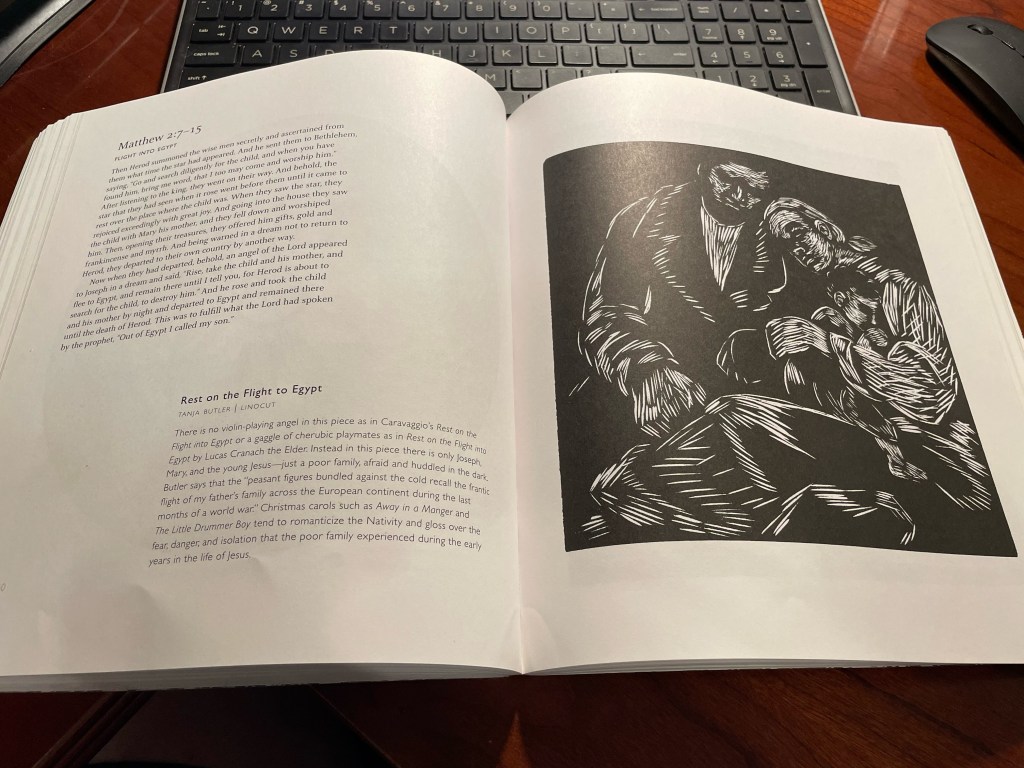
As I look at this picture by Tanja Butler, I notice that it is made completely of lines and shadows. Frankly, the lines make me think of straw (almost like the Scarecrow in the Wizard of Oz). That makes me think of the manger in which Jesus was laid. The shadows give the impression that it’s dark and the white are the scant reflections of just enough light to give us the picture. Jesus is in Mary’s arms, sucking his thumb. Mary has her head against Joseph’s shoulder. Perhaps she’s resting. Perhaps he’s comforting her. Maybe both. I cannot tell if her eyes are open or not. The one line on her left eye makes me think they are closed. And Joseph is there. The design of his coat is almost a more modern look with lapels. Perhaps Butler is trying to make me think of his as a professional who has given up his business for this journey. Perhaps she is trying to communicate that the weather demands a coat. But Jesus appears to be barefoot, so maybe I’m wrong about all of that. The depiction of Joseph’s face actually makes him look a little like Abraham Lincoln to me. I wonder if that was intentional as well.
Looking at Bustard’s commentary on this piece, he says:
There is no violin-playing angel in this piece as in Caravaggio’s “Rest on the Flight into Egypt” or a gaggle of cherubic playmates as in “Rest on the Flight into Egypt by Lucas Cranach the Elder. Instead in this piece there is only Joseph, Mary, and the young Jesus–just a poor family, afraid and huddled in the dark. Butler says that the peasant figures buddled against the cold [maybe I was right about the coat] recall the frantic flight of my father’s family across the European continent during the last months of the world war.” Christmas carols such as “Away in a Manger” and “The Little Drummer Boy” tend to romanticize the Nativity and gloss over the fear, danger, and isolation that the poor family experienced during the early years in the life of Jesus.
Father, I don’t know what is coming for my children. I don’t know what plans Satan has. I don’t know what plans he has for me. But I know that I love you, I worship you, and I want to be everything you need me to be for them regardless of what it costs me. Oh, help me to be the man my children need me to be.


 Emails to God