23 When Jesus returned to the Temple and began teaching, the leading priests and elders came up to him. They demanded, “By what authority are you doing all these things? Who gave you the right?”
24 “I’ll tell you by what authority I do these things if you answer one question,” Jesus replied. 25 “Did John’s authority to baptize come from heaven, or was it merely human?”
They talked it over among themselves. “If we say it was from heaven, he will ask us why we didn’t believe John. 26 But if we say it was merely human, we’ll be mobbed because the people believe John was a prophet.” 27 So they finally replied, “We don’t know.”
And Jesus responded, “Then I won’t tell you by what authority I do these things.
Matthew 21:23-27
Dear God, I was asking yesterday about the purpose of John’s ministry as it relates to Jesus and wondering if he was more for the moment or for us now. I kind of concluded it was more for that moment than for us (although it’s impossible to know how much he actually does impact me), and this certainly affirms that his ministry was important in Jesus’s time.
I wonder what the answer to the question was. Did they each have a different answer? Did some believe he was from heaven? Did some, like Nicodemus, secretly repent and believe? Were they just blowing John off and trying not to anger the people by blowing him off privately?
The truth is, John’s authority was from heaven. And Jesus’s authority was from heaven. John was from you. Jesus was of you. He was you. I really don’t envy the Pharisees back then because I would probably have been skeptical too. I wouldn’t have readily trusted you. At best, I would have been like Nicodemus and secretly believed and followed you, but I know I wouldn’t have just openly followed you in the moment. It was too strange of a plan. I’d never have been able to get my mind around it.
Now, Father, I pray for this day. I have work to do. I have some work to do that is critical to helping our patients. I have some work to do that is important to others. I have some work to do that I don’t want to do. Help me to do it all well. Help me to be your servant and to work cheerfully in everything. Help me to get done what you need me to get done today. And I’ll confess that my performance, or lack thereof, with the man I saw in public while I was praying who was seemingly homeless, is still haunting me a bit. I’m sorry for my inaction. I’m sorry for my fear and my dread. Help me to do what you need me to do in those circumstances.
42 “What sorrow awaits you Pharisees! For you are careful to tithe even the tiniest income from your herb gardens, but you ignore justice and the love of God. You should tithe, yes, but do not neglect the more important things.
43 “What sorrow awaits you Pharisees! For you love to sit in the seats of honor in the synagogues and receive respectful greetings as you walk in the marketplaces. 44 Yes, what sorrow awaits you! For you are like hidden graves in a field. People walk over them without knowing the corruption they are stepping on.”
45 “Teacher,” said an expert in religious law, “you have insulted us, too, in what you just said.”
46 “Yes,” said Jesus, “what sorrow also awaits you experts in religious law! For you crush people with unbearable religious demands, and you never lift a finger to ease the burden.
Luke 11:42-46
Dear God, I’ve had a frustration rolling around in my head over the last 12 or so hours that my first temptation is to take these verses and apply them to the people who are frustrating me, making them the Pharisees and experts in the law and me, well…, Jesus. Okay, even on the face of it, that is absurd. But one thing you’ve taught me to do when I read a biblical story that includes clear delineations between good people and bad people is that I need to first consider that I might be the bad guy in the story. How am I like the Pharisee or expert in the law? Does Jesus have an admonition and correction for me in his words here?
So let me start with the idea that I might be missing the important things. Are there important things I’m missing? And how do we define important? I might tend to think of great political policies as important. I might even think of programs in our city that could help the poor. That could be important (and I think on Jesus’s “important scale” that might be closer to important than the political policy issues). But maybe the most important is the person right in front of me and their need. Am I missing them.
Here’s an example that you just brought to mind. There was an elderly woman in our clinic yesterday. She was there for a dental appointment. She was frustrated that she paid $30 for her first visit in over a year, which by policy was an exam and x-ray only when it’s been that long since a visit, and now she was having to pay another $30 for a separate visit, which was a cleaning. She mentioned that she only had $37 left in her account. We told her she could owe us for the cleaning, but she was still upset she was being charged at all and clearly frustrated. I felt badly for her, but I let her go on her way. I was a little annoyed at how abrupt she was with the staff so my compassion meter got turned down a bit. Now, as I sit here, I’m wondering whether we missed an opportunity to help her. Should we have taken a beat to talk to her about her financial issues and talk with her about resources in the community available to her–utility assistance, food, financial counselors, etc.? Did I miss what’s important?
Father, I am sorry for missing that opportunity yesterday along with so many others. Help me to have real eyes to see and ears to hear what is important. Help me to love. Help me to also re-think our policy and question how we charge patients for their appointments. And find this woman today. Meet her where she is. Help her. I think of the widow and her mite. If this woman is another version of her, help us to be part of your blessing to her.
37 As Jesus was speaking, one of the Pharisees invited him home for a meal. So he went in and took his place at the table. 38 His host was amazed to see that he sat down to eat without first performing the hand-washing ceremony required by Jewish custom. 39 Then the Lord said to him, “You Pharisees are so careful to clean the outside of the cup and the dish, but inside you are filthy—full of greed and wickedness! 40 Fools! Didn’t God make the inside as well as the outside? 41 So clean the inside by giving gifts to the poor, and you will be clean all over.
Luke 11:37-41
Dear God, I’ll admit it can be hard to figure out which rules I’m supposed to follow and which ones I’m not. First, let’s be clear, Jesus was walking into a situation where he knew he was being set up. He knew he was going to have to argue about something. Did he do this so he could set the stage for the argument he wanted to have? Did he intentionally violate the handwashing ceremony so he could launch into the cleanliness of the heart? If so, it’s pretty clever (of course it was clever–it was Jesus).
I think about the things that we do that grieve you and vs. the things we focus on. I think about the parts of Matthew 5 and the Sermon on the Mount where Jesus does the list of “You have heard it said ______, but I say ______” as he references hate/murder, lust/adultery, etc. Then I think about the things the church is fixated on today. On the LGBTQ+ issue, for example, what would Jesus say? “You have heard it said, ‘Don’t like with a man as one lies with a woman, that is detestable,’ but I say, ‘If you don’t love your wife as I love you then you are detestable.” That’s just an absolute guess made for effect, but I can’t help but Jesus’s target in the LGBTQ+ issue would be the accusers more than the accused. Heterosexual married couples are grieving your heart as much as anyone. I have grieved you sexually as much as anyone. And that’s just one example.
Father, as I go through this day, and as I prepare to teach the Christian Men’s Life Skills class tonight on Motivation, help me to be loving and not judgmental. These men are all guilty of some crime and this class is part of their sentence. They need to see you in me tonight. They need to see both your grace and your “Go and sin no more.” Help me to be that deliverer. Help the men leading tonight to be those deliverers as well. Prepare hearts to be yours. Prepare hearts for the seeds you are planting. Give us the seeds and help us to sow them generously. And teach me through the other men there tonight as well. Let your Spirit reign in my place of work, in my home, in my vehicle, and in that place tonight. And also thank you for answering our prayers from yesterday. Thank you, Father, for everything–even what I cannot see.
33 One day some people said to Jesus, “John the Baptist’s disciples fast and pray regularly, and so do the disciples of the Pharisees. Why are your disciples always eating and drinking?”
34 Jesus responded, “Do wedding guests fast while celebrating with the groom? Of course not. 35 But someday the groom will be taken away from them, and then they will fast.”
36 Then Jesus gave them this illustration: “No one tears a piece of cloth from a new garment and uses it to patch an old garment. For then the new garment would be ruined, and the new patch wouldn’t even match the old garment.
37 “And no one puts new wine into old wineskins. For the new wine would burst the wineskins, spilling the wine and ruining the skins. 38 New wine must be stored in new wineskins. 39 But no one who drinks the old wine seems to want the new wine. ‘The old is just fine,’ they say.”
Luke 5:33-39
Dear God, what is the role of fasting in my faith? I was having lunch with a friend three days ago, and he asked me when the last time I fasted was. I told him it was about 6 months. He was actually surprised it had been that recently. And I remember that day. I just woke up and as I started my morning it just felt like the right thing to do to fast that day. I had some big challenges at work that I wanted to bring to you at that level. I have the ever-present sorrows in my personal life I wanted to lift to you. So I took the day to fast and pray. And I think it was good. I’ve seen great success with that one specific challenge at work. And while I haven’t seen progress in my personal sorrow, I continue on with faith that you are working in ways I cannot see.
Interestingly, I just did a search for fasting in the New Testament and found only two references outside of the gospels. They were all in Acts and both involved selecting Paul and Barnabas for work.
I wonder why it wasn’t more a part of Paul’s instructions in his epistles. It seems like the kind of thing James would have told people to do. And John might have mentioned it too. Why did it kind of disappear?
Father, I know the point of this passage isn’t necessarily to get me to fast more. In fact, Jesus seems to be introducing a new standard while still saying that his disciples will resume the practice of fasting when he is gone. No, I think the point of this story is more about setting the tone for the difference between what Jesus is teaching us about who you are vs. the perception by the Jewish people up to that point. I’m not sure if I have things in my life that I’m doing that are foolish because they are no longer relevant. I don’t even think I can see those things on my own. So I guess my prayer is that the Holy Spirit will reveal to me the things I’ve made sacred that are irrelevant and the things that should be sacred that I’ve ignored or been reluctant to adopt. I guess I do have something else I need to lift to you before I stop this prayer. I am interviewing two people today and one person Monday for an open position where I work. Help me to see what you see and guide me to the right person. I have someone helping me in this process. Guide here as well.
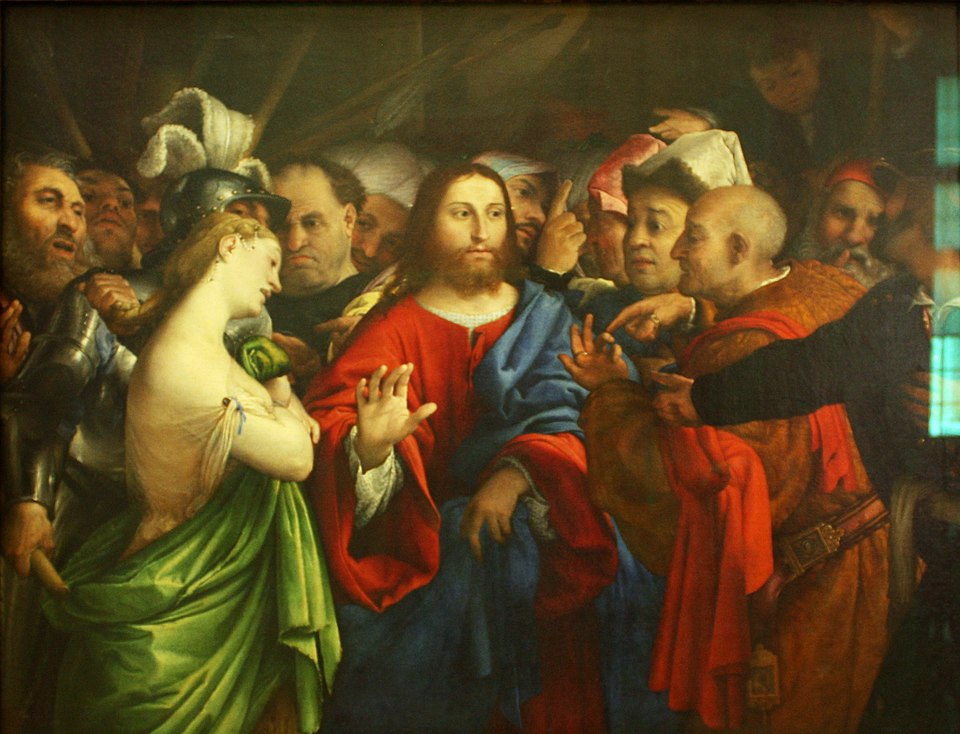
Painting: La Femme adultère “The woman Taken in Adultery” by Lorenzo Lotto
8 Jesus returned to the Mount of Olives, 2 but early the next morning he was back again at the Temple. A crowd soon gathered, and he sat down and taught them. 3 As he was speaking, the teachers of religious law and the Pharisees brought a woman who had been caught in the act of adultery. They put her in front of the crowd.
4 “Teacher,” they said to Jesus, “this woman was caught in the act of adultery. 5 The law of Moses says to stone her. What do you say?”
6 They were trying to trap him into saying something they could use against him, but Jesus stooped down and wrote in the dust with his finger. 7 They kept demanding an answer, so he stood up again and said, “All right, but let the one who has never sinned throw the first stone!” 8 Then he stooped down again and wrote in the dust.
9 When the accusers heard this, they slipped away one by one, beginning with the oldest, until only Jesus was left in the middle of the crowd with the woman. 10 Then Jesus stood up again and said to the woman, “Where are your accusers? Didn’t even one of them condemn you?”
11 “No, Lord,” she said.
And Jesus said, “Neither do I. Go and sin no more.”
John 8:1-11
Dear God, I don’t think this story gets enough time. It’s quite remarkable. My wife and I were talking about something last night and this story came up. I can’t remember what we were saying or the context in which we talked about it, but she mentioned this painting by Lorenzo Lotto to me. It gave me an interesting thought: What would it be like to follow this woman after she left Jesus that day? What was the rest of that day like for her? So I decided to take a little creative break from my 1 Samuel series and spend a little time with this woman this morning.
First, I want to back up and set the context. There was a festival going on in Jerusalem when this happened. It was the Festival of Shelters (John 7:1-10). I Googled that festival and found it was a seven-day commemoration of the years the Israelites spent in tents in the wilderness. That made me think of the book I read last year, The Year of Living Biblically: One Man’s Humble Quest to Follow the Bible as Literally as Possible by A.J. Jacobs. I remembered he had done something that seemed to line up with this so I looked it up. He called in the “Feast of Ingathering–or Sukkoth.” His description seems to indicate it’s the same thing and he said Orthodox Jewish people still celebrate it by building huts and sleeping in them (he was in New York City so he had to build one in his living room). So that’s the context. An annual festival in Jerusalem where a lot of extra people are in town. In fact, this is part of the story when Jesus’s brothers told him to go to Jerusalem and show himself off and he told them he wasn’t going to go, but then he went secretly until starting to teach in the Temple halfway through the festival.
Now, back to this passage. After I read it this morning, I had some thoughts. Let me stress here that ALL of this is my speculation and there is a great likelihood that I’m completely wrong about it. With that disclaimer said, I wonder what the previous 12 hours were like for this woman and then what were the next 12 hours like. What were the circumstances under which she was caught? Who was she? Was she the one who was married to someone else or had she slept with someone who was married to someone else but she was single? Was she a prostitute? In that culture, if she was a prostitute, would they have cared? I believe there were a lot of prostitutes running around and sleeping with married men so my guess is that she was the on who was married and caught. Perhaps her husband caught her that night before and brought her to the Temple for punishment for stoning.
It occurs to me as I write this that this could have been Jesus’s own mother, Mary, when she was pregnant with him. Wow! What a thought. The husband could easily have been Joseph, taking her to the Temple for judgment and stoning. But “Joseph, to whom she was engaged, was a righteous man and did not want to disgrace her publicly, so he decided to break the engagement quietly.” I wonder if Jesus had this same thought that morning. If this had happened to his own mother while she was pregnant with him, it would have been a disaster.
As I’m sitting here (and I think I’m going to have a lot of disjointed, random thoughts this morning), I wonder why stoning was the chosen method of execution for so many sins. Was it because it wasn’t a hands-on approach? Back then, I suppose their options were to physically touch the person and kill them with some sort of blade or do something from a distance like throw stones or shoot an arrow.
Now that I think about it, the Jews under Rome didn’t have the right to execute people (that’s why they needed Pilate to sign off on Jesus’s execution). Was there an exception for stoning? I just Googled that too. Apparently, to compare it with modern American law, there were federal crimes (crimes against the Roman Empire) and state crimes (in this case, crimes against the Jewish religious law). Jesus’s crime was a federal crime because he claimed to be king while adultery or Stephen’s crime in Acts would be against Jewish law and could be executed by the Sanhedrin.
So back to our story. There’s a festival. I’m guessing that the woman’s husband catches her sleeping with someone else during the festival (maybe in someone’s special tent?) and takes her to the Temple for judgment and execution. Lots of anger. Lots of fear. As I’ve heard said in movies and other places before, “Women need a reason to have sex. Men just need a place.” (City Slickers) So perhaps this woman had a reason to not be faithful to her husband. I don’t know. But now she’s here, and she must be both terrified and humiliated. Regretful too. What’s going to happen now?
Then Jesus shows up in the Temple and starts teaching halfway through the Festival. I won’t go into the days he spent talking and everything he said, but, suffice it to say, the Pharisees were none too pleased. Then, on the last day of the festival, what John describes in John 7:37 as “the climax of the festival,” Jesus did one last big provocation about being living water. The Pharisees apparently sent the Temple guards to arrest him but they didn’t. Nicodemus, one of my heroes, tries to defend Jesus with, “Is it legal to convict a man before he is given a hearing?” and he gets jumped on and accused of being a Jesus defender: “Are you from Galilee, too?”
So now our scene takes place on the morning after the festival. Everyone might be a little hungover. This woman might have gotten caught up in the revelry of the night. And now she is standing in front of Jesus. The men (there are likely few if any women present) are simultaneously indignantly ready to stone her and wondering what it would be like to have sex with her (let’s be real, some of them were thinking that–that’s probably the most confident I am about any guesses I’ve made this morning), and she watches Jesus through a bowed head out of the upper part of her peripheral vision. What’s he going to do. So he bends down to write on the ground.
Here’s a new thought. Maybe he bent down to write on the ground so that she could see what he was writing. Maybe he wrote it for her. We assume he was writing to her judges and accusers, but maybe her face was so downcast that he knew this was the only way to communicate love and a new life to her.
So we know this next part. He stands up and affirms they are right that she should be stoned according to the law of Moses. But then he makes an interesting statement that (and again, this is a brand new thought to me) indicates humans don’t have the authority to commit capital punishment: “Let the one who has never sinned throw the first stone!” This statement could be applied to any sin such as murder that we think deserves the death penalty. As sinful creatures, do we have the authority to take a life–even the most heinous life, as the result of a crime? Wars are different animals that I won’t get into right now, but in this area, I think it helps convince me more than ever that capital punishment does not align with Jesus’s teaching.
So now everyone eventually admits they aren’t able to live up to the standard Jesus has now set for capital punishment and walks away, leaving only the woman, to whom Jesus famously says, “Where are your accusers? Didn’t even one of them condemn you?” She says no, and he closes the scene saying, “Neither do I. Go and sin no more.” End scene.
So what happened next? That’s the first thought I had last night when my wife brought up this story. What was the rest of her day like as a forgiven woman? Was her husband one of the people who dropped his stone and walked away? Did he divorce her? Did she have to move in with a friend? And what was the state of her heart from that day forward? If it was a long-term affair, did she break up with the guy? Did she take her freedom from her sin and turn over a new leaf? Did she earnestly start to follow you? Who did she become as a result of this absolution from her sin?
Father, I am not without sin. I have no stones to throw. Jesus taught such a unique…what’s the word I’m looking for? He taught a unique perspective on who we are as humans and who you are as God. Oh, Father, help me to “go and sin no more” and to offer this same opportunity of your unique perspective on who we can be through following you to others. Help me to make this the evangelism that brings your kingdom into this world and drives the hell out of people.
Mark 12:38-44
Jesus also taught: “Beware of these teachers of religious law! For they like to parade around in flowing robes and receive respectful greetings as they walk in the marketplaces. And how they love the seats of honor in the synagogues and the head table at banquets. Yet they shamelessly cheat widows out of their property and then pretend to be pious by making long prayers in public. Because of this, they will be more severely punished.” Jesus sat down near the collection box in the Temple and watched as the crowds dropped in their money. Many rich people put in large amounts. Then a poor widow came and dropped in two small coins. Jesus called his disciples to him and said, “I tell you the truth, this poor widow has given more than all the others who are making contributions. For they gave a tiny part of their surplus, but she, poor as she is, has given everything she had to live on.”
Dear God, I think one of the biggest obstacles for people as we try to read the Bible is the same obstacle we have when we read a text from a friend–tone of voice can be everything. This story about the widow is a great example. I’ve read it countless times. Most Christians are familiar with it. If I say the words “The Widow’s Mite” to a group of Christians, they immediately know what I mean. But how much do we miss in this story?
Several years ago, I had a revelation from you that this widow likely never knew that Jesus saw her faithfulness that day, and she likely went home that day as poor as she was when the day started. She likely died however many years later as poor as she was when she dropped in those coins. There was no monetary reward for her faithfulness. There was provision from you. There was peace. And there was the immortality of me even knowing about her 2,000 years later. But here were no earthly riches for her.
So that’s a pretty good revelation. But then I read Fred Smith’s blog post this morning, and he pointed out another aspect of this story. Because of story headings, chapter breaks, and verses that translators of the Bible have given us so that we can more easily find things, we often make the mistake of separating stories in the middle. This one is an example.
Fred pointed out that Mark tells us two stories back to back. Jesus has just finished a rant about the Pharisees taking from widows (among others) and then he goes over to the offerings and seems to wait for a widow to come by to make his point. Fred mentioned that this widow was giving to the very group that Jesus said had held her down and even taken from her. This add even another layer to this story. How do I keep myself from being a Pharisee that 1.) takes advantage of widows and 2.) doesn’t squander the offerings the give to you?
I’m in a unique position as the director of a nonprofit that takes donations from hundreds of people each year, including some widows. This story is not just a reminder for me to be a giver of my personal resources, but also reminds me to make sure I am being fair to and loving each donor and then using their donations to reach out and help everyone we can.
Father, help me to hear your voice when I read my Bible. Help me to hear your tone of voice in the words. Reveal to me the things I’ve missed over the years. Help me to break away from the erroneous teaching that has been accidentally (or perhaps intentionally) passed down from each preceding generation. Love through me, and help me to decrease so that you will increase. Of course, the ultimate goal for my life is that you will use it however you need to so that you kingdom will come and your will will be done on earth as it is in heaven.
John 19:38-42
Afterward Joseph of Arimathea, who had been a secret disciple of Jesus (because he feared the Jewish leaders), asked Pilate for permission to take down Jesus’ body. When Pilate gave permission, Joseph came and took the body away. With him came Nicodemus, the man who had come to Jesus at night. He brought about seventy-five pounds of perfumed ointment made from myrrh and aloes. Following Jewish burial custom, they wrapped Jesus’ body with the spices in long sheets of linen cloth. The place of crucifixion was near a garden, where there was a new tomb, never used before. And so, because it was the day of preparation for the Jewish Passover and since the tomb was close at hand, they laid Jesus there.
Dear God, this is the story that made me love and appreciate Nicodemus. John seems to have a soft spot in his heart for Nicodemus (and Pilate for that matter, but that is a subject for another prayer journal). John 3 never references anyone being with Jesus and Nicodemus but Jesus, although it’s feasible that John and some other disciples could have been there. But the story in chapter 7 about Nicodemus trying to passively defend Jesus must have been relayed to John by someone else. Perhaps Nicodemus himself after Jesus’s death and resurrection. I assume John and Nicodemus had a personal relationship. Otherwise, why would John be the only Gospel writer to mention him? And why did he go to great pains in chapters 7 and 19 to not only call Nicodemus by name, but intentionally reference his conversation with Jesus in chapter 3?
So now for this story. Why do I like it so much? Mainly because It is Nicodemus at his lowest point, and yet he shows so much love for Jesus. His anger and anguish drives him into action. He loves this man he believed to be your Messiah, and he is going to show it to the world regardless of the consequences. And although we never read his name again after this story, I’m sure this act cost him his place in the temple and in the community. I would bet that this was his last Passover as a Pharisee.
Afterward Joseph of Arimathea, who had been a secret disciple of Jesus (because he feared the Jewish leaders), asked Pilate for permission to take down Jesus’ body. When Pilate gave permission, Joseph came and took the body away.
First, however, let’s talk about Joseph of Arimathea. Luke and Mark tell us that Joseph was a prominent member of the council, but he did not consent to the death sentence Jesus had received. He was a secret disciple of Jesus. Did he and Nicodemus know this about each other all along, or was this something they figured out over the previous 12 hours?
With him came Nicodemus, the man who had come to Jesus at night. He brought about seventy-five pounds of perfumed ointment made from myrrh and aloes.
John is careful to tell us that Nicodemus brought 75 pounds of perfumed ointment with him. I don’t know how this worked, but I would imagine they did the work right there at the foot of the cross. I would think that they would want to put the ointment on the body and wrap it up before they transported it to the tomb. I have this image in my mind of Nicodemus, grief stricken, disillusioned, and angry carrying this ointment in silence. Then he and Joseph take the body and start to handle the bloody mess. Where would you start? Blood would have to be everywhere. Did they clean the body with the ointment? But they did it.
Following Jewish burial custom, they wrapped Jesus’ body with the spices in long sheets of linen cloth.
This is where I want to spend some time with the other Pharisees. This scene is amazing to me. I picture it completely silent except for hushed murmurs between the Pharisees, wondering what Joseph and Nicodemus were doing. And why were they doing it. Then I imagine no words between Joseph and Nicodemus themselves. Just looks. Glances. Tears. Confusion. I would imagine that the Pharisees were furious and there was hell to pay on Sunday–especially after the resurrection. Joseph was highly respected. Did his exhibited love for Jesus make any of them doubt? How about Nicodemus? Did his demonstration of discipleship and belief make them second guess their own beliefs, if only for a moment? Joseph and Nicodemus said more through their actions than they could ever have said through words.
The place of crucifixion was near a garden, where there was a new tomb, never used before. And so, because it was the day of preparation for the Jewish Passover and since the tomb was close at hand, they laid Jesus there.
I wonder what it was like that night and the rest of the Sabbath and Passover for both Nicodemus and Joseph. Were they afraid? If not for their lives, for their careers and standing in the community? Did they talk to their wives? Their children? Were their families mad at them, or had they already told them how they felt about Jesus? And what about after the resurrection? Did the two men who had lost their standing in the community as well as, likely, their livelihoods join “The Way?” Did Nicodemus and John become friends. Did Joseph get to know all of the apostles? So many unanswerable questions. But I am certain that they both had to pay a price. The questions is, how big?
Father, I have followed you in the past and been disappointed. Even now, part of my soul is comforted by you through these prayer journals. I find camaraderie with characters like Nicodemus. We are all sojourners on this road. We are community, even though 2,000 years separates our earthly lives. Thank you for that. Thank you for loving me even when I question you and half-heartedly acknowledge my love for you. Thank you for forgiving me.
John 7:32, 45-52
32 When the Pharisees heard that the crowds were whispering such things, they and the leading priests sent Temple guards to arrest Jesus.
—
45 When the Temple guards returned without having arrested Jesus, the leading priests and Pharisees demanded, “Why didn’t you bring him in?”
46 “We have never heard anyone speak like this!” the guards responded.
47 “Have you been led astray, too?” the Pharisees mocked. 48 “Is there a single one of us rulers or Pharisees who believes in him? 49 This foolish crowd follows him, but they are ignorant of the law. God’s curse is on them!”
50 Then Nicodemus, the leader who had met with Jesus earlier, spoke up. 51 “Is it legal to convict a man before he is given a hearing?” he asked.
52 They replied, “Are you from Galilee, too? Search the Scriptures and see for yourself—no prophet ever comes from Galilee!”
Dear God, I kind of missed something in yesterday’s journal that I want to touch on before I get into this passage today. What was the context within which Nicodemus talked to Jesus at night back in chapter 3? Well, according to John, Jesus was in Jerusalem for the Passover, and he had just cleared the temple of the money changers and such and had told the “Jews” who asked for a miracle that if they destroyed “this temple” he would raise it again in three days. Nicodemus was just trying to make sense of what he was seeing and hearing.
32 When the Pharisees heard that the crowds were whispering such things, they and the leading priests sent Temple guards to arrest Jesus.
Now, for this part of the story, we find Nicodemus again. Jesus goes back to Jerusalem for the Feast of Tabernacles and he upsets the Pharisees. So much so that by the time we get to verse 32 they decide to send temple guards to arrest him.
45 When the Temple guards returned without having arrested Jesus, the leading priests and Pharisees demanded, “Why didn’t you bring him in?” 46 “We have never heard anyone speak like this!” the guards responded. 47 “Have you been led astray, too?” the Pharisees mocked. 48 “Is there a single one of us rulers or Pharisees who believes in him? 49 This foolish crowd follows him, but they are ignorant of the law. God’s curse is on them!”
It wasn’t that the guards couldn’t arrest Jesus. They intentionally chose not to. And they admitted as much to the Pharisees. And the Pharisees’ response? They basically tell the guards that God’s curse is on them and John tells us they ask an interesting question: “Is there a single one of us rulers or Pharisees who believes in him?” In showing their intellectual and spiritual superiority while shaming the guards, they push Nicodemus to a moral dilemma that pushes him just a little out of hiding.
50 Then Nicodemus, the leader who had met with Jesus earlier, spoke up. 51 “Is it legal to convict a man before he is given a hearing?” he asked.
No, it’s not the strongest defense in the world, but it’s enough of an admission of sympathy to reveal some of his inner feelings to his fellow Pharisees. He’s been completely in the closet up until now. He met with Jesus in chapter 3 at night, when no one knew about it. But now he couldn’t keep silent any longer. He was trying to do it in a way that wouldn’t completely reveal his hand. He brought in “the law.” But just saying even the slightest thing in Jesus’s defense provoked their wrath.
52 They replied, “Are you from Galilee, too? Search the Scriptures and see for yourself—no prophet ever comes from Galilee!”
The Pharisees are so flabbergasted by Nicodemus’s defense of Jesus that they accuse him of being a “homer.” They see that he has sympathy for Jesus and their only explanation is to accuse him not of believing in Jesus, but of hoping for the best for him for other emotional reasons.
So in looking back on this story, Nicodemus is on a journey of faith. He is working it out with literal fear and trembling (Philippians 2:12). He tested the waters in this story, and he got smacked down. Did he fail Jesus? Perhaps? Did he ultimately decided on this day to save his own skin rather than argue with his colleagues? Yes. But he definitely progressed on his journey. He hadn’t arrived yet. He hadn’t entered into a stage of worship that would cause him to risk it all out of his love for you and belief in Jesus. He did, however, grow and prepare himself for a day that would ask more from him.
Father, help me to be a little better today than I was yesterday. Help me to have eyes to see my own weaknesses and address them. Give me the serenity to accept the things I cannot change, the courage to change the things I can, and the wisdom to know the difference.
1 Then Jesus left Capernaum and went down to the region of Judea and into the area east of the Jordan River. Once again crowds gathered around him, and as usual he was teaching them.
2 Some Pharisees came and tried to trap him with this question: “Should a man be allowed to divorce his wife?”
3 Jesus answered them with a question: “What did Moses say in the law about divorce?”
4 “Well, he permitted it,” they replied. “He said a man can give his wife a written notice of divorce and send her away.”
5 But Jesus responded, “He wrote this commandment only as a concession to your hard hearts.6 But ‘God made them male and female’ from the beginning of creation.7 ‘This explains why a man leaves his father and mother and is joined to his wife,8 and the two are united into one.’ Since they are no longer two but one,9 let no one split apart what God has joined together.”
10 Later, when he was alone with his disciples in the house, they brought up the subject again.11 He told them, “Whoever divorces his wife and marries someone else commits adultery against her.12 And if a woman divorces her husband and marries someone else, she commits adultery.”
Dear God, I wonder why the Pharisees picked this topic to trap Jesus. There were a lot of things they could have asked him about. Why divorce? What were they hoping he would say? Were they trying to get him to say that divorce was okay so they could pounce on him? Was one of them wanting a divorce? It seems like a weird thing to ask him.
“He wrote this commandment only as a concession to your hard hearts.” When I think about it, this is a surprising line. Why would Moses (or you through Moses) have made this concession in the first place? Is there a point that my hard heart/stubbornness can change your law?
Then I have to ask myself where my own heart is hard? Are there beliefs that I have that I stubbornly hold onto for selfish/self-indulgent reasons? Just because Jesus mentions in verse six that “God made them male and female,” I wonder about the gay marriage thing and if the belief that is spreading in our generation that gay marriage is biblically okay is an example of this hard-heartedness. I have certainly evolved on this issue over the course of the last 20 years. Is that me finding truth, or is it the hard hearts winning?
Well, I probably just touched the third rail of theological topics there, so I’m going to move on and wonder what other areas in my own life might be driven by a hard heart. The scary thing is that I can’t immediately think of any. That scares me because it makes me think I am likely blind to my own stubbornness.
Father, help me to hear your voice. Help me to know your truth. Help me to accept your will and submit to it. Help me to stand up for your Kingdom.
Jesus called the crowd to him and said, “Listen and understand. 11 What goes into someone’s mouth does not defile them, but what comes out of their mouth, that is what defiles them.” Then the disciples came to him and asked, “Do you know that the Pharisees were offended when they heard this?” He replied, “Every plant that my heavenly Father has not planted will be pulled up by the roots. 14 Leave them; they are blind guides. If the blind lead the blind, both will fall into a pit.” Peter said, “Explain the parable to us.” 16 “Are you still so dull?” Jesus asked them. 17 “Don’t you see that whatever enters the mouth goes into the stomach and then out of the body? 18 But the things that come out of a person’s mouth come from the heart, and these defile them. 19 For out of the heart come evil thoughts—murder, adultery, sexual immorality, theft, false testimony, slander. 20 These are what defile a person; but eating with unwashed hands does not defile them.”
Matthew 15:10-20
Dear God, it takes a special kind of humility to be the one to ask what everyone else is thinking but too scared to say. Notice how the NIV puts it. Peter asks the question, but Jesus tells “them.” They were all thinking it. It was just probably silently, not wanting to appear foolish.
That reminds me of a Mark Twain quote that I’ve always gravitated towards: “Better to remain silent and appear foolish than open your mouth and remove all doubt.” Now, I still think this is right when it comes to trying to show people how smart you are, but it’s okay to appear foolish when it comes to humbly asking questions and admitting I don’t know.
Peter blew into a lot of situations that made him look foolish, that’s true. But that part of his personality also led him into being willing to ask the potentially embarrassing question. He wanted to know and he thought it was foolish to be unsure. It might cost him some pride, but, to him, it was worth it.
Father, I know I need to let my ego go more. I’m in a couple of roles in my life now where I don’t want to appear foolish. But it’s also important that I really understand what’s going on. I’m thinking about a board on which I currently serve. I don’t need the impetuous part of Peter’s character in the boardroom, but I need his humility and his desire to be the best he can be. Help me to get there so that you can use me as much as possible.


 Emails to God