RSS

Passion Week – Killing the Master’s Son: Matthew 21:33-41

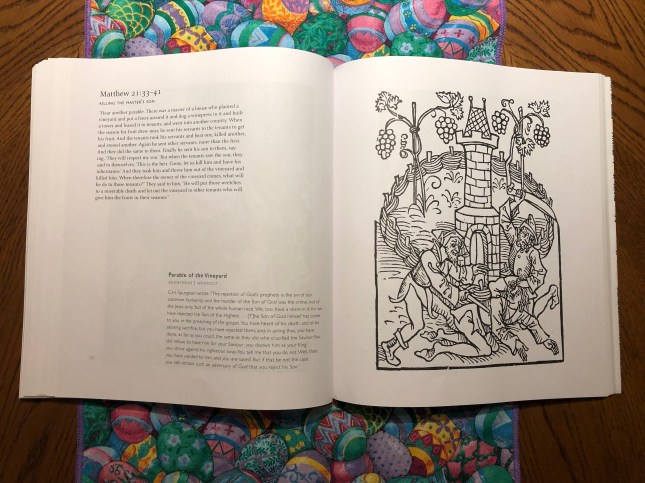
The image above is from Revealed: A Storybook Bible for Grown-Ups by Ned Bustard. The image is called “Parable of the Vineyard” and was created by Anonymous.

Matthew 21:33-41 [ESV]

33 “Hear another parable. There was a master of a house who planted a vineyard and put a fence around it and dug a winepress in it and built a tower and leased it to tenants, and went into another country. 34 When the season for fruit drew near, he sent his servants to the tenants to get his fruit. 35 And the tenants took his servants and beat one, killed another, and stoned another. 36 Again he sent other servants, more than the first. And they did the same to them. 37 Finally he sent his son to them, saying, ‘They will respect my son.’ 38 But when the tenants saw the son, they said to themselves, ‘This is the heir. Come, let us kill him and have his inheritance.’ 39 And they took him and threw him out of the vineyard and killed him. 40 When therefore the owner of the vineyard comes, what will he do to those tenants?” They said to him, “He will put those wretches to a miserable death and let out the vineyard to other tenants who will give him the fruits in their seasons.”

Dear God, one question I’m asking myself this morning that I’ve never asked before is, Why do we do it? As I look at this image of the two men beating and killing the son, I wonder about their motivation. It’s interesting that the artist drew them as being more in “Robin Hood” times than biblical times, but the question still remains: Why?

What do we think we will gain by kicking you out of our world and running it ourselves? Bringing it down to the personal level, what do I think I will gain by kicking you out of my life rather than living it under your authority? I suppose it comes down to instant gratification that ultimately kills vs. the idea that you might call me to delay my gratification or to never experience gratification at all. It’s easy to judge others and our society as a whole, but how am I doing with the vineyard of my own life that you have leased to me? When you come, do I embrace you or snuff you out?

I have been thinking about the burning of Notre Dame Cathedral in Paris yesterday. I know it is Easter week and a lot of people will make their once-a-year visit to church on Sunday, but I wonder how many more will be shaken by this sad tragedy. How many vineyard workers will be shocked into realizing that they have taken the master for granted. It makes me think of Congress standing on the capitol steps in September 2001 and singing “God Bless America” together. Will this shocking even that damaged something we have taken for granted for nearly 900 years remind us to worship you? Will you use this to call some of us home?

Father, remind me that all of this starts with me. I’m not here to judge anyone else. I’m not here to try and list the people I think have rejected your authority over their lives. I’m here to look in the mirror. I’m here to ask your forgiveness. I’m sorry for being a poor tenant and acting like the landowner instead. You are my God. This life I’m living is your life. Help me to be the steward of it that you need me to be.

In Jesus’s name I pray,

Amen


Tags: , , ,

Passion Week – Cleansing the Temple: Matthew 21:12-17


The image above is from Revealed: A Storybook Bible for Grown-Ups by Ned Bustard. The image was created by Albrecht Durer and is called “Christ Driving the Moneylenders from the Temple.”

Matthew 21:12-17

And Jesus entered the temple and drove out all who sold and bought in the temple, and he overturned the tables of the money-changers and the seats of those who sold pigeons. He said to them, “It is written, ‘My house shall be called a house of prayer,’ but you make it a den of robbers.” And the blind and the lame came to him in the temple, and he healed them. But when the chief priests and the scribes saw the wonderful things that he did, and the children crying out in the temple, “Hosanna to the Son of David!” they were indignant, and they said to him, “Do you hear what these are saying?” And Jesus said to them, “Yes; have you never read, “‘Out of the mouth of infants and nursing babies you have prepared praise’?” And leaving them, he went out of the city to Bethany and lodged there.

Dear God, I’ve read this story and heard about this story so many times that it can be hard to come at it fresh. But this image from Mr. Durer helps a little. There are some striking things about it:

  • Jesus is holding a whip. It’s different than the one that will be used on him later in the week, but it’s interesting to see a violent Jesus. Is there a time and a place for violence?
  • The man on the ground seems to be knocked out or incapacitated in some way. I know this is just the artist’s rendition, but it’s an interesting thought as to what extent of physical damage Jesus did.
  • There is a man holding a lamb. People were there to get what they needed for the Passover. Jesus would become their lamb. In fact, in reality, there would become no need for these things again. It makes me wonder what the disciples did for the Passover in the y ears to come. Did they still follow all of the Jewish rituals? I’ll be they did.
  • I think I see a Pharisee’s hat way in the background on the right.
  • Jesus is very heavily clothed. I don’t normally picture him with that much clothing.
  • The artist decided that Jesus was right-handed. I wonder if he really was.

Here i what the author of the book had to say about this image:

in contrast to Late Gothic depictions of a delicate or fragile Christ, in this piece, Durer created an intense, militant, and manly Christ. A modern Jesus would politely ask the money changers to leave. But that is not the Jesus of Scripture. He forcefully drives the money changers out, overturning tables and throwing seats. Jesus acts in this audacious manner because he knows he owns the temple. He is defending his place in the same way a home owner would defend his own house. Jesus is violent, defiant, and takes into his own hands the removal of those who desecrate the temple. This work was part of a larger series of prints called The Small Passion, and was quite relevant to the time. A Christ who as fighting for holiness rang true with young Reformers.

I guess the thing that I would also add is that this is the beginning of a violent week. Jesus is very intense in his emotion and his passion (little “p”). He only has a little bit of time left and there isn’t any to waste.

Father, help me to not grieve you the way these moneychangers grieved you. As I raise money for a nonprofit, help me to aspire to the best parts of philanthropy and not manipulate people for my own purposes. During this Passion Week, help me to be very mindful of who you are, what you did, and what that means to me today. Help me to worship you well and follow your leading.

In Jesus’s name I pray,

Amen


Tags: , , , ,

Passion Week – The Triumphal Entry: Matthew 21:1-11; Mark 11:1-11; Luke 19:28-44; John 12:12-16

The image above is from Revealed: A Storybook Bible for Grown-Ups by Ned Bustard. The image is called “The Triumphal Entry” and was created by Diego Jourdan Pereira.

Matthew 21:1-11

As Jesus and the disciples approached Jerusalem, they came to the town of Bethphage on the Mount of Olives. Jesus sent two of them on ahead. “Go into the village over there,” he said. “As soon as you enter it, you will see a donkey tied there, with its colt beside it. Untie them and bring them to me. If anyone asks what you are doing, just say, ‘The Lord needs them,’ and he will immediately let you take them.” This took place to fulfill the prophecy that said, “Tell the people of Jerusalem, ‘Look, your King is coming to you. He is humble, riding on a donkey— riding on a donkey’s colt.’” The two disciples did as Jesus commanded. They brought the donkey and the colt to him and threw their garments over the colt, and he sat on it. Most of the crowd spread their garments on the road ahead of him, and others cut branches from the trees and spread them on the road. Jesus was in the center of the procession, and the people all around him were shouting, “Praise God for the Son of David! Blessings on the one who comes in the name of the Lord! Praise God in highest heaven!” The entire city of Jerusalem was in an uproar as he entered. “Who is this?” they asked. And the crowds replied, “It’s Jesus, the prophet from Nazareth in Galilee.”

Mark 11:1-11

As Jesus and his disciples approached Jerusalem, they came to the towns of Bethphage and Bethany on the Mount of Olives. Jesus sent two of them on ahead. “Go into that village over there,” he told them. “As soon as you enter it, you will see a young donkey tied there that no one has ever ridden. Untie it and bring it here. If anyone asks, ‘What are you doing?’ just say, ‘The Lord needs it and will return it soon.’” The two disciples left and found the colt standing in the street, tied outside the front door. As they were untying it, some bystanders demanded, “What are you doing, untying that colt?” They said what Jesus had told them to say, and they were permitted to take it. Then they brought the colt to Jesus and threw their garments over it, and he sat on it. Many in the crowd spread their garments on the road ahead of him, and others spread leafy branches they had cut in the fields. Jesus was in the center of the procession, and the people all around him were shouting, “Praise God! Blessings on the one who comes in the name of the Lord! Blessings on the coming Kingdom of our ancestor David! Praise God in highest heaven!” So Jesus came to Jerusalem and went into the Temple. After looking around carefully at everything, he left because it was late in the afternoon. Then he returned to Bethany with the twelve disciples.

Luke 19:28-44

After telling this story, Jesus went on toward Jerusalem, walking ahead of his disciples. As he came to the towns of Bethphage and Bethany on the Mount of Olives, he sent two disciples ahead. “Go into that village over there,” he told them. “As you enter it, you will see a young donkey tied there that no one has ever ridden. Untie it and bring it here. If anyone asks, ‘Why are you untying that colt?’ just say, ‘The Lord needs it.’” So they went and found the colt, just as Jesus had said. And sure enough, as they were untying it, the owners asked them, “Why are you untying that colt?” And the disciples simply replied, “The Lord needs it.” So they brought the colt to Jesus and threw their garments over it for him to ride on. As he rode along, the crowds spread out their garments on the road ahead of him. When he reached the place where the road started down the Mount of Olives, all of his followers began to shout and sing as they walked along, praising God for all the wonderful miracles they had seen. “Blessings on the King who comes in the name of the Lord! Peace in heaven, and glory in highest heaven!” But some of the Pharisees among the crowd said, “Teacher, rebuke your followers for saying things like that!” He replied, “If they kept quiet, the stones along the road would burst into cheers!” But as he came closer to Jerusalem and saw the city ahead, he began to weep. “How I wish today that you of all people would understand the way to peace. But now it is too late, and peace is hidden from your eyes. Before long your enemies will build ramparts against your walls and encircle you and close in on you from every side. They will crush you into the ground, and your children with you. Your enemies will not leave a single stone in place, because you did not recognize it when God visited you.”

John 12:12-16

The next day, the news that Jesus was on the way to Jerusalem swept through the city. A large crowd of Passover visitors took palm branches and went down the road to meet him. They shouted, “Praise God! Blessings on the one who comes in the name of the Lord! Hail to the King of Israel!” Jesus found a young donkey and rode on it, fulfilling the prophecy that said: Do not be afraid, O Daughter of Zion; see your king is coming, seated on a donkey’s cold.” His disciples didn’t understand at the time that this was a fulfillment of prophecy. But after Jesus entered into his glory, they remembered what had happened and realized that these things had been written about him.

Dear God, I want to spend some time with the Triumphal Entry today. It is Palm Sunday after all. My wife and I went to a special church service this morning where a man who is with “Jews for Jesus” came to walk the congregation through the different parts of the Passover meal. So now, as we enter Passion Week, I want to take some time to really sit with this week in a different way than I ever have before. Of course, that starts with Revealed: A Storybook Bible for Grown-Ups and what I’ve been getting out of the different artists’ interpretations of the stories.

So here I am with the Triumphal Entry. The first thing I did was look to confirm that the story shows up in all four Gospels. It does, although John seems to have a different focus than the other three. The first three give a lot more backstory, but John focuses on the crowds, the excitement, how the prophecy angle impacted the disciples after it was all said and done, and the Lazarus connection (remembering that one John gives us the Lazarus resurrection story).

So what did Diego Jourdan Pereira notice in this story? First, this image is a little difficult for a left-brained person like me to decipher. It’s hard to tell what I’m seeing here. I see the donkey with its head down. I see Jesus, who appears to have his head down. Are those lines in the background palm branches? I ended up having to go to the commentary on this piece a little sooner than I like. Here’s what Ned Bustard said about the piece, including a quote from the artist:

According to Jewish tradition the glory of God appeared through the Beautiful Gate and will appear again when the Messiah comes (Ezekiel 44:1-3). And it is said that Jesus entered through this gate on Palm Sunday. But the gate, disciples, crowds, cloaks, palm branches, and hosannas are all missing from this depiction of the Triumphal Entry. All that remains is a downcast donkey and a sorrowful Jesus. The artist explains, “The more I thought about it, the more it seemed to me that while everyone else was celebrating around him, Christ’s mind was elsewhere. He was thinking about the destruction of Jerusalem and his own impending fate on the Cross. His tears are internal as well as external.” But Jesus would not turn aside from the path. Luke 9:51 says, “When the days drew near for him to be taken up, he set his face to go to Jerusalem.”

I’m having so many thoughts, it’s hard to sort through them. I guess my day started with a revelation that might have been more obvious to other Christians–you intentionally made Jesus’s crucifixion and resurrection part of Passover. Jesus could have been killed any time and in any way, but your plan was to have his death and resurrection exactly coincide with the Passover celebration in Jerusalem that year. Why had I never thought of that? I guess I can be a little dense.

Then I have the thought from Luke 9 that Bustard brings out in the end of his description–that Jesus “set his face to go to Jerusalem.” We’ll see the emotions of Jesus play out over the next few days. In fact, he probably shows more emotion during this week than he does in the rest of the stories about him. He clears the temple out of anger. He curses a fig tree. He sweats blood. But when it comes down to it, he didn’t have to do this. He could have bailed, except for the fact that he was following your will, and your will was for him to walk this path. He was to be our Passover lamb.

Father, hep me to sink into this week. Help me to spend this week worshipping you–every aspect of you. You are GREAT and yet you are humble. You are all powerful, yet you are sacrificially loving. You can look through the screaming crowds of the Triumphal Entry and see the wickedness in each of us, and yet you proceed. You knew better than to believe the love you were getting from the crowd. You knew that some would turn on you and some would simply disappear. The more I sit with these ideas the more humbled and thankful I am.

In Jesus’ name I pray,

Amen
 

Tags: , ,

John 11:32-46 — The Raising of Lazarus


The image above is from Revealed: A Storybook Bible for Grown-Ups by Ned Bustard. The image itself was created by Kevin Lindholm and is called “Take Off the Grave Clothes.”

John 11:32-46 [ESV]
Now when Mary came to where Jesus was and saw him, she fell at his feet, saying to him, “Lord, if you had been here, my brother would not have died.” When Jesus saw her weeping, and the Jews who had come with her also weeping, he was deeply moved in his spirit and greatly troubled. And he said, “Where have you laid him?” They said to him, “Lord, come and see.” Jesus wept. So the Jews said, “See how he loved him!” But some of them said, “Could not he who opened the eyes of the blind man also have kept this man from dying?” Then Jesus, deeply moved again, came to the tomb. It was a cave, and a stone lay against it. Jesus said, “Take away the stone.” Martha, the sister of the dead man, said to him, “Lord, by this time there will be an odor, for he has been dead four days.” Jesus said to her, “Did I not tell you that if you believed you would see the glory of God?” So they took away the stone. And Jesus lifted up his eyes and said, “Father, I thank you that you have heard me. 42 I knew that you always hear me, but I said this on account of the people standing around, that they may believe that you sent me.” When he had said these things, he cried out with a loud voice, “Lazarus, come out.” The man who had died came out, his hands and feet bound with linen strips, and his face wrapped with a cloth. Jesus said to them, “Unbind him, and let him go.” Many of the Jews therefore, who had come with Mary and had seen what he did, believed in him, but some of them went to the Pharisees and told them what Jesus had done.

Dear God, I’ve heard this story many, many times before, but in the spirit of what I’ve been doing with Martha and Mary recently I wanted to spend a little time with it. I went to my new favorite book this morning to see if any of the Martha and Mary stories were in it, and I found Lazarus’s resurrection.

In the spirit of using this book, I want to see what the artist put in here that I might not have thought about before. Let’s see what I can see in the image:

  • He made what the Bible describes as a cave with a stone into more of a tomb in the ground made out of bricks. Hmm. I wonder why.
  • I don’t know if it is Mary or Martha, who has her hand over her mouth, but she is there. Her hair is shorter than I would have expected it to be. Her hand is over her mouth. She is looking at Lazarus.
  • The man helping Mary/Martha isn’t looking at Lazarus, but is looking at her to see her reaction. I never thought much about whether or not the mourners there were mourning because they missed Lazarus or if they were weeping to comfort the sisters. This man seems really interested in Mary’s/Martha’s reaction.
  • Lazarus is partially unbound and exposed. He has one eye open and his left hand and are are free.
  • Radiance is coming from Jesus. Is that the sun behind him? Is the radiance from him? But all of the shadows are falling away from Jesus so it was an intentional choice by the artist to have the source of light be from Jesus’ direction.
  • I think there are a couple of people over Jesus’s left shoulder. Were these mourners? Was one of them the other sister? Disciples?

I guess the thing that I notice in this story is the last phrase: “…but some of them went to the Pharisees and told them what Jesus had done.” What was their motivation? Were they snitches? Were they trying to believers of the Pharisees?

Another thing I’ve learned over the last week as I’ve looked at this story a little more carefully is that there is a lot more to this story than the verses Bustard chose to include here. The first part of this story is really quite interesting in terms of Jesus’s delay, Martha’s approaching of Jesus without Mary, and then Martha’s retrieval of Mary, bringing her to Jesus. In fact, for the woman in the image above to be showing the emotion that she is, and for the man to be so concerned about her, I’ll bet that the artist was thinking about Mary when he drew her.

Father, there are obviously a lot of moving parts to this story, but I think the lessons for me are to be at peace, have faith, and worship you regardless of the answer you give to my prayers. It also tells me that it’s okay to mourn and feel anguish. It’s okay to weep. It is okay for tragedy to upset me. It’s what I do with that angst and frustration that I need to submit to you.

In Jesus’ name I pray,

Amen


Tags: , , , , , ,

Mary & Martha — Luke 10:38

Luke 10:38 [NLT]
As Jesus and the disciples continued on their way to Jerusalem, they came to a certain village where a woman named Martha welcomed him into her home.

Dear God, it’s time to give Martha some props. I might be reading too much into this story, but it appears to me that they didn’t know Jesus before this visit. It looks like Jesus came to town and Martha was the one who invited him over. What I’d like to say in support of Martha is that sometimes it takes the “doer” to get the job done. Yes, the “doer” can get distracted in the midst of beauty, but the “appreciator” often won’t be in the midst of the beauty unless the “doer” helps make it possible.

My wife and I were talking about how we are like these two, with me being like Martha and her being Mary. An example of this is how we approach something as simple as a bike ride. We will both take the same 30-mile bike ride (separately because of how differently we ride), but we will approach it differently. She cruises and looks around, enjoying the country roads and beauty. The wild flowers. The pecan orchard. The new house that was just built in that pasture. I don’t see any of that. But I can tell you how long the ride took me. I can tell you the distance, the elevation gain, my average speed, and my max speed. I know every part that requires extra effort and where I can rest a little while going downhill. One could read the story of our bike riding and say that I need to learn from her (and I do), but without me there would be no ride for her because I am the one who makes sure her bike is ready to go for each ride, including making sure her brakes aren’t rubbing and airing up her tires each time.

Father, it is obviously true that I have a lot to learn from the Mary’s of the world and that you have given me a perfect example to use in my wife. But it’s also true that there are the Martha parts of me that bring something to the table as well, and I shouldn’t forget that. Please help me continue on this journey so that I can die to my strengths by sacrificing them to you and embracing the lessons you have to teach me.

In Jesus’ name I pray,

Amen


Tags: ,

Making a Pearl

“Over and Over Again” by Fred Smith

Dear God, I was reading Fred Smith’s blog today, which I normally do on Thursday mornings, and it got me to thinking (as it normally does). I didn’t necessarily go with it where Fred did, but his description of the new information we have about how oysters make pearls got me to thinking about age and experience.

I told someone yesterday at work that my 49th birthday is coming up, and that when the board of directors hired me in 2005 I was 35 years old. Everyone called me a child back then and I took umbrage to that because I felt very mature. I was a father with two children. I had business and nonprofit experience. I had experienced some loss. No, I was mature.

Of course, as I look back on the last 13 years, I realize that there was so much I still had to learn. But the great thing that that experience brings me is also the acceptance that there is so much I still have to learn. Over 13 years later, I have experienced heartache with children, the aging of parents and in-laws (with the loss of an in-law), failures at work, a dark time in my relationship with you when the costs on my part didn’t seem to pay enough dividends, struggles in my marriage,..

To Fred’s point, different foreign bodies/experiences penetrated my world and it has been my job to walk with you and allow those intrusions to turn into something good for not only me, but for the world around me. But now I am old enough to know that I have not arrived. I have a lifetime ahead of me still. And when I am in my 70s, I will still not have arrived. I will still be sifting and taking the intrusions that come and trying to surround them with your Spirit. Hopefully, by the end, the life that others will see will be a pearl that, while people might not remember me, will be remembered through time by the lives that I touched.

Father, two generations of my lineage from now might never know my name or anything about me, but that’s not why I’m living. I am here much like the lineages we read in the Bible, or the centuries of Israelites that were born, lived, and died in slavery in Egypt. My life is about how you use it for your purposes and the opportunity to worship you now and forever. Please walk with me to make it a pearl with which you are pleased.

In Jesus’ name I pray,

Amen

 
Leave a comment

Posted by on April 11, 2019 in Musings and Stories


Tags: , , ,

Mary & Martha — John 11:28-29

John 11:28-29 [NLT]
Then she returned to Mary. She called Mary aside from the mourners and told her, “The Teacher is here and wants to see you.” So Mary immediately went to him.

Dear God, I’m reading A LOT into this story, and I might be way off base on some of it, but I’m trying to get a feel for why Martha went to see Jesus without Mary the first time. Martha was doing a lot of walking here, going back and forth. And why did Jesus stay where he was instead of going with Martha to the house? Was he trying to avoid all of the mourners as long as he could?

I have never had to face a significant loss like Martha and Mary did here. The closest I’ve come is a mother-in-law nine years ago and my grandparents in my 20s. I would imagine, however, that my response would be much like Martha’s. I would want to keep in motion. I would want to take charge and do the work that needs done. I’m not sure how I would process the mourning part of the experience.

Father, Mary has always been the one held up to us as an example and Martha the cautionary tale. I do think Martha has her good points, however. I just think she needed to be a little more well-rounded. Of course, Mary did too. But Mary allowed herself to grieve. She allowed herself to sit at Jesus’ feet. She allowed herself to give the perfume. Help me to reach that level of sensitivity, generosity, and peace.

In Jesus’s name I pray,

Amen

 
Leave a comment

Posted by on April 10, 2019 in John, Mary & Martha


Tags: , , ,

Mary & Martha — John 11:21-23, 29-35

John 11:21-23,29-35 [NLT]
Martha said to Jesus, “Lord, if only you had been here, my brother would not have died. But even now I know that God will give you whatever you ask.” Jesus told her, “Your brother will rise again.” So Mary immediately went to him. Jesus had stayed outside the village, at the place where Martha met him. When the people who were at the house consoling Mary saw her leave so hastily, they assumed she was going to Lazarus’s grave to weep. So they followed her there. When Mary arrived and saw Jesus, she fell at his feet and said, “Lord, if only you had been here, my brother would not have died.” When Jesus saw her weeping and saw the other people wailing with her, a deep anger welled up within him, and he was deeply troubled. “Where have you put him?” he asked them. They told him, “Lord, come and see.” Then Jesus wept.

Dear God, it is interesting that John records both Martha and Mary as having said the same thing to Jesus when they first saw him: “Lord, if only you had been here, my brother would not have died.” I would imagine they had been saying that to each other for the last four days. Were they angry with Jesus? Were they disappointed?

Martha adds something to hers. She adds a little expectation: “But even now I know God will give you whatever you ask.” (Hint, hint) And Jesus seems to take the bait and tells her that her brother will rise again.

But his response to Mary is different. Martha was seemingly a little bit more reserved emotionally than Mary. The way this story is told, her words to Jesus were from a place of sorrow, but she was also likely a little more stoic. Mary, on the other hand, was weeping. I imagine her sentence being said to Jesus between sobs. In fact, these are the only words Mary speaks in the whole story. And the people seem to be with Mary, comforting her, instead of with Martha. John’s telling doesn’t really mention anyone following Martha around, but Mary probably came across as being more in need. Certainly, watching Mary’s response evoked a surprising response in Jesus—weeping and anger.

Father, I’m not sure if there are too many applications in this story in my life except to appreciate how different we all are. Martha and Mary were very different people and had different needs. They also evoked different responses out of the people around them. And you loved them both. Thank you for loving me as well, even though I am sometimes a terrible mess. Your patience with me is extraordinary, and I am grateful for all that you do for me.

In Jesus’ name I pray,

Amen

 
Leave a comment

Posted by on April 9, 2019 in John, Mary & Martha


Tags: , , , ,

Mary & Martha — John 11:1-3,20

John 11:1-3,20 [NLT]
A man named Lazarus was sick. He lived in Bethany with his sisters, Mary and Martha. This is the Mary who later poured the expensive perfume on the Lord’s feet and wiped them with her hair. Her brother, Lazarus, was sick. So the two sisters sent a message to Jesus telling him, “Lord, your dear friend is very sick.” When Martha got word that Jesus was coming, she went to meet him. But Mary stayed in the house.

Dear God, I want to do a little series on Martha and Mary. I’ve thought about them before as people who were described in a given situation, but I’ve never tried to get to know them a little better through the stories we get about them in scripture. In this case, Luke and John are the ones who tell us about them and only John tells us about Lazarus’s death and resurrection. I wonder why.

So in this story, Mary and Martha, right up front, have different responses to the loss of their brother. Mary stays home to just melt and mourn through her grief while Martha is motivated into action. I suppose she has to do something. That’s kind of her personality anyway. She has to be in motion. So they seemingly both get word that Jesus is coming and Martha doesn’t even wait. She goes immediately to meet Jesus on the way. Mary doesn’t. We don’t know why except that this tells us something about their personalities. It helps us get to know them as people. I think one thing I’m taking from this is that Mary is much more emotional than Martha. That has its strengths and its weaknesses.

As for me, in a day when there were no cars and I would have to wait on a walking Jesus to get to me, I probably would have walked out to him as well. I don’t sit still very well. I’m identifying much more with Martha as a personality type than I am Mary.

Father, I don’t think the lesson here is that either one is better than the other. But each woman had strengths and weaknesses. They were just different. Help me to look into my own life and identify the weaknesses you want me to address. Help me to find the things in Martha that are like me that I should embrace and help me see what Mary has that I should try to adopt. And help me, Father, to be your child in every situation. Forgive me of my sins. I’m really sorry for letting you down and for allowing my heart to turn selfish. Guide me into completeness in you.

In Jesus’ name I pray,

Amen

 
Leave a comment

Posted by on April 8, 2019 in John, Mary & Martha


Tags:

John 12:1-8

John 12:1-8
Six days before the Passover celebration began, Jesus arrived in Bethany, the home of Lazarus—the man he had raised from the dead. A dinner was prepared in Jesus’ honor. Martha served, and Lazarus was among those who ate with him. Then Mary took a twelve-ounce jar of expensive perfume made from essence of nard, and she anointed Jesus’ feet with it, wiping his feet with her hair. The house was filled with the fragrance. But Judas Iscariot, the disciple who would soon betray him, said, “That perfume was worth a year’s wages. It should have been sold and the money given to the poor.” Not that he cared for the poor—he was a thief, and since he was in charge of the disciples’ money, he often stole some for himself. Jesus replied, “Leave her alone. She did this in preparation for my burial. You will always have the poor among you, but you will not always have me.”

Dear God, I have to admit that I never noticed this before, but I think it is interesting. Frankly, it makes me think that I should spend some more time with Mary and Martha and who they were as people. Who said what and when?

Mary and Martha appear to have definite personality types, and I am starting to get the picture that there was something about Mary that irritated left-brained, Type-A personalities, but Jesus liked. He saw a value in Mary’s seeming immaturity and irresponsibility. Martha got mad at her sister for not helping out and Jesus told her in Luke 10:41-42, “My dear Martha, you are worried and upset over all these details! There is only one thing worth being concerned about. Mary has discovered it, and it will not be taken away from her.”

In this story, when Judas gets mad at Mary for wasting the perfume, Jesus says, “Leave her alone. She did this in preparation for my burial. You will always have the poor among you, but you will not always have me.”

So as someone who is more like Martha and even Judas than I am like Mary, what does Jesus have to say to me? I think you probably need me to know that I worry about a lot of stuff and a lot of details, but I allow myself to take my eyes off what what I should be concerned about—you.

I was talking to my wife this morning about fundraising for the nonprofit where I work. Last night, I was at a very expensive private school, and a parent at the school was telling me how they do their fundraising gala every other year. I won’t go into the details, but it is basically evident that the strategy is to get as much money as they can from people by appealing to their egos. Whether it is putting a name on a building or even auctioning off good parking places for 5-figure amounts, people are encouraged to give as a way of increasing themselves. The value given in exchange for the donation focuses on building up the donor.

When I am planning an event for our nonprofit, it is tempting to sometimes fall into that trap. But that’s not what you have called us to do. If I am going to “treat fundraising as ministry” then the value exchange isn’t about appealing to and increasing the donor’s humanness. It is about helping them to decrease as you increase. It is about putting them in touch with a world that is beyond the one that they know. It is about loving them and caring about them. It is about glorifying you. It is about the peace and joy that you give to us when we give of ourselves sacrificially.

Father, all of that sounds very noble, but it is harder to put into practice. Even now, our nonprofit has an event coming up soon and I have a couple of things designed to give donors some recognition (putting their name on a table or listing them in a program). Some of that is necessary and I get that. But help me to focus on what’s important in this and the other areas of my life. When it comes to my children, help me to ignore the things that the world measures as success and to care about, pray for, and nurture the aspects of their lives that will impact their souls. Help me to learn the lesson you want to teach me through Mary’s life.

In Jesus’s name I pray,

Amen

 
Leave a comment

Posted by on April 6, 2019 in John


Tags: , , ,