RSS

Category Archives: Uncategorized

Fathers of the Bible — Joseph, Jesus’s Earthly Father (Part 4)

2 In those days Caesar Augustus issued a decree that a census should be taken of the entire Roman world. 2 (This was the first census that took place while Quirinius was governor of Syria.) 3 And everyone went to their own town to register.
4 So Joseph also went up from the town of Nazareth in Galilee to Judea, to Bethlehem the town of David, because he belonged to the house and line of David. 5 He went there to register with Mary, who was pledged to be married to him and was expecting a child. 6 While they were there, the time came for the baby to be born, 7 and she gave birth to her firstborn, a son. She wrapped him in cloths and placed him in a manger, because there was no guest room available for them.
Luke 2:1-7

Dear God, it seems that this just wasn’t going well at all. I mean, Joseph said yes to the angel in the dream. He did his duty and went to Bethlehem. And he took his pregnant fiance with him. They were probably camping outside of town when “the time came for the baby to be born.” What to do? Where to go? “No guest room [was] available for them.” So there they sat. I’m sure they had had some amazing conversations leading up to this moment. How they must have talked, wondered, and dreamed! Can you believe this is happening? The Messiah is coming! And now, here they are, sitting in a barn-like area, all alone with their new baby.

I’ve used it here before, but the words to the 4 Him Christmas song, “Strange Way to Save the World” come to mind: “Why me? I’m just a simple man of trade. Why him, with all the rulers in the world? Why here, inside this stable filled with hay? Why her, she’s just an ordinary girl? Now I’m not one to second guess what angels have to say, but this is such a strange way to save the world.”

Did he have doubts in this moment? Did he start to wonder about his dream? Did he start to doubt Mary? This was not the path of least resistance for him. What will happen next?

Father, I’ll get to what happens next tomorrow because what happens next deserves its own time. Right now, as I sit here in the midst of a pandemic that no one really knows how to respond to, I want to relate to Joseph a little. Mary too, but she’ll get her time in these journals. Right now, this is about a man with responsibilities trying to figure out the right thing to do. He’s trying to love his fiance, care for a new son that isn’t his, all while living up to his duty as a citizen. In that moment, he had to be talking to you and maybe even doubting. After all this was an awfully strange way to save the world.

In Jesus’s name I pray,

Amen


Tags: , ,

Catching Up

No verse.

Dear God, I spend some time this weekend worshiping you and talking to you. I prayed for others. I worked on a project that I hope will bring you glory and bring others to you. But I didn’t spend time this weekend journaling to you. I don’t know what it is about this form of prayer that makes a huge difference to me, but it does. I can feel the loss of it.

So now I need my vine. I am just a branch and I am nothing without you. I’m grateful, I suppose, that I can feel the difference in my soul when I’m not as attached to you as I should be, and right now I need to be attached to you in every way possible: worship, prayer, and time in scripture. I need to be hearing sermons and communicating with other believers. I need to find ways to bring my individual coal to the fire so that it can burn hotter and longer than if it was out there alone. I need to help lead and comfort my wife and family. I need to be lead by you.

Father, help me to be completely in the moment with you at every moment. Help me to be connected to your vine as I allow the Holy Spirit to lead me.

In Jesus’s name I pray,

Amen


Fathers of the Bible — Joseph, Jesus’s Earthly Father (Part 3)

20 As he considered this, an angel of the Lord appeared to him in a dream. “Joseph, son of David,” the angel said, “do not be afraid to take Mary as your wife. For the child within her was conceived by the Holy Spirit. 21 And she will have a son, and you are to name him Jesus, for he will save his people from their sins.”

24 When Joseph woke up, he did as the angel of the Lord commanded and took Mary as his wife. 25 But he did not have sexual relations with her until her son was born. And Joseph named him Jesus.
Matthew 1:20-21,24-25

Dear God, I just love this guy. “As he considered this.” I checked. This is the New Living Translation, but I wanted to see what the other translations said here. The New American Standard says, “But when he had considered this…” The New International Version says, “But after he had considered this…” They all use the word “considered. I’m not sure why I’m so hung up on this word, but I feel like it helps paint a picture. This wasn’t an impetuous decision. He wasn’t allowing himself to just react out of emotion. He considered this. I’m sure he wrestled with it. As much as I’ve ever considered, contemplated, or wrestled with any decision, that’s what Joseph had done here. And his ultimate decision was to absorb the cost and still divorce her quietly. This was not a small, insecure, vindictive man. You gave Jesus as an earthly father a man who was able to love and still show mercy in the midst of hurt. I wish my kids had grown up with that.

So then the angel appears to him in a dream. I have to admit that I had a couple of dreams last night that were pretty vivid and clear. Maybe you were talking to me through them and maybe you weren’t. They were good and affirming dreams. But I don’t know that if they had gone the other way and told me I was doing the wrong thing that I would have woken up and changed the course of my life. No, I would say that Joseph probably really wanted to believe the angel and was ready to embrace the idea that this pain he had just “considered” wasn’t legitimate. He had no reason to feel this pain because Mary hadn’t done anything wrong. In fact, quite they opposite. She had done everything so right that you wanted her to be the earthly mother of your son.

We will get into this in future journals about Joseph, but this was not to be an easy path for him. It’s probably a good thing he didn’t know. If he (or she) had known what the future held for them they would probably have passed. I know I would have. That’s why you keep me so ignorant about the future. It’s better if I just don’t know.

Father, help me to spend more time in “consider” mode. Help me to stop and prayerfully consider my situations more. Speak to me through whatever means you think will reach me. Give me ears to hear, eyes to see, and courage to either act or not act. Grant me the serenity to accept the things I cannot change, the courage to change the things I can, and the wisdom to know the difference. And please bless the path I am on for your glory. Lead me straight down that path. Don’t let me falter from it.

In Jesus’s name I pray,

Amen


Tags:

Mothers of the Bible — Mother who Gave Her Son Five Loaves and Two Fish

A huge crowd kept following him wherever he went, because they saw his miraculous signs as he healed the sick. Then Jesus climbed a hill and sat down with his disciples around him. (It was nearly time for the Jewish Passover celebration.) Jesus soon saw a huge crowd of people coming to look for him. Turning to Philip, he asked, “Where can we buy bread to feed all these people?” He was testing Philip, for he already knew what he was going to do. Philip replied, “Even if we worked for months, we wouldn’t have enough money to feed them!” Then Andrew, Simon Peter’s brother, spoke up. “There’s a young boy here with five barley loaves and two fish. But what good is that with this huge crowd?” “Tell everyone to sit down,” Jesus said. So they all sat down on the grassy slopes. (The men alone numbered about 5,000.) Then Jesus took the loaves, gave thanks to God, and distributed them to the people. Afterward he did the same with the fish. And they all ate as much as they wanted. After everyone was full, Jesus told his disciples, “Now gather the leftovers, so that nothing is wasted.” So they picked up the pieces and filled twelve baskets with scraps left by the people who had eaten from the five barley loaves.
John 6:2-13

Dear God, I’m going to make a couple of big assumptions here. In fact, they are so big that they probably don’t warrant me even taking this line of thought when I think about this story. I don’t know. I’ll play with it and see if it goes anywhere. Who knows? What I’m about to type to you might be complete heresy.

Assumption #1: This boy had the fish and loaves because his mother gave them to him.

It could have been his dad. It could have been his mom. Maybe an aunt or grandmother. In fact, as I think about this, perhaps it is too much to assume that his mother gave him this food because of my second possibly erroneous assumption.

Assumption #2: The five loaves and two fish were for his lunch.

I guess I’ve been hearing this story for almost 45 years and the image I always get is of a boy with his lunch bag who is willing to share his food with Jesus. But is that a typical amount of food for a “young boy” in that period. Would a mother send her son off for the day with some fish that can rot and five barley loaves? I don’t know how much the fish or the loaves were, but that seems like a lot of food for his lunch.

The truth is, I don’t really have enough education to answer this question. Perhaps I should go and consult a biblical commentary. I’ll be right back…

Okay, according to Roger L. Frederikson in the Communicator’s Commentary on John (edited by Lloyd J. Ogilvie), “This was bread eaten by the very poor, and the fish were little more than large dried minnows.” So maybe it was lunch. I guess that takes me back to mom.

Now that I’ve talked my way around that circle, let’s just appreciate a woman who ensures her son (even though Frederikson indicates they are likely poor) has enough to eat for the day. I wish we knew more than “young boy,” but I’m assuming (there’s that word again) he must be under 13 because of Jewish tradition of becoming a man at 13. Anyway, this boy was there and prepared to be able to hang out all day without getting hungry. Did his mother make sure he was the most prepared person that day?

Father, moms are amazing. They really are. They love and nurture in a way that, on a whole, fathers don’t. Now fathers tend to have a different role in their children’s lives. It’s an important role. But there is just no replacing mom. And I’m sure this mom had no idea that the love she showed her son that morning didn’t only help thousands of people that day (I’m sure she heard about that part later), but would also be an example of humility, generosity, and your power thousands of years later. The faithful act of one woman one morning dominoed into a teachable moment for us all. May my small acts be pleasing to you as well.

In Jesus’s name I pray,

Amen


Tags: ,

Exodus 24:12-18

The LORD said to Moses, “Come up to me on the mountain, and wait there; and I will give you the tablets of stone, with the law and the commandment, which I have written for their instruction.” So Moses set out with his assistant Joshua, and Moses went up into the mountain of God. To the elders he had said, “Wait here for us, until we come to you again; for Aaron and Hur are with you; whoever has a dispute may go to them.” Then Moses went up on the mountain, and the cloud covered the mountain. The glory of the LORD settled on Mount Sinai, and the cloud covered it for six days; on the seventh day he called to Moses out of the cloud. Now the appearance of the glory of the LORD was like a devouring fire on the top of the mountain in the sight of the people of Israel. Moses entered the cloud, and went up on the mountain. Moses was on the mountain for forty days and forty nights.
Exodus 24:12-18.


Dear God, this is one of those scenes that reminds me of the proverb of the blind men touching different parts of an elephant and then describing an elephant to someone. There are a lot of people involved in this story, and each one has a different perspective:

  • Moses: He is the one that went into the fire and saw you up close. He got to be in the loop and have first-hand knowledge of you. But he didn’t know what it was like to just see a mountain with cloud and fire, not knowing what was going on. He was just trying to figure out what you wanted him to do and getting to know you better. And he was getting several chapters worth of instructions from you down to some pretty specific details.
  • Joshua: He went only so far, but not all of the way with Moses. He saw some special stuff. He probably heard more than the Israelites did. But he didn’t see everything Moses saw. He had a unique experience.
  • Aaron and Hur: Moses left them in charge. They were caught between watching Moses and Joshua disappear onto the mountain, seeing the cloud and fire, and then having to manage the people–mainly being their judge–while Moses was away.
  • The elders: They were in a unique form of leadership. They were watching Moses and Joshua disappear, witnessing the cloud and fire, and then submitting to the two men Moses left in charge. We don’t know how they felt about Aaron, but we know that they will feel leaderless after several days and demand that Aaron build them a god (Exodus 32). But from their perspective, they were coming from a world where they probably didn’t have much faith and gods were tangible inanimate objects, the person that seemed to be leading them and talking to you was missing into a cloud of fire for over a month, and they apparently felt lost. It’s hard for me to imagine how seeing a golden calf would make me feel better about my situation, but there was obviously something about it that helped them. Almost like a child’s security blanket or a prized stuffed animal. You and I know that the security blanket and stuffed animal don’t offer any real protections, but there is something about its presence that is reassuring to a child. The same is apparently true for the Israelites in this story. Come to think of it, what is it about cows (sacred cows?) that people find worthy of worship? I think that Hindus have a special place for cows as well. Hmm. Interesting tangent for another day.
  • You (God): Yes, you are a witness to this whole thing as well. You saw your interaction with Moses. You saw Joshua, Aaron, Hur, the elders, and the people all respond to this situation. You know what was in each one’s heart. And like the parent who can see things that their small child cannot see, you could and still can see things that we cannot see. You know more than we know. You understand more than we understand. You also are capable of loving us more than we are capable of loving you.

Father, once again the theme of what I seem to be learning through these times with you is that my knowledge of the past, present, and future is so limited. Faith is something that is not only recommended for a relationship with you and a life spent worshipping you–it is a requirement. So please give me the faith I need to have to let go of my own wisdom and simply trust in you. Whether it be in how I manage my own life or try to have input into others, please guide me beyond my own wisdom (a.k.a. foolishness) and into your peace.

In Jesus’s name I pray,

Amen


1 Comment

Posted by on February 15, 2020 in Exodus, Uncategorized


Tags: , ,

Parents of the Bible — Manoah and His Wife (Samson’s Parents) Part 2

One day when Samson was in Timnah, one of the Philistine women caught his eye. When he returned home, he told his father and mother, “A young Philistine woman in Timnah caught my eye. I want to marry her. Get her for me.” His father and mother objected. “Isn’t there even one woman in our tribe or among all the Israelites you could marry?” they asked. “Why must you go to the pagan Philistines to find a wife?” But Samson told his father, “Get her for me! She looks good to me.” His father and mother didn’t realize the Lord was at work in this, creating an opportunity to work against the Philistines, who ruled over Israel at that time. As Samson and his parents were going down to Timnah, a young lion suddenly attacked Samson near the vineyards of Timnah. At that moment the Spirit of the Lord came powerfully upon him, and he ripped the lion’s jaws apart with his bare hands. He did it as easily as if it were a young goat. But he didn’t tell his father or mother about it. When Samson arrived in Timnah, he talked with the woman and was very pleased with her. Later, when he returned to Timnah for the wedding, he turned off the path to look at the carcass of the lion. And he found that a swarm of bees had made some honey in the carcass. He scooped some of the honey into his hands and ate it along the way. He also gave some to his father and mother, and they ate it. But he didn’t tell them he had taken the honey from the carcass of the lion. As his father was making final arrangements for the marriage, Samson threw a party at Timnah, as was the custom for elite young men. When the bride’s parents saw him, they selected thirty young men from the town to be his companions. Samson said to them, “Let me tell you a riddle. If you solve my riddle during these seven days of the celebration, I will give you thirty fine linen robes and thirty sets of festive clothing. But if you can’t solve it, then you must give me thirty fine linen robes and thirty sets of festive clothing.” “All right,” they agreed, “let’s hear your riddle.” So he said: “Out of the one who eats came something to eat; out of the strong came something sweet.” Three days later they were still trying to figure it out. On the fourth day they said to Samson’s wife, “Entice your husband to explain the riddle for us, or we will burn down your father’s house with you in it. Did you invite us to this party just to make us poor?” So Samson’s wife came to him in tears and said, “You don’t love me; you hate me! You have given my people a riddle, but you haven’t told me the answer.” “I haven’t even given the answer to my father or mother,” he replied. “Why should I tell you?” So she cried whenever she was with him and kept it up for the rest of the celebration. At last, on the seventh day he told her the answer because she was tormenting him with her nagging. Then she explained the riddle to the young men. So before sunset of the seventh day, the men of the town came to Samson with their answer: “What is sweeter than honey? What is stronger than a lion?” Samson replied, “If you hadn’t plowed with my heifer, you wouldn’t have solved my riddle!” Then the Spirit of the Lord came powerfully upon him. He went down to the town of Ashkelon, killed thirty men, took their belongings, and gave their clothing to the men who had solved his riddle. But Samson was furious about what had happened, and he went back home to live with his father and mother. So his wife was given in marriage to the man who had been Samson’s best man at the wedding.
Judges 14

Dear God, these poor people. I would not have liked to have been Samson’s father. What do you do with him? He’s another one that you made a judge of Israel that I just don’t get. He was terrible. Is that really what you wanted? Did you really want him to do all of the awful things he did? And what were his parents to do?

This one sentence is what humbles me about my own parenting and what I think is my wisdom and insight: “His father and mother didn’t realize the Lord was at work in this, creating an opportunity to work against the Philistines, who ruled over Israel at that time.” If Samson had been my son I would have been telling him he was wrong to do what he was doing. If he was the president, I would be wanting to vote him out. If he was the king I would hope he would be overthrown. That’s why, ultimately, I can have my opinions, and I may very well be right, but I can also not live in fear when things don’t go my way. Maybe you are doing exactly what you want done through those who are ungodly.

Father, thank you for this faithful couple. This is the last story we get about them. I think it’s interesting to see Samson’s love for them in his line to the woman: “I haven’t even given the answer to my father or mother. Why should I tell you?” He obviously respected them and revered them as his parents because he said as much to his new wife. They were good people who really tried. I am sure it didn’t work out at all like they thought it might. It almost never does. But here they are. They get their own chapter in Judges 13 and then we get to see them doing their best in the next chapter (chapter 14). I hope history will look on me as kindly (if not as publicly) as it does these two people.

In Jesus’s name I pray,

Amen


Tags: , , ,

Sacred Marriage by Gary Thomas (Selected Study Guide Questions)

Dear God, as I finalize what I’m going to do with this home church tonight, I thought I would go through the Sacred Marriage study guide that’s available free online and answer some of the questions for not only myself, but also you.

What has your marriage revealed to you about your sinful attitudes, selfish behaviors, and other character flaws? Why do you think marriage brings so many character issues to the surface?

  • I’ve talked ad nauseum about my neediness that you helped to mostly (not completely) purge from me through marriage. This is what comes to mind first. The change in paradigm to look to you for my wholeness and not to my wife. Well, I don’t know that you used my wife to teach me that, but, thankfully, you taught me that before my neediness destroyed my marriage.
  • I’ve talked about losing some of my selfishness in the interest of serving her and serving my children (without expecting anything in return–that’s important).
  • One of the things my wife, in particular, has taught me is how to appreciate the arts more. Musical theater. Poetry. She is a deep thinker and a very intelligent woman. I used to be very dismissive of the arts, and it was foolish of me.
  • She has modeled forgiveness to me. Not only how she forgives me, but also how she forgives others.
  • She challenges me spiritually by her example of pursuing you. There have been times when I haven’t pursued you like I should, but she has always been an example of steady perseverance.
  • Her self-discipline is quite remarkable and an example to me.

I could go on an on, but I better get to the next question.

How can a discouraged spouse directly apply the admonition to seek God in the midst of disappointments rather than to obsess over where the spouse falls short?

This is obviously the crux of the entire book. The ideal situation is when each spouse pursues a selfless attitude towards their mate. In that situation, one would likely naturally find their needs being met. But when it’s a one-way street, what is someone to do?

The thing I love about this book is that if someone reads it and says, “Boy, my husband/wife needs to read this,” then they’ve missed the point. For millennia people have been in unequally yoked marriages. Outside of an emotionally/physically abusive relationship (which needs intervention and more drastic measures), the answer is that your selfless loving actions will ultimately bring Jesus into your home and to your spouse, and there is a good chance that it evolve a change in your spouse. They will see Jesus in you (and the love, joy, peace, patients, etc.) present in you and then be more likely to respond positively. As opposed to the nagging, preachy spouse that becomes an obstacle to change.

How much time do you spend thinking about how to make your spouse happy, compared to the amount of time you spend thinking about how well your spouse is pleasing you? Do you think your answer is about right, or do you need to do better in this area?

Well, now that I’ve lived with these concepts for nearly 20 years, I think I am fairly close to a good balance. For the most part, I spend more time thinking about blessing her without looking for my benefits. Again, it goes back to loving. And I guess I should put this here because it needs to be said somewhere. My wife does NOT nag me. I weighed over 300 lbs. at one point, and in over 30 years together she has never said one word to me about my weight. She has never suggested I am not attractive to her. It’s a blessing she has given to me that I hope I am getting better about returning to her.

How is any lack of respect or active contempt for your spouse negatively affecting your own life and the lives of your children?

Some questions just shouldn’t be answered out loud. This is one that shouldn’t be answered in a group, but needs to be contemplated. I know my wife and I have tried to show each other respect behind the other’s back, especially with our children. We do our best to not be critical of the other to our parents, our siblings, or our children. I’ve witnessed this kind of negativity. We both have, and it is toxic to everyone involved. This one is a really big deal. No, if we are going over these questions tonight, this is one that needs to just soak in and fester.

How do you want people to describe your marriage at your golden wedding anniversary?

Oh, boy! I’ve always said that I’d love for it to be said of me that I never had a negative things to say about anyone. It won’t be said of me, but I’d love for it to be said of me. For my marriage, I’d love for people to say that they always felt welcome around us. I would want them to reflect on us and see us a serving others and that we lived harmonious lives with each other, yielding to the other whenever possible.

Do you and your mate face the difficulties in your marriage differently? What can you learn from your spouse’s approach? What can your spouse learn from your approach?

YES! Oh, did I say that too loud? I’m not going to say what she can learn from my approach because I have learned so much from hers. Some difficulties we have faced include:

  • Extended unemployment
  • Parenting struggles
  • Relationships with extended family

My approach is usually to be straight ahead confrontational. Hers is to take a beat and see if there is a more loving, less confrontational way to handle it. What I’ve learned from her is to take my desire to confront and package it in a way that enables me to deliver it lovingly. Again, I’m not perfect at it, but I’m better than I was.

The unemployment was a little different. In that case, there was a lot of uncertainty and praying to you. There was also, seemingly, a lot of silence from you. Having her there kept me accountable for moving forward. I can see where I would easily have slipped into a depression if I wouldn’t have had the responsibility of her and my children to keep me going and persevering.

Is there a “file cabinet” in your marriage’s “confessional”? What do you have to do to forgive your spouse and get rid of the filing cabinet?

There is one thing that my wife did that still brings me pain when I think about it. I don’t think about it often, but it really hurts when I do. And she has told me how sorry she is for it. And it happened over seven years ago so you would think that it would be gone. Why have I held onto it? Maybe it’s ego. Hmm. Good question. What do I have to do to forgive her and get rid of that thing? I think it might come down to dying to the part of my ego and pride that were hurt by it. Father, help me to stop thinking that I was too “good” for that to happen to.

How can a husband and wife more consciously invite the presence of God into their marriage?

About the best thing that we do is pray together almost every morning. She also knows when I am having my private prayer time, and I know when she is either having hers or going to the chapel. I think that knowledge is a good affirmation for each of us. Of course, we worship together most Sundays. I think that is important. We are part of a couples group at our church which has been very positive as well. And we talk about what we might be learning at any given time through our personal faith walks. I think one of the big things is that we give each other the freedom to pursue you in our own way, and we approach you very differently.

Consider the effects that these stages of family life can have on ministry:

  • newly married, without children
  • married with toddlers
  • raising teenagers
  • empty nesters

What are the advantages and challenges of each phase of life as it relates to living out your ministry calling?

Maybe I should have started with this question because now that I’m at the “empty nester” stage, I can look back and see all kinds of lessons you taught me along the way. It’s too much to go into here, but each phase has helped to break me, melt me, and mold me. And hopefully with each lesson, I’ve been able to provide you with a vessel that you can fill.

Father, thank you for my marriage. Thank you that you have really changed me for the better through my wife. I pray (literally) that I’ve done the same for her. Help me to be exactly what you need me to be tonight. I’m probably walking into dangerous territory. Let your Holy Spirit be there and help us all to approach our marriages and you in a humble way.

In Jesus’s name I pray,

Amen
 

Tags: , ,

John 14:15-31

“If you love me, obey my commandments. And I will ask the Father, and he will give you another Advocate, who will never leave you. He is the Holy Spirit, who leads into all truth. The world cannot receive him, because it isn’t looking for him and doesn’t recognize him. But you know him, because he lives with you now and later will be in you. No, I will not abandon you as orphans—I will come to you. Soon the world will no longer see me, but you will see me. Since I live, you also will live. When I am raised to life again, you will know that I am in my Father, and you are in me, and I am in you. Those who accept my commandments and obey them are the ones who love me. And because they love me, my Father will love them. And I will love them and reveal myself to each of them.” Judas (not Judas Iscariot, but the other disciple with that name) said to him, “Lord, why are you going to reveal yourself only to us and not to the world at large?” Jesus replied, “All who love me will do what I say. My Father will love them, and we will come and make our home with each of them. Anyone who doesn’t love me will not obey me. And remember, my words are not my own. What I am telling you is from the Father who sent me. I am telling you these things now while I am still with you. But when the Father sends the Advocate as my representative—that is, the Holy Spirit—he will teach you everything and will remind you of everything I have told you. “I am leaving you with a gift—peace of mind and heart. And the peace I give is a gift the world cannot give. So don’t be troubled or afraid. Remember what I told you: I am going away, but I will come back to you again. If you really loved me, you would be happy that I am going to the Father, who is greater than I am. I have told you these things before they happen so that when they do happen, you will believe. “I don’t have much more time to talk to you, because the ruler of this world approaches. He has no power over me, but I will do what the Father requires of me, so that the world will know that I love the Father. Come, let’s be going.
John 14:15-31

Dear God, there’s a little second coming action in this story today. But what does Jesus say about it?

“I am leaving you with a gift—peace of mind and heart. And the peace I give is a gift the world cannot give. So don’t be troubled or afraid.”

You came to bring peace and to take away our fear. You didn’t attract people to you through fear. The early church didn’t attract others to faith in Jesus through fear. If I’m doing something in my representation of you that brings fear then I think I’m doing something wrong. Not that Jesus didn’t get angry or warn people about not being ready. But what he really offers is relationship with you and peace.

Father, make me an instrument of your peace. Holy Spirit, please live through me and in me today. When anyone looks at me I want them to see the light of the world inside.

In Jesus’s name I pray,

Amen

 
Leave a comment

Posted by on September 6, 2019 in John, Uncategorized


Yet I Will Rejoice — Habakkuk 3:17-19

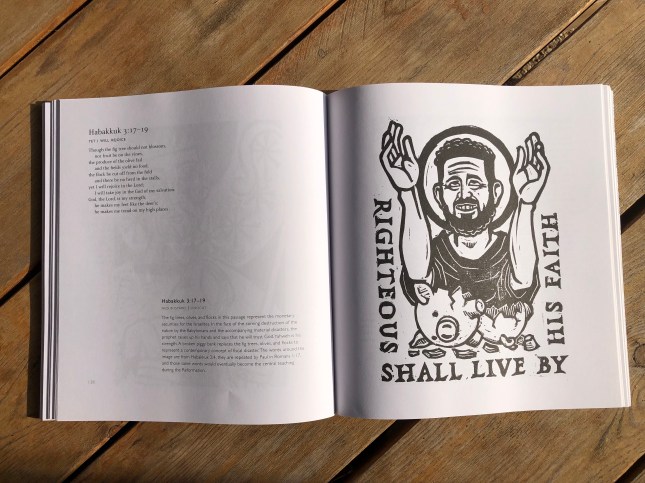
The above image is from Revealed: A Storybook Bible for Grown-Ups by Ned Bustard. The image was created by Ned Bustard and is called “Habakkuk 3:17-19.”

Habakkuk 3:17-19
Even though the fig trees have no blossoms, and there are no grapes on the vines; even though the olive crop fails, and the fields lie empty and barren; even though the flocks die in the fields, and the cattle barns are empty, yet I will rejoice in the Lord! I will be joyful in the God of my salvation! The Sovereign Lord is my strength! He makes me as surefooted as a deer, able to tread upon the heights.

Dear God, I was flipping through the Revealed book this morning and this image struck me. It was the broken piggy bank that got my attention. My first thought head, Oh, I’ll bet there’s a story in this.

Then I read the passage. Once again, this seems to go with the theme of my prayers to you lately about how we just don’t know what the future holds, and even though my circumstances might look bad to me my worship of you will remain.

In this case, Habakkuk is praying and he is worshipping. This whole chapter is actually a prayer to you. These last three verses bring it all together. Basically, even if everything around me is falling apart, I will rejoice in you. I will take joy in you because you are God and the God of my salvation. You are my strength and my security, even if my earthly security seems in doubt.

As for this image, here are a few things I notice. First, I doubt Habakkuk had a piggy bank, so this is given to me to make a point that I get as a 21st-century American. Habakkuk would have looked at this image and not understood the shattered pig, but I get what Bustard is communicating to me here. My money is gone. My earthly security is gone. The last of my back-up plan is gone. I didn’t just take money out of the bank. I irrevocably broke the piggy bank as a last resort. Now it’s all gone. And yet, Habakkuk is worshipping. His arms could be up in despair, but the key is in the expression on the face that Bustard gave Habakkuk here. He is smiling (I think) and his eyes are looking at heaven. He has the halo around his head to signify that he is a holy man/saint/prophet.

And then there are the words that Bustard chose to you: Righteous//Shall Live By//His Faith. This is a call back to Habakkuk 2:4 when he says, “Look at the proud! They trust in themselves, and their lives are crooked. But the righteous will live by their faithfulness to God.” By including part of this passage in the image, I think Bustard is also contrasting this image with the actions of the proud. A proud person would be sitting in front of a broken piggy bank with their head down in despair, weeping. But Habakkuk is advocating that the righteous person will live by his/her faith. When the piggy bank is broken and all of the earthly resources are exhausted, the righteous person will be found worshipping you.

Father, there have been several times over the last year when I’ve turned to you in faith. There were some instances when I hand’t even gotten around to bringing the need to you yet, and you were providing anyway. But there have also been times when I was at the end of my resources and I was discouraged and depressed. There have been times when I didn’t live by my faith and worship you. Thank you for this image by Ned Bustard. Thank you for reminding me this morning that you are sovereign and my hope. Thank you for reminding me that there is more to my life than what I see with my eyes and can process with my brain. There is faith, and when I live by that then I don’t need to understand what is happening around me. I just need to worship you.

In Jesus’s name I pray,

Amen


Tags: ,

The Definition of Insanity

2019-01-13 07-49
The above image is from Revealed: A Storybook Bible for Grown-Ups by Ned Bustard. It is called “Isaac Blesses Jacob” and was created by Wayne Forte.


Dear God, I’ve heard this definition of insanity attributed to several people and I don’t know who exactly said it, but the idea is that insanity is doing the same thing over and over again and expecting different results. That’s what I think of when I think about the ritual in many cultures that the eldest child is assumed to be the head of the children for that generation. The problem with that logic is that all one has to do is look at the Old Testament and see that it hardly ever worked out that way.

  • Abel was younger than Cain and yet he was the one who pleased you more with his heart and his worship.
  • Isaac was the son you wanted to bless even though Ishmael was Abraham’s first-born.
  • Jacob was famously second to Esau and yet he received an unbelievable blessing from you that I still can’t believe.
  • Joseph was not the oldest by a long shot, but he ended up being the most useful.
  • Skipping forward, David was the youngest of his brothers and he was obviously the one you called for Israel.
  • Solomon wasn’t anywhere near the oldest of David’s sons.

The list goes on and on. There is a flaw in our logic. I think I saw that Prince Harry’s new son is 7th in line to the throne of England. What? Picking your line of succession that way is like playing roulette. How can you possibly know through birth order who will be the next best king?

But let’s slow down. How often does our logic and intuition fail us as well? How many times have I hired the wrong person? How many times have I trusted the wrong person? How many times have a voted for the wrong person? In terms of King David, he certainly wasn’t Samuel’s first choice, and Samuel was really wise and clued into you.

No, at the end of the day, I think I need to 1.) seek your wisdom more and not lean on my own, and 2.) be prepared to walk down the road you have for me regardless of what it might hold. I remember when I was about to be a freshman in college I had been assigned a three-person dorm room with two other random guys. My mother had a friend whose son was going to my university and they decided to set us up as roommates. I remember protesting at the time, even telling her that I didn’t want to force anything, but let things play out the way you had set them up. But she did it and I ended up with a great roommate. The she go a little Rebekah on me and upset the natural order of things? Probably. But much like Rebekah’s decision, it probably worked out for the best.

Father, help me to first and foremost be sensitive to you and what you have to say to me. Love through me. Help me to give good counsel when asked and to know when to remain silent and admit that I don’t know. Give me your peace. Give me your discernment. But most importantly, give me your love, joy, peace, patience, gentleness, faithfulness, kindness, etc. in all situations.

In Jesus’ name I pray,

Amen