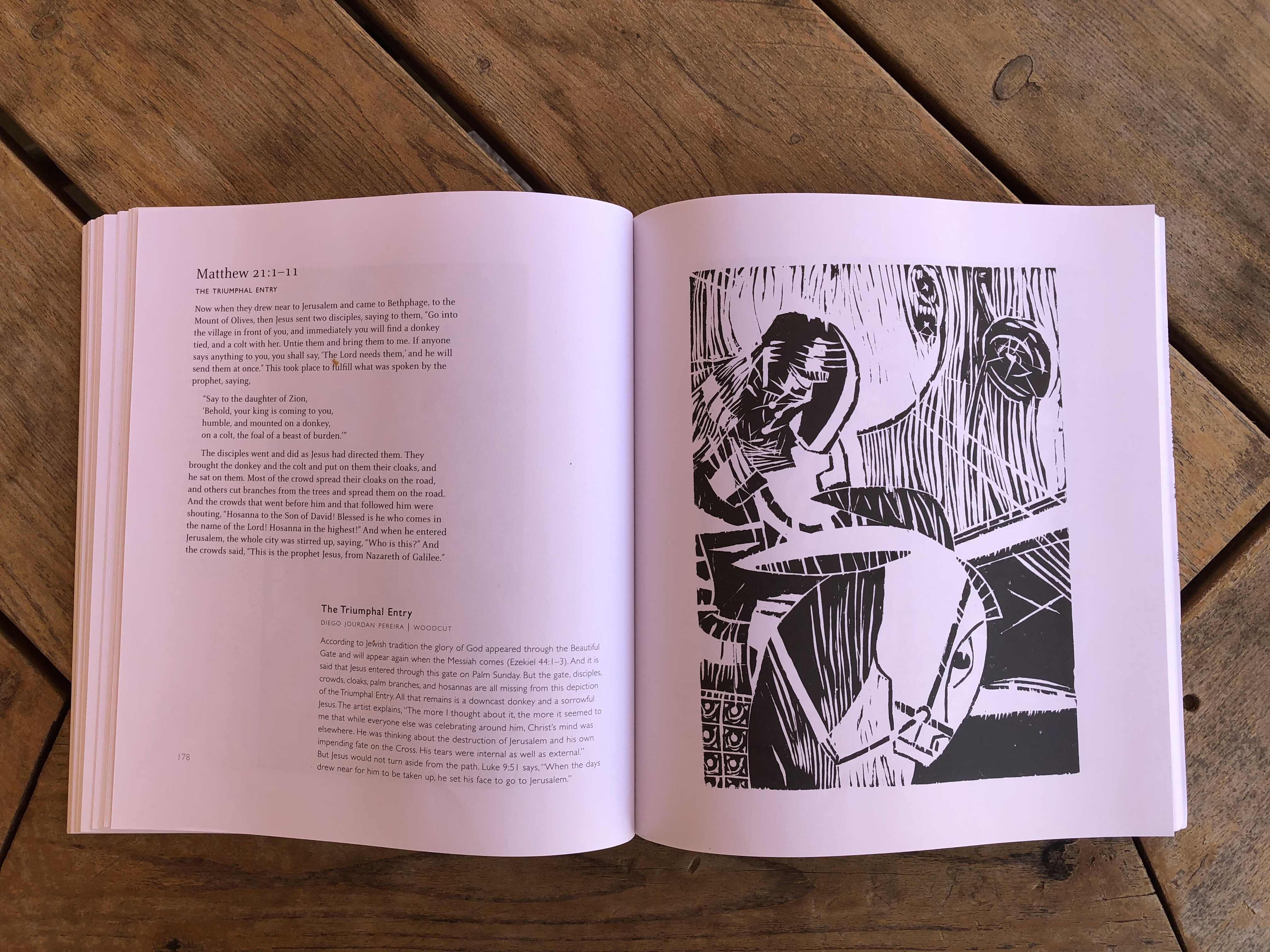
The image above is from Revealed: A Storybook Bible for Grown-Ups by Ned Bustard. The image is called “The Triumphal Entry” and was created by Diego Jourdan Pereira.
—
Matthew 21:1-11
As Jesus and the disciples approached Jerusalem, they came to the town of Bethphage on the Mount of Olives. Jesus sent two of them on ahead. “Go into the village over there,” he said. “As soon as you enter it, you will see a donkey tied there, with its colt beside it. Untie them and bring them to me. If anyone asks what you are doing, just say, ‘The Lord needs them,’ and he will immediately let you take them.” This took place to fulfill the prophecy that said, “Tell the people of Jerusalem, ‘Look, your King is coming to you. He is humble, riding on a donkey— riding on a donkey’s colt.’” The two disciples did as Jesus commanded. They brought the donkey and the colt to him and threw their garments over the colt, and he sat on it. Most of the crowd spread their garments on the road ahead of him, and others cut branches from the trees and spread them on the road. Jesus was in the center of the procession, and the people all around him were shouting, “Praise God for the Son of David! Blessings on the one who comes in the name of the Lord! Praise God in highest heaven!” The entire city of Jerusalem was in an uproar as he entered. “Who is this?” they asked. And the crowds replied, “It’s Jesus, the prophet from Nazareth in Galilee.”
—
Mark 11:1-11
As Jesus and his disciples approached Jerusalem, they came to the towns of Bethphage and Bethany on the Mount of Olives. Jesus sent two of them on ahead. “Go into that village over there,” he told them. “As soon as you enter it, you will see a young donkey tied there that no one has ever ridden. Untie it and bring it here. If anyone asks, ‘What are you doing?’ just say, ‘The Lord needs it and will return it soon.’” The two disciples left and found the colt standing in the street, tied outside the front door. As they were untying it, some bystanders demanded, “What are you doing, untying that colt?” They said what Jesus had told them to say, and they were permitted to take it. Then they brought the colt to Jesus and threw their garments over it, and he sat on it. Many in the crowd spread their garments on the road ahead of him, and others spread leafy branches they had cut in the fields. Jesus was in the center of the procession, and the people all around him were shouting, “Praise God! Blessings on the one who comes in the name of the Lord! Blessings on the coming Kingdom of our ancestor David! Praise God in highest heaven!” So Jesus came to Jerusalem and went into the Temple. After looking around carefully at everything, he left because it was late in the afternoon. Then he returned to Bethany with the twelve disciples.
—
Luke 19:28-44
After telling this story, Jesus went on toward Jerusalem, walking ahead of his disciples. As he came to the towns of Bethphage and Bethany on the Mount of Olives, he sent two disciples ahead. “Go into that village over there,” he told them. “As you enter it, you will see a young donkey tied there that no one has ever ridden. Untie it and bring it here. If anyone asks, ‘Why are you untying that colt?’ just say, ‘The Lord needs it.’” So they went and found the colt, just as Jesus had said. And sure enough, as they were untying it, the owners asked them, “Why are you untying that colt?” And the disciples simply replied, “The Lord needs it.” So they brought the colt to Jesus and threw their garments over it for him to ride on. As he rode along, the crowds spread out their garments on the road ahead of him. When he reached the place where the road started down the Mount of Olives, all of his followers began to shout and sing as they walked along, praising God for all the wonderful miracles they had seen. “Blessings on the King who comes in the name of the Lord! Peace in heaven, and glory in highest heaven!” But some of the Pharisees among the crowd said, “Teacher, rebuke your followers for saying things like that!” He replied, “If they kept quiet, the stones along the road would burst into cheers!” But as he came closer to Jerusalem and saw the city ahead, he began to weep. “How I wish today that you of all people would understand the way to peace. But now it is too late, and peace is hidden from your eyes. Before long your enemies will build ramparts against your walls and encircle you and close in on you from every side. They will crush you into the ground, and your children with you. Your enemies will not leave a single stone in place, because you did not recognize it when God visited you.”
—
John 12:12-16
The next day, the news that Jesus was on the way to Jerusalem swept through the city. A large crowd of Passover visitors took palm branches and went down the road to meet him. They shouted, “Praise God! Blessings on the one who comes in the name of the Lord! Hail to the King of Israel!” Jesus found a young donkey and rode on it, fulfilling the prophecy that said: Do not be afraid, O Daughter of Zion; see your king is coming, seated on a donkey’s cold.” His disciples didn’t understand at the time that this was a fulfillment of prophecy. But after Jesus entered into his glory, they remembered what had happened and realized that these things had been written about him.
Dear God, I want to spend some time with the Triumphal Entry today. It is Palm Sunday after all. My wife and I went to a special church service this morning where a man who is with “Jews for Jesus” came to walk the congregation through the different parts of the Passover meal. So now, as we enter Passion Week, I want to take some time to really sit with this week in a different way than I ever have before. Of course, that starts with Revealed: A Storybook Bible for Grown-Ups and what I’ve been getting out of the different artists’ interpretations of the stories.
So here I am with the Triumphal Entry. The first thing I did was look to confirm that the story shows up in all four Gospels. It does, although John seems to have a different focus than the other three. The first three give a lot more backstory, but John focuses on the crowds, the excitement, how the prophecy angle impacted the disciples after it was all said and done, and the Lazarus connection (remembering that one John gives us the Lazarus resurrection story).
So what did Diego Jourdan Pereira notice in this story? First, this image is a little difficult for a left-brained person like me to decipher. It’s hard to tell what I’m seeing here. I see the donkey with its head down. I see Jesus, who appears to have his head down. Are those lines in the background palm branches? I ended up having to go to the commentary on this piece a little sooner than I like. Here’s what Ned Bustard said about the piece, including a quote from the artist:
According to Jewish tradition the glory of God appeared through the Beautiful Gate and will appear again when the Messiah comes (Ezekiel 44:1-3). And it is said that Jesus entered through this gate on Palm Sunday. But the gate, disciples, crowds, cloaks, palm branches, and hosannas are all missing from this depiction of the Triumphal Entry. All that remains is a downcast donkey and a sorrowful Jesus. The artist explains, “The more I thought about it, the more it seemed to me that while everyone else was celebrating around him, Christ’s mind was elsewhere. He was thinking about the destruction of Jerusalem and his own impending fate on the Cross. His tears are internal as well as external.” But Jesus would not turn aside from the path. Luke 9:51 says, “When the days drew near for him to be taken up, he set his face to go to Jerusalem.”
I’m having so many thoughts, it’s hard to sort through them. I guess my day started with a revelation that might have been more obvious to other Christians–you intentionally made Jesus’s crucifixion and resurrection part of Passover. Jesus could have been killed any time and in any way, but your plan was to have his death and resurrection exactly coincide with the Passover celebration in Jerusalem that year. Why had I never thought of that? I guess I can be a little dense.
Then I have the thought from Luke 9 that Bustard brings out in the end of his description–that Jesus “set his face to go to Jerusalem.” We’ll see the emotions of Jesus play out over the next few days. In fact, he probably shows more emotion during this week than he does in the rest of the stories about him. He clears the temple out of anger. He curses a fig tree. He sweats blood. But when it comes down to it, he didn’t have to do this. He could have bailed, except for the fact that he was following your will, and your will was for him to walk this path. He was to be our Passover lamb.
Father, hep me to sink into this week. Help me to spend this week worshipping you–every aspect of you. You are GREAT and yet you are humble. You are all powerful, yet you are sacrificially loving. You can look through the screaming crowds of the Triumphal Entry and see the wickedness in each of us, and yet you proceed. You knew better than to believe the love you were getting from the crowd. You knew that some would turn on you and some would simply disappear. The more I sit with these ideas the more humbled and thankful I am.
In Jesus’ name I pray,
Amen


 Emails to God
Luke 19:41-42
41 But as he came closer to Jerusalem and saw the city ahead, he began to weep. 42 “How I wish today that you of all people would understand the way to peace. But now it is too late, and peace is hidden from your eyes.
Luke 19:41-42
Dear God, I’ve taken these two verses out of context because I want to sit with this this morning, but they are part of the Triumphal Entry story:
28 After telling this story, Jesus went on toward Jerusalem, walking ahead of his disciples. 29 As he came to the towns of Bethphage and Bethany on the Mount of Olives, he sent two disciples ahead. 30 “Go into that village over there,” he told them. “As you enter it, you will see a young donkey tied there that no one has ever ridden. Untie it and bring it here. 31 If anyone asks, ‘Why are you untying that colt?’ just say, ‘The Lord needs it.’”
32 So they went and found the colt, just as Jesus had said. 33 And sure enough, as they were untying it, the owners asked them, “Why are you untying that colt?”
34 And the disciples simply replied, “The Lord needs it.” 35 So they brought the colt to Jesus and threw their garments over it for him to ride on.
36 As he rode along, the crowds spread out their garments on the road ahead of him. 37 When he reached the place where the road started down the Mount of Olives, all of his followers began to shout and sing as they walked along, praising God for all the wonderful miracles they had seen.
38 “Blessings on the King who comes in the name of the Lord!
Peace in heaven, and glory in highest heaven!”
39 But some of the Pharisees among the crowd said, “Teacher, rebuke your followers for saying things like that!”
40 He replied, “If they kept quiet, the stones along the road would burst into cheers!”
41 But as he came closer to Jerusalem and saw the city ahead, he began to weep. 42 “How I wish today that you of all people would understand the way to peace. But now it is too late, and peace is hidden from your eyes. 43 Before long your enemies will build ramparts against your walls and encircle you and close in on you from every side. 44 They will crush you into the ground, and your children with you. Your enemies will not leave a single stone in place, because you did not recognize it when God visited you.”
45 Then Jesus entered the Temple and began to drive out the people selling animals for sacrifices. 46 He said to them, “The Scriptures declare, ‘My Temple will be a house of prayer,’ but you have turned it into a den of thieves.”
47 After that, he taught daily in the Temple, but the leading priests, the teachers of religious law, and the other leaders of the people began planning how to kill him. 48 But they could think of nothing, because all the people hung on every word he said.
Jesus longed that the people understood the way to peace. So what is the way to peace? Reading The Communicator’s Commentary: Luke by Bruce Larson, I saw that “the donkey was a symbol of peace in those days. Horses were symbols of military might. Conquering generals came on horses. An ambassador coming on a peaceful mission rode on a donkey. Jesus was an ambassador of peace from the Ultimate Kingdom.”
I found myself wondering an impossible question to answer when I read this passage this morning: What if they had understood and gotten it right that day? What if the Pharisees embraced him and asked what they must do to repent? What if the people ignored Roman rule, the Israelites embraced Jesus as your son/the Messiah, and then took reconciliation with you to the Gentiles? What if everyone cheering and jeering Jesus that day embraced who he was and then started worshipping you with every thing they have and loved their neighbors as themselves? What if?
Of course, it didn’t happen that way. But is there a lesson for your faithful remnant now? As I see Christians striving for political power and influence, I can’t help but wonder if they aren’t making the same mistake the crowds made that day. In my opinion, they are. They do not “understand the way to peace.” Are they embracing reconciliation with you through Jesus? Sure. Are they taking that to the world and ungodly? They probably think so. But I think they see the more expedient path of doing it through power and control, and not the slow, deliberate path of loving one person at a time.
Father, I am reminded of the thing I heard once from John Dickson, that Jesus used (and gave to us to use) four tools, and four tools only, to impact the world around us: Prayer, Service, Persuasion, and Suffering. I don’t pray enough for people. I could probably serve more. My persuasion abilities on the ungodly are weak. And, well, let’s face it, I don’t suffer much. Show me what that means. Show me what it means to worship you through the deliberate acts of worshipping you, but also through the acts of Prayer, Service, Persuasion, and Suffering.
I pray this in Jesus and with your Holy Spirit,
Amen
Posted by John D. Willome on November 20, 2025 in Luke
Tags: bible, Bruce Larson, christianity, Faith, Jesus, John Dickson, Luke, Palm Sunday, The Communicator's Commentary, Triumphal Entry, Weeping for Jerusalem