RSS

Tag Archives: Jesus

Mothers of the Bible — Elizabeth (Part 1)

When Herod was king of Judea, there was a Jewish priest named Zechariah. He was a member of the priestly order of Abijah, and his wife, Elizabeth, was also from the priestly line of Aaron. Zechariah and Elizabeth were righteous in God’s eyes, careful to obey all of the Lord’s commandments and regulations. They had no children because Elizabeth was unable to conceive, and they were both very old. Soon afterward his wife, Elizabeth, became pregnant and went into seclusion for five months. “How kind the Lord is!” she exclaimed. “He has taken away my disgrace of having no children.” A few days later Mary hurried to the hill country of Judea, to the town where Zechariah lived. She entered the house and greeted Elizabeth. At the sound of Mary’s greeting, Elizabeth’s child leaped within her, and Elizabeth was filled with the Holy Spirit. Elizabeth gave a glad cry and exclaimed to Mary, “God has blessed you above all women, and your child is blessed. Why am I so honored, that the mother of my Lord should visit me? When I heard your greeting, the baby in my womb jumped for joy. You are blessed because you believed that the Lord would do what he said.”
Luke 1:5-7,24-25,39-45

Dear God, maybe this comment is more about Mary that it is Elizabeth, and I’m going to hold off on Mary and Joseph until they end of this series (they’re obviously the best parents in the Bible, after all), but it is so nice that you have her Elizabeth and Zechariah. You gave her a safe place. And the angel told her about Elizabeth being pregnant so she’d know that Elizabeth will understand what’s going on. Elizabeth will believe you. She’ll believe you because she’s living in the midst of her own miracle.

For those first seven or eight months of conceiving and pregnancy before Mary arrived, I wonder what Elizabeth’s communications with Zechariah were like. Did Zechariah write down what Gabriel told him for her to see? I’m sure he did. Did they talk about it, with Zechariah writing his part down? I’m sure they did. Did they pray to you? Did they dream of what this would look like? Were they filled with hope and joy? Did they mistakenly dream of power and might for their child? I’m sure they never imagined him living in the wilderness, wearing animal skins, eating bugs, and eventually being beheaded. No, they didn’t need to know that about him. As with me, you kept them on a need-to-know basis. They needed to know their child’s relationship and connection to the Messiah. They needed to know to not cut his hair (I still don’t know why that was a thing except to maybe help John the Baptist [JTB] have a constant reminder that he was set apart for you). Knowing what they knew helped prepare them to raise this boy, but it also gave Elizabeth the intuition and sensitivity to the Holy Spirit that she needed to recognize what you were doing through Mary.

A few days later Mary hurried to the hill country of Judaea, to the town where Zechariah lived. She entered the house and greeted Elizabeth. At the sound of Mary’s greeting, Elizabeth’s child leaped within her. Elizabeth was filled wit the Holy Spirit. Elizabeth gave a glad cry and exclaimed to Mary, “God has blessed you above all women, and y our child is blessed.”

What a great affirmation for Mary! I’m sure she was scared. She knew the angel mentioned Elizabeth so she “hurried” to Zechariah’s house. But now, how will she tell Elizabeth what is happening with her? How will she explain? Well, she didn’t have to. What a gift. You used Elizabeth’s motherhood of JTB to grow her in a new way and make her available to Mary in a way she never would have been before.

Father, you certainly stretch me through my children. You love others through me because of what you have taught me as a father. You have taught me lessons I’d have never otherwise learned. You continue to show me new aspects of who you are through them. And just as Zechariah and Elizabeth had no idea what JTB’s and Jesus’s futures looked like, I have no idea what the futures of my children or even my wife and me will look like. But you have shown me what I need to know for today. You have given me good work to do today. Help me to have eyes that see and ears that hear. Make me slow to speak and discerning.

In Jesus’s name I pray,

Amen

 
Leave a comment

Posted by on March 19, 2020 in Luke, Mothers of the Bible


Tags: , , , ,

Parents of the Bible — Herod & Herodias

When Herod heard about Jesus, he said, “John, the man I beheaded, has come back from the dead.” For Herod had sent soldiers to arrest and imprison John as a favor to Herodias. She had been his brother Philip’s wife, but Herod had married her. John had been telling Herod, “It is against God’s law for you to marry your brother’s wife.” So Herodias bore a grudge against John and wanted to kill him. But without Herod’s approval she was powerless, for Herod respected John; and knowing that he was a good and holy man, he protected him. Herod was greatly disturbed whenever he talked with John, but even so, he liked to listen to him. Herodias’s chance finally came on Herod’s birthday. He gave a party for his high government officials, army officers, and the leading citizens of Galilee. Then his daughter, also named Herodias, came in and performed a dance that greatly pleased Herod and his guests. “Ask me for anything you like,” the king said to the girl, “and I will give it to you.” He even vowed, “I will give you whatever you ask, up to half my kingdom!” She went out and asked her mother, “What should I ask for?” Her mother told her, “Ask for the head of John the Baptist!” So the girl hurried back to the king and told him, “I want the head of John the Baptist, right now, on a tray!” Then the king deeply regretted what he had said; but because of the vows he had made in front of his guests, he couldn’t refuse her. So he immediately sent an executioner to the prison to cut off John’s head and bring it to him. The soldier beheaded John in the prison, brought his head on a tray, and gave it to the girl, who took it to her mother. When John’s disciples heard what had happened, they came to get his body and buried it in a tomb.
Mark 6:16-29

Dear God, for a short time I debated whether or not to include Herod and Herodias in my “Parents of the Bible” series, but I decided that we see them interacting with their daughter and making decisions with her as their parent so I guess they count. You put them and their story in here for us so let’s see what we can learn from them.

Herod

Here is a list of what we see Herod do in this story:

  • He takes his brother’s wife.
  • He didn’t necessarily want to arrest John the Baptist (JTB), but he did it at the behest of his wife.
  • JTB made him uncomfortable by presenting Herod’s sin to Heron any chance he got, but he “respected John; and knowing that he was a good and holy man, he protected him.”
  • This part is interesting. I saw a movie about Jesus one time that showed this story. It had an adult daughter dancing seductively for her father, him getting turned on, and then making a foolish, drunken vow to her. While that could be an interpretation, that’s not what the story says. It just says his daughter “came in and performed a dance that greatly pleased Herod and his guests.” That’s it. She could have been a 10-year-old that he was proud of. His vow was stupid, but it wasn’t necessarily made out of lust for his daughter. It could have been simple pride in her.
  • He makes a foolish vow, but “because of the vows he had made in front of his guests, he couldn’t refuse her.” We’ll come back to that.
  • He had JTB’s head given to the girl.

I guess my big thing for Herod is that he simply allowed his pride to impact his parenting. What will others think? That was a teachable moment for him with his daughter. We can’t ask for illegal and immoral things and expect to get them. But to say that to her in front of his guests would have been too much for him to swallow. In relating this to my own life, I can see where I might allow what others will say/think to influence my parenting decisions. Yes, this is part of Herod’s cautionary tale.

Herodias

Ah, Herodias. Her actions all come back to a very familiar motive: Shame. I won’t speculate as to what her role was in being Herod’s wife instead of Philip’s. But JTB’s rebukes obviously bothered her more than they did Herod so I’ll assume (and it’s a fairly big assumption) she felt some responsibility and guilt over it.

Then her daughter, perhaps unwittingly, gets involved. She does something that pleases her father, she is granted a huge favor and she doesn’t know how to respond. “Mom, what should I ask for?!? Servants? A city? Gold? Jewelry?” Then Herodias (the mother) sees an opportunity. She’s been trying to get Herod to get rid of JTB for a long time, but he’s refused. She didn’t have that much leverage over him. But now her daughter did so she used her daughter for her own gain. All to deal with her own shame.

I’d like to think I’m above ever doing anything like that, but am I? Have I ever used my children to get my way with my spouse? Just this week, I saw a divorced couple using their children to get back at each other. I’d love to judge Herodias ruthlessly for thinking of herself and her own wants/needs before her child’s, but I know I’ve done it and I’ve seen nearly every other parent do it as well.

Father, I’m glad I didn’t skip over these two parents I could seem myself in them as much as I have seen myself in any of these other biblical parents. I am sorry for the times when I put my own needs ahead of my child’s. Maybe it’s even as simple as a need to be liked by them instead of making a hard decision that will be for their best but cause them to be angry with me. Maybe it’s doing something mean out of revenge for a hurt they did to me. Guilty, guilty, guilty. I am guilty and I am sorry. Help me to be better.

In Jesus’s name I pray,

Amen


Tags: , , ,

Mothers of the Bible — Gentile Woman Who Asked Jesus to Heal Her Daughter

Then Jesus left Galilee and went north to the region of Tyre and Sidon. A Gentile woman who lived there came to him, pleading, “Have mercy on me, O Lord, Son of David! For my daughter is possessed by a demon that torments her severely.” But Jesus gave her no reply, not even a word. Then his disciples urged him to send her away. “Tell her to go away,” they said. “She is bothering us with all her begging.” Then Jesus said to the woman, “I was sent only to help God’s lost sheep—the people of Israel.” But she came and worshiped him, pleading again, “Lord, help me!” Jesus responded, “It isn’t right to take food from the children and throw it to the dogs.” She replied, “That’s true, Lord, but even dogs are allowed to eat the scraps that fall beneath their masters’ table.” “Dear woman,” Jesus said to her, “your faith is great. Your request is granted.” And her daughter was instantly healed.
Matthew 15:21-28

Dear God, this story has always been hard for me because Jesus comes off as a bit of a jerk. Is he racist? Is he elitist? Is he none of those things, but simply testing her? I’m sure it’s the latter, but it doesn’t seem that way at first.

I think I’m going to do what I did with Jairus yesterday and just make bullet points about another rich story that is told in a tight eight verses.

  • This Gentile woman already lived among the Jewish people in Tyre and Sidon. Had she already started to become acclimated to Jewish traditions, or was she overcoming a lot of racism she had experienced to go to Jesus in the first place?
  • She calls him “O Lord, Son of David!” Is this an admission on her part that he is the Messiah? He isn’t only a rabbi to her. Jairus’s friends called him a teacher. That’s not who she says he is. I could be wrong in how I’m reading this, but I think she’s willing to put the Messiah label on him. Now maybe this is just kissing up out of desperation. Maybe she doesn’t have a barrier to calling him that because the Messiah doesn’t mean as much to her as if she had been raised Jewish. But it’s still quite an admission.
  • The labels her daughter’s illness as a demon that torments her. I don’t know how this manifests itself, but that’s the language she uses with him.
  • “Jesus gave her no reply, not even a word.” That seems harsh? A test?
  • “Tell her to go away. She is bothering us with all her begging.” Did Jesus set a bad example for the disciples here. Was this incident reshaping his own attitudes towards his being there for Gentiles too. I think he had already healed the Centurion’s servant at this point, so it’s probably not that. But it’s interesting that his response to her seems to encourage racism and bigotry among the disciples.
  • “I was sent only to help God’s lost sheep–the people of Israel.” Again, racism or a test?
  • “She came and she worshiped him.” She didn’t just plead. She acknowledged his God-ness over her as well. She asked to be considered one of his people. She worshiped him.
  • They have their exchange about food and scraps from the table. This is the part of the story everyone remembers. If you try to bring this story to someone’s mind, all you have to say is, “The one where the woman just wants scraps from the table like a dog.” I was thinking about my dogs the other day and how grateful I am they can’t talk back. We definitely have a master/slave relationship with them. We tell them when to go to sleep, where to sleep, when to go to the bathroom, when to eat, to be quiet, to go away, to come here, etc. Then there is the part of the relationship where we play with them and scratch them. We feed them. We walk them. We give them shelter. We even pay a sitter to come and care for them when we leave town so they won’t have to be boarded. I’ve always kind of just read over this story, but maybe there is something more to this being a representation of my relationship with you than I’ve given it credit for.
  • Jesus is impressed with her answer and heals her daughter.

Father, I don’t know that this woman would ever have been driven to worship Jesus without going through this terrible thing with her daughter. It humbled her. Her love for her daughter and desperation brought her to her knees. I’m sure she told her daughter from that time forward how this man named Jesus, a Jewish Messiah, healed her. I wonder how she felt when she heard about the crucifixion. Did she hear about the resurrection too? You made the pain she experienced count, and I’m grateful for that. I’m grateful for her, and, as a Gentile, I’m grateful for myself as well.

I pray all of this in the name of that same Jesus,

Amen


Tags: ,

Fathers of the Bible — Jairus

Then a leader of the local synagogue, whose name was Jairus, arrived. When he saw Jesus, he fell at his feet, pleading fervently with him. “My little daughter is dying,” he said. “Please come and lay your hands on her; heal her so she can live.” Jesus went with him, and all the people followed, crowding around him. While he was still speaking to her, messengers arrived from the home of Jairus, the leader of the synagogue. They told him, “Your daughter is dead. There’s no use troubling the Teacher now.” But Jesus overheard them and said to Jairus, “Don’t be afraid. Just have faith.” Then Jesus stopped the crowd and wouldn’t let anyone go with him except Peter, James, and John (the brother of James). When they came to the home of the synagogue leader, Jesus saw much commotion and weeping and wailing. He went inside and asked, “Why all this commotion and weeping? The child isn’t dead; she’s only asleep.” The crowd laughed at him. But he made them all leave, and he took the girl’s father and mother and his three disciples into the room where the girl was lying. Holding her hand, he said to her, “Talitha koum,” which means “Little girl, get up!” And the girl, who was twelve years old, immediately stood up and walked around! They were overwhelmed and totally amazed. Jesus gave them strict orders not to tell anyone what had happened, and then he told them to give her something to eat.
Mark 5:22-24,35-43

Dear God, so much happens in this story. That’s the pretty incredible thing about the Bible overall. It has some of the tightest, best editing ever. In this case, it takes just 12 verses to say so much. It paints quite a picture.

Here are the key phrases that communicate so much:

  • “Leader of the local synagogue”– This wasn’t just anyone. This was someone with some community standing and pride. He should be able to handle something like this on his own. Why would he need to go to a traveling rabbi and get his help?
  • “My little girl is dying”– When one becomes a parent…well, there’s just a mystery there that you and I have discussed before. Imprinting. Bonding. Call it whatever you want, but there is something powerful about your child.
  • “Heal her so she can live”– It’s not like healing was common in those days. Jairus wasn’t making a common request. He was making a desperate request. He wanted his daughter to live. He wanted it for his own sake. I’m sure he wanted it for his wife as well.
  • “There’s no use troubling the Teacher now”–It’s one thing to heal. It’s another thing to resurrect. We were now beyond healing, and resurrection was too much to expect.
  • “Don’t be afraid. Just have faith”– Faith in what? That you’re going to raise her from the dead? Really? There’s no way.
  • “The child isn’t dead; she’s only asleep”– What? Was Jesus being intentionally deceptive here in order to prevent a furor after the resurrection about to take place? Did he try to protect the little girl from being the one who was raised from the dead as opposed to simply being someone who was healed? Was he protecting Jairus and his wife from that kind of attention as well? I’ve always seen this as being…well, I’ll call it a misleading. I’ve always seen this as a misleading that would protect Jesus from unwanted acclaim, but maybe it was for Jairus’s family’s benefit as well.
  • “They were overwhelmed and totally amazed”– Yeah, I would imagine so. Despair to elation. Hope. I wonder where Jairus was the week of Jesus’s crucifixion. It’s too bad we don’t have any further information about him or his family. I’d like to know if he became like Nicodemus. It’d be nice if we had that follow up.
  • “Jesus game them strict orders not to tell anyone what had happened”– Back to the…misleading. Obfuscation? This is the part that must have struck Don Francisco in the song I liked to above: “I’ve Got to Tell Somebody
  • “Give her something to eat”– She’s been sick a while. It’s probably been days since she has eaten, but she isn’t only alive. She isn’t sick anymore. Give that girl something to eat.

Father, I wish I knew more about Jairus. What I do know is pretty great. And I’m about to go through some stories about more fathers like him. I don’t have too many parents left really, but there are several who bring their children to Jesus for healing. I was going to bunch them together, but my wife encouraged me to break them out separately to see if there is anything unique about this. In this case, I would say that Jairus being the local synagogue leader is significant. The implications of what this would mean to his position in the community is significant. And that fact that he had to keep it quiet and participate in the obfuscation is unique as well. Thank you for his example of a father who really loved his daughter beyond what it would cost him personally and professionally.

In Jesus’s name I pray,

Amen

 
Leave a comment

Posted by on March 8, 2020 in Fathers of the Bible, Mark


Tags: , ,

Matthew 17:1-13

Six days later Jesus took Peter and the two brothers, James and John, and led them up a high mountain to be alone. As the men watched, Jesus’ appearance was transformed so that his face shone like the sun, and his clothes became as white as light. Suddenly, Moses and Elijah appeared and began talking with Jesus. Peter exclaimed, “Lord, it’s wonderful for us to be here! If you want, I’ll make three shelters as memorials —one for you, one for Moses, and one for Elijah.” But even as he spoke, a bright cloud overshadowed them, and a voice from the cloud said, “This is my dearly loved Son, who brings me great joy. Listen to him.” The disciples were terrified and fell face down on the ground. Then Jesus came over and touched them. “Get up,” he said. “Don’t be afraid.” And when they looked up, Moses and Elijah were gone, and they saw only Jesus. As they went back down the mountain, Jesus commanded them, “Don’t tell anyone what you have seen until the Son of Man has been raised from the dead.” Then his disciples asked him, “Why do the teachers of religious law insist that Elijah must return before the Messiah comes? ” Jesus replied, “Elijah is indeed coming first to get everything ready. But I tell you, Elijah has already come, but he wasn’t recognized, and they chose to abuse him. And in the same way they will also make the Son of Man suffer.” Then the disciples realized he was talking about John the Baptist.
Matthew 17:1-13

Dear God, I want to look at this story today from Peter’s, James’s and John’s perspective. Well, mainly Peter’s since he is the one who talks so we know a little more of what is going on with him. That, and the fact that the New Testament reading for this weekend is Peter using this Tory to make his point.

I’ve talked before with you about how I think this experience was your way of encouraging, affirming, and even comforting Jesus on his way to Jerusalem. But, frankly, he didn’t have to have these three disciples with him. But maybe they needed to be there. In fact, who’s to say that Jesus didn’t have several experiences like this that weren’t recorded because no one was there?

I would say that one of the things Peter got was a revelation that this was all for real. He had just seen Moses and Elijah, for crying out loud! What a testimony this was to them in a time when they might have started to doubt!

You can tell they are trying to process what they just saw as they walk down because they are trying to make sense of having just seen Elijah (they just saw Elijah!) and how it might fit into the prophecy about him coming back before the Messiah comes.

Of course, Peter uses this experience later in his epistle to underscore that this is all very real. You are real. Jesus was/is real. The message he was preaching is real. This one little event had a huge impact on him.

Father, you do things that encourage me all of the time. Sometimes I notice and sometimes I miss them. Please help me to notice you in every moment. Help me to be grateful for every single thing you do for me. And, really, thank you for even caring about me at all, not to mention loving me so much.

In Jesus’s name I pray,

Amen

 
1 Comment

Posted by on February 19, 2020 in Matthew


Tags: , , , ,

John 14:15-26

15 “If you love me, keep my commands. 16 And I will ask the Father, and he will give you another advocate to help you and be with you forever— 17 the Spirit of truth. The world cannot accept him, because it neither sees him nor knows him. But you know him, for he lives with you and will be in you. 18 I will not leave you as orphans; I will come to you. 19 Before long, the world will not see me anymore, but you will see me. Because I live, you also will live. 20 On that day you will realize that I am in my Father, and you are in me, and I am in you. 21 Whoever has my commands and keeps them is the one who loves me. The one who loves me will be loved by my Father, and I too will love them and show myself to them.” Then Judas (not Judas Iscariot) said, “But, Lord, why do you intend to show yourself to us and not to the world?” Jesus replied, “Anyone who loves me will obey my teaching. My Father will love them, and we will come to them and make our home with them. 24 Anyone who does not love me will not obey my teaching. These words you hear are not my own; they belong to the Father who sent me. 25 “All this I have spoken while still with you. 26 But the Advocate, the Holy Spirit, whom the Father will send in my name, will teach you all things and will remind you of everything I have said to you.
John 14:15-26

Dear God, I think that one of the biggest mistakes I make in my life is that I underestimate the role and power of the Holy Spirit. I know a recently baptized Christian who told me the age studied the religions of the world and one thing she decided is that Christianity is the only one to offer mercy and meet you where you are. I agreed with him, but as I read this and sit with it, I wonder if perhaps the real difference for the discipling Christian isn’t that you impart you own Spirit to dwell in us.

So how does the Holy Spirit manifest itself in my life. He is supposed to be my counselor, my comforter, and my advocate. What does that soil like in practical terms? What difference does that make? Well, as long as I’m making room for him and not squelching him, it means that he is helping me to learn, whispering to me in a still small voice, and praying for me when I don’t know how to pray. How amazing is it that you did this?!? You gave us your Spirit to be in us and among us!

Father, help me to live my life in a way that makes room for the Holy Spirit. Help me to lean into him more. Help me to also pray better and with more wisdom. Help me to see reality as you see reality. Help me to see the spiritual warfare around me. Help me to see above it all and to give my utmost for your highest.

In Jesus’s name I pray,

Amen

 
Leave a comment

Posted by on June 6, 2019 in John


Tags: ,

The Sower — Mark 4:1-20


The image above is from
Revealed: A Storybook Bible for Grown-Ups by Ned Bustard. The image itself is called “Sower (after Van Gogh)” and was created by Ned Bustard.

Mark 4:1-20
Once again Jesus began teaching by the lakeshore. A very large crowd soon gathered around him, so he got into a boat. Then he sat in the boat while all the people remained on the shore. He taught them by telling many stories in the form of parables, such as this one: “Listen! A farmer went out to plant some seed. As he scattered it across his field, some of the seed fell on a footpath, and the birds came and ate it. Other seed fell on shallow soil with underlying rock. The seed sprouted quickly because the soil was shallow. But the plant soon wilted under the hot sun, and since it didn’t have deep roots, it died. Other seed fell among thorns that grew up and choked out the tender plants so they produced no grain. Still other seeds fell on fertile soil, and they sprouted, grew, and produced a crop that was thirty, sixty, and even a hundred times as much as had been planted!” Then he said, “Anyone with ears to hear should listen and understand.” Later, when Jesus was alone with the twelve disciples and with the others who were gathered around, they asked him what the parables meant. He replied, “You are permitted to understand the secret of the Kingdom of God. But I use parables for everything I say to outsiders, so that the Scriptures might be fulfilled: ‘When they see what I do, they will learn nothing. When they hear what I say, they will not understand. Otherwise, they will turn to me and be forgiven.’” Then Jesus said to them, “If you can’t understand the meaning of this parable, how will you understand all the other parables? The farmer plants seed by taking God’s word to others. The seed that fell on the footpath represents those who hear the message, only to have Satan come at once and take it away. The seed on the rocky soil represents those who hear the message and immediately receive it with joy. But since they don’t have deep roots, they don’t last long. They fall away as soon as they have problems or are persecuted for believing God’s word. The seed that fell among the thorns represents others who hear God’s word, but all too quickly the message is crowded out by the worries of this life, the lure of wealth, and the desire for other things, so no fruit is produced. And the seed that fell on good soil represents those who hear and accept God’s word and produce a harvest of thirty, sixty, or even a hundred times as much as had been planted!”

Dear God, I used to pray this parable a lot when my children were little. I prayed that the seeds my wife and I were planting each day would find good soil. I prayed that we would be able to plant good seeds in the first place. I loved this illustration.

Now that they are in their 20’s, my prayer has shifted a little. They are on their own paths now. They struggle. They succeed. They have revelations and they have blinders. Just like me. I have all of those things in my life as well. But my prayer for them is slightly different. I am not the one doing much planting in their lives so I end up praying over the seeds that were planted long ago, some of which I am hoping are still there, but dormant with roots that are reaching for good soil. I pray for those who are planting seeds in their lives today. I pray for the soil in their heart.

Sometimes I have the presence of mind to pray about the soil in my own heart. Am I able to listen to those who bring your word to me, or do I dismiss them? Does Satan steal away the seed? Do I allow selfishness and pleasures of the world to choke it the seeds that get through? Do I intentionally cultivate the soil of my heart and make it seed-ready?

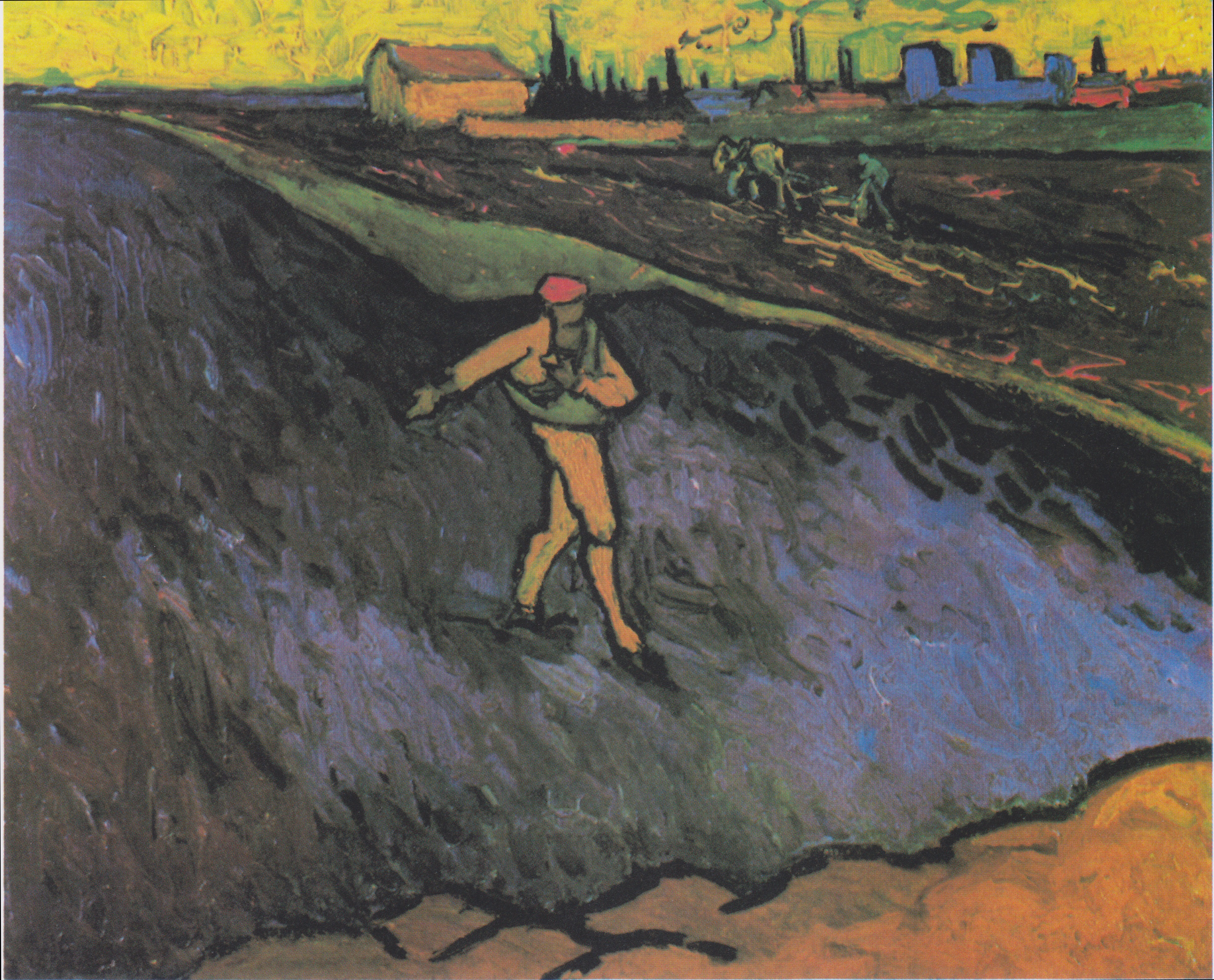
Now, for this image from Bustard. I guess one thing about this story is that the sower is not very discriminating. He is very generous with his seeds, scattering them everywhere. He doesn’t seem to care what kind of soil it finds. He’ll put some on the path. He’ll put some on shallow soil. He’ll put some in the thorns. And it seems that, just as randomly, some will find good soil. But the sower doesn’t seem to care. He just throws it out there. I should probably be more conscious of how I sow seeds. Am I stingy with them, or do I just spread them everywhere?

Another thing about this image is that I can see a big crop in the background. I think Bustard must have thought about what a 100-fold crop looked like and included it in the image. The Sun and the sky are there. The ground where the sower is walking is there. But the crop in the background is our goal.

Bustard says that his rendition of this story is inspired by Vincent van Gogh’s painting. Here it is for reference.

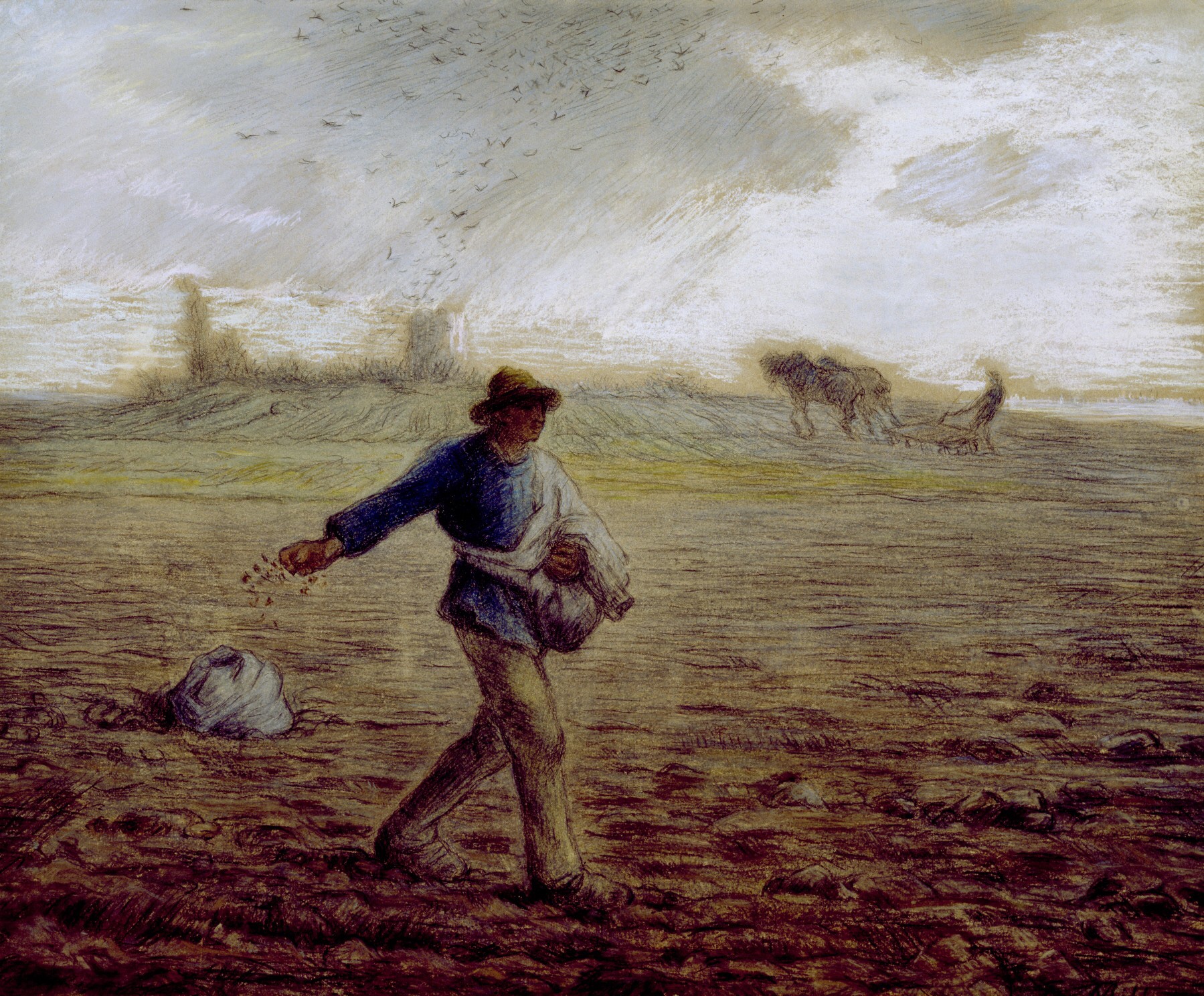
Apparently, according to Bustard, van Gogh’s piece was inspired by Jean Francois Millet’s piece describing the same parable Here is Millet’s image.

I guess the last thing I will notice about all of the art is that none of them created an image set in Jesus’s time. They are all more modern than that. I suppose Millet is the one who started with that concept. This isn’t just a story with a lesson for 2,000 years ago. It is a modern story.

Father, I will have opportunities to spread some seeds today. I will also have opportunities to prepare the soil of my heart to receive the seeds you have for me. Help me to be mindful of that. Help me to embrace this whole concept. Help me to give you a great harvest that will help your kingdom to come and your will to be done on Earth as it is in Heaven.

In Jesus’s name I pray,

Amen


Tags: , ,

Nicodemus Part 3 — John 19:38-42

John 19:38-42
Afterward Joseph of Arimathea, who had been a secret disciple of Jesus (because he feared the Jewish leaders), asked Pilate for permission to take down Jesus’ body. When Pilate gave permission, Joseph came and took the body away. With him came Nicodemus, the man who had come to Jesus at night. He brought about seventy-five pounds of perfumed ointment made from myrrh and aloes. Following Jewish burial custom, they wrapped Jesus’ body with the spices in long sheets of linen cloth. The place of crucifixion was near a garden, where there was a new tomb, never used before. And so, because it was the day of preparation for the Jewish Passover and since the tomb was close at hand, they laid Jesus there.

Dear God, this is the story that made me love and appreciate Nicodemus. John seems to have a soft spot in his heart for Nicodemus (and Pilate for that matter, but that is a subject for another prayer journal). John 3 never references anyone being with Jesus and Nicodemus but Jesus, although it’s feasible that John and some other disciples could have been there. But the story in chapter 7 about Nicodemus trying to passively defend Jesus must have been relayed to John by someone else. Perhaps Nicodemus himself after Jesus’s death and resurrection. I assume John and Nicodemus had a personal relationship. Otherwise, why would John be the only Gospel writer to mention him? And why did he go to great pains in chapters 7 and 19 to not only call Nicodemus by name, but intentionally reference his conversation with Jesus in chapter 3?

So now for this story. Why do I like it so much? Mainly because It is Nicodemus at his lowest point, and yet he shows so much love for Jesus. His anger and anguish drives him into action. He loves this man he believed to be your Messiah, and he is going to show it to the world regardless of the consequences. And although we never read his name again after this story, I’m sure this act cost him his place in the temple and in the community. I would bet that this was his last Passover as a Pharisee.

Afterward Joseph of Arimathea, who had been a secret disciple of Jesus (because he feared the Jewish leaders), asked Pilate for permission to take down Jesus’ body. When Pilate gave permission, Joseph came and took the body away.

First, however, let’s talk about Joseph of Arimathea. Luke and Mark tell us that Joseph was a prominent member of the council, but he did not consent to the death sentence Jesus had received. He was a secret disciple of Jesus. Did he and Nicodemus know this about each other all along, or was this something they figured out over the previous 12 hours?

With him came Nicodemus, the man who had come to Jesus at night. He brought about seventy-five pounds of perfumed ointment made from myrrh and aloes.

John is careful to tell us that Nicodemus brought 75 pounds of perfumed ointment with him. I don’t know how this worked, but I would imagine they did the work right there at the foot of the cross. I would think that they would want to put the ointment on the body and wrap it up before they transported it to the tomb. I have this image in my mind of Nicodemus, grief stricken, disillusioned, and angry carrying this ointment in silence. Then he and Joseph take the body and start to handle the bloody mess. Where would you start? Blood would have to be everywhere. Did they clean the body with the ointment? But they did it.

Following Jewish burial custom, they wrapped Jesus’ body with the spices in long sheets of linen cloth.

This is where I want to spend some time with the other Pharisees. This scene is amazing to me. I picture it completely silent except for hushed murmurs between the Pharisees, wondering what Joseph and Nicodemus were doing. And why were they doing it. Then I imagine no words between Joseph and Nicodemus themselves. Just looks. Glances. Tears. Confusion. I would imagine that the Pharisees were furious and there was hell to pay on Sunday–especially after the resurrection. Joseph was highly respected. Did his exhibited love for Jesus make any of them doubt? How about Nicodemus? Did his demonstration of discipleship and belief make them second guess their own beliefs, if only for a moment? Joseph and Nicodemus said more through their actions than they could ever have said through words.

The place of crucifixion was near a garden, where there was a new tomb, never used before. And so, because it was the day of preparation for the Jewish Passover and since the tomb was close at hand, they laid Jesus there.

I wonder what it was like that night and the rest of the Sabbath and Passover for both Nicodemus and Joseph. Were they afraid? If not for their lives, for their careers and standing in the community? Did they talk to their wives? Their children? Were their families mad at them, or had they already told them how they felt about Jesus? And what about after the resurrection? Did the two men who had lost their standing in the community as well as, likely, their livelihoods join “The Way?” Did Nicodemus and John become friends. Did Joseph get to know all of the apostles? So many unanswerable questions. But I am certain that they both had to pay a price. The questions is, how big?

Father, I have followed you in the past and been disappointed. Even now, part of my soul is comforted by you through these prayer journals. I find camaraderie with characters like Nicodemus. We are all sojourners on this road. We are community, even though 2,000 years separates our earthly lives. Thank you for that. Thank you for loving me even when I question you and half-heartedly acknowledge my love for you. Thank you for forgiving me.

In Jesus’s name I pray,

Amen

Nicodemus Part 1
Nicodemus Part 2

 
Leave a comment

Posted by on May 4, 2019 in John, Nicodemus


Tags: , , , , , ,

Nicodemus Part 2 — John 7:32, 45-52

John 7:32, 45-52
32 When the Pharisees heard that the crowds were whispering such things, they and the leading priests sent Temple guards to arrest Jesus.

45 When the Temple guards returned without having arrested Jesus, the leading priests and Pharisees demanded, “Why didn’t you bring him in?”
46 “We have never heard anyone speak like this!” the guards responded.
47 “Have you been led astray, too?” the Pharisees mocked. 48 “Is there a single one of us rulers or Pharisees who believes in him? 49 This foolish crowd follows him, but they are ignorant of the law. God’s curse is on them!”
50 Then Nicodemus, the leader who had met with Jesus earlier, spoke up. 51 “Is it legal to convict a man before he is given a hearing?” he asked.
52 They replied, “Are you from Galilee, too? Search the Scriptures and see for yourself—no prophet ever comes from Galilee!”

Dear God, I kind of missed something in yesterday’s journal that I want to touch on before I get into this passage today. What was the context within which Nicodemus talked to Jesus at night back in chapter 3? Well, according to John, Jesus was in Jerusalem for the Passover, and he had just cleared the temple of the money changers and such and had told the “Jews” who asked for a miracle that if they destroyed “this temple” he would raise it again in three days. Nicodemus was just trying to make sense of what he was seeing and hearing.

32 When the Pharisees heard that the crowds were whispering such things, they and the leading priests sent Temple guards to arrest Jesus.

Now, for this part of the story, we find Nicodemus again. Jesus goes back to Jerusalem for the Feast of Tabernacles and he upsets the Pharisees. So much so that by the time we get to verse 32 they decide to send temple guards to arrest him.

45 When the Temple guards returned without having arrested Jesus, the leading priests and Pharisees demanded, “Why didn’t you bring him in?”
46 “We have never heard anyone speak like this!” the guards responded.
47 “Have you been led astray, too?” the Pharisees mocked. 48 “Is there a single one of us rulers or Pharisees who believes in him? 49 This foolish crowd follows him, but they are ignorant of the law. God’s curse is on them!”

It wasn’t that the guards couldn’t arrest Jesus. They intentionally chose not to. And they admitted as much to the Pharisees. And the Pharisees’ response? They basically tell the guards that God’s curse is on them and John tells us they ask an interesting question: “Is there a single one of us rulers or Pharisees who believes in him?” In showing their intellectual and spiritual superiority while shaming the guards, they push Nicodemus to a moral dilemma that pushes him just a little out of hiding.

50 Then Nicodemus, the leader who had met with Jesus earlier, spoke up. 51 “Is it legal to convict a man before he is given a hearing?” he asked.

No, it’s not the strongest defense in the world, but it’s enough of an admission of sympathy to reveal some of his inner feelings to his fellow Pharisees. He’s been completely in the closet up until now. He met with Jesus in chapter 3 at night, when no one knew about it. But now he couldn’t keep silent any longer. He was trying to do it in a way that wouldn’t completely reveal his hand. He brought in “the law.” But just saying even the slightest thing in Jesus’s defense provoked their wrath.

52 They replied, “Are you from Galilee, too? Search the Scriptures and see for yourself—no prophet ever comes from Galilee!”

The Pharisees are so flabbergasted by Nicodemus’s defense of Jesus that they accuse him of being a “homer.” They see that he has sympathy for Jesus and their only explanation is to accuse him not of believing in Jesus, but of hoping for the best for him for other emotional reasons.

So in looking back on this story, Nicodemus is on a journey of faith. He is working it out with literal fear and trembling (Philippians 2:12). He tested the waters in this story, and he got smacked down. Did he fail Jesus? Perhaps? Did he ultimately decided on this day to save his own skin rather than argue with his colleagues? Yes. But he definitely progressed on his journey. He hadn’t arrived yet. He hadn’t entered into a stage of worship that would cause him to risk it all out of his love for you and belief in Jesus. He did, however, grow and prepare himself for a day that would ask more from him.

Father, help me to be a little better today than I was yesterday. Help me to have eyes to see my own weaknesses and address them. Give me the serenity to accept the things I cannot change, the courage to change the things I can, and the wisdom to know the difference.

In Jesus’s name I pray,

Amen

Nicodemus Part 1
Nicodemus Part 3

 
Leave a comment

Posted by on May 4, 2019 in John, Nicodemus


Tags: , , ,

Nicodemus Part 1 — John 3:1-21

John 3:1-21 [NLT]
There was a man named Nicodemus, a Jewish religious leader who was a Pharisee. 2 After dark one evening, he came to speak with Jesus. “Rabbi,” he said, “we all know that God has sent you to teach us. Your miraculous signs are evidence that God is with you.”
3 Jesus replied, “I tell you the truth, unless you are born again, you cannot see the Kingdom of God.”
4 “What do you mean?” exclaimed Nicodemus. “How can an old man go back into his mother’s womb and be born again?”
5 Jesus replied, “I assure you, no one can enter the Kingdom of God without being born of water and the Spirit. 6 Humans can reproduce only human life, but the Holy Spirit gives birth to spiritual life. 7 So don’t be surprised when I say, ‘You must be born again.’ 8 The wind blows wherever it wants. Just as you can hear the wind but can’t tell where it comes from or where it is going, so you can’t explain how people are born of the Spirit.”
9 “How are these things possible?” Nicodemus asked.
10 Jesus replied, “You are a respected Jewish teacher, and yet you don’t understand these things? 11 I assure you, we tell you what we know and have seen, and yet you won’t believe our testimony. 12 But if you don’t believe me when I tell you about earthly things, how can you possibly believe if I tell you about heavenly things? 13 No one has ever gone to heaven and returned. But the Son of Man has come down from heaven. 14 And as Moses lifted up the bronze snake on a pole in the wilderness, so the Son of Man must be lifted up, 15 so that everyone who believes in him will have eternal life.
16 “For this is how God loved the world: He gave his one and only Son, so that everyone who believes in him will not perish but have eternal life. 17 God sent his Son into the world not to judge the world, but to save the world through him.
18 “There is no judgment against anyone who believes in him. But anyone who does not believe in him has already been judged for not believing in God’s one and only Son. 19 And the judgment is based on this fact: God’s light came into the world, but people loved the darkness more than the light, for their actions were evil. 20 All who do evil hate the light and refuse to go near it for fear their sins will be exposed. 21 But those who do what is right come to the light so others can see that they are doing what God wants.”

Dear God, I want to take apart this conversation a little bit because I think it is important that John is the only Gospel writer who told us about Nicodemus. There is obviously something about him that John wants us to know. Much like good story telling, I think one of the things John is doing is giving us something early in the story that he will pay off in the end at the crucifixion.

So let’s start at the beginning:

There was a man named Nicodemus, a Jewish religious leader who was a Pharisee. 2 After dark one evening, he came to speak with Jesus. “Rabbi,” he said, “we all know that God has sent you to teach us. Your miraculous signs are evidence that God is with you.”

John sets up that Nicodemus is one of the dreaded Pharisees that are so ridiculed throughout the Gospels, but he immediately lets us know there is something different about this one. He didn’t come to publicly challenge, trap, and, hopefully, humiliate and disprove Jesus. He came to get to know him a little. He came with an open mind. He came to learn. And he doesn’t lead with a question. He comes “after dark” to speak directly with Jesus, one-on-one, and acknowledges that he recognizes that Jesus is from God.

3 Jesus replied, “I tell you the truth, unless you are born again, you cannot see the Kingdom of God.”
4 “What do you mean?” exclaimed Nicodemus. “How can an old man go back into his mother’s womb and be born again?”

According to John’s account, Jesus immediately initiates the conversation, ignoring the flattery that Nicodemus gave him. He seems to want to challenge Nicodemus–to test him and see why he is really there.

We take the phrase “born again” and put it into the context of this passage, but Nicodemus didn’t have this passage. He was really trying to understand. Jesus is like one of those teachers who asks the vague, esoteric question that is hard to answer, or, in this case, says the provocative thing that will either send someone away or draw them in deeper. In this case, he drew Nicodemus in. Jesus had a lot more to say, but he wanted to first know if Nicodemus was ready to hear it. Would he scoff at Jesus’s statement and leave, or was he really there to learn? Apparently, Nicodemus was there to learn.

5 Jesus replied, “I assure you, no one can enter the Kingdom of God without being born of water and the Spirit. 6 Humans can reproduce only human life, but the Holy Spirit gives birth to spiritual life. 7 So don’t be surprised when I say, ‘You must be born again.’ 8 The wind blows wherever it wants. Just as you can hear the wind but can’t tell where it comes from or where it is going, so you can’t explain how people are born of the Spirit.”
9 “How are these things possible?” Nicodemus asked.

Water and Spirit. That’s the answer to Nicodemus’s question. Jesus acknowledges that, no, you can’t go back into your mother’s womb, but there is a new baptism that is of water and the Spirit. The problem is, the concept of being born of the Spirit is something that can’t be explained in words. So Jesus tells him that being born again means being born of water and the Spirit, but it’s a process that Jesus can’t put into words. But Nicodemus doesn’t give up. He wants to understand: “How are these things possible?”

10 Jesus replied, “You are a respected Jewish teacher, and yet you don’t understand these things? 11 I assure you, we tell you what we know and have seen, and yet you won’t believe our testimony. 12 But if you don’t believe me when I tell you about earthly things, how can you possibly believe if I tell you about heavenly things? 13 No one has ever gone to heaven and returned. But the Son of Man has come down from heaven. 14 And as Moses lifted up the bronze snake on a pole in the wilderness, so the Son of Man must be lifted up, 15 so that everyone who believes in him will have eternal life.

I’m going to break Jesus’s little speech to Nicodemus up into parts. I think this first part is about setting the context. Jesus is basically saying forthrightly to Nicodemus, “I am the Messiah.” Skipping verses 10-12 where he exhibits his exasperation with Nicodemus, Jesus goes on in verse 13 to say that he has come from God in heaven. Then in verse 14 he compares himself with the snake that was sent to save the Israelites from their sin and the snake bites that resulted in Numbers 21:4-9. But then he says that he, Jesus, will be the one lifted up so that everyone who believes in him will have eternal life.

We never get Nicodemus’s reaction to this little speech, but I can only imagine what it was like to hear it in that context. Who does this guy think he is? On the other hand, Nicodemus entered this conversation earnestly trying to get an answer to that question, and now he was getting it. This guy claims to be the Messiah.

16 “For this is how God loved the world: He gave his one and only Son, so that everyone who believes in him will not perish but have eternal life. 17 God sent his Son into the world not to judge the world, but to save the world through him.

Now Jesus gives us a glimpse into your heart. You love us. How much? Well, so much that you gave us Jesus, your one and only son, so that we would have the opportunity to commune with you for eternity. Your heart is to give us a pathway to salvation. He is saying, “Nicodemus, you need to understand that this God that you worship as all powerful is everything you can imagine and so much more. But don’t miss this one fact that might be hard to believe. He loves you and he wants you. He loves and wants you so much that he sacrificed for it. God gave out of his own being and love just so that you and your fellow humans, Jew or Gentile, will be with him.”

18 “There is no judgment against anyone who believes in him. But anyone who does not believe in him has already been judged for not believing in God’s one and only Son. 19 And the judgment is based on this fact: God’s light came into the world, but people loved the darkness more than the light, for their actions were evil. 20 All who do evil hate the light and refuse to go near it for fear their sins will be exposed. 21 But those who do what is right come to the light so others can see that they are doing what God wants.”

And finally, the wrap-up. You are doing your best to not judge me, but I have to at least love the light more than the darkness. I have to let go of my sin. I have to take the hand that is reaching out to me. You care about me, but as much as Nicodemus had to come to terms with his pride, as a Pharisee and as a man, so I must come to the end of my own pride and love the light more than the darkness.

Father, help me to not only internalize the words that John shared in this passage, but to reflect them to the world as well. Help me to be your ambassador. Help me to take your hand, receive your light, and the humbly share it with the world.

In Jesus’s name I pray,

Amen

Nicodemus Part 2
Nicodemus Part 3

 
Leave a comment

Posted by on May 3, 2019 in John, Nicodemus


Tags: , , , , , ,