RSS

Sacred Marriage by Gary Thomas (Selected Study Guide Questions)

Dear God, as I finalize what I’m going to do with this home church tonight, I thought I would go through the Sacred Marriage study guide that’s available free online and answer some of the questions for not only myself, but also you.

What has your marriage revealed to you about your sinful attitudes, selfish behaviors, and other character flaws? Why do you think marriage brings so many character issues to the surface?

  • I’ve talked ad nauseum about my neediness that you helped to mostly (not completely) purge from me through marriage. This is what comes to mind first. The change in paradigm to look to you for my wholeness and not to my wife. Well, I don’t know that you used my wife to teach me that, but, thankfully, you taught me that before my neediness destroyed my marriage.
  • I’ve talked about losing some of my selfishness in the interest of serving her and serving my children (without expecting anything in return–that’s important).
  • One of the things my wife, in particular, has taught me is how to appreciate the arts more. Musical theater. Poetry. She is a deep thinker and a very intelligent woman. I used to be very dismissive of the arts, and it was foolish of me.
  • She has modeled forgiveness to me. Not only how she forgives me, but also how she forgives others.
  • She challenges me spiritually by her example of pursuing you. There have been times when I haven’t pursued you like I should, but she has always been an example of steady perseverance.
  • Her self-discipline is quite remarkable and an example to me.

I could go on an on, but I better get to the next question.

How can a discouraged spouse directly apply the admonition to seek God in the midst of disappointments rather than to obsess over where the spouse falls short?

This is obviously the crux of the entire book. The ideal situation is when each spouse pursues a selfless attitude towards their mate. In that situation, one would likely naturally find their needs being met. But when it’s a one-way street, what is someone to do?

The thing I love about this book is that if someone reads it and says, “Boy, my husband/wife needs to read this,” then they’ve missed the point. For millennia people have been in unequally yoked marriages. Outside of an emotionally/physically abusive relationship (which needs intervention and more drastic measures), the answer is that your selfless loving actions will ultimately bring Jesus into your home and to your spouse, and there is a good chance that it evolve a change in your spouse. They will see Jesus in you (and the love, joy, peace, patients, etc.) present in you and then be more likely to respond positively. As opposed to the nagging, preachy spouse that becomes an obstacle to change.

How much time do you spend thinking about how to make your spouse happy, compared to the amount of time you spend thinking about how well your spouse is pleasing you? Do you think your answer is about right, or do you need to do better in this area?

Well, now that I’ve lived with these concepts for nearly 20 years, I think I am fairly close to a good balance. For the most part, I spend more time thinking about blessing her without looking for my benefits. Again, it goes back to loving. And I guess I should put this here because it needs to be said somewhere. My wife does NOT nag me. I weighed over 300 lbs. at one point, and in over 30 years together she has never said one word to me about my weight. She has never suggested I am not attractive to her. It’s a blessing she has given to me that I hope I am getting better about returning to her.

How is any lack of respect or active contempt for your spouse negatively affecting your own life and the lives of your children?

Some questions just shouldn’t be answered out loud. This is one that shouldn’t be answered in a group, but needs to be contemplated. I know my wife and I have tried to show each other respect behind the other’s back, especially with our children. We do our best to not be critical of the other to our parents, our siblings, or our children. I’ve witnessed this kind of negativity. We both have, and it is toxic to everyone involved. This one is a really big deal. No, if we are going over these questions tonight, this is one that needs to just soak in and fester.

How do you want people to describe your marriage at your golden wedding anniversary?

Oh, boy! I’ve always said that I’d love for it to be said of me that I never had a negative things to say about anyone. It won’t be said of me, but I’d love for it to be said of me. For my marriage, I’d love for people to say that they always felt welcome around us. I would want them to reflect on us and see us a serving others and that we lived harmonious lives with each other, yielding to the other whenever possible.

Do you and your mate face the difficulties in your marriage differently? What can you learn from your spouse’s approach? What can your spouse learn from your approach?

YES! Oh, did I say that too loud? I’m not going to say what she can learn from my approach because I have learned so much from hers. Some difficulties we have faced include:

  • Extended unemployment
  • Parenting struggles
  • Relationships with extended family

My approach is usually to be straight ahead confrontational. Hers is to take a beat and see if there is a more loving, less confrontational way to handle it. What I’ve learned from her is to take my desire to confront and package it in a way that enables me to deliver it lovingly. Again, I’m not perfect at it, but I’m better than I was.

The unemployment was a little different. In that case, there was a lot of uncertainty and praying to you. There was also, seemingly, a lot of silence from you. Having her there kept me accountable for moving forward. I can see where I would easily have slipped into a depression if I wouldn’t have had the responsibility of her and my children to keep me going and persevering.

Is there a “file cabinet” in your marriage’s “confessional”? What do you have to do to forgive your spouse and get rid of the filing cabinet?

There is one thing that my wife did that still brings me pain when I think about it. I don’t think about it often, but it really hurts when I do. And she has told me how sorry she is for it. And it happened over seven years ago so you would think that it would be gone. Why have I held onto it? Maybe it’s ego. Hmm. Good question. What do I have to do to forgive her and get rid of that thing? I think it might come down to dying to the part of my ego and pride that were hurt by it. Father, help me to stop thinking that I was too “good” for that to happen to.

How can a husband and wife more consciously invite the presence of God into their marriage?

About the best thing that we do is pray together almost every morning. She also knows when I am having my private prayer time, and I know when she is either having hers or going to the chapel. I think that knowledge is a good affirmation for each of us. Of course, we worship together most Sundays. I think that is important. We are part of a couples group at our church which has been very positive as well. And we talk about what we might be learning at any given time through our personal faith walks. I think one of the big things is that we give each other the freedom to pursue you in our own way, and we approach you very differently.

Consider the effects that these stages of family life can have on ministry:

  • newly married, without children
  • married with toddlers
  • raising teenagers
  • empty nesters

What are the advantages and challenges of each phase of life as it relates to living out your ministry calling?

Maybe I should have started with this question because now that I’m at the “empty nester” stage, I can look back and see all kinds of lessons you taught me along the way. It’s too much to go into here, but each phase has helped to break me, melt me, and mold me. And hopefully with each lesson, I’ve been able to provide you with a vessel that you can fill.

Father, thank you for my marriage. Thank you that you have really changed me for the better through my wife. I pray (literally) that I’ve done the same for her. Help me to be exactly what you need me to be tonight. I’m probably walking into dangerous territory. Let your Holy Spirit be there and help us all to approach our marriages and you in a humble way.

In Jesus’s name I pray,

Amen


Tags: , ,

My Father-In-Law

Dear God, a couple of days ago, I prayed to you about Gary Thomas’s book Sacred Marriage. This morning, while I was eating breakfast, I listed to a talk he gave seven or eight years ago (link above). I don’t mean for these prayer journals to become a sales pitch for Gary, but his stuff is really good.

The title of this prayer to you is NOT about my wife’s physical father who happens to live next door to me. No, it’s about you. At about the 29-minute mark of this talk, Thomas said something that really struck a chord with me. YOU are my Father-in-law because YOU are my wife’s father. Thomas said:

If there was a guy who came up to me and said, “Gary, I’m going to give you 10% of my income. I going to memorize your books. I’m going to tell others about you. I’m going to try to get everybody to by your book. But he’s abusing my daughter? He’s neglecting my daughter? I’m going to have one conversation with him and one thing only: ‘Hey, buddy, if you respect me, you take care of my little girl. I have nothing else to say to you.'”

Wow. Conviction. How am I doing? Unlike my earthly father-in-law, who is only next door, you see EVERYTHING I do. You see every inkling of disrespect I give her. You see every little thing I might want to hide from her such as something I want to purchase or even lust. You see any shortness of temper I have. You see how I talk about her to others when she is in the room and when she’s not.

How about my children. I suppose they are your children too. In a way, I am a step-father caring for them on your behalf. How am I doing with your children?

Expand it out. Everyone I meet today is your child. How am I treating your children? Some of them are young. Some are old. Some are wealthy. Some are poor. Some are struggling. All are your children. How will I treat your children today? Will I see them with your eyes and act accordingly?

Father, I am your child too. Thank you. I love you. And I’m really sorry for any failings I might have as a husband to your daughter, a parent to your children, a son to your children, a brother to your children, a friend to your children, and a fellow citizen to your children. Help me to be about loving you by loving all of them as you would have me to.

In Jesus’s name I pray,

Amen

 
Leave a comment

Posted by on January 18, 2020 in Miscellaneous


Tags: , ,

Sacred Marriage by Gary Thomas

Sacred Marriage: What if God Designed Marriage to Make us Holy more that to Make us Happy? By Gary Thomas

Dear God, I am speaking to a home church this weekend and as I prayed to you and talked to you about what you would have me discuss, this book that I read nearly 20 years ago kept coming to mind. It is the best marriage book I’ve ever read, and its lessons have stuck with me through the years. However, as I’ve sat down a few times over the last few days to try to collect my thoughts and synthesize the message of this book into a lesson, I’ve struggled. There’s so much here. I could almost do a lesson on each chapter. Ultimately, I decided that the best thing to do was to sit down and just talk with you about what it was about this book that meant so much to me 20 years ago.

I think it starts with me being a very needy husband for the first 10-ish years of our marriage. I have two dogs right now, and one of them is very needy. She’s always looking for attention from anyone who will love her. She annoys the heck out of me. I think this is how I was when I got married. I came into marriage very insecure. I grew up witnessing a fairly tumultuous marriage, and I didn’t want to give my wife (and ultimately, my children after they were born) any excuse to not love me or like me. To add to that, I needed that love affirmed all of the time.

My best example is my wife’s first Mother’s Day after our son was born. I did everything for her that day. He was about 10 months old, and I took care of him all day. I made her breakfast in bed. I did everything around the house. I did it all! Later, she told me that all she could think about was how she could never live up to what I had done when Father’s Day came a month later. I wasn’t giving freely out of love for her, and she could tell. I was being needy and giving so that I could receive. That kind of love was very oppressive to her.

One of the first lessons I had to learn was to give her the freedom to feel about me any way that she wished. It was her right to like me or not. I order to do that, I had to find my peace in something else. Yeah, I guess peace is the best word. What is it that we are looking for when we are being needy? When our hearts are unsettled and in search of something? The answer: Peace. When I look for my peace in anything but you (money, sex, wife, fun, job, etc.) that object or activity becomes my idol. Thank you that I ultimately didn’t have to do with my marriage what you almost made Abraham do with his idol, Isaac.

So now that my wife had the freedom from me to like/love me at her own discretion, I needed a new paradigm for my marriage. Providentially, Thomas’s thoughts on marriage came to me just at the right time. If the book came out in 2000, then we probably went to the marriage conference he did in Waco in maybe 2000 or 2001. Just after I started doing the regular prayer journals to you in April 2000.

So what are some of the concepts in this book? Well, the subtitle alone is practically all you need: What if God designed marriage to make us holy more than to make us happy? It starts by exposing the lie that undergirds the prosperity gospel message that I deserve to be happy. He’s careful to say that holiness and happiness are not mutually exclusive concepts, but if you pursue happiness through your marriage then you have the wrong frame of mind. “You wont find happiness at the end of a road named selfishness.” (Page 12) Here’s another quote: “Just as celibates use abstinence and religious hermits use isolation, so we can use marriage for the same purpose–to grow in our service, obedience, character, pursuit, and love of God.” (Page 12)

These two quotes, taken to their logical conclusions, give you these chapter titles:

  1. The Greatest Challenge in the World: A Call to Holiness more than Happiness

  2. Romanticism’s Ruse: How Marriage Points us to True Fulfillment

  3. Finding God in Marriage: Marital Analogies Teach Us Truths about God

  4. Learning to Love: How Marriage Teaches Us to Love

  5. Holy Honor: Marriage Teaches Us to Respect Others

  6. The Soul’s Embrace: Good Marriage Can Foster Good Prayer

  7. The Cleansing of Marriage: How Marriage Exposes our Sin

  8. Sacred History: Building the Spiritual Discipline of Perseverance

  9. Sacred Struggle: Embracing Difficulty in Order to Build Character

  10. Falling Forward: Marriage Teaches Us to Forgive

  11. Make Me a Servant: Marriage Can Build in Us a Servant’s Heart

  12. Sexual Saints: Marital Sexuality Can Provide Spiritual Insights and Character Development

  13. Sacred Presence: How Marriage Can Make us more Aware of God’s Presence

  14. Sacred Mission: Marriage Can Develop our Spiritual Calling, Mission, and Purpose

  15. Epilogue: The Holy Couple

It’s ween a while since I read some of these chapters. Nearly 20 years. But each chapter title alone is enough to spark my thoughts. When I was in high school, I asked my dad one time what benefit any parent gets from parenting. Why would someone want to do it. His answer was interesting. Paraphrasing, “The adults I know with no children tend to be some of the most selfish, self-centered people I know because they never had to learn to put someone else’s needs above their own.” Thinking about that concept, I think marriage is supposed to be a building block towards selfLESSness too.

I’ve known my wife for over 30 years, and we are coming up on 28 years of marriage. It’s unbelievable when I look back on how you have used her and our relationship to shape me. You did the same with our children. And you’ve done the same with jobs, friends, church experiences, extended family, etc. But my ability to grow beyond serving my wife out of need and into serving her in love transformed me into being less needy in the other areas of my life too. I am a less needy employee. I am a less needy father. Now I’m not perfect, and there are still times when self-pity comes crashing in on me and I feel the pain of rejection. But I don’t think I would even be able to recognize those failures in myself if I didn’t start by turning loose of my neediness in marriage.

Thankfully, Thomas’ theory worked in my case. His theory is that if both spouses are committed to this selfLESS pursuit of God through marriage then each will find that you are meeting a lot of their needs through the other. Since my wife has embraced this same attitude in our marriage then a terrific balance is created. I honestly don’t know what it would be like to live in a marriage where only one spouse lived this way and the other didn’t. I suppose I could ask my wife because I think she was closer to it those first few years of marriage than I was. But, ultimately, the spouse that pursues you and holiness through their marriage will even be able to be at peace in an unbalanced marriage. To be clear, there are unhealthy situations such as physical or emotional abuse that should not be tolerated, but a simple shift of focus off of myself and onto serving my wife through my pursuit of you in an incredibly liberating thing.

One last thing–the idea of the pursuit of happiness (and I’m still learning to truly live what I’m about to say). I reject the idea that my life and your purpose for my life must be about my happiness. There are some happinesses in life that are denied to me. That’s okay. There were generations of Israelites that were born into slavery, lived in slavery and died in slavery. One result of that is that you built a nation through those years in Egypt. The widow Jesus saw put two coins in the offering went home and likely died as poor as she was when she woke up that morning, but she likely never knew that I would know about her and use her as an example 2,000 years later. Some people do everything right with their children and it still goes wrong. Some people are excellent employees/workers and still go broke. And some are in one-way marriages. The idea that any of these people are not living their best lives because they are experiencing pain is foolish. I don’t know why some of this stuff happens, but mine is not to know why. Mine is to love and worship you, and to do my best with those people and responsibilities you have given to me. The results of all of that are not mine, they are yours. Of course, now that I’ve said those thoughtful, deep things, Father, I pray that you help men to truly live it.

In Jesus’s name I pray,

Amen


Tags: , , , ,

Fathers of the Bible — Jacob (Part 4)

So when the Midianite merchants came by, his brothers pulled Joseph up out of the cistern and sold him for twenty shekels of silver to the Ishmaelites, who took him to Egypt. When Reuben returned to the cistern and saw that Joseph was not there, he tore his clothes. He went back to his brothers and said, “The boy isn’t there! Where can I turn now?” Then they got Joseph’s robe, slaughtered a goat and dipped the robe in the blood. They took the ornate robe back to their father and said, “We found this. Examine it to see whether it is your son’s robe.” He recognized it and said, “It is my son’s robe! Some ferocious animal has devoured him. Joseph has surely been torn to pieces.” Then Jacob tore his clothes, put on sackcloth and mourned for his son many days. All his sons and daughters came to comfort him, but he refused to be comforted. “No,” he said, “I will continue to mourn until I join my son in the grave. ” So his father wept for him. Meanwhile, the Midianites sold Joseph in Egypt to Potiphar, one of Pharaoh’s officials, the captain of the guard.
Genesis 37:28-36

Dear God, isn’t it interesting that it was Ishmaelites (their second-cousins) that ended up taking Joseph? But I digress.

Jacob’s life of deception and selfishness catches up to him with the story of Joseph. What’s going to be interesting is how you’re going to use all of this as part of an unusual plan to build Israel as a nation that lasts to this day. But it’s also interesting that the Ishmaelites last to this day as well, I’m seemingly larger numbers. But I digress again.

Jacob’s response to Joseph’s loss is pretty typical for a father. I suppose it’s good that Rachel wasn’t around to experience this deception. I’ll bet it was frustrating for the brothers to not realize any of the benefits they hoped to gain from Joseph’s disappearance. Yes, they got rid of the annoyance, but they certainly didn’t get anymore love from their dad. In fact, he went into mourning, and they took away any annoyance that Jacob had with Joseph.

Father, once again there is freedom in this story for me. Your plan for Abraham’s offspring was Jacob-proof. It was also beyond what his sons could screw up. If this is true, it is probably true for me as well. Well, my life is dedicated to you as best I know how, so I will live in the faith that anything I see that isn’t according to my plan is ultimately part of yours.

In Jesus’s name I pray,

Amen

 
Leave a comment

Posted by on January 14, 2020 in Fathers of the Bible, Genesis


Tags: , ,

Fathers of the Bible — Jacob (Part 3)

Jacob lived in the land where his father had stayed, the land of Canaan. This is the account of Jacob’s family line. Joseph, a young man of seventeen, was tending the flocks with his brothers, the sons of Bilhah and the sons of Zilpah, his father’s wives, and he brought their father a bad report about them. Now Israel loved Joseph more than any of his other sons, because he had been born to him in his old age; and he made an ornate robe for him. When his brothers saw that their father loved him more than any of them, they hated him and could not speak a kind word to him. Joseph had a dream, and when he told it to his brothers, they hated him all the more. He said to them, “Listen to this dream I had: We were binding sheaves of grain out in the field when suddenly my sheaf rose and stood upright, while your sheaves gathered around mine and bowed down to it.” His brothers said to him, “Do you intend to reign over us? Will you actually rule us?” And they hated him all the more because of his dream and what he had said. Then he had another dream, and he told it to his brothers. “Listen,” he said, “I had another dream, and this time the sun and moon and eleven stars were bowing down to me.” When he told his father as well as his brothers, his father rebuked him and said, “What is this dream you had? Will your mother and I and your brothers actually come and bow down to the ground before you?” His brothers were jealous of him, but his father kept the matter in mind.
Genesis 37:1-11

Dear God, I intended to go through the whole story until Joseph was sold into slavery and the boys lied to him, but Jacob did made such a terrible parenting decision at the beginning of this passage that I had to stop there.

To show such favoritism among your children and make Jospeh a special coat is a huge parental mistake. Most parents know that. But as I think about it, Jacob had some pretty bad boys and I wonder how much of this was disgust it at least frustration with them. This family of multiple children by multiple mothers was a complicated mess.

Another thing I’m noticing about Jacob is the he only seems to care about his boys’ activities when they threaten him. The only examples I can think of when Jacob admonishes his children are when his Levi and Simeon slaughter the town and he gets mad because now he will be hated and they have to move. And now, at the end of this story, he gets mad at Joseph because Joseph suggested that Jacob (and everyone else) would one day now down to him.

The great thing about this story? Well, it’s nice to see that you were working all of this together for your plan. Jacob’s foolish parenting. Joseph’s arrogance. This is how you would provide for the nation of Israel. And the writer of Genesis recorded it all here for us. If this is how you work, then there is hope for redemption for my foolishness too.

Father, I don’t want to be a foolish parent. I want to instruct my children for the right reasons, not because of how it will reflect on me or my ego. But I also feel some freedom and some hope that you have made your plan John-proof. While you have your best for me, you know all and you will accomplish your plans regardless of my mistakes. Thank you for the peace that comes with that knowledge. Now, please help me to be the father, husband, son, brother, and friend you need me to be, but do it for your glory and not mine.

In Jesus’s name I pray,

Amen

 
Leave a comment

Posted by on January 13, 2020 in Fathers of the Bible, Genesis


Tags: , , ,

Fathers of the Bible — Jacob (Part 2)

Then Jacob traveled on and camped beyond Migdal-eder. While he was living there, Reuben had intercourse with Bilhah, his father’s concubine, and Jacob soon heard about it.
Genesis 35:21-22a

Dear God, It seems that this is a sign of great disrespect that I think we will see repeated later with David and one of his sons. It is fascinating that this is a second story where Jacob is informed of something involving his children, and nothing of his reaction to it is recorded. It’s almost as if this duplicitous liar was also weak when it came to confrontation. First, his daughter, Dinah, is raped and he waits for his sons to take matters into their own hands. Now, his oldest son has sex with his concubine (we won’t get into the wrongness of that), Jacob heard about it, and then nothing.

I think this family culture will play out later when we see that no one was afraid of Jacob when they decided to kill (and ultimately decide to sell into slavery) Joseph. Their father is not respected. Their father seems to be more interested in acquiring for himself than molding a culture if integrity and worship of you among his children and family.

I always wonder if I am tough enough, and I often fear I am not. I tend to avoid conflict. And I remember when my son was 13 and started to test my authority. It was hard, but I remember one instance when he did something that was rude. I can’t tell you I did the right thing in responding to him, but he certainly needed to respect his mother and me more.

I read a book once called Sacred Parenting. It is by Gary Thomas, author of my favorite book that I’ll actually be praying through more this coming week called Sacred Marriage. In Sacred Parenting, Thomas points to all of the lineages that are presented in the Bible and basically says that, ultimately, our purpose is to live, raise children, and then get out of the way. Now that’s simplistic and he didn’t mean that what we do with out lives doesn’t matter, but on a macro level, our lives will likely be forgotten within a couple of generations, but the people we set in motion will be our legacy. Raising those children is more important no less important (and likely more important) than the work I will do because they will be here after I am gone.

Father, I find myself repeating this prayer every day as I pray through these stories, but it bears repeating. Please help me know how to parent my adult children. Give them what they need through me. Show my wife as well. Unite us completely together in how we approach them so that they will be able to be the parents they need to be one day. And do all of this for your glory and not ours. I will be forgotten, but you will never die. You are I am. May all of that I do end up, if even accidentally, help to bring about your glory.

In Jesus’s name I pray,

Amen

 
Leave a comment

Posted by on January 12, 2020 in Fathers of the Bible, Genesis


Tags: ,

Dear Evan Hansen — “Does Anybody Have A Map?”

https://youtu.be/–F-nTJM4kQ
Mom: Have you been writing those letters to yourself? “Dear Evan Hansen, this is going to be a good day and here’s why…”
Evan: I started one.
Mom: Those letters are important honey. They’re going to help you build your confidence
Evan: I guess
Mom: Can we try to have an optimistic outlook? Huh? Can we buck just enough to see the world won’t fall apart? Maybe this year we decide we’re not giving up before we’ve tried. This year, we’ll make a new start. I know you can go around today and ask the other kids to sign your cast. How about that?
Evan: Perfect (sarcasm implied)
Mom: I’m proud of you already.
Evan: Oh…Good…
Mom (by herself): Another stellar conversation for the scrapbook. Another stumble as I’m reaching for the right thing to say. I’m kind of coming up empty, can’t find my way to you…Does anybody have map, anybody maybe happen to know how the hell to do this? I don’t know if you can tell but this is me just pretending to know. So where’s the map? I need a clue ‘cuz the scary truth is I’m flying blind and I’m making this up as I go.
—-
Mom: It’s your senior year, Conner. You are not missing the first day.
Conner: I already said I’d go tomorrow.
Dad: He doesn’t listen. Look at him. He’s probably high.
Sister: He’s definitely high.
Mom: I don’t want you going to school high, Conner
Conner: Perfect, so then I won’t go. Thanks, Mom!
Mom: Another masterful attempt ends with disaster.
Dad: Interstate is already jammed.
Mom: Pour another cup of coffee and watch it all crash and burn.
Sister: Conner finished the milk
Mom: It’s a puzzle, it’s a maze. I try to steer through it a million ways, but each day’s another wrong turn.
Dad: I’d better head out.
Sister: If Conner’s not ready I’m leaving without him.
Both Moms: Does anybody have a map, anybody maybe happen to know how the hell to do this? I don’t know if you can tell, but this is me just pretending to know. So where’s the map? I need a clue ‘cuz the scary truth is I’m flying blind, I’m flying blind, I’m flying blind, and I’m making this up as I go…as I go

Dear God, I actually prayed to you about this song earlier, but it was all lost in a saving error, and I just couldn’t bare to lose it so I thought I just look at this song one more time. Maybe it will be better a second time–kind of like watching a movie a second time and catching things you missed the first time.

The first thing is that this song is obviously all about the two moms. Both living in different worlds, and both desperate to break through the walls all around them, especially with their boys.

The musical actually opens up before this song with Evan talking to his friend on the computer. His mom walks in the room and he slams the laptop lid shut. It exhibits instant distrust. The Evan doesn’t trust him mom to be part of that world, and his mom must wonder what Evan is hiding. As a parent, those walls can be so difficult. You move from a time of being part of your child’s world and being trusted to being excluded. And while the children are kind of ready for that break, in a way they aren’t. Oh, the teen years just seem like such a cruel process for both the children and the parents. As a dad who went through it with two children, I can say that I knew it would be hard, but I still underestimated. When I saw the musical, it was painful to watch a lot of this from the parents’ perspective.

In the Evan’s mom’s little speech about bucking up and having a positive attitude, you can almost feel how she wishes she could do this for him. It’s almost like she’s saying, “Honey, I’ve been in this hole before and I know the way out.”

Shift to Conner’s family. Instant battling, and I can’t help but notice that the dad already seems to have surrendered. While the mom is trying to pull the fat out of the fire the father’s words are:

He doesn’t listen. Look at him. He’s probably high.

Interstate is already jammed.

I’d better head out.

You can tell he’s already charged hell with his water pistol too many times and he’s done. This battle is his wife’s to fight if she still wants to.

The sister is done with Conner too.

He’s definitely high.

Conner finished the milk.

If Conner’s not ready I’m leaving without him.

One of the setups is that Conner doesn’t have any friends. I find this puzzling on the part of the writers. It seems like kids like Conner would always have plenty of like-minded people to see at school and get high with outside of school.

But back to the moms. After all, it is there song. The feel so alone. Even Conner’s mom is alone in her quest to help her son. They are looking for ways into their sons’ lives.

One thing I used to wonder when my children were that age was, “What does it look like to turn your children over to God?” They were still children. They were under my roof. I had a responsibility. Sure, now that they are grown I can turn them over to you and be in the background to support them, but while they were still in school I could never find that place of peace with them. I never found a good answer to my question, and I still don’t know.

Father, I pray for my adult children. I pray for my wife as we try to find our way in still being their parents now that they are adults. I pray for my sisters and brothers-in-law as they raise their children. I pray for my nieces and nephews. It’s so hard. Show my wife and me how to be there for all of them as well. Whatever I can do in any life around me, including the sixth-grade boy I am mentoring, please let me know what you would have me do. Give me eyes to see and ears to hear. And for every time I have grieved you as you have tried to be my father, I am truly sorry.

In Jesus’s name I pray,

Amen

 
1 Comment

Posted by on January 12, 2020 in Dear Evan Hansen, Hymns and Songs


Tags: ,

Fathers of the Bible — Jacob (Part 1: Jacob & Dinah)

Now Dinah, the daughter Leah had borne to Jacob, went out to visit the women of the land. When Shechem son of Hamor the Hivite, the ruler of that area, saw her, he took her and raped her. His heart was drawn to Dinah daughter of Jacob; he loved the young woman and spoke tenderly to her. And Shechem said to his father Hamor, “Get me this girl as my wife.” When Jacob heard that his daughter Dinah had been defiled, his sons were in the fields with his livestock; so he did nothing about it until they came home. Then Shechem’s father Hamor went out to talk with Jacob. Meanwhile, Jacob’s sons had come in from the fields as soon as they heard what had happened. They were shocked and furious, because Shechem had done an outrageous thing in Israel by sleeping with Jacob’s daughter—a thing that should not be done. But Hamor said to them, “My son Shechem has his heart set on your daughter. Please give her to him as his wife. Intermarry with us; give us your daughters and take our daughters for yourselves. You can settle among us; the land is open to you. Live in it, trade in it, and acquire property in it. ” Then Shechem said to Dinah’s father and brothers, “Let me find favor in your eyes, and I will give you whatever you ask. Make the price for the bride and the gift I am to bring as great as you like, and I’ll pay whatever you ask me. Only give me the young woman as my wife.” Because their sister Dinah had been defiled, Jacob’s sons replied deceitfully as they spoke to Shechem and his father Hamor. They said to them, “We can’t do such a thing; we can’t give our sister to a man who is not circumcised. That would be a disgrace to us. We will enter into an agreement with you on one condition only: that you become like us by circumcising all your males. Then we will give you our daughters and take your daughters for ourselves. We’ll settle among you and become one people with you. But if you will not agree to be circumcised, we’ll take our sister and go.” Their proposal seemed good to Hamor and his son Shechem. The young man, who was the most honored of all his father’s family, lost no time in doing what they said, because he was delighted with Jacob’s daughter. So Hamor and his son Shechem went to the gate of their city to speak to the men of their city. “These men are friendly toward us,” they said. “Let them live in our land and trade in it; the land has plenty of room for them. We can marry their daughters and they can marry ours. But the men will agree to live with us as one people only on the condition that our males be circumcised, as they themselves are. Won’t their livestock, their property and all their other animals become ours? So let us agree to their terms, and they will settle among us. ” All the men who went out of the city gate agreed with Hamor and his son Shechem, and every male in the city was circumcised. Three days later, while all of them were still in pain, two of Jacob’s sons, Simeon and Levi, Dinah’s brothers, took their swords and attacked the unsuspecting city, killing every male. They put Hamor and his son Shechem to the sword and took Dinah from Shechem’s house and left. The sons of Jacob came upon the dead bodies and looted the city where their sister had been defiled. They seized their flocks and herds and donkeys and everything else of theirs in the city and out in the fields. They carried off all their wealth and all their women and children, taking as plunder everything in the houses. Then Jacob said to Simeon and Levi, “You have brought trouble on me by making me obnoxious to the Canaanites and Perizzites, the people living in this land. We are few in number, and if they join forces against me and attack me, I and my household will be destroyed.” But they replied, “Should he have treated our sister like a prostitute? ”
Genesis 34

Dear God, there are so many stories of Jacob as a father, I’m going to have to break them up into vignettes.

This is another Old Testament story of a father not responding to the rape of his daughter. I’m sure I’ll pray about David’s experience as well. But in this case, I’m going to talk about Jacob.

It’s interesting that the author is careful to give us only certain details. First, why tell this story except to give an explanation of why Jacob’ family ended up settling in Bethel (chapter 35)? Maybe he also wanted us to know that the deceit runs in the family. From Rebekah and Laban’s generations, to Jacob’s, Leah’s and Rachel’s, and now to his sons. Lying and deceit came pretty easily to all of these people.

I also wonder how much of the sons’ solution was based around defending their sister and how much was about killing the men and plundering the city. I mean, they repaid a heinous crime with a vengeance that was really over the top.

Finally, while Jacob never lied about his wives and said they were his sisters (as did both his grandfather Abraham and his father Isaac), but he certainly didn’t seem too upset about what happened to Dinah. I guess it is hard for me to figure out the context of all of this in a real way because it is just hard for me to put myself in the skin of these men and how they felt about the value of a woman–even their own daughter/sister.

What I do get told to me explicitly is that Levi and Simeon, specifically, took the lead on avenging their sister’s rape, they took it to an extreme and profited from their revenge, including taking women and children who weren’t theirs, and their father was concerned to the point where, at your direction, he relocated them to Bethel. I suppose I can also surmise that Jacob’s lack of leadership in response to Dinah’s rape left the door open for his sons to really go over the top and indulge their own vices and selfishness as well.

Father, reveal to me any ways in which I wrongly abdicate my responsibilities as a father, husband, supervisor, etc. Give me the courage to confront when I need to confront and do what you need me to do. In fact, as I sit here now, I can think of a couple of areas that require me to step in and lead with your love and your compassion. Help me to do it and prepare the path before me.

In Jesus’s name I pray,

Amen

 
Leave a comment

Posted by on January 9, 2020 in Fathers of the Bible, Genesis


Tags: , , ,

Fathers of the Bible – Laban

As soon as Laban heard the news about Jacob, his sister’s son, he hurried to meet him. He embraced him and kissed him and brought him to his home, and there Jacob told him all these things. Then Laban said to him, “You are my own flesh and blood.” After Jacob had stayed with him for a whole month, Laban said to him, “Just because you are a relative of mine, should you work for me for nothing? Tell me what your wages should be.” Now Laban had two daughters; the name of the older was Leah, and the name of the younger was Rachel. Leah had weak eyes, but Rachel had a lovely figure and was beautiful. Jacob was in love with Rachel and said, “I’ll work for you seven years in return for your younger daughter Rachel.” Laban said, “It’s better that I give her to you than to some other man. Stay here with me.” So Jacob served seven years to get Rachel, but they seemed like only a few days to him because of his love for her. Then Jacob said to Laban, “Give me my wife. My time is completed, and I want to make love to her. ” So Laban brought together all the people of the place and gave a feast. But when evening came, he took his daughter Leah and brought her to Jacob, and Jacob made love to her. And Laban gave his servant Zilpah to his daughter as her attendant. When morning came, there was Leah! So Jacob said to Laban, “What is this you have done to me? I served you for Rachel, didn’t I? Why have you deceived me? ” Laban replied, “It is not our custom here to give the younger daughter in marriage before the older one. Finish this daughter’s bridal week; then we will give you the younger one also, in return for another seven years of work. ” And Jacob did so. He finished the week with Leah, and then Laban gave him his daughter Rachel to be his wife. Laban gave his servant Bilhah to his daughter Rachel as her attendant. Jacob made love to Rachel also, and his love for Rachel was greater than his love for Leah. And he worked for Laban another seven years. After Rachel gave birth to Joseph, Jacob said to Laban, “Send me on my way so I can go back to my own homeland. Give me my wives and children, for whom I have served you, and I will be on my way. You know how much work I’ve done for you.” But Laban said to him, “If I have found favor in your eyes, please stay. I have learned by divination that the Lord has blessed me because of you.” He added, “Name your wages, and I will pay them.” Jacob heard that Laban’s sons were saying, “Jacob has taken everything our father owned and has gained all this wealth from what belonged to our father.” And Jacob noticed that Laban’s attitude toward him was not what it had been. Then the Lord said to Jacob, “Go back to the land of your fathers and to your relatives, and I will be with you.” So Jacob sent word to Rachel and Leah to come out to the fields where his flocks were. He said to them, “I see that your father’s attitude toward me is not what it was before, but the God of my father has been with me. You know that I’ve worked for your father with all my strength, yet your father has cheated me by changing my wages ten times. However, God has not allowed him to harm me. If he said, ‘The speckled ones will be your wages,’ then all the flocks gave birth to speckled young; and if he said, ‘The streaked ones will be your wages,’ then all the flocks bore streaked young. So God has taken away your father’s livestock and has given them to me. Then Rachel and Leah replied, “Do we still have any share in the inheritance of our father’s estate? Does he not regard us as foreigners? Not only has he sold us, but he has used up what was paid for us. Surely all the wealth that God took away from our father belongs to us and our children. So do whatever God has told you.” Then Jacob put his children and his wives on camels, and he drove all his livestock ahead of him, along with all the goods he had accumulated in Paddan Aram, to go to his father Isaac in the land of Canaan. When Laban had gone to shear his sheep, Rachel stole her father’s household gods. Moreover, Jacob deceived Laban the Aramean by not telling him he was running away. So he fled with all he had, crossed the Euphrates River, and headed for the hill country of Gilead. On the third day Laban was told that Jacob had fled. Taking his relatives with him, he pursued Jacob for seven days and caught up with him in the hill country of Gilead. Then God came to Laban the Aramean in a dream at night and said to him, “Be careful not to say anything to Jacob, either good or bad.” Jacob had pitched his tent in the hill country of Gilead when Laban overtook him, and Laban and his relatives camped there too. Then Laban said to Jacob, “What have you done? You’ve deceived me, and you’ve carried off my daughters like captives in war. Why did you run off secretly and deceive me? Why didn’t you tell me, so I could send you away with joy and singing to the music of timbrels and harps? You didn’t even let me kiss my grandchildren and my daughters goodbye. You have done a foolish thing. I have the power to harm you; but last night the God of your father said to me, ‘Be careful not to say anything to Jacob, either good or bad.’ Now you have gone off because you longed to return to your father’s household. But why did you steal my gods? ” Jacob answered Laban, “I was afraid, because I thought you would take your daughters away from me by force. But if you find anyone who has your gods, that person shall not live. In the presence of our relatives, see for yourself whether there is anything of yours here with me; and if so, take it.” Now Jacob did not know that Rachel had stolen the gods. So Laban went into Jacob’s tent and into Leah’s tent and into the tent of the two female servants, but he found nothing. After he came out of Leah’s tent, he entered Rachel’s tent. Now Rachel had taken the household gods and put them inside her camel’s saddle and was sitting on them. Laban searched through everything in the tent but found nothing. Rachel said to her father, “Don’t be angry, my lord, that I cannot stand up in your presence; I’m having my period. ” So he searched but could not find the household gods. Jacob was angry and took Laban to task. “What is my crime?” he asked Laban. “How have I wronged you that you hunt me down? Now that you have searched through all my goods, what have you found that belongs to your household? Put it here in front of your relatives and mine, and let them judge between the two of us. “I have been with you for twenty years now. Your sheep and goats have not miscarried, nor have I eaten rams from your flocks. I did not bring you animals torn by wild beasts; I bore the loss myself. And you demanded payment from me for whatever was stolen by day or night. This was my situation: The heat consumed me in the daytime and the cold at night, and sleep fled from my eyes. It was like this for the twenty years I was in your household. I worked for you fourteen years for your two daughters and six years for your flocks, and you changed my wages ten times. If the God of my father, the God of Abraham and the Fear of Isaac, had not been with me, you would surely have sent me away empty-handed. But God has seen my hardship and the toil of my hands, and last night he rebuked you. ” Laban answered Jacob, “The women are my daughters, the children are my children, and the flocks are my flocks. All you see is mine. Yet what can I do today about these daughters of mine, or about the children they have borne? Come now, let’s make a covenant, you and I, and let it serve as a witness between us.” So Jacob took a stone and set it up as a pillar. He said to his relatives, “Gather some stones.” So they took stones and piled them in a heap, and they ate there by the heap. Laban called it Jegar Sahadutha, and Jacob called it Galeed. Laban said, “This heap is a witness between you and me today.” That is why it was called Galeed. It was also called Mizpah, because he said, “May the Lord keep watch between you and me when we are away from each other. If you mistreat my daughters or if you take any wives besides my daughters, even though no one is with us, remember that God is a witness between you and me.” Laban also said to Jacob, “Here is this heap, and here is this pillar I have set up between you and me. This heap is a witness, and this pillar is a witness, that I will not go past this heap to your side to harm you and that you will not go past this heap and pillar to my side to harm me. May the God of Abraham and the God of Nahor, the God of their father, judge between us.” So Jacob took an oath in the name of the Fear of his father Isaac. He offered a sacrifice there in the hill country and invited his relatives to a meal. After they had eaten, they spent the night there. Early the next morning Laban kissed his grandchildren and his daughters and blessed them. Then he left and returned home.
Genesis 29:13-30,30:25-28,31:1-9,14-55

Dear God, I sat down to do this yesterday and I got stuck because I was going to do Jacob. The stores of him as a father are so many that I wasn’t sure how to proceed. I gave up, but then last night I realized I had skipped a pretty influential father from Genesis–Laban.

Laban and his sister, Rebekah, Jacob’s mother, were pretty deceitful people. Rebekah was willing to tell Isaac anything to get her way and Laban proved to be a similar person with Jacob. He knew he would never marry off Leah so he pulled the old switcharoo. What’s interesting is how this family trait seems to filter down by generations with Rachel stealing his gods and lying about it.

So what should Laban have done with Leah? Should he have made the honest bargain up front? And how did all of this impact both Leah and Rachel? Well, the jealousy is easy enough to see. But Leah must have always carried around an insecurity because she knew she was Jacob’s second choice to her beautiful sister. And then there was the business of having their servants sleep with Jacob to have more children. Just weird. I have to tell you, this is a really weird way to build a nation of your chosen people. I don’t see anyone here who is really worth choosing.

So Laban and Rebekah had a family culture of deceit. Rachel perpetuated it to some extent. And every woman in the story felt insecure and jealous. What would their lives have been like with some simplicity and honesty? And if they had done it right, would your plan have played out?

Father, like I said, all of these people are interesting and I can’t say that I would choose any of them as my people if I were you. But I’m not you. I think the theme of all of these parent stories from the Bible is that all of them were pretty bad parents. But somehow your plan allows for that. So I can perhaps take a little of the pressure off of myself and simply throw myself at your feet in worship. I will just have to trust that you have made your plan “John proof.”

In Jesus’s name I pray,

Amen

 
Leave a comment

Posted by on January 8, 2020 in Fathers of the Bible, Genesis


Tags: , , ,

Fathers of the Bible — Isaac

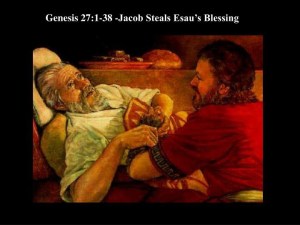
This is the account of the family line of Abraham’s son Isaac. Abraham became the father of Isaac, and Isaac was forty years old when he married Rebekah daughter of Bethuel the Aramean from Paddan Aram and sister of Laban the Aramean. Isaac prayed to the Lord on behalf of his wife, because she was childless. The Lord answered his prayer, and his wife Rebekah became pregnant. The boys grew up, and Esau became a skillful hunter, a man of the open country, while Jacob was content to stay at home among the tents. Isaac, who had a taste for wild game, loved Esau, but Rebekah loved Jacob. When Esau was forty years old, he married Judith daughter of Beeri the Hittite, and also Basemath daughter of Elon the Hittite. They were a source of grief to Isaac and Rebekah. When Isaac was old and his eyes were so weak that he could no longer see, he called for Esau his older son and said to him, “My son.” “Here I am,” he answered. Isaac said, “I am now an old man and don’t know the day of my death. Now then, get your equipment—your quiver and bow—and go out to the open country to hunt some wild game for me. Prepare me the kind of tasty food I like and bring it to me to eat, so that I may give you my blessing before I die.” Now Rebekah was listening as Isaac spoke to his son Esau. When Esau left for the open country to hunt game and bring it back, Rebekah said to her son Jacob, “Look, I overheard your father say to your brother Esau, ‘Bring me some game and prepare me some tasty food to eat, so that I may give you my blessing in the presence of the Lord before I die.’ Now, my son, listen carefully and do what I tell you: Go out to the flock and bring me two choice young goats, so I can prepare some tasty food for your father, just the way he likes it. Then take it to your father to eat, so that he may give you his blessing before he dies.” Jacob said to Rebekah his mother, “But my brother Esau is a hairy man while I have smooth skin. What if my father touches me? I would appear to be tricking him and would bring down a curse on myself rather than a blessing.” His mother said to him, “My son, let the curse fall on me. Just do what I say; go and get them for me.” So he went and got them and brought them to his mother, and she prepared some tasty food, just the way his father liked it. Then Rebekah took the best clothes of Esau her older son, which she had in the house, and put them on her younger son Jacob. She also covered his hands and the smooth part of his neck with the goatskins. Then she handed to her son Jacob the tasty food and the bread she had made. He went to his father and said, “My father.” “Yes, my son,” he answered. “Who is it?” Jacob said to his father, “I am Esau your firstborn. I have done as you told me. Please sit up and eat some of my game, so that you may give me your blessing.” Isaac asked his son, “How did you find it so quickly, my son?” “The Lord your God gave me success, ” he replied. Then Isaac said to Jacob, “Come near so I can touch you, my son, to know whether you really are my son Esau or not.” Jacob went close to his father Isaac, who touched him and said, “The voice is the voice of Jacob, but the hands are the hands of Esau.” He did not recognize him, for his hands were hairy like those of his brother Esau; so he proceeded to bless him. “Are you really my son Esau?” he asked. “I am,” he replied. Then he said, “My son, bring me some of your game to eat, so that I may give you my blessing.” Jacob brought it to him and he ate; and he brought some wine and he drank. Then his father Isaac said to him, “Come here, my son, and kiss me.” So he went to him and kissed him. When Isaac caught the smell of his clothes, he blessed him and said, “Ah, the smell of my son is like the smell of a field that the Lord has blessed. May God give you heaven’s dew and earth’s richness — an abundance of grain and new wine. May nations serve you and peoples bow down to you. Be lord over your brothers, and may the sons of your mother bow down to you. May those who curse you be cursed and those who bless you be blessed. ” After Isaac finished blessing him, and Jacob had scarcely left his father’s presence, his brother Esau came in from hunting. He too prepared some tasty food and brought it to his father. Then he said to him, “My father, please sit up and eat some of my game, so that you may give me your blessing.” His father Isaac asked him, “Who are you?” “I am your son,” he answered, “your firstborn, Esau. ” Isaac trembled violently and said, “Who was it, then, that hunted game and brought it to me? I ate it just before you came and I blessed him—and indeed he will be blessed! ” When Esau heard his father’s words, he burst out with a loud and bitter cry and said to his father, “Bless me—me too, my father!” But he said, “Your brother came deceitfully and took your blessing.” Esau said, “Isn’t he rightly named Jacob? This is the second time he has taken advantage of me: He took my birthright, and now he’s taken my blessing!” Then he asked, “Haven’t you reserved any blessing for me?” Isaac answered Esau, “I have made him lord over you and have made all his relatives his servants, and I have sustained him with grain and new wine. So what can I possibly do for you, my son?” Esau said to his father, “Do you have only one blessing, my father? Bless me too, my father!” Then Esau wept aloud. His father Isaac answered him, “Your dwelling will be away from the earth’s richness, away from the dew of heaven above. You will live by the sword and you will serve your brother. But when you grow restless, you will throw his yoke from off your neck. ” Esau held a grudge against Jacob because of the blessing his father had given him. He said to himself, “The days of mourning for my father are near; then I will kill my brother Jacob.” When Rebekah was told what her older son Esau had said, she sent for her younger son Jacob and said to him, “Your brother Esau is planning to avenge himself by killing you. Now then, my son, do what I say: Flee at once to my brother Laban in Harran. Stay with him for a while until your brother’s fury subsides. When your brother is no longer angry with you and forgets what you did to him, I’ll send word for you to come back from there. Why should I lose both of you in one day?” Then Rebekah said to Isaac, “I’m disgusted with living because of these Hittite women. If Jacob takes a wife from among the women of this land, from Hittite women like these, my life will not be worth living.” So Isaac called for Jacob and blessed him. Then he commanded him: “Do not marry a Canaanite woman. Go at once to Paddan Aram, to the house of your mother’s father Bethuel. Take a wife for yourself there, from among the daughters of Laban, your mother’s brother. May God Almighty bless you and make you fruitful and increase your numbers until you become a community of peoples. May he give you and your descendants the blessing given to Abraham, so that you may take possession of the land where you now reside as a foreigner, the land God gave to Abraham.” Then Isaac sent Jacob on his way, and he went to Paddan Aram, to Laban son of Bethuel the Aramean, the brother of Rebekah, who was the mother of Jacob and Esau. Now Esau learned that Isaac had blessed Jacob and had sent him to Paddan Aram to take a wife from there, and that when he blessed him he commanded him, “Do not marry a Canaanite woman,” and that Jacob had obeyed his father and mother and had gone to Paddan Aram. Esau then realized how displeasing the Canaanite women were to his father Isaac; so he went to Ishmael and married Mahalath, the sister of Nebaioth and daughter of Ishmael son of Abraham, in addition to the wives he already had.
Genesis 25:19-21,27-28,26:34-28:9

Dear God, I don’t know enough about these boys to judge what Isaac and Rebekah did here. Just how bad were these two wives of Esau? Just how difficult was Esau? On the other side, Jacob seems spoiled and soft. Was he really worthy of the blessing. And then you have the prophecy given to Rebekah about the boys. Did Jacob have a special place in her heart from that?

As for focusing on Isaac, there are a couple of remarkable things here. First, Esau seemed to make him more proud from a manly standpoint. The boy can hunt and be tough. The other likes to stay home. I wonder if you considered that Jacob was spoiled because his time with Laban later certainly taught him hard work. He learned how to get out beyond the tents. He learned to suffer.

I talked with my sister recently about our children suffering and how hard it can be to allow it. But the struggle is what teaches us. The struggle is what makes us stronger. Yet, as parents, we tend to short circuit those lessons by intervening to make things easier. I wonder how much Isaac might have done that for Jacob.

I also think it is interesting to see how much Rebekah manipulated and lied to Isaac. She not only participated in the blessing deception, but she also lied to Isaac about why they should send Jacob to Laban (or she at the least didn’t tell him the entire reason). Was Isaac too old to make that kind of judgment? Would Isaac have said that Jacob needs to face his brother and Rebekah didn’t want him to?

Father, parenting has never been easy and it never will be. We just don’t know how to respond to these people that walk around with free will. They are the products of our parenting and examples (good and bad), life circumstances that they witness and experience, and then that strange internal structure that causes them to respond to all of this in the way that only they will. And our job is to somehow guide them into being the best possible version of themselves. Through that lens, it seems impossible. So help me to see what I really need to be doing with and for my children and what I need to not do. Be with them in ways I cannot. And help me to continue to grow into the man, husband, and father you need me to be.

In Jesus’s name I pray,

Amen

 
Leave a comment

Posted by on January 6, 2020 in Fathers of the Bible, Genesis


Tags: , , ,