RSS

Category Archives: Revealed: A Storybook Bible for Grown-Ups

Passion Week – The Crucifixion: John 19:23-30 / “Thief” by Third Day

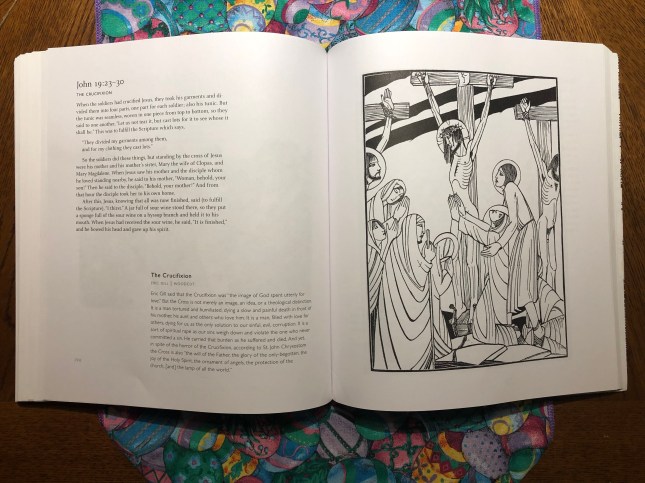
The above image is from Revealed: A Storybook Bible for Grown-Ups by Ned Bustard. The image itself is called “The Crucifixion” as was created by Eric Gill.

John 19:23-30 [ESV]
When the soldiers had crucified Jesus, they took his garments and divided them into four parts, one part for each soldier; also his tunic. But the tunic was seamless, woven in one piece from top to bottom, so they said to one another, “Let us not tear it, but cast lots for it to see whose it shall be.” This was to fulfill the Scripture which says, “They divided my garments among them, and for my clothing they cast lots.” So the soldiers did these things, but standing by the cross of Jesus were his mother and his mother’s sister, Mary the wife of Clopas, and Mary Magdalene. When Jesus saw his mother and the disciple whom he loved standing nearby, he said to his mother, “Woman, behold, your son!” Then he said to the disciple, “Behold, your mother!” And from that hour the disciple took her to his own home. After this, Jesus, knowing that all was now finished, said ( to fulfill the Scripture), “I thirst.” A jar full of sour wine stood there, so they put a sponge full of the sour wine on a hyssop branch and held it to his mouth. When Jesus had received the sour wine, he said, “It is finished,” and he bowed his head and gave up his spirit.

Dear God, I spent some time with this image this morning before I left town for the day, and I’ve thought about it a lot since then. Now, its late in the evening and my wife has gone to bed. I have some time to really sit with it and consider what Eric Gill wanted to share.

  • Jesus is obviously the focus of the image. He has the halo around him that Catholics and some others put around Saints and the Holy Family. He looks thin. He has his thorn of crowns. He is totally naked, but Gill gives him some modesty by covering him with someone’s outstretched hands. Could this be Jesus’s mother helping to cover her boy?
  • It appears that three women have the halo as well. One has her face hidden and the other two are shown. Is this Gill showing us Mary, Jesus’ mother, Mary’s sister, and Mary Magdalene?
  • There is one man in the picture. Is this John? He is standing near the three women, so I would say it is probably John, readying to take care of Jesus’s mother.
  • Oh, there are two other men in the picture too. One is on the cross on the left and the other on the right. The one on the left is only shone by his face, but he has the Saint halo. There are five haloed people in this image, and he is one of them. The other man on the cross is shown not only with no halo, but his nakedness is shown as well. Gill allowed Jesus and the other dying man some modesty, but to the man who mocked Jesus Gill gave a complete humiliation.
  • Gill included the writing at the top of Jesus’s cross, and he gives us the version of the cross that looks more like a capital “T” than a lowercase “t.”

Last night, I sat with the image of the last supper. Now, this image shows the culmination of what happened over the next 18 hours. It happened that fast. No due process. No jury of peers. Just humiliation and death.

I was talking with my dad this evening about how sometimes the plan we would lay out on paper is the wrong plan, and the plan that will accomplish your actual will looks terrible on paper. I would say that this whole thing with Jesus is a prime example of that.

Then there is the haloed man on the cross to Jesus’s right. While I was driving today, I heard a song I hadn’t heard in about 20 years. It’s called “Thief” and is by Third Day.

“Thief” by Third Day

I am a thief, I am a murderer
Walking up this lonely hill
What have I done? No, I don’t remember
No one knows just how I feel
And I know that my time is coming soon

It’s been so long, oh, such a long time
Since lived with peace and rest
Now I am here, my destination
I guess things work for the best
And I know that my time is coming soon

Who is this man? This man beside me
They call the King of the Jews
They don’t believe that He’s the Messiah
But somehow, I know that it’s true

They laugh at Him in mockery
And they beat Him ’til He bleeds
And they nail Him to the rugged cross
They raise Him, yeah, they raise Him up next to me

My time has come and I’m slowly fading
I deserve what I receive
Jesus when You are in Your kingdom
Could You please, please remember me?

And He looks at me still holding on
The tears fall from His eyes
And He says I tell the truth
Today, you will be with Me in paradise

And I know that my time, yes my time is coming soon
And I know that my time, yes my time, is coming soon
And I know Paradise, Paradise is coming soon

Songwriters: Bradley B. C. Avery / David Carr / Johnny Mac Powell / Mark D. Lee / Samuel Tai Anderson

Father, in the end, so much happened in 18 hours. The world changed in 18 hours. All of human time and space changed in 18 hours. Mercy came to the world in those 18 hours. And the plan looked absolutely terrible on paper, but it’s exactly what we needed. We needed our Passover Lamb. I needed a Passover Lamb. I needed mercy. I needed grace. I needed freedom. And the sacrifice all came in these 18 hours. But at this point on that Friday night, the plan looked like it had all fallen apart. We just never know what you’re up to. They didn’t know it then, and I don’t know it now. But I trust you.

In Jesus’s name I pray,

Amen


Tags: , , , , , ,

Passion Week – The Last Supper: Matthew, Mark, Luke & John

The above image is from Revealed: A Storybook Bible for Grown-Ups by Ned Bustard. The image itself is called “Bitter Herbs” and was created by Tanja Butler.

MATTHEW

Matthew 26:20-35
When it was evening, he reclined at table with the twelve. And as they were eating, he said, “Truly, I say to you, one of you will betray me.” And they were very sorrowful and began to say to him one after another, “Is it I, Lord?” He answered, “He who has dipped his hand in the dish with me will betray me. 24 The Son of Man goes as it is written of him, but woe to that man by whom the Son of Man is betrayed! It would have been better for that man if he had not been born.” Judas, who would betray him, answered, “Is it I, Rabbi?” He said to him, “You have said so.” Now as they were eating, Jesus took bread, and after blessing it broke it and gave it to the disciples, and said, “Take, eat; this is my body.” And he took a cup, and when he had given thanks he gave it to them, saying, “Drink of it, all of you, 28 for this is my blood of the covenant, which is poured out for many for the forgiveness of sins. 29 I tell you I will not drink again of this fruit of the vine until that day when I drink it new with you in my Father’s kingdom.” And when they had sung a hymn, they went out to the Mount of Olives. Then Jesus said to them, “You will all fall away because of me this night. For it is written, ‘I will strike the shepherd, and the sheep of the flock will be scattered.’ 32 But after I am raised up, I will go before you to Galilee.” Peter answered him, “Though they all fall away because of you, I will never fall away.” Jesus said to him, “Truly, I tell you, this very night, before the rooster crows, you will deny me three times.” Peter said to him, “Even if I must die with you, I will not deny you!” And all the disciples said the same.

MARK

Mark 14:17-31
And when it was evening, he came with the twelve. And as they were reclining at table and eating, Jesus said, “Truly, I say to you, one of you will betray me, one who is eating with me.” They began to be sorrowful and to say to him one after another, “Is it I?” He said to them, “It is one of the twelve, one who is dipping bread into the dish with me. 21 For the Son of Man goes as it is written of him, but woe to that man by whom the Son of Man is betrayed! It would have been better for that man if he had not been born.” And as they were eating, he took bread, and after blessing it broke it and gave it to them, and said, “Take; this is my body.” And he took a cup, and when he had given thanks he gave it to them, and they all drank of it. And he said to them, “This is my blood of the covenant, which is poured out for many. 25 Truly, I say to you, I will not drink again of the fruit of the vine until that day when I drink it new in the kingdom of God.” And when they had sung a hymn, they went out to the Mount of Olives. And Jesus said to them, “You will all fall away, for it is written, ‘I will strike the shepherd, and the sheep will be scattered.’ 28 But after I am raised up, I will go before you to Galilee.” Peter said to him, “Even though they all fall away, I will not.” And Jesus said to him, “Truly, I tell you, this very night, before the rooster crows twice, you will deny me three times.” But he said emphatically, “If I must die with you, I will not deny you.” And they all said the same.

LUKE

Luke 22:14-38
And when the hour came, he reclined at table, and the apostles with him. And he said to them, “I have earnestly desired to eat this Passover with you before I suffer. 16 For I tell you I will not eat it until it is fulfilled in the kingdom of God.” And he took a cup, and when he had given thanks he said, “Take this, and divide it among yourselves. 18 For I tell you that from now on I will not drink of the fruit of the vine until the kingdom of God comes.” And he took bread, and when he had given thanks, he broke it and gave it to them, saying, “This is my body, which is given for you. Do this in remembrance of me.” And likewise the cup after they had eaten, saying, “This cup that is poured out for you is the new covenant in my blood. 21 But behold, the hand of him who betrays me is with me on the table. 22 For the Son of Man goes as it has been determined, but woe to that man by whom he is betrayed!” And they began to question one another, which of them it could be who was going to do this. A dispute also arose among them, as to which of them was to be regarded as the greatest. And he said to them, “The kings of the Gentiles exercise lordship over them, and those in authority over them are called benefactors. 26 But not so with you. Rather, let the greatest among you become as the youngest, and the leader as one who serves. 27 For who is the greater, one who reclines at table or one who serves? Is it not the one who reclines at table? But I am among you as the one who serves. 28 “You are those who have stayed with me in my trials, 29 and I assign to you, as my Father assigned to me, a kingdom, 30 that you may eat and drink at my table in my kingdom and sit on thrones judging the twelve tribes of Israel. 31 “Simon, Simon, behold, Satan demanded to have you, that he might sift you like wheat, 32 but I have prayed for you that your faith may not fail. And when you have turned again, strengthen your brothers.” Peter said to him, “Lord, I am ready to go with you both to prison and to death.” Jesus said, “I tell you, Peter, the rooster will not crow this day, until you deny three times that you know me.” And he said to them, “When I sent you out with no moneybag or knapsack or sandals, did you lack anything?” They said, “Nothing.” He said to them, “But now let the one who has a moneybag take it, and likewise a knapsack. And let the one who has no sword sell his cloak and buy one. 37 For I tell you that this Scripture must be fulfilled in me: ‘And he was numbered with the transgressors.’ For what is written about me has its fulfillment.” And they said, “Look, Lord, here are two swords.” And he said to them, “It is enough.”

JOHN

John 13-17
Now before the Feast of the Passover, when Jesus knew that his hour had come to depart out of this world to the Father, having loved his own who were in the world, he loved them to the end. During supper, when the devil had already put it into the heart of Judas Iscariot, Simon’s son, to betray him, Jesus, knowing that the Father had given all things into his hands, and that he had come from God and was going back to God, rose from supper. He laid aside his outer garments, and taking a towel, tied it around his waist. Then he poured water into a basin and began to wash the disciples’ feet and to wipe them with the towel that was wrapped around him. He came to Simon Peter, who said to him, “Lord, do you wash my feet?” Jesus answered him, “What I am doing you do not understand now, but afterward you will understand.” Peter said to him, “You shall never wash my feet.” Jesus answered him, “If I do not wash you, you have no share with me.” Simon Peter said to him, “Lord, not my feet only but also my hands and my head!” Jesus said to him, “The one who has bathed does not need to wash, except for his feet, but is completely clean. And you are clean, but not every one of you.” For he knew who was to betray him; that was why he said, “Not all of you are clean.” When he had washed their feet and put on his outer garments and resumed his place, he said to them, “Do you understand what I have done to you? 13 You call me Teacher and Lord, and you are right, for so I am. 14 If I then, your Lord and Teacher, have washed your feet, you also ought to wash one another’s feet. 15 For I have given you an example, that you also should do just as I have done to you. 16 Truly, truly, I say to you, a servant is not greater than his master, nor is a messenger greater than the one who sent him. 17 If you know these things, blessed are you if you do them. 18 I am not speaking of all of you; I know whom I have chosen. But the Scripture will be fulfilled, ‘He who ate my bread has lifted his heel against me.’ 19 I am telling you this now, before it takes place, that when it does take place you may believe that I am he. 20 Truly, truly, I say to you, whoever receives the one I send receives me, and whoever receives me receives the one who sent me.” After saying these things, Jesus was troubled in his spirit, and testified, “Truly, truly, I say to you, one of you will betray me.” The disciples looked at one another, uncertain of whom he spoke. One of his disciples, whom Jesus loved, was reclining at table at Jesus’ side, so Simon Peter motioned to him to ask Jesus of whom he was speaking. So that disciple, leaning back against Jesus, said to him, “Lord, who is it?” Jesus answered, “It is he to whom I will give this morsel of bread when I have dipped it.” So when he had dipped the morsel, he gave it to Judas, the son of Simon Iscariot. Then after he had taken the morsel, Satan entered into him. Jesus said to him, “What you are going to do, do quickly.” Now no one at the table knew why he said this to him. Some thought that, because Judas had the moneybag, Jesus was telling him, “Buy what we need for the feast,” or that he should give something to the poor. So, after receiving the morsel of bread, he immediately went out. And it was night. When he had gone out, Jesus said, “Now is the Son of Man glorified, and God is glorified in him. 32 If God is glorified in him, God will also glorify him in himself, and glorify him at once. 33 Little children, yet a little while I am with you. You will seek me, and just as I said to the Jews, so now I also say to you, ‘Where I am going you cannot come.’ 34 A new commandment I give to you, that you love one another: just as I have loved you, you also are to love one another. 35 By this all people will know that you are my disciples, if you have love for one another.” Simon Peter said to him, “Lord, where are you going?” Jesus answered him, “Where I am going you cannot follow me now, but you will follow afterward.” Peter said to him, “Lord, why can I not follow you now? I will lay down my life for you.” Jesus answered, “Will you lay down your life for me? Truly, truly, I say to you, the rooster will not crow till you have denied me three times. 14 “Let not your hearts be troubled. Believe in God; believe also in me. 2 In my Father’s house are many rooms. If it were not so, would I have told you that I go to prepare a place for you? 3 And if I go and prepare a place for you, I will come again and will take you to myself, that where I am you may be also. 4 And you know the way to where I am going.” Thomas said to him, “Lord, we do not know where you are going. How can we know the way?” Jesus said to him, “I am the way, and the truth, and the life. No one comes to the Father except through me. 7 If you had known me, you would have known my Father also. From now on you do know him and have seen him.” Philip said to him, “Lord, show us the Father, and it is enough for us.” Jesus said to him, “Have I been with you so long, and you still do not know me, Philip? Whoever has seen me has seen the Father. How can you say, ‘Show us the Father’? 10 Do you not believe that I am in the Father and the Father is in me? The words that I say to you I do not speak on my own authority, but the Father who dwells in me does his works. 11 Believe me that I am in the Father and the Father is in me, or else believe on account of the works themselves. 12 “Truly, truly, I say to you, whoever believes in me will also do the works that I do; and greater works than these will he do, because I am going to the Father. 13 Whatever you ask in my name, this I will do, that the Father may be glorified in the Son. 14 If you ask me anything in my name, I will do it. 15 “If you love me, you will keep my commandments. 16 And I will ask the Father, and he will give you another Helper, to be with you forever, 17 even the Spirit of truth, whom the world cannot receive, because it neither sees him nor knows him. You know him, for he dwells with you and will be in you. 18 “I will not leave you as orphans; I will come to you. 19 Yet a little while and the world will see me no more, but you will see me. Because I live, you also will live. 20 In that day you will know that I am in my Father, and you in me, and I in you. 21 Whoever has my commandments and keeps them, he it is who loves me. And he who loves me will be loved by my Father, and I will love him and manifest myself to him.” Judas (not Iscariot) said to him, “Lord, how is it that you will manifest yourself to us, and not to the world?” Jesus answered him, “If anyone loves me, he will keep my word, and my Father will love him, and we will come to him and make our home with him. 24 Whoever does not love me does not keep my words. And the word that you hear is not mine but the Father’s who sent me. 25 “These things I have spoken to you while I am still with you. 26 But the Helper, the Holy Spirit, whom the Father will send in my name, he will teach you all things and bring to your remembrance all that I have said to you. 27 Peace I leave with you; my peace I give to you. Not as the world gives do I give to you. Let not your hearts be troubled, neither let them be afraid. 28 You heard me say to you, ‘I am going away, and I will come to you.’ If you loved me, you would have rejoiced, because I am going to the Father, for the Father is greater than I. 29 And now I have told you before it takes place, so that when it does take place you may believe. 30 I will no longer talk much with you, for the ruler of this world is coming. He has no claim on me, 31 but I do as the Father has commanded me, so that the world may know that I love the Father. Rise, let us go from here. 15 “I am the true vine, and my Father is the vinedresser. 2 Every branch in me that does not bear fruit he takes away, and every branch that does bear fruit he prunes, that it may bear more fruit. 3 Already you are clean because of the word that I have spoken to you. 4 Abide in me, and I in you. As the branch cannot bear fruit by itself, unless it abides in the vine, neither can you, unless you abide in me. 5 I am the vine; you are the branches. Whoever abides in me and I in him, he it is that bears much fruit, for apart from me you can do nothing. 6 If anyone does not abide in me he is thrown away like a branch and withers; and the branches are gathered, thrown into the fire, and burned. 7 If you abide in me, and my words abide in you, ask whatever you wish, and it will be done for you. 8 By this my Father is glorified, that you bear much fruit and so prove to be my disciples. 9 As the Father has loved me, so have I loved you. Abide in my love. 10 If you keep my commandments, you will abide in my love, just as I have kept my Father’s commandments and abide in his love. 11 These things I have spoken to you, that my joy may be in you, and that your joy may be full. 12 “This is my commandment, that you love one another as I have loved you. 13 Greater love has no one than this, that someone lay down his life for his friends. 14 You are my friends if you do what I command you. 15 No longer do I call you servants, for the servant does not know what his master is doing; but I have called you friends, for all that I have heard from my Father I have made known to you. 16 You did not choose me, but I chose you and appointed you that you should go and bear fruit and that your fruit should abide, so that whatever you ask the Father in my name, he may give it to you. 17 These things I command you, so that you will love one another. 18 “If the world hates you, know that it has hated me before it hated you. 19 If you were of the world, the world would love you as its own; but because you are not of the world, but I chose you out of the world, therefore the world hates you. 20 Remember the word that I said to you: ‘A servant is not greater than his master.’ If they persecuted me, they will also persecute you. If they kept my word, they will also keep yours. 21 But all these things they will do to you on account of my name, because they do not know him who sent me. 22 If I had not come and spoken to them, they would not have been guilty of sin, but now they have no excuse for their sin. 23 Whoever hates me hates my Father also. 24 If I had not done among them the works that no one else did, they would not be guilty of sin, but now they have seen and hated both me and my Father. 25 But the word that is written in their Law must be fulfilled: ‘They hated me without a cause.’ 26 “But when the Helper comes, whom I will send to you from the Father, the Spirit of truth, who proceeds from the Father, he will bear witness about me. 27 And you also will bear witness, because you have been with me from the beginning. 16 “I have said all these things to you to keep you from falling away. 2 They will put you out of the synagogues. Indeed, the hour is coming when whoever kills you will think he is offering service to God. 3 And they will do these things because they have not known the Father, nor me. 4 But I have said these things to you, that when their hour comes you may remember that I told them to you. “I did not say these things to you from the beginning, because I was with you. 5 But now I am going to him who sent me, and none of you asks me, ‘Where are you going?’ 6 But because I have said these things to you, sorrow has filled your heart. 7 Nevertheless, I tell you the truth: it is to your advantage that I go away, for if I do not go away, the Helper will not come to you. But if I go, I will send him to you. 8 And when he comes, he will convict the world concerning sin and righteousness and judgment: 9 concerning sin, because they do not believe in me; 10 concerning righteousness, because I go to the Father, and you will see me no longer; 11 concerning judgment, because the ruler of this world is judged. 12 “I still have many things to say to you, but you cannot bear them now. 13 When the Spirit of truth comes, he will guide you into all the truth, for he will not speak on his own authority, but whatever he hears he will speak, and he will declare to you the things that are to come. 14 He will glorify me, for he will take what is mine and declare it to you. 15 All that the Father has is mine; therefore I said that he will take what is mine and declare it to you. 16 “A little while, and you will see me no longer; and again a little while, and you will see me.” So some of his disciples said to one another, “What is this that he says to us, ‘A little while, and you will not see me, and again a little while, and you will see me’; and, ‘because I am going to the Father’?” So they were saying, “What does he mean by ‘a little while’? We do not know what he is talking about.” Jesus knew that they wanted to ask him, so he said to them, “Is this what you are asking yourselves, what I meant by saying, ‘A little while and you will not see me, and again a little while and you will see me’? 20 Truly, truly, I say to you, you will weep and lament, but the world will rejoice. You will be sorrowful, but your sorrow will turn into joy. 21 When a woman is giving birth, she has sorrow because her hour has come, but when she has delivered the baby, she no longer remembers the anguish, for joy that a human being has been born into the world. 22 So also you have sorrow now, but I will see you again, and your hearts will rejoice, and no one will take your joy from you. 23 In that day you will ask nothing of me. Truly, truly, I say to you, whatever you ask of the Father in my name, he will give it to you. 24 Until now you have asked nothing in my name. Ask, and you will receive, that your joy may be full. 25 “I have said these things to you in figures of speech. The hour is coming when I will no longer speak to you in figures of speech but will tell you plainly about the Father. 26 In that day you will ask in my name, and I do not say to you that I will ask the Father on your behalf; 27 for the Father himself loves you, because you have loved me and have believed that I came from God. 28 I came from the Father and have come into the world, and now I am leaving the world and going to the Father.” His disciples said, “Ah, now you are speaking plainly and not using figurative speech! Now we know that you know all things and do not need anyone to question you; this is why we believe that you came from God.” Jesus answered them, “Do you now believe? 32 Behold, the hour is coming, indeed it has come, when you will be scattered, each to his own home, and will leave me alone. Yet I am not alone, for the Father is with me. 33 I have said these things to you, that in me you may have peace. In the world you will have tribulation. But take heart; I have overcome the world.” When Jesus had spoken these words, he lifted up his eyes to heaven, and said, “Father, the hour has come; glorify your Son that the Son may glorify you, 2 since you have given him authority over all flesh, to give eternal life to all whom you have given him. 3 And this is eternal life, that they know you, the only true God, and Jesus Christ whom you have sent. 4 I glorified you on earth, having accomplished the work that you gave me to do. 5 And now, Father, glorify me in your own presence with the glory that I had with you before the world existed. 6 “I have manifested your name to the people whom you gave me out of the world. Yours they were, and you gave them to me, and they have kept your word. 7 Now they know that everything that you have given me is from you. 8 For I have given them the words that you gave me, and they have received them and have come to know in truth that I came from you; and they have believed that you sent me. 9 I am praying for them. I am not praying for the world but for those whom you have given me, for they are yours. 10 All mine are yours, and yours are mine, and I am glorified in them. 11 And I am no longer in the world, but they are in the world, and I am coming to you. Holy Father, keep them in your name, which you have given me, that they may be one, even as we are one. 12 While I was with them, I kept them in your name, which you have given me. I have guarded them, and not one of them has been lost except the son of destruction, that the Scripture might be fulfilled. 13 But now I am coming to you, and these things I speak in the world, that they may have my joy fulfilled in themselves. 14 I have given them your word, and the world has hated them because they are not of the world, just as I am not of the world. 15 I do not ask that you take them out of the world, but that you keep them from the evil one. 16 They are not of the world, just as I am not of the world. 17 Sanctify them in the truth; your word is truth. 18 As you sent me into the world, so I have sent them into the world. 19 And for their sake I consecrate myself, that they also may be sanctified in truth. 20 “I do not ask for these only, but also for those who will believe in me through their word, 21 that they may all be one, just as you, Father, are in me, and I in you, that they also may be in us, so that the world may believe that you have sent me. 22 The glory that you have given me I have given to them, that they may be one even as we are one, 23 I in them and you in me, that they may become perfectly one, so that the world may know that you sent me and loved them even as you loved me. 24 Father, I desire that they also, whom you have given me, may be with me where I am, to see my glory that you have given me because you loved me before the foundation of the world. 25 O righteous Father, even though the world does not know you, I know you, and these know that you have sent me. 26 I made known to them your name, and I will continue to make it known, that the love with which you have loved me may be in them, and I in them.”

Dear God, it’s Maundy Thursday. I thought I would spend some time with all four Gospels and how they tell the story of The Last Supper. Keeping with the theme of the synoptic Gospels (Matthew, Mark, and Luke) vs. John’s Gospel, the first three tellings of the story are quite similar and John’s is much more detailed. Judas’s betrayal and Peter’s denial makes all four stories, as does the breaking of the bread and pouring of the wine. Luke gives us the part about selling cloaks for swords (very odd and controversial), but John really goes off and captures Jesus’ mood in a different way. The washing of feet. The teaching that happened.

As I look at the image “Bitter Herbs” created by Tanja Butler, Jesus is at the head of the table, and Judas is at the end, looking away. Bustard says of the image, “In this print, Christ offers Judas bread with his own hand, a gift the defecting disciple receives with a distracted mind and heart.” That’s not how it hits me. I see it as Judas not being able to look Jesus in the eye. Everyone else has their attention on Jesus–either on his face or his hands. But Judas has to look away.

I honestly don’t know how Jesus even got through this evening. This meal. This last time with his disciples. This last moment before great pain and suffering. But meals can be bonding.

I happened to read a great article this evening that my son pointed out to me. It was about how Gregg Popovich of the San Antonio Spurs uses food and wine to build his team into a family. It was a great piece that I read out loud to my wife and then forwarded to several people. I wonder how many meals these men, these 12, shared like this.

I could go on an on. I could talk about all of the things that Jesus said in John as he tried to leave them with one last piece of himself. But at the end of the day, this meal is about relationship. Eleven men are in as much relationship with Jesus as they can humanly be, while one knows it’s already too late. Thankfully for the first 11, even though Jesus tries to warn them, they are not completely aware of what the next 18 hours holds.

Father, thank you for providing a Passover Lamb for me. Thank you for giving my home blood on the doorpost and causing the angel of death to pass over it (with my “home” being my body). I can never fully appreciate what happened this night nearly 2,000 years ago, but to the extent that I can, I am very grateful that the fruits of it have poured all of the way down to me.

In Jesus’s name I pray,

Amen


Tags: ,

Passion Week – Killing the Master’s Son: Matthew 21:33-41

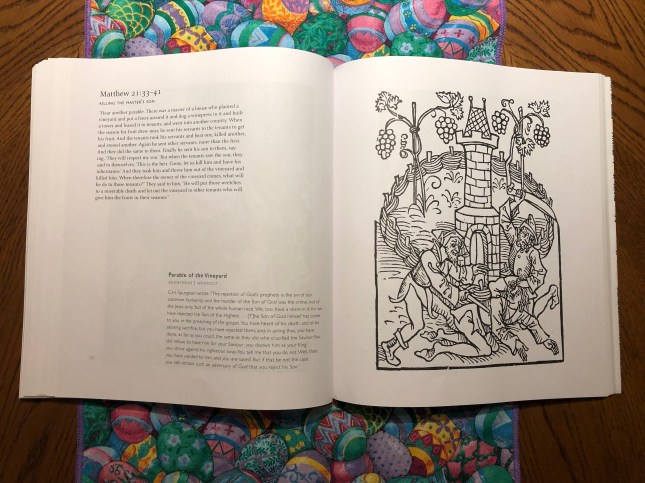
The image above is from Revealed: A Storybook Bible for Grown-Ups by Ned Bustard. The image is called “Parable of the Vineyard” and was created by Anonymous.

Matthew 21:33-41 [ESV]

33 “Hear another parable. There was a master of a house who planted a vineyard and put a fence around it and dug a winepress in it and built a tower and leased it to tenants, and went into another country. 34 When the season for fruit drew near, he sent his servants to the tenants to get his fruit. 35 And the tenants took his servants and beat one, killed another, and stoned another. 36 Again he sent other servants, more than the first. And they did the same to them. 37 Finally he sent his son to them, saying, ‘They will respect my son.’ 38 But when the tenants saw the son, they said to themselves, ‘This is the heir. Come, let us kill him and have his inheritance.’ 39 And they took him and threw him out of the vineyard and killed him. 40 When therefore the owner of the vineyard comes, what will he do to those tenants?” They said to him, “He will put those wretches to a miserable death and let out the vineyard to other tenants who will give him the fruits in their seasons.”

Dear God, one question I’m asking myself this morning that I’ve never asked before is, Why do we do it? As I look at this image of the two men beating and killing the son, I wonder about their motivation. It’s interesting that the artist drew them as being more in “Robin Hood” times than biblical times, but the question still remains: Why?

What do we think we will gain by kicking you out of our world and running it ourselves? Bringing it down to the personal level, what do I think I will gain by kicking you out of my life rather than living it under your authority? I suppose it comes down to instant gratification that ultimately kills vs. the idea that you might call me to delay my gratification or to never experience gratification at all. It’s easy to judge others and our society as a whole, but how am I doing with the vineyard of my own life that you have leased to me? When you come, do I embrace you or snuff you out?

I have been thinking about the burning of Notre Dame Cathedral in Paris yesterday. I know it is Easter week and a lot of people will make their once-a-year visit to church on Sunday, but I wonder how many more will be shaken by this sad tragedy. How many vineyard workers will be shocked into realizing that they have taken the master for granted. It makes me think of Congress standing on the capitol steps in September 2001 and singing “God Bless America” together. Will this shocking even that damaged something we have taken for granted for nearly 900 years remind us to worship you? Will you use this to call some of us home?

Father, remind me that all of this starts with me. I’m not here to judge anyone else. I’m not here to try and list the people I think have rejected your authority over their lives. I’m here to look in the mirror. I’m here to ask your forgiveness. I’m sorry for being a poor tenant and acting like the landowner instead. You are my God. This life I’m living is your life. Help me to be the steward of it that you need me to be.

In Jesus’s name I pray,

Amen
 

Tags: , , ,

Passion Week – Cleansing the Temple: Matthew 21:12-17


The image above is from Revealed: A Storybook Bible for Grown-Ups by Ned Bustard. The image was created by Albrecht Durer and is called “Christ Driving the Moneylenders from the Temple.”

Matthew 21:12-17

And Jesus entered the temple and drove out all who sold and bought in the temple, and he overturned the tables of the money-changers and the seats of those who sold pigeons. He said to them, “It is written, ‘My house shall be called a house of prayer,’ but you make it a den of robbers.” And the blind and the lame came to him in the temple, and he healed them. But when the chief priests and the scribes saw the wonderful things that he did, and the children crying out in the temple, “Hosanna to the Son of David!” they were indignant, and they said to him, “Do you hear what these are saying?” And Jesus said to them, “Yes; have you never read, “‘Out of the mouth of infants and nursing babies you have prepared praise’?” And leaving them, he went out of the city to Bethany and lodged there.

Dear God, I’ve read this story and heard about this story so many times that it can be hard to come at it fresh. But this image from Mr. Durer helps a little. There are some striking things about it:

  • Jesus is holding a whip. It’s different than the one that will be used on him later in the week, but it’s interesting to see a violent Jesus. Is there a time and a place for violence?
  • The man on the ground seems to be knocked out or incapacitated in some way. I know this is just the artist’s rendition, but it’s an interesting thought as to what extent of physical damage Jesus did.
  • There is a man holding a lamb. People were there to get what they needed for the Passover. Jesus would become their lamb. In fact, in reality, there would become no need for these things again. It makes me wonder what the disciples did for the Passover in the y ears to come. Did they still follow all of the Jewish rituals? I’ll be they did.
  • I think I see a Pharisee’s hat way in the background on the right.
  • Jesus is very heavily clothed. I don’t normally picture him with that much clothing.
  • The artist decided that Jesus was right-handed. I wonder if he really was.

Here i what the author of the book had to say about this image:

in contrast to Late Gothic depictions of a delicate or fragile Christ, in this piece, Durer created an intense, militant, and manly Christ. A modern Jesus would politely ask the money changers to leave. But that is not the Jesus of Scripture. He forcefully drives the money changers out, overturning tables and throwing seats. Jesus acts in this audacious manner because he knows he owns the temple. He is defending his place in the same way a home owner would defend his own house. Jesus is violent, defiant, and takes into his own hands the removal of those who desecrate the temple. This work was part of a larger series of prints called The Small Passion, and was quite relevant to the time. A Christ who as fighting for holiness rang true with young Reformers.

I guess the thing that I would also add is that this is the beginning of a violent week. Jesus is very intense in his emotion and his passion (little “p”). He only has a little bit of time left and there isn’t any to waste.

Father, help me to not grieve you the way these moneychangers grieved you. As I raise money for a nonprofit, help me to aspire to the best parts of philanthropy and not manipulate people for my own purposes. During this Passion Week, help me to be very mindful of who you are, what you did, and what that means to me today. Help me to worship you well and follow your leading.

In Jesus’s name I pray,

Amen


Tags: , , , ,

Passion Week – The Triumphal Entry: Matthew 21:1-11; Mark 11:1-11; Luke 19:28-44; John 12:12-16

The image above is from Revealed: A Storybook Bible for Grown-Ups by Ned Bustard. The image is called “The Triumphal Entry” and was created by Diego Jourdan Pereira.

Matthew 21:1-11

As Jesus and the disciples approached Jerusalem, they came to the town of Bethphage on the Mount of Olives. Jesus sent two of them on ahead. “Go into the village over there,” he said. “As soon as you enter it, you will see a donkey tied there, with its colt beside it. Untie them and bring them to me. If anyone asks what you are doing, just say, ‘The Lord needs them,’ and he will immediately let you take them.” This took place to fulfill the prophecy that said, “Tell the people of Jerusalem, ‘Look, your King is coming to you. He is humble, riding on a donkey— riding on a donkey’s colt.’” The two disciples did as Jesus commanded. They brought the donkey and the colt to him and threw their garments over the colt, and he sat on it. Most of the crowd spread their garments on the road ahead of him, and others cut branches from the trees and spread them on the road. Jesus was in the center of the procession, and the people all around him were shouting, “Praise God for the Son of David! Blessings on the one who comes in the name of the Lord! Praise God in highest heaven!” The entire city of Jerusalem was in an uproar as he entered. “Who is this?” they asked. And the crowds replied, “It’s Jesus, the prophet from Nazareth in Galilee.”

Mark 11:1-11

As Jesus and his disciples approached Jerusalem, they came to the towns of Bethphage and Bethany on the Mount of Olives. Jesus sent two of them on ahead. “Go into that village over there,” he told them. “As soon as you enter it, you will see a young donkey tied there that no one has ever ridden. Untie it and bring it here. If anyone asks, ‘What are you doing?’ just say, ‘The Lord needs it and will return it soon.’” The two disciples left and found the colt standing in the street, tied outside the front door. As they were untying it, some bystanders demanded, “What are you doing, untying that colt?” They said what Jesus had told them to say, and they were permitted to take it. Then they brought the colt to Jesus and threw their garments over it, and he sat on it. Many in the crowd spread their garments on the road ahead of him, and others spread leafy branches they had cut in the fields. Jesus was in the center of the procession, and the people all around him were shouting, “Praise God! Blessings on the one who comes in the name of the Lord! Blessings on the coming Kingdom of our ancestor David! Praise God in highest heaven!” So Jesus came to Jerusalem and went into the Temple. After looking around carefully at everything, he left because it was late in the afternoon. Then he returned to Bethany with the twelve disciples.

Luke 19:28-44

After telling this story, Jesus went on toward Jerusalem, walking ahead of his disciples. As he came to the towns of Bethphage and Bethany on the Mount of Olives, he sent two disciples ahead. “Go into that village over there,” he told them. “As you enter it, you will see a young donkey tied there that no one has ever ridden. Untie it and bring it here. If anyone asks, ‘Why are you untying that colt?’ just say, ‘The Lord needs it.’” So they went and found the colt, just as Jesus had said. And sure enough, as they were untying it, the owners asked them, “Why are you untying that colt?” And the disciples simply replied, “The Lord needs it.” So they brought the colt to Jesus and threw their garments over it for him to ride on. As he rode along, the crowds spread out their garments on the road ahead of him. When he reached the place where the road started down the Mount of Olives, all of his followers began to shout and sing as they walked along, praising God for all the wonderful miracles they had seen. “Blessings on the King who comes in the name of the Lord! Peace in heaven, and glory in highest heaven!” But some of the Pharisees among the crowd said, “Teacher, rebuke your followers for saying things like that!” He replied, “If they kept quiet, the stones along the road would burst into cheers!” But as he came closer to Jerusalem and saw the city ahead, he began to weep. “How I wish today that you of all people would understand the way to peace. But now it is too late, and peace is hidden from your eyes. Before long your enemies will build ramparts against your walls and encircle you and close in on you from every side. They will crush you into the ground, and your children with you. Your enemies will not leave a single stone in place, because you did not recognize it when God visited you.”

John 12:12-16

The next day, the news that Jesus was on the way to Jerusalem swept through the city. A large crowd of Passover visitors took palm branches and went down the road to meet him. They shouted, “Praise God! Blessings on the one who comes in the name of the Lord! Hail to the King of Israel!” Jesus found a young donkey and rode on it, fulfilling the prophecy that said: Do not be afraid, O Daughter of Zion; see your king is coming, seated on a donkey’s cold.” His disciples didn’t understand at the time that this was a fulfillment of prophecy. But after Jesus entered into his glory, they remembered what had happened and realized that these things had been written about him.

Dear God, I want to spend some time with the Triumphal Entry today. It is Palm Sunday after all. My wife and I went to a special church service this morning where a man who is with “Jews for Jesus” came to walk the congregation through the different parts of the Passover meal. So now, as we enter Passion Week, I want to take some time to really sit with this week in a different way than I ever have before. Of course, that starts with Revealed: A Storybook Bible for Grown-Ups and what I’ve been getting out of the different artists’ interpretations of the stories.

So here I am with the Triumphal Entry. The first thing I did was look to confirm that the story shows up in all four Gospels. It does, although John seems to have a different focus than the other three. The first three give a lot more backstory, but John focuses on the crowds, the excitement, how the prophecy angle impacted the disciples after it was all said and done, and the Lazarus connection (remembering that one John gives us the Lazarus resurrection story).

So what did Diego Jourdan Pereira notice in this story? First, this image is a little difficult for a left-brained person like me to decipher. It’s hard to tell what I’m seeing here. I see the donkey with its head down. I see Jesus, who appears to have his head down. Are those lines in the background palm branches? I ended up having to go to the commentary on this piece a little sooner than I like. Here’s what Ned Bustard said about the piece, including a quote from the artist:

According to Jewish tradition the glory of God appeared through the Beautiful Gate and will appear again when the Messiah comes (Ezekiel 44:1-3). And it is said that Jesus entered through this gate on Palm Sunday. But the gate, disciples, crowds, cloaks, palm branches, and hosannas are all missing from this depiction of the Triumphal Entry. All that remains is a downcast donkey and a sorrowful Jesus. The artist explains, “The more I thought about it, the more it seemed to me that while everyone else was celebrating around him, Christ’s mind was elsewhere. He was thinking about the destruction of Jerusalem and his own impending fate on the Cross. His tears are internal as well as external.” But Jesus would not turn aside from the path. Luke 9:51 says, “When the days drew near for him to be taken up, he set his face to go to Jerusalem.”

I’m having so many thoughts, it’s hard to sort through them. I guess my day started with a revelation that might have been more obvious to other Christians–you intentionally made Jesus’s crucifixion and resurrection part of Passover. Jesus could have been killed any time and in any way, but your plan was to have his death and resurrection exactly coincide with the Passover celebration in Jerusalem that year. Why had I never thought of that? I guess I can be a little dense.

Then I have the thought from Luke 9 that Bustard brings out in the end of his description–that Jesus “set his face to go to Jerusalem.” We’ll see the emotions of Jesus play out over the next few days. In fact, he probably shows more emotion during this week than he does in the rest of the stories about him. He clears the temple out of anger. He curses a fig tree. He sweats blood. But when it comes down to it, he didn’t have to do this. He could have bailed, except for the fact that he was following your will, and your will was for him to walk this path. He was to be our Passover lamb.

Father, hep me to sink into this week. Help me to spend this week worshipping you–every aspect of you. You are GREAT and yet you are humble. You are all powerful, yet you are sacrificially loving. You can look through the screaming crowds of the Triumphal Entry and see the wickedness in each of us, and yet you proceed. You knew better than to believe the love you were getting from the crowd. You knew that some would turn on you and some would simply disappear. The more I sit with these ideas the more humbled and thankful I am.

In Jesus’ name I pray,

Amen


Tags: , ,

John 11:32-46 — The Raising of Lazarus


The image above is from Revealed: A Storybook Bible for Grown-Ups by Ned Bustard. The image itself was created by Kevin Lindholm and is called “Take Off the Grave Clothes.”

John 11:32-46 [ESV]
Now when Mary came to where Jesus was and saw him, she fell at his feet, saying to him, “Lord, if you had been here, my brother would not have died.” When Jesus saw her weeping, and the Jews who had come with her also weeping, he was deeply moved in his spirit and greatly troubled. And he said, “Where have you laid him?” They said to him, “Lord, come and see.” Jesus wept. So the Jews said, “See how he loved him!” But some of them said, “Could not he who opened the eyes of the blind man also have kept this man from dying?” Then Jesus, deeply moved again, came to the tomb. It was a cave, and a stone lay against it. Jesus said, “Take away the stone.” Martha, the sister of the dead man, said to him, “Lord, by this time there will be an odor, for he has been dead four days.” Jesus said to her, “Did I not tell you that if you believed you would see the glory of God?” So they took away the stone. And Jesus lifted up his eyes and said, “Father, I thank you that you have heard me. 42 I knew that you always hear me, but I said this on account of the people standing around, that they may believe that you sent me.” When he had said these things, he cried out with a loud voice, “Lazarus, come out.” The man who had died came out, his hands and feet bound with linen strips, and his face wrapped with a cloth. Jesus said to them, “Unbind him, and let him go.” Many of the Jews therefore, who had come with Mary and had seen what he did, believed in him, but some of them went to the Pharisees and told them what Jesus had done.

Dear God, I’ve heard this story many, many times before, but in the spirit of what I’ve been doing with Martha and Mary recently I wanted to spend a little time with it. I went to my new favorite book this morning to see if any of the Martha and Mary stories were in it, and I found Lazarus’s resurrection.

In the spirit of using this book, I want to see what the artist put in here that I might not have thought about before. Let’s see what I can see in the image:

  • He made what the Bible describes as a cave with a stone into more of a tomb in the ground made out of bricks. Hmm. I wonder why.
  • I don’t know if it is Mary or Martha, who has her hand over her mouth, but she is there. Her hair is shorter than I would have expected it to be. Her hand is over her mouth. She is looking at Lazarus.
  • The man helping Mary/Martha isn’t looking at Lazarus, but is looking at her to see her reaction. I never thought much about whether or not the mourners there were mourning because they missed Lazarus or if they were weeping to comfort the sisters. This man seems really interested in Mary’s/Martha’s reaction.
  • Lazarus is partially unbound and exposed. He has one eye open and his left hand and are are free.
  • Radiance is coming from Jesus. Is that the sun behind him? Is the radiance from him? But all of the shadows are falling away from Jesus so it was an intentional choice by the artist to have the source of light be from Jesus’ direction.
  • I think there are a couple of people over Jesus’s left shoulder. Were these mourners? Was one of them the other sister? Disciples?

I guess the thing that I notice in this story is the last phrase: “…but some of them went to the Pharisees and told them what Jesus had done.” What was their motivation? Were they snitches? Were they trying to believers of the Pharisees?

Another thing I’ve learned over the last week as I’ve looked at this story a little more carefully is that there is a lot more to this story than the verses Bustard chose to include here. The first part of this story is really quite interesting in terms of Jesus’s delay, Martha’s approaching of Jesus without Mary, and then Martha’s retrieval of Mary, bringing her to Jesus. In fact, for the woman in the image above to be showing the emotion that she is, and for the man to be so concerned about her, I’ll bet that the artist was thinking about Mary when he drew her.

Father, there are obviously a lot of moving parts to this story, but I think the lessons for me are to be at peace, have faith, and worship you regardless of the answer you give to my prayers. It also tells me that it’s okay to mourn and feel anguish. It’s okay to weep. It is okay for tragedy to upset me. It’s what I do with that angst and frustration that I need to submit to you.

In Jesus’ name I pray,

Amen


Tags: , , , , , ,

The Binding – Genesis 22:9-18

IMG_1724
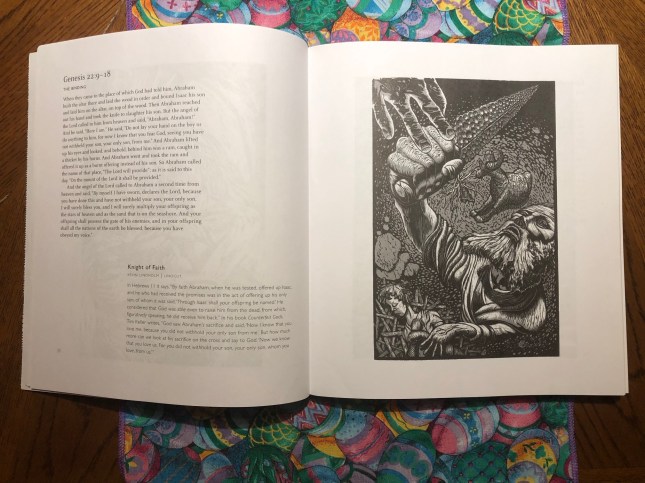
The image above is from Redeemed: A Storybook Bible for Grown-ups by Ned Bustard. This particular piece of art was done by Kevin Lindholm and is called “Knight of Faith.”

Genesis 22:9-18 [NLT]
9 When they arrived at the place where God had told him to go, Abraham built an altar and arranged the wood on it. Then he tied his son, Isaac, and laid him on the altar on top of the wood. 10 And Abraham picked up the knife to kill his son as a sacrifice. 11 At that moment the angel of the Lord called to him from heaven, “Abraham! Abraham!”
“Yes,” Abraham replied. “Here I am!”
12 “Don’t lay a hand on the boy!” the angel said. “Do not hurt him in any way, for now I know that you truly fear God. You have not withheld from me even your son, your only son.”
13 Then Abraham looked up and saw a ram caught by its horns in a thicket. So he took the ram and sacrificed it as a burnt offering in place of his son. 14 Abraham named the place Yahweh-Yireh (which means “the Lord will provide”). To this day, people still use that name as a proverb: “On the mountain of the Lord it will be provided.”
15 Then the angel of the Lord called again to Abraham from heaven. 16 “This is what the Lord says: Because you have obeyed me and have not withheld even your son, your only son, I swear by my own name that 17 I will certainly bless you. I will multiply your descendants[a] beyond number, like the stars in the sky and the sand on the seashore. Your descendants will conquer the cities of their enemies. 18 And through your descendants all the nations of the earth will be blessed—all because you have obeyed me.”

Dear God, I’ve spent some time with this story in the past. So much time, in fact, that I’m curious to see what I might have missed.

It’s interesting to me that Bustard chose, in this book’s telling of the story of Abraham being asked to sacrifice Isaac, to start with their arrival at the place for the sacrifice. I’ve usually spent more time in verses 1-8 than I have 9-18. So what is here that I might have missed in the past? Or what have I seen before of which you need to remind me?

Verse 9 alone must have really done something to alter the relationship between Isaac and Abraham. Frankly, I’m a little surprised that Isaac even worshipped you after that. If I had been him, I would have thought my dad was crazy and that would have included his worship of you. If I try to imagine this scene, it’s horrific. I almost need to just set that aside before I get deeper into the story because if I start to look at this story through Isaac’s eyes it freaks me out a little.

The thing I’ve noticed in this story in the past is Abraham’s possible idolization of his son and the promise that you gave him about his descendants. In verses 1-8, as he is lying to Sarah, to the servant, and to Isaac; as he is walking for a few days to reach the site; as he is eating and talking with Isaac; as he is silently thinking and praying; I am sure that he was doing a lot of repenting and wondering how much he had failed you by taking his eyes off of you and giving in to his own vanity.

With all of that said, let me see what I notice in this image:

  • The most prominent thing in the image is the knife. It seems like it’s the first thing Lindholm wants me to see. The knife, gripped by Abraham’s fist. Something horrific is about to happen and I don’t think the artist wants me to miss that fact.
  • The next thing I notice is Abraham’s face. He is staring up. Is the look in his eyes desperation? Despair? Anguish? Surprise?
  • There is a hand with two fingers touching Abraham’s hand. The fingers are no bigger than Abraham’s. They are a different color.
  • There is the boy. His eyes are closed. Given the comments I made earlier about the horror of verse 9, it would have been an interesting choice to leave Isaac’s eyes open. Did Lindholm consider that? Was that perhaps just too hard to see so he closed them instead? Was Isaac just waiting for the end? Another choice would have been to make Isaac look afraid. Terrified. But Lindholm chose to make him asleep. Interesting. Perhaps he envisioned that Abraham knocked him out.
  • There is the ram, already there, with his horns stuck in the thicket. If I had been the artist I might have shown a larger, more dense thicket, but perhaps Lindholm is suggesting that you didn’t need to do much to provide this ram for the sacrifice.

In the description of this picture, Bustard quotes Tim Keller: “God saw Abraham’s sacrifice and said, ‘Now I know that you love me, because you did not withhold your only son from me.’ But how much more can we look at his sacrifice on the cross and say to God, ‘Now we know that you love us. For you did not withhold your son, your only son, whom you love, from us.”

Father, search me today and help me to see what I have not sacrificed to you. Which parts of my vanity are still too important to me? Deal with me gently, Father. I know I am proud. I know I am vain. I know I can be selfish. Help me, Father to not get to a point where you have to go to these lengths to get my attention and repentance.

In Jesus’ name I pray,

Amen


Tags: , , , , , ,

The Woman at the Well – John 4:13-26

Woman at the Well
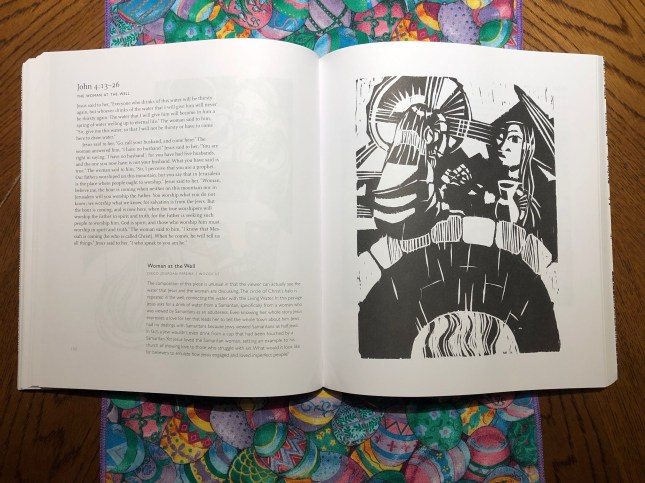
The image above is from Revealed: A Storybook Bible for Grown-Ups by Ned Bustard. The image itself was created by Diego Jourdan Pereira and is called “Woman at the Well.”

John 4:13-26 [NLT]
13 Jesus replied, “Anyone who drinks this water will soon become thirsty again. 14 But those who drink the water I give will never be thirsty again. It becomes a fresh, bubbling spring within them, giving them eternal life.”
15 “Please, sir,” the woman said, “give me this water! Then I’ll never be thirsty again, and I won’t have to come here to get water.”
16 “Go and get your husband,” Jesus told her.
17 “I don’t have a husband,” the woman replied.
Jesus said, “You’re right! You don’t have a husband— 18 for you have had five husbands, and you aren’t even married to the man you’re living with now. You certainly spoke the truth!”
19 “Sir,” the woman said, “you must be a prophet. 20 So tell me, why is it that you Jews insist that Jerusalem is the only place of worship, while we Samaritans claim it is here at Mount Gerizim, where our ancestors worshiped?”
21 Jesus replied, “Believe me, dear woman, the time is coming when it will no longer matter whether you worship the Father on this mountain or in Jerusalem. 22 You Samaritans know very little about the one you worship, while we Jews know all about him, for salvation comes through the Jews. 23 But the time is coming—indeed it’s here now—when true worshipers will worship the Father in spirit and in truth. The Father is looking for those who will worship him that way. 24 For God is Spirit, so those who worship him must worship in spirit and in truth.”
25 The woman said, “I know the Messiah is coming—the one who is called Christ. When he comes, he will explain everything to us.”
26 Then Jesus told her, “I am the Messiah!”


Dear God, I’ve heard this story so many times that I want to see if I can enter it through the image created by Diego Jourdan Pereira instead of starting with the passage.

Knowing what I know of the story, what is it that I see here?

  • First I suppose I have to admit that it’s a little hard for a left-brained person like me to make out everything in this image.
  • I see the woman first. She is the center of the story, and she is holding a pitcher in which she can carry the water she’s come to get.
  • There’s the well. It has water at the bottom and rocks surrounding it at the top.
  • Jesus has his back to us and is sitting on the well. Okay, maybe I am noticing something interesting that Mr. Jourdan Pereira did here–he kept the woman the center of the story. Jesus is looking at her just like we are.
  • I never imagined Jesus sitting on the actual well itself talking to the woman. That’s interesting.
  • Jesus seems to have the holiness halo around his head that a lot of Catholic artwork does for the Holy Family and saints. (Bustard’s commentary mentions that “the circle of Christ’s halo is repeated in the well, connecting the water with the Living Water.)
  • I can’t tell what it is, but there seems to be a subtle cross that is upside down and crooked just above Jesus hands–between him and the woman.
  • I suppose those are mountains in the distance behind her.

I really like the idea that this image and this story are all about the woman. It’s not about Jesus needing water. It’s about Jesus entering this woman’s life and world. She is holding her pitcher, in need of some water. She came to the well for the water, but what she found there was Jesus sitting on the well. He’s in the same place as the water for which she came, but he has a different water to offer her.

Of course, there is the story itself. What is the living water of which Jesus speaks? The first thing he has to do is get her sin out on the table. She is going to be ashamed of it, and she’ll get mad, change the subject, and try to fight back by drawing a line between them: We Samaritans think this while you Jews think that. But Jesus changes the premise of her argument and tells her that all of it is wrong: Jesus replied, “Believe me, dear woman, the time is coming when it will no longer matter whether you worship the Father on this mountain or in Jerusalem.” (verse 21)

Then he has to teach her about worshiping “in spirit and in truth.” (verses 23 and 24) We’ve put so many constructs on what worshiping you looks like, when the truth is that you are so much bigger than our constructs.

My wife and I were talking this morning about death and afterlife. We discussed the difference between those who believe that we are dormant until Jesus comes again and those who believe we enter the afterlife immediately (whether it be heaven, hell or even purgatory). We finally concluded that all of this is problematic because we are putting our earthly construct of “time” onto the construct of your timelessness. My personal belief is that I don’t know how it will all happen, but I’m confident that I’m not capable of understanding it on this side of death because it is through death that I will cross through the veil.

Okay, now I’m rambling. I guess the point I am getting from this story this morning is that you are there to meet us where we are, get us to discuss our sin and deal with it through your grace and your call to holiness, and then worship you in spirit and in truth, which is possible because you are the Messiah. How’s that for a summary?

Father, help me to really worship you today. I started this day with a secular song in my head and I played it while I made my breakfast. It was a nice love song. Then I decided that I needed to prepare my heart for this time with you so I put on some Christian songs that would lead me into worship and bring me into a place of wanting to spend this time with you. Thankfully, it worked. So, like I said at the beginning of this paragraph, help me to worship you today, but to do it in spirit and in truth. Help me to deal with my sin in a humble way before you. Help me to do what you would have me to do for your glory.

In Jesus’ name I pray,

Amen


Tags: , , , , , ,

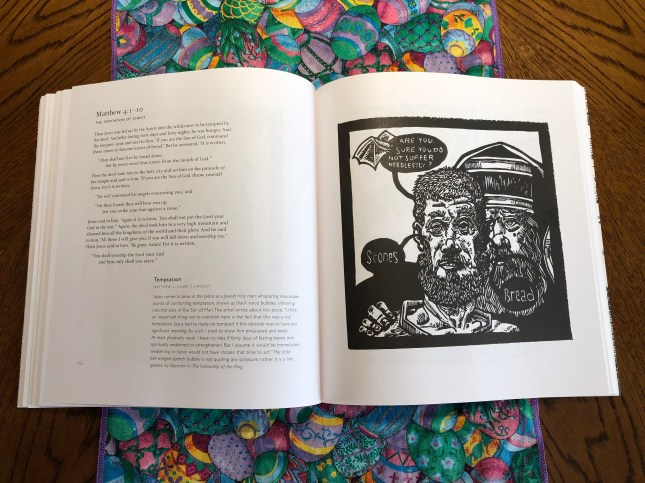
The Temptation of Christ — Matthew 4:1-4

IMG_1704
This image is from Revealed: A Storybook Bible for Grown-Ups by Ned Bustard. The image was created by Matthew L. Clark.

Matthew 4:1-4
1 Then Jesus was led by the Spirit into the wilderness to be tempted there by the devil. 2 For forty days and forty nights he fasted and became very hungry.
3 During that time the devil came and said to him, “If you are the Son of God, tell these stones to become loaves of bread.”
4 But Jesus told him, “No! The Scriptures say,
‘People do not live by bread alone,
but by every word that comes from the mouth of God.’”


Dear God, I might or might not have noticed this before, but this morning what strikes me about this passage is the fact that the Spirit appears to Jesus in the form of a dove at his baptism, and then it is the Spirit that leads him into the wilderness to be tempted. You didn’t shield him from temptation. You actually led him into it so that he could learn and be stronger.

That’s one of the hardest things to understand as a parent. Where is the line between protecting our child and getting in the way of the lessons they need to learn for later in life? And it changes with every age. There are the early stages when they reach for an electrical outlet and we physically prevent it because they cannot understand. Then there is the phase where we warn them with words, but sometimes they disobey us and get hurt anyway. And then there are the times when they are adults that we offer them our love, but we also offer them tough love and truth (not that tough love isn’t appropriate during the earlier parts as well).

In the spirit of looking at the art that Ned Bustard put with these Bible stories in Revealed: A Storybook Bible for Grown-ups, I want to spend some time with the artist who did a piece about this picture and see what he/she noticed that I might have missed or interpreted differently. In this case, Matthew L. Clark did this piece called “Temptation.”

So what do I notice in this piece?

  • Jesus looks pretty haggard. I’m not sure that I’ve ever thought about what he would look like after being in the wilderness for 40 days with no food, but I suppose he wouldn’t have looked like the pretty pictures of him I saw in Sunday school. This is a good point by the artist.
  • This image focuses only on the first temptation. The first words at the top are not explicitly said by Satan, but they carry that feeling of self pity that we all get from time to time. Self pity is the root of a lot of sin. “I have the right.” “I deserve better.” “How dare you?!?” In this case, Clark is suggesting that part of Jesus’ temptation is the idea that he might be questioning what all of this is for. “Why did the Spirit lead me out here for 40 days to do this?” “Is this suffering necessary?”
  • The words “Stones” and “Bread” set the stage for the temptation Clark is addressing. It’s hunger, but he is also suggesting in the first one that it’s also about doubting you and doubting the Spirit.
  • I couldn’t tell what the image is at the top of the top speech bubble. In the description, it is apparently batwings. It is to indicate that this is not scripture. Clark says he took the line from Boromir in The Fellowship of the Ring.
  • I wondered what Satan is wearing in the picture. Is he a king? Again, thankfully, Clark gives us an explanation. He has Satan appearing to tempt Jesus as a Jewish holy man. Someone whom he should trust. How many times have I been led astray by those I trusted? How many times have I led others astray who trusted me

Finally, here is what Clark has to say about his piece:

I think an important thing not to overlook here is the fact that this was a real temptation. Jesus had to really be tempted if this episode was to have any significant meaning. As such, I tried to show him emaciated and weak. At least physically weak. I have no idea if forty days of fasting leaves one spiritually weakened or strengthened. But I assume it would be immediately weakening or Satan would not have chosen that time to act.”

Father, I will face temptations today. Help me to recognize them when they come. Help me to renounce self pity and embrace the work you have given me to do today. Guide my heart into the channel of your will for me regardless of its benefits or costs to me. And help me to know how to parent my grown children. Help me to not do anything that will get in the way of what you are trying to do in their lives. Love them richly. Love my wife as well and help me to know how you need me to love her. Again, do all of this for your glory, your plan, and so that your will and kingdom will come to earth.

In Jesus’ name I pray,

Amen


Tags: , , , , ,

The Baptism of Christ — Matthew 3:1-2, 11-17

IMG_1695
The image above is from Revealed: A Storybook Bible for Grown-ups by Ned Bustard. While not all of the images in the book were created by Bustard, this one happens to be. It is called “Baptism (after Otto Dix).”

Matthew 3:1-2, 11-17
1 In those days John the Baptist came to the Judean wilderness and began preaching. His message was, 2 “Repent of your sins and turn to God, for the Kingdom of Heaven is near.”

11 “I baptize with[a] water those who repent of their sins and turn to God. But someone is coming soon who is greater than I am—so much greater that I’m not worthy even to be his slave and carry his sandals. He will baptize you with the Holy Spirit and with fire. 12 He is ready to separate the chaff from the wheat with his winnowing fork. Then he will clean up the threshing area, gathering the wheat into his barn but burning the chaff with never-ending fire.”
13 Then Jesus went from Galilee to the Jordan River to be baptized by John. 14 But John tried to talk him out of it. “I am the one who needs to be baptized by you,” he said, “so why are you coming to me?”
15 But Jesus said, “It should be done, for we must carry out all that God requires.” So John agreed to baptize him.
16 After his baptism, as Jesus came up out of the water, the heavens were opened[d] and he saw the Spirit of God descending like a dove and settling on him. 17 And a voice from heaven said, “This is my dearly loved Son, who brings me great joy.”

Dear God, when I think about this story it always makes me wonder where baptism came from and why it all of a sudden appeared with John. And why did Jesus need to be baptized? It’s really interesting.

But today isn’t about wrestling with that question. The point of this series is to take an artist’s interpretation of this story and see if there is something she or he saw that I missed. In this case, Ned Bustard (and Matthäus Evangelium) did some interesting things that I’m noticing here:

  • The first thing I noticed was that the Holy Spirit, as represented by a dove, seems to be funneling through the water in John’s hand. The image makes me think about your Holy Spirit entering the world through us through our baptism.
  • John is wearing his trademark animal skins for clothes. No shoes, of course, but that leads me to the next point.
  • He is not in the water with Jesus. It would have been easy for the artist to put John in the water with Jesus, but John is intentionally drawn as standing on dry land. I’m not sure how to interpret this except to say that this baptism is all about Jesus.
  • Visually, the artist depicted John as being completely dry. The lines that make up his body run in every direction. Up, down, crisscross, diagonally, etc. On the other hand, Jesus is drawn under the water  as represented by the water flowing over him. Except for his specific facial features, nipples, abdomen, and belly button, everything else is drawn vertically and seems to represent the water flowing over him.
  • John is just using his hand and seems to be getting a lot of water to pour from that method. This again leads me back to the idea that there is more than just water flowing over Jesus, but it is your Holy Spirit flowing through the water that is pouring from John’s hand.
  • Jesus’ face looks sad, and John looks very serious. I don’t know why the artist chose these facial expressions. Perhaps the artist was thinking about what was about to come in Jesus’ live over the next 40 days?
  • Jesus is clean-shaven with a nice haircut, and John has long hair and a beard. This certainly shows a difference in the style of the two men.

I intentionally didn’t read Bustard’s description of this piece until after I had gone through this exercise. Here is what he had to say about it:

Baptism (after Otto Dix)

Dix (1891-1969) was a German artist, painter, and print maker know for his harshly realistic depictions of the brutality of war; but his post-World War II work was largely religious in nature. This linocut is based on Baptism of Jesus, a lithograph from Matthäus Evangelium. Art historian James Romaine observed that the Holy Spirit is funneled through the hand of John like a sieve, baptizing Jesus in both water and in the Spirit. About the Bible, Dix is quoted to have said, “You have to read every single word. For the Bible is a wonderful history book. There is great truth in all of it. Most people don’t read the Bible, but reading the Bile, reading it as it is, in all of its realism, including the Old Testament: It’s quite a book. Quite a book, you even say it is the book of books…simply magnificent!”

5950-2

Reading Bustards description reminded me of something I noticed, but forgot to mention. I am a believer in both the baptism by water and the baptism in the Holy Spirit. I think there is good evidence for it in not only the book of Acts, but in my life as well. This image shows that both water and the Holy Spirit were involved in Jesus’ baptism, with Bustard’s interpretation making that point a little more obvious than the original.

Father, help me to remember today that I am covered in your water, in your Holy Spirit, and in Jesus’ redeeming blood. Help me to remember that I am not only covered by these things, but filled with them as well. I am no longer my own. I am a new creation. The old has gone and the new has come. Help me to remember that.

In Jesus’ name I pray,

Amen


Tags: , , , ,