RSS

Category Archives: Mark

Mark 9:30-35

Leaving that region, they traveled through Galilee. Jesus didn’t want anyone to know he was there, for he wanted to spend more time with his disciples and teach them. He said to them, “The Son of Man is going to be betrayed into the hands of his enemies. He will be killed, but three days later he will rise from the dead.” They didn’t understand what he was saying, however, and they were afraid to ask him what he meant.

After they arrived at Capernaum and settled in a house, Jesus asked his disciples, “What were you discussing out on the road?” But they didn’t answer, because they had been arguing about which of them was the greatest. He sat down, called the twelve disciples over to him, and said, “Whoever wants to be first must take last place and be the servant of everyone else.”

Mark 9:30-35

Dear God, even now, it is so hard for us to get what Jesus is saying. And we have the texts. We have the history. We have hindsight. It is so easy to look at this and question why the disciples heard Jesus talking about his betrayal, death, and resurrection, and then wonder how they could possibly, one road trip later, be arguing over who would be the greatest in the kingdom. Even if they didn’t understand what he was telling them about the crucifixion, resurrection, and ultimate plan of the Gospel in that moment, how did they get to the point where they were positioning themselves for glory?

But don’t we do it too? Don’t I do it too? I want to be seen as smarter than others. I want to be seen as better. I was just with my parents for a couple of days. I have older siblings. I want to show my parents I’m the better child. There are people in our community who know me. I want to impress them and make them respect me. How can I see Jesus’s example and hear his teachings and ever adopt any of those positions?

Father, I am sorry. I don’t think I was all that you wanted me to be over the last 48 hours. I wasn’t terrible or anything, but I was closer to what Jesus saw in his disciples that I was like the little child he put before them just after this to make his point. I have a lot of work to do this week. I will interact with a lot of people on behalf of the nonprofit where I work. Make my contacts with them not about me but about you. About bringing glory to you. About helping them to draw closer to you. About my utmost for your highest.

I pray this in Jesus and with your Holy Spirit,

Amen

 
Leave a comment

Posted by on September 22, 2024 in Mark


Mark 8:27-38

27 Jesus and his disciples left Galilee and went up to the villages near Caesarea Philippi. As they were walking along, he asked them, “Who do people say I am?”

28 “Well,” they replied, “some say John the Baptist, some say Elijah, and others say you are one of the other prophets.”

29 Then he asked them, “But who do you say I am?”

Peter replied, “You are the Messiah.”

30 But Jesus warned them not to tell anyone about him.

31 Then Jesus began to tell them that the Son of Man must suffer many terrible things and be rejected by the elders, the leading priests, and the teachers of religious law. He would be killed, but three days later he would rise from the dead. 32 As he talked about this openly with his disciples, Peter took him aside and began to reprimand him for saying such things.

33 Jesus turned around and looked at his disciples, then reprimanded Peter. “Get away from me, Satan!” he said. “You are seeing things merely from a human point of view, not from God’s.”

34 Then, calling the crowd to join his disciples, he said, “If any of you wants to be my follower, you must give up your own way, take up your cross, and follow me. 35 If you try to hang on to your life, you will lose it. But if you give up your life for my sake and for the sake of the Good News, you will save it. 36 And what do you benefit if you gain the whole world but lose your own soul? 37 Is anything worth more than your soul? 38 If anyone is ashamed of me and my message in these adulterous and sinful days, the Son of Man will be ashamed of that person when he returns in the glory of his Father with the holy angels.”

Mark 8:27-38

Dear God, as I read this passage this morning, I was wondering about how close Peter was and yet how far. He knew Jesus was the Messiah, but he didn’t know how to define Messiah. His Messiah would conquer. That’s what he thought he was signing up for. Yes, we are going to fish for men, but we are gathering them together so that Israel will be great again. Yes, they will be devout Jews in this new era. Yes, they will be closer to God, but with Jesus here, it’s just about “go time.” So he defines him as the Messiah, but he puts his own definition on what Messiah means.

Then Jesus starts teaching them the real definition of Messiah, but Peter isn’t having it. I don’t know the exact words of Peter’s rebuke, but after Jesus begins to “teach” them that the Messiah must suffer greatly, be rejected by the Jewish leadership, and be killed, he decides that Jesus is teaching the wrong thing. It’s Jesus who does not understand what Messiah means.

In “The Grand Inquisitor” by Fyodor Dostoevsky, the grand inquisitor during the Spanish Inquisition makes the same mistake Peter makes. Here’s a summary from Wikipedia:

In a long diatribe directed at Jesus Himself, who has returned to Earth in Seville at the height of the Inquisition, the Grand Inquisitor defends the following ideas: only the principles of the devil can lead to mankind’s unification; give man bread, control his conscience, and rule the world; Jesus limited himself to a small group of chosen ones, while the Catholic Church improved on his work and addresses all people; the church rules the world in the name of God, but with the devil’s principles; Jesus was mistaken in holding man in high esteem. Jesus remains silent throughout the Inquisitor’s speech.

Father, help me to not repeat Peter’s mistake. Help me to really know how you defined Messiah. In fact, let me take a shot at defining Messiah now. How did you define it compared with how Peter defined it. I think my definition is somewhere along the lines of, “A piece of God that came to earth to teach us directly who God intended us to be and how to act, and then offer himself as a sacrifice so that we might be rightly related to God and, through that relationship with God live out what Jesus taught. In the process, we invite everyone we can to join us. That’s the Good news. Help me live that today.

I pray this in Jesus the Messiah and your Holy Spirit,

Amen

 
Leave a comment

Posted by on September 15, 2024 in Mark


Tags: , ,

Mark 7:1-23 (Part 2)

One day some Pharisees and teachers of religious law arrived from Jerusalem to see Jesus. They noticed that some of his disciples failed to follow the Jewish ritual of hand washing before eating. (The Jews, especially the Pharisees, do not eat until they have poured water over their cupped hands, as required by their ancient traditions. Similarly, they don’t eat anything from the market until they immerse their hands in water. This is but one of many traditions they have clung to—such as their ceremonial washing of cups, pitchers, and kettles.)

So the Pharisees and teachers of religious law asked him, “Why don’t your disciples follow our age-old tradition? They eat without first performing the hand-washing ceremony.”

Jesus replied, “You hypocrites! Isaiah was right when he prophesied about you, for he wrote,

‘These people honor me with their lips,
    but their hearts are far from me.
Their worship is a farce,
    for they teach man-made ideas as commands from God.’

For you ignore God’s law and substitute your own tradition.”

Then he said, “You skillfully sidestep God’s law in order to hold on to your own tradition. 10 For instance, Moses gave you this law from God: ‘Honor your father and mother,’ and ‘Anyone who speaks disrespectfully of father or mother must be put to death.’ 11 But you say it is all right for people to say to their parents, ‘Sorry, I can’t help you. For I have vowed to give to God what I would have given to you.’ 12 In this way, you let them disregard their needy parents. 13 And so you cancel the word of God in order to hand down your own tradition. And this is only one example among many others.”

14 Then Jesus called to the crowd to come and hear. “All of you listen,” he said, “and try to understand. 15 It’s not what goes into your body that defiles you; you are defiled by what comes from your heart.”

17 Then Jesus went into a house to get away from the crowd, and his disciples asked him what he meant by the parable he had just used. 18 “Don’t you understand either?” he asked. “Can’t you see that the food you put into your body cannot defile you? 19 Food doesn’t go into your heart, but only passes through the stomach and then goes into the sewer.” (By saying this, he declared that every kind of food is acceptable in God’s eyes.)

20 And then he added, “It is what comes from inside that defiles you. 21 For from within, out of a person’s heart, come evil thoughts, sexual immorality, theft, murder, 22 adultery, greed, wickedness, deceit, lustful desires, envy, slander, pride, and foolishness. 23 All these vile things come from within; they are what defile you.”

Mark 7:1-23

Dear God, I heard a really good homily yesterday title “The Floor” from Fr. Mike Schmitz on this passage. Well, it was loosely on this passage. He took a different tack on it than I had considered when I prayed about it yesterday before church. He was saying how the Pharisees had taken things that were originally developed as something people would “get” to do as part of their worship of you, and they made it a “have” to do. The ceremonial cleansing the Pharisees were admonishing Jesus’s disciples about wasn’t a “have” to, but over the years it became that for them. They became legalistic about it.

So Fr. Mike talked about what is the floor? What is the minimum we have to do to be in relationship with you. He had a list of five things Catholics believe, and, interestingly, I think I was really only down for two of them as being a “have” to. For me, even those things were rules the church has made up over the centuries (millennia?). But that made me ask myself what my floor is. I talked with my wife about it last night. Our things that each of us feel we “have” to do are different, which I think is good. You have put different things on our hearts as they pertain to us. And then, even after our conversation last night, I’ve had a couple more things occur to me as being things I “have” to do to feel close to you. So what is my floor?

  • The prayer journals. Spending 15-30 minutes a day in a concentrated time of prayer like this has become a have to for me. And it didn’t used to be that way. A year ago I would have said that I need to do it 4-5 times a week. But since Lent I haven’t missed a day because I know I need this time meditating on you, listening to your Holy Spirit, and learning from the bazaar thing you left us called Scripture.
  • Giving. Ten percent of our gross is a minimum. Not that we are giving away even 20%, but we try to be generous when we see needs arise. Giving 10% is a floor.
  • Intentional time in conversation with my wife at least once a day is a floor. If we are available around each other at a meal, we each make it a priority to sit with each other, even if one of us isn’t eating at the time.
  • At least one sermon/Bible teaching a week. I need to hear someone else I trust teaching me the Bible in a way I wouldn’t see on my own (this homily is a perfect example of that).
  • Communication and contact with at least one of the two male friends I have. It doesn’t even have to be a conversation, but I need to touch their lives in some way–even if it is to text about sports.
  • Avoiding sexual temptation/lust. This has to be a floor. When you look at the lists of sins Jesus and Paul talk about, it’s always on there. I must do this.
  • Exercising at least four times a week. I am mentally better when I am taking care of myself physically. I should probably make better eating habits a floor, but I haven’t chosen to do that yet. Perhaps it will be one day.
  • Doing the things I know bless my wife like fixing things around the house, managing our money and then sharing with her what our status is, doing my laundry, making the bed, etc. Even listening to things I like but I know she doesn’t care for on my headphones instead of subjecting her to it. There’s a whole set of “floor” issues for my relationship with her that are important for her to feel loved.

So then what are some of the things I “get” to do, but aren’t necessarily something I “have” to do every week?

  • Church. A lot of Christians would probably disagree with me on this one. While I feel like it is important to have a church you belong to and to be involved in that church, I don’t feel like the foundation in my life is cracking if I miss a week.
  • My extra writing projects. I get joy from writing and thinking about how to bless others, but it’s a “get” to and not a “have” to.
  • Teaching. Similarly, I enjoy taking what I get from you during my prayer journal time and sharing it with others through preaching or teaching, but those occasions happen infrequently, and, while they help me and teach me, they aren’t the floor.
  • Engaging healthily through prayer and action in my community. This is close to a “have” to because it is part of me loving others as I love myself, but it’s not something that is foundational. Well, maybe it is. It actually might belong in the “have” to list.
  • Listening to Christian music. I mix it in during the week, but I also listen to secular as well.
  • Listening to Christian podcasts. Similar to music, I mix it in, but it’s a “get” to.

There is probably a lot more. I could probably type this forever. But one of the things my wife and I discussed last night and I can even see from these two lists is how the closer we get to you some of the things that we once considered a “get” to are not a “have” to. For example, doing these prayer journals daily. I need this. I am missing it without you. Yes, you are, indeed, slowly remaking this heart of stone into your image. I’m sorry it is taking so long.

Father, I’m sorry for the times I am too selfish to keep up with my “have” to list. I am sorry for giving in to that selfishness. But I am also so thankful that you are remaking me a little bit every day. I am not the man I was five years ago. I am not the man I will be five years from now, if you are willing for me to be here that long. No, I am just a work in progress. Splintered. mal-shaped. But by reaching the floor you have given to me every day, I am slowly becoming yours. So give me this day my daily bread. And lead me not into temptation. And forgive me as I forgive others.

I pray this in Jesus and with your Holy Spirit,

Amen

 
5 Comments

Posted by on September 2, 2024 in Mark


Tags: , ,

Mark 7:1-23

One day some Pharisees and teachers of religious law arrived from Jerusalem to see Jesus. They noticed that some of his disciples failed to follow the Jewish ritual of hand washing before eating. (The Jews, especially the Pharisees, do not eat until they have poured water over their cupped hands, as required by their ancient traditions. Similarly, they don’t eat anything from the market until they immerse their hands in water. This is but one of many traditions they have clung to—such as their ceremonial washing of cups, pitchers, and kettles.)

So the Pharisees and teachers of religious law asked him, “Why don’t your disciples follow our age-old tradition? They eat without first performing the hand-washing ceremony.”

Jesus replied, “You hypocrites! Isaiah was right when he prophesied about you, for he wrote,

‘These people honor me with their lips,
    but their hearts are far from me.
Their worship is a farce,
    for they teach man-made ideas as commands from God.’

For you ignore God’s law and substitute your own tradition.”

Then he said, “You skillfully sidestep God’s law in order to hold on to your own tradition. 10 For instance, Moses gave you this law from God: ‘Honor your father and mother,’ and ‘Anyone who speaks disrespectfully of father or mother must be put to death.’ 11 But you say it is all right for people to say to their parents, ‘Sorry, I can’t help you. For I have vowed to give to God what I would have given to you.’ 12 In this way, you let them disregard their needy parents. 13 And so you cancel the word of God in order to hand down your own tradition. And this is only one example among many others.”

14 Then Jesus called to the crowd to come and hear. “All of you listen,” he said, “and try to understand. 15 It’s not what goes into your body that defiles you; you are defiled by what comes from your heart.”

17 Then Jesus went into a house to get away from the crowd, and his disciples asked him what he meant by the parable he had just used. 18 “Don’t you understand either?” he asked. “Can’t you see that the food you put into your body cannot defile you? 19 Food doesn’t go into your heart, but only passes through the stomach and then goes into the sewer.” (By saying this, he declared that every kind of food is acceptable in God’s eyes.)

20 And then he added, “It is what comes from inside that defiles you. 21 For from within, out of a person’s heart, come evil thoughts, sexual immorality, theft, murder, 22 adultery, greed, wickedness, deceit, lustful desires, envy, slander, pride, and foolishness. 23 All these vile things come from within; they are what defile you.”

Mark 7:1-23

Dear God, I have a few thoughts about this passage. Let me say the probably least important one first. I am always amazed at how the New and Old Testaments focus on sexual immorality. This isn’t something that came with the sexual revolution in the 1960s, and everyone was chaste and pure before then. In Jesus’s list in verses 21 and 22, he not only says sexual immorality, but also adultery and lustful desires. of the 13 things listed, three of them are sexually-related. So this is obviously an area that you intended for such good that our sinful hearts are prone to take and pervert. If Jesus were to say, “You have heard it said, do not lie with a man as you lie with a woman, for that is detestable (Lev. 18:22), but I say…” how would he complete that sentence? I think it would be to show all of the heterosexuals how we have perverted sex into something you never intended. So that’s the least important thing I have here.

The other part that caught me this morning was his Isaiah quote:

‘These people honor me with their lips,
    but their hearts are far from me.
Their worship is a farce,
    for they teach man-made ideas as commands from God.’

I think of the puritanical people I know in our community and on a national stage and I wonder what their real prayer lives are like. Do they spend time in prayer? If they do, what is their heart like?

And then that takes my judge-y heart to myself. How do I honor you with my lips but still allow my heart to be far from you. When I go to church this morning, will my worship be a farce?

Father, help me to examine my heart while I am at church this morning. My sitting here and judging others will not do me any good. But when I pray to you, I need to examine my own heart and figure out which things on Jesus’s list I allow to be in my life and separate me from you. Create in me a clean a pure heart, oh, God.

I pray this in Jesus and with your Holy Spirit,

Amen

 
Leave a comment

Posted by on September 1, 2024 in Mark


Lent Day 26

Dear God, I actually finished a book yesterday. You know I don’t spend tons of time reading whole books, but this one had some theology in it that I suspected I would disagree with (and I was right). I read it because some people I respect really liked the book so I wanted to be informed as to what it was saying and the arguments it made. I am hopeful that i will be able to discuss it with my friends so that they can explain what they see in it that I don’t, and then maybe I can share some of my perspective. Maybe neither of us are all right or all wrong. Where can we learn from each other? I pray this will go well.

While I am thinking about prayers, I just learned that a friend is expecting triplets. Oh, please protect the women I know who are currently pregnant (there are three of them). One is imminently due, the triplets are due this summer and one is due in September. Please be with all of them. Be with their babies. Be with the fathers of the children too. Protect their lives. These are all wanted children. Wrap them all up in your love. Bring yourself into their lives. Help them to all seek you.

And while I’m praying for others and the health of others, I have another couple friend where the wife is struggling against cancer. Oh, Father, have mercy. Oh, Jesus, have mercy. Oh, Holy Spirit, have mercy. Heal. Comfort. Strengthen. My prayers seem so feeble. I believe. Help my unbelief.

And then I have a friend who is really struggling with his marriage. Speak to him. Guide him. Guide his wife. Be with their children. Marriage can be hard. Bring people to them who can be your words, your comfort, and your joy.

Finally, I have another unpleasant project to do today. I’ll keep it vague as I type here, but you know what I mean. Help me to learn from it, change from it, and be more loving after having experienced it. Bring good from it, please.

And with all of that said, here are the passages for this fourth Sunday of Lent from Sacred Invitation: Lenten Devotions Inspired by the Book of Common Prayer:

  • AM Psalms: 66, 67
  • PM Psalms: 19, 46
  • Jeremiah 14: 1-9, 17-22
  • Mark 8:11-21
  • 4:21-5:1

Psalms 66, 67 – These are just two nice, straight ahead, worshipful psalms. The first one made me think of the song “Shout to the Lord.” The second one reminded me of “The Blessing” which really touched me when different people from the UK recorded it for the world. I know that text is actually from Number 26, but this psalm starts that way as well. In fact, I just kept it running while I type this. I remember 2020 as such a surreal time. Scared. At home. A sense of isolation. Significant problems to solve. Prayer walks around our local hospital. Changes to how we functioned at work. But there were beautiful expressions of your love like this song as well. If those who are hurting in the world had only seen these types of expressions of your love during that dark time, how would they have responded to you and to your Church? But too many started fighting for the Church’s rights to assemble, not wear masks, or whatever else they decided to be angry about. It did nothing to be your witness to this world or comfort it during a scary time. Instead, the Church just looked like any other group looking for power and influence.

Psalm 19, 46 – Just a few lines from Psalm 19 that touch me this morning: The statutes of the LORD are trustworthy, making wise the simple. The precepts of the LORD are right, giving joy to the heart. The commands of the LORD are radiant, giving light to the eyes. The things you have given us to do. The “rules” to obey. They aren’t arbitrary. They aren’t for your kicks so that we will be good rule followers. They are for us. Following them leads us to joy in our hearts. They make us wise. They give us light. The other line from Psalm 19 that is great is, “Who can discern his errors? Forgive my hidden faults.” And then, “Keep your servant also from willful sins; may they not rule over me.” I know I have faults that are hidden from me. I know I have sin I commit that I don’t think is sin or I don’t want to admit is sin. Holy Spirit, please continue to work with my heart.

Jeremiah 14: 1-9, 17-22 – What is the best way to bring a nation to repentance? That seems to be the question Christians are asking each other. Some are answering that we need to be a force for repentance. We need to force those who are doing what we think are wrong to repent and agree with us. Others will say that we need to completely love and accept everyone and then let you work on their hearts individually. Still others say we need to just work on ourselves in the church and become as Christlike as possible and then let the church grow organically from there. Personally, I agree with some of those perspectives more than others.

Mark 8:11-21 – The yeast of the Pharisees. I started to write what I think it is, but then I deleted it. What exactly do I think the yeast of the Pharisees is? I’ve already admitted that, had I been there at the time, I would not have believed Jesus was the Messiah. So does that mean I have their yeast in my heart too? First, Jesus was critical that the Pharisees had become so legalistic that they couldn’t see what you were calling them to do at any given time–particularly in loving others and having mercy. They were superior. Harsh. Egotistical. Judgmental. Hateful. Jesus said that we should not judge. We should serve our neighbors and love them as ourselves. We should forgive easily. We should humble ourselves.

Galatians 4:21-5:1 – I’ve got to say, I don’t care for Paul’s analogy here. Hagar was ultimately freed, as was Ishmael. I need someone more educated than me to explain this to me theologically. I think Paul is encouraging them to be free from their sin, selfishness, and shame through Jesus. That’s great. I don’t like the Hagar and Ishmael comparison, but maybe I’m wrong and that’s just me because I came to like Hagar when I read closely about her in Genesis.

Father, I offer this fourth Sunday of Lent to you. Help me to accomplish the things you have for me to accomplish. Do it for the good of my soul, the good for the souls of those I love, and for your glory.

I pray this in Jesus and with your Holy Spirit,

Amen


Tags: ,

Lent Day 5:

Dear God, as I enter the first Sunday of Lent, I come to you with a full heart. I’ll confess that I’m already getting a little tired of spending this much focused time every morning, getting up early. Normally when I do these they take about 15 minutes, but the way I am doing this take a whole 30! (Sarcasm intended, but it’s also a little true.) And I’m doing it every day! (Sarcasm again intended, but it’s also a little true.)

Here are today’s readings from Sacred Invitation: Lenten Devotions Inspired by the Book of Common Prayer:

  • AM Psalms: 63, 98
  • PM Psalms: 103
  • Deuteronomy 8:1-10
  • Mark 2:18-22
  • 1 Corinthians 1:17-31

As I wrote those, I just remembered that I forgot to read the PM Psalms from yesterday. I’ll do that now. Two things really quickly from yesterday’s PM Psalms: 42 and 43. First, the phrase from 42:4: These things I remember as I pour out my soul: How I used to with the multitude, leading the procession to the house of God, with shouts of joy and thanksgiving among the festive throng. Isn’t that what I was kind of saying about myself when I started this prayer? It’s only Day 5. I started with much enthusiasm and focus. Now, the newness of this has worn off and I’m disciplining myself to do this.

The next was the fact that both psalms used the phrase, “Why are you downcast, O my soul? Why so disturbed within me? Put your hope in God, for I will yet praise him, my Savior and my God.” I wonder if that was a phrase commonly known to the Israelites. A quick Google search didn’t show anything beyond these two psalms for this phrase, but it’s interesting that it was in both psalms.

As for today’s verses, let me see what we have here. After reading everything, including the commentary from the book, it is fasting mentioned in Mark 2:18-22 that comes up a few times. And I guess I started to understand what has always been kind of a weird parable to me: the old/new wineskins, and the patch on the old/new cloth. Jesus was saying that fasting is important to bring us closer to you, God, but while he (you) was literally and physically among them there was a new paradigm. No fasting required. This new situation did not fit any of the metaphorical old cloths or wineskins they knew. A new cloth and wineskin was required.

Father, through the Lenten season, help me to sink into you. Help me to emerge from this after Easter in some sort of new paradigm that will stick and help me to grow in you. Break me, melt me, mold me, fill me.

I pray this in Jesus and with the Holy Spirit,

Amen

 
Leave a comment

Posted by on February 18, 2024 in Lent 2024, Mark, Psalms


Tags:

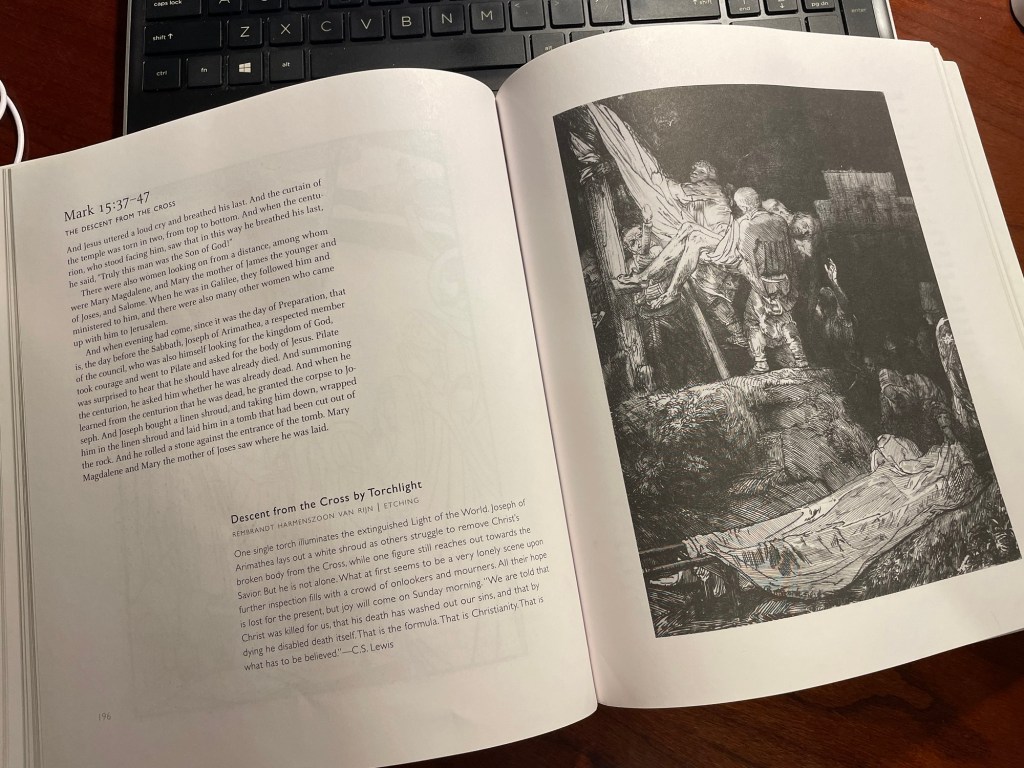
Mark 15:37-47 “The Descent from the Cross”

The above image is from Revealed: A Storybook Bible for Grown-Ups, written and compiled by Ned Bustard. The image is called “Descent from the Cross by Torchlight and was created by Rembrandt Harmenszoon Van Rijn.

37 Then Jesus uttered another loud cry and breathed his last. 38 And the curtain in the sanctuary of the Temple was torn in two, from top to bottom.

39 When the Roman officer who stood facing him saw how he had died, he exclaimed, “This man truly was the Son of God!”

40 Some women were there, watching from a distance, including Mary Magdalene, Mary (the mother of James the younger and of Joseph), and Salome. 41 They had been followers of Jesus and had cared for him while he was in Galilee. Many other women who had come with him to Jerusalem were also there.

42 This all happened on Friday, the day of preparation, the day before the Sabbath. As evening approached, 43 Joseph of Arimathea took a risk and went to Pilate and asked for Jesus’ body. (Joseph was an honored member of the high council, and he was waiting for the Kingdom of God to come.) 44 Pilate couldn’t believe that Jesus was already dead, so he called for the Roman officer and asked if he had died yet. 45 The officer confirmed that Jesus was dead, so Pilate told Joseph he could have the body. 46 Joseph bought a long sheet of linen cloth. Then he took Jesus’ body down from the cross, wrapped it in the cloth, and laid it in a tomb that had been carved out of the rock. Then he rolled a stone in front of the entrance. 47 Mary Magdalene and Mary the mother of Joseph saw where Jesus’ body was laid.

Mark 15:37-47

Dear God, the moments after Jesus’s death are some of the most precious to me because they represent the depths of misunderstanding and lostness for his followers and family, and the wicked delight of those who were threatened by him and killed him. Regarding Caiaphas and those with him, I wonder what the Passover was like for him over the next 24-36 hours. Did he feel convicted over what he had done? Was he afraid of what Jesus’s followers would do (as represented by him asking for guards for the tomb)? Or was it a time of celebration and calculated caution? I don’t know. I do know how Judas felt–guilt to the point of suicide.

What I do know is that the followers and Mary were devastated. Disillusioned, even. This wasn’t what they had dreamed of. This wasn’t what they thought about. Where was the kingdom James and John aspired to help Jesus rule from his right and his left (Mark 10:35-45)? Where was the power? Why was Rome still in charge? What would their standing now be in the church.

With that, I want to look at Rembrandt’s image and see what details he thought about as he pondered this story:

  • Someone is preparing a stretcher on which they can carry his body to the tomb.
  • It looks like they used a sheet to lower Jesus from the cross with someone on the ladder and someone catching him below. The person on the ladder almost looks like a woman with no facial hair and long hair, but I can’t be sure. After reading John’s account, I would think this is Joseph of Arimathea and Nicodemus (John 19:38-42), but I think Rembrandt had another picture of this.
  • The person on the far right of the image has a special hat so I am assuming this is a Pharisee. Perhaps Caiaphas.
  • There is someone down below the man holding Jesus to the right. It looks like he is ready to help should the man holding Jesus lose his balance.
  • There are faint images of others behind the man preparing the stretcher. I assume these are just onlookers.
  • There is the man holding the torch. This is a unique thought. I don’t think anyone ever thought about the need for light. I would actually assume it wasn’t dark yet because they had to get the body down before sundown for the Passover (that’s why the broke the legs of the other two and put a spear into Jesus’s side (John 19:31-34), but because the Sun wasn’t down yet doesn’t mean they didn’t need a little more light.
  • Now here’s the big one I noticed this morning that I’ve never thought of: The man on the other side of the cross from the man with the torch. He’s on the very edge of the image, and he’s holding a hammer. That’s when I looked to see that one of Jesus’s feet is still nailed to the cross and the man with the hammer is banging it out from the other side. Perhaps one of the feet tore off of the spike as they removed him, but they couldn’t get the other one off without banging it out. I had never thought about removing the spikes before, but Rembrandt must have as he pictured this image in his mind.

Here is the commentary Bustard gave for this scene and story:

One single torch illuminates the extinguished Light of the World. Joseph of Arimathea lays out a white shroud as others struggle to remove Christ’s broken body from the Cross, while one figure still reaches out towards the Savior: But he is not alone. What at first seems to be a very lonely scene upon further inspection fills with a crowd of onlookers and mourners. All their hope is lost for the present, but joy will come on Sunday morning. “We are told that Christ was killed for us, that his death has washed out our sins, and that by dying he disabled death itself. That is the formula. That is Christianity. That is what has to be believed.” –C.S. Lewis.

The only thing I would add to Bustard’s description is that their “hope” and expectation was wrong. They wanted the wrong thing. They wanted what you didn’t want. And you knew better than to give them what they wanted.

Father, you know better than to give me what I want too. I was thinking earlier today about some regrets I have–especially as a parent. There is one decision I made that was the best one I knew to make at the time and was done with an earnest heart, but I would love to change it and have gone down another road. But I started wondering what the unintended consequences of that would have been. As much as I don’t like some of my current circumstances, would the alternative have been even worse? There is obviously no way for me to know this, but that’s where I have to not look back or even forward, but keep myself in this moment. This moment is my reality, and this moment is the one that interfaces with you. Not the past. Not the future. So I offer this moment to you. I worship you. I give you my heart and ask that you would redeem the mistakes I’ve made. Heal those harmed by them, including myself. Let your life and fruit live in and grow out of me.

I pray all of this in your holy, Triune name: The Father, the Son, and the Holy Spirit,

Amen


Tags: , , ,

Judas and Barabbas

Matthew

26 When Jesus had finished saying all these things, he said to his disciples, “As you know, Passover begins in two days, and the Son of Man will be handed over to be crucified.”

At that same time the leading priests and elders were meeting at the residence of Caiaphas, the high priest, plotting how to capture Jesus secretly and kill him. “But not during the Passover celebration,” they agreed, “or the people may riot.”

Meanwhile, Jesus was in Bethany at the home of Simon, a man who had previously had leprosy. While he was eating, a woman came in with a beautiful alabaster jar of expensive perfume and poured it over his head.

The disciples were indignant when they saw this. “What a waste!” they said. “It could have been sold for a high price and the money given to the poor.”

10 But Jesus, aware of this, replied, “Why criticize this woman for doing such a good thing to me? 11 You will always have the poor among you, but you will not always have me. 12 She has poured this perfume on me to prepare my body for burial. 13 I tell you the truth, wherever the Good News is preached throughout the world, this woman’s deed will be remembered and discussed.”

14 Then Judas Iscariot, one of the twelve disciples, went to the leading priests 15 and asked, “How much will you pay me to betray Jesus to you?” And they gave him thirty pieces of silver. 16 From that time on, Judas began looking for an opportunity to betray Jesus.

Matthew 26:1-16

27 Very early in the morning the leading priests and the elders of the people met again to lay plans for putting Jesus to death. Then they bound him, led him away, and took him to Pilate, the Roman governor.

When Judas, who had betrayed him, realized that Jesus had been condemned to die, he was filled with remorse. So he took the thirty pieces of silver back to the leading priests and the elders. “I have sinned,” he declared, “for I have betrayed an innocent man.”

“What do we care?” they retorted. “That’s your problem.”

Then Judas threw the silver coins down in the Temple and went out and hanged himself.

Matthew 27:1-5

15 Now it was the governor’s custom each year during the Passover celebration to release one prisoner to the crowd—anyone they wanted. 16 This year there was a notorious prisoner, a man named Barabbas. 17 As the crowds gathered before Pilate’s house that morning, he asked them, “Which one do you want me to release to you—Barabbas, or Jesus who is called the Messiah?” 18 (He knew very well that the religious leaders had arrested Jesus out of envy.)

19 Just then, as Pilate was sitting on the judgment seat, his wife sent him this message: “Leave that innocent man alone. I suffered through a terrible nightmare about him last night.”

20 Meanwhile, the leading priests and the elders persuaded the crowd to ask for Barabbas to be released and for Jesus to be put to death. 21 So the governor asked again, “Which of these two do you want me to release to you?”

The crowd shouted back, “Barabbas!”

22 Pilate responded, “Then what should I do with Jesus who is called the Messiah?”

They shouted back, “Crucify him!”

23 “Why?” Pilate demanded. “What crime has he committed?”

But the mob roared even louder, “Crucify him!”

24 Pilate saw that he wasn’t getting anywhere and that a riot was developing. So he sent for a bowl of water and washed his hands before the crowd, saying, “I am innocent of this man’s blood. The responsibility is yours!”

25 And all the people yelled back, “We will take responsibility for his death—we and our children!”

26 So Pilate released Barabbas to them. He ordered Jesus flogged with a lead-tipped whip, then turned him over to the Roman soldiers to be crucified.

Matthew 27:15-26

Mark

14 It was now two days before Passover and the Festival of Unleavened Bread. The leading priests and the teachers of religious law were still looking for an opportunity to capture Jesus secretly and kill him. “But not during the Passover celebration,” they agreed, “or the people may riot.”

Meanwhile, Jesus was in Bethany at the home of Simon, a man who had previously had leprosy. While he was eating, a woman came in with a beautiful alabaster jar of expensive perfume made from essence of nard. She broke open the jar and poured the perfume over his head.

Some of those at the table were indignant. “Why waste such expensive perfume?” they asked. “It could have been sold for a year’s wages and the money given to the poor!” So they scolded her harshly.

But Jesus replied, “Leave her alone. Why criticize her for doing such a good thing to me? You will always have the poor among you, and you can help them whenever you want to. But you will not always have me. She has done what she could and has anointed my body for burial ahead of time. I tell you the truth, wherever the Good News is preached throughout the world, this woman’s deed will be remembered and discussed.”

10 Then Judas Iscariot, one of the twelve disciples, went to the leading priests to arrange to betray Jesus to them. 11 They were delighted when they heard why he had come, and they promised to give him money. So he began looking for an opportunity to betray Jesus.

Mark 14:1-11

Now it was the governor’s custom each year during the Passover celebration to release one prisoner—anyone the people requested. One of the prisoners at that time was Barabbas, a revolutionary who had committed murder in an uprising. The crowd went to Pilate and asked him to release a prisoner as usual.

“Would you like me to release to you this ‘King of the Jews’?” Pilate asked. 10 (For he realized by now that the leading priests had arrested Jesus out of envy.) 11 But at this point the leading priests stirred up the crowd to demand the release of Barabbas instead of Jesus. 12 Pilate asked them, “Then what should I do with this man you call the king of the Jews?”

13 They shouted back, “Crucify him!”

14 “Why?” Pilate demanded. “What crime has he committed?”

But the mob roared even louder, “Crucify him!”

15 So to pacify the crowd, Pilate released Barabbas to them. He ordered Jesus flogged with a lead-tipped whip, then turned him over to the Roman soldiers to be crucified.

Mark 15:6-15

Luke

22 The Festival of Unleavened Bread, which is also called Passover, was approaching. The leading priests and teachers of religious law were plotting how to kill Jesus, but they were afraid of the people’s reaction.

Then Satan entered into Judas Iscariot, who was one of the twelve disciples, and he went to the leading priests and captains of the Temple guard to discuss the best way to betray Jesus to them. They were delighted, and they promised to give him money. So he agreed and began looking for an opportunity to betray Jesus so they could arrest him when the crowds weren’t around.

Luke 22:1-6

13 Then Pilate called together the leading priests and other religious leaders, along with the people, 14 and he announced his verdict. “You brought this man to me, accusing him of leading a revolt. I have examined him thoroughly on this point in your presence and find him innocent. 15 Herod came to the same conclusion and sent him back to us. Nothing this man has done calls for the death penalty. 16 So I will have him flogged, and then I will release him.”

18 Then a mighty roar rose from the crowd, and with one voice they shouted, “Kill him, and release Barabbas to us!” 19 (Barabbas was in prison for taking part in an insurrection in Jerusalem against the government, and for murder.) 20 Pilate argued with them, because he wanted to release Jesus. 21 But they kept shouting, “Crucify him! Crucify him!”

22 For the third time he demanded, “Why? What crime has he committed? I have found no reason to sentence him to death. So I will have him flogged, and then I will release him.”

23 But the mob shouted louder and louder, demanding that Jesus be crucified, and their voices prevailed. 24 So Pilate sentenced Jesus to die as they demanded. 25 As they had requested, he released Barabbas, the man in prison for insurrection and murder. But he turned Jesus over to them to do as they wished.

Luke 23:13-25

John

12 Six days before the Passover celebration began, Jesus arrived in Bethany, the home of Lazarus—the man he had raised from the dead. A dinner was prepared in Jesus’ honor. Martha served, and Lazarus was among those who ate[a] with him. Then Mary took a twelve-ounce jar of expensive perfume made from essence of nard, and she anointed Jesus’ feet with it, wiping his feet with her hair. The house was filled with the fragrance.

But Judas Iscariot, the disciple who would soon betray him, said, “That perfume was worth a year’s wages. It should have been sold and the money given to the poor.” Not that he cared for the poor—he was a thief, and since he was in charge of the disciples’ money, he often stole some for himself.

Jesus replied, “Leave her alone. She did this in preparation for my burial. You will always have the poor among you, but you will not always have me.”

John 12:1-8

It was time for supper, and the devil had already prompted Judas, son of Simon Iscariot, to betray Jesus.

John 13:2

38 “What is truth?” Pilate asked. Then he went out again to the people and told them, “He is not guilty of any crime. 39 But you have a custom of asking me to release one prisoner each year at Passover. Would you like me to release this ‘King of the Jews’?”

40 But they shouted back, “No! Not this man. We want Barabbas!” (Barabbas was a revolutionary.)

John 18:38-40

Dear God, so I started this because I was thinking about Judas and his disillusionment with Jesus and who he was turning out to be compared with who Judas wanted Jesus to be.

Last year, I was listening to a Catholic “Bible in a Year” podcast, and I remember a new thought coming to me when I was listening to Maccabees for the first time. The text referred to Judas Maccabeus. Now, I know his name was also pronounced Judah, so I might be making a reach here, but after realizing there were so many people in the New Testament names Judas, including another disciple, it made me wonder if Judas hadn’t been named for a revolutionary hero from 160 years before he was born.

Everyone in the New Testament was longing for a victorious Messiah who would triumph over Rome and make Israel great again. Even Zechariah’s prophecy over John the Baptist in Luke 1 shows that they were looking for a savior from Rome, not a savior from their own sins:

67 Then his father, Zechariah, was filled with the Holy Spirit and gave this prophecy:

68 “Praise the Lord, the God of Israel,
    because he has visited and redeemed his people.
69 He has sent us a mighty Savior
    from the royal line of his servant David,
70 just as he promised
    through his holy prophets long ago.
71 Now we will be saved from our enemies
    and from all who hate us.
72 He has been merciful to our ancestors
    by remembering his sacred covenant—
73 the covenant he swore with an oath
    to our ancestor Abraham.
74 We have been rescued from our enemies
    so we can serve God without fear,
75 in holiness and righteousness
    for as long as we live.

76 “And you, my little son,
    will be called the prophet of the Most High,
    because you will prepare the way for the Lord.
77 You will tell his people how to find salvation
    through forgiveness of their sins.
78 Because of God’s tender mercy,
    the morning light from heaven is about to break upon us,

79 to give light to those who sit in darkness and in the shadow of death,
    and to guide us to the path of peace.”

Luke 1:67-79

I think the other disciples had the same problem. Take this story about James and John:

51 As the time drew near for him to ascend to heaven, Jesus resolutely set out for Jerusalem. 52 He sent messengers ahead to a Samaritan village to prepare for his arrival. 53 But the people of the village did not welcome Jesus because he was on his way to Jerusalem. 54 When James and John saw this, they said to Jesus, “Lord, should we call down fire from heaven to burn them up?” 55 But Jesus turned and rebuked them. 56 So they went on to another village.

Luke 9:51-56

Or when they put their mother up to asking for seats of honor in what they perceived to be the Kingdom Jesus would establish as Messiah:

17 As Jesus was going up to Jerusalem, he took the twelve disciples aside privately and told them what was going to happen to him. 18 “Listen,” he said, “we’re going up to Jerusalem, where the Son of Man[b] will be betrayed to the leading priests and the teachers of religious law. They will sentence him to die. 19 Then they will hand him over to the Romans to be mocked, flogged with a whip, and crucified. But on the third day he will be raised from the dead.”

20 Then the mother of James and John, the sons of Zebedee, came to Jesus with her sons. She knelt respectfully to ask a favor. 21 “What is your request?” he asked.

She replied, “In your Kingdom, please let my two sons sit in places of honor next to you, one on your right and the other on your left.”

22 But Jesus answered by saying to them, “You don’t know what you are asking! Are you able to drink from the bitter cup of suffering I am about to drink?”

“Oh yes,” they replied, “we are able!”

Matthew 20:17-22

And then the other disciples got jealous and had to be rebuked by Jesus:

24 When the ten other disciples heard what James and John had asked, they were indignant. 25 But Jesus called them together and said, “You know that the rulers in this world lord it over their people, and officials flaunt their authority over those under them. 26 But among you it will be different. Whoever wants to be a leader among you must be your servant, 27 and whoever wants to be first among you must become your slave. 28 For even the Son of Man came not to be served but to serve others and to give his life as a ransom for many.”

Matthew 20:24-28

My point is, no one could begin to fathom what your plan was. Judas was the weakest, most deceptive, and the one willing to act on his frustration that you weren’t living up to your “promise” as a Messiah, but everyone else figured you were there to take over our world at that time. But your plan was so amazing. So different.

And why do I bring Barabbas into this? Well, because he was the revolutionary the Pharisees stoked the crowd/mob to set free. He was the kind of leader they wanted. It was easy to get behind them. Earlier in the week, some of them saw what they perceived to be the “make Israel great again” Messiah triumphantly enter the down on the donkey to great fanfare, but not one of them knew what was happening or what would happen. They were thinking what everyone else was thinking: “This is it! It’s go time!” And even the Pharisees might have been down with that kind of Messiah had he not always turned his ire on them and not the Romans. But instead he angered them, made a scene at the Temple, and basically dared them to kill him. So by the end of the week, the Pharisees and those they were able to get in the crowd were sick of it. They wanted someone they perceived to be strong. They wanted someone who would fight for them because they were under siege. In the end, Barabbas will be remembered for all time not because of the actual things he did, but because he was the mob’s preference when they had to choose between your true Messiah and a person they thought would fight for them.

So what was it that Jesus did? What was his plan? It was actually remarkably simple: Teach us to love, serve, forgive, pray, and repent, and then show us how to do all of these things. He taught us to not make idols out of things and simply worship you. He showed us how miraculous you can be. He destroyed racism through the acceptance of not only Samaritans, but Gentiles too. He taught us that we should render unto the government what is the government’s. He didn’t show any interest in exerting power, but showing mercy instead. He prayed, served, persuaded and suffered. He exhibited how power. He taught us through his example. And then the most surprising things happened: he ascended to heaven and left us as his/your church to carry on.

Father, I can make idols out of the government. I can make idols out of my job. My wife. My children. I’m sorry for worrying about who will govern me–as if I have the power beyond one American vote in Texas to do anything about it. I’m sorry for worrying about the economy, or even where my next meal or paycheck will come from. What was it the people of Jesus’s time, including the disciples and even John the Baptist, who was disappointed with Jesus (18 The disciples of John the Baptist told John about everything Jesus was doing. So John called for two of his disciples, 19 and he sent them to the Lord to ask him, “Are you the Messiah we’ve been expecting, or should we keep looking for someone else?” Luke 7:18-19), were wanting? They wanted power. The wanted peace. They wanted security. They wanted influence. But that is not what you came to give. So I am sorry for wanting those things too. What you have given me is a knowledge of you and an expectation that I worship you–and it’s actually to my benefit when I worship you. You have given me people to love–family, friends, and “neighbors” in my community. Basically, you have given me the two things you expect from me: to love you with all my heart, soul, mind, and strength and to love my neighbor as myself. That’s it. And the more I do those things, including my neighbors and my world within my small sphere of influence, the more I find that the fruits of your Spirit are growing in me. So help me to do that today. Oh, Lord, thank you for making me your child. Thank you for being here with me in this moment. And thank you for not being the kind of Messiah everyone around Jesus wanted.

I pray all of this in the name of your Messiah, Jesus,

Amen
 
1 Comment

Posted by on December 10, 2023 in John, Luke, Mark, Matthew


Tags: ,

Parable of the Mustard Seed (Mark 4:30-32)

30 Jesus said, “How can I describe the Kingdom of God? What story should I use to illustrate it? 31 It is like a mustard seed planted in the ground. It is the smallest of all seeds, 32 but it becomes the largest of all garden plants; it grows long branches, and birds can make nests in its shade.”

Mark 4:30-32

Dear God, verse 30 is interesting. It portrays a little of Jesus’s tone of voice that we don’t often get. I can just kind of picture him puzzling over how to get his point across to this group of people who don’t get it yet. He search for a metaphor. To see the example he finally came up with, it’s almost like he’s saying to himself, “How do I get through to them that the Father’s kingdom doesn’t come in big? It comes in surprisingly small and grows out. And if it grows correctly, it will not only be big, but it will be a blessing to everything.

Then he comes up with the seed metaphor. “Okay, how about a tree? A tree does so many things. It can provide food. It can provide shade. It can provide a resting place for birds. So if a tree is my end, how can I get across to them that the beginning is always small? Well, a mustard tree seed is really small. Yeah, that should work. A mustard tree seed.”

Then he pitches this concept to them: “It is like a mustard seed planed in the ground. It is the smallest of all seeds, but it becomes the largest of all garden plants; it grows long branches, and birds can make nests in its shade.

So going back to the purpose of this series on learning about you through what Jesus says about you (the autobiography of God), what can I learn about you and how you work through this parable? Well, let me reverse it. You could be a god (little “g” intended) who said, “The kingdom of god is a king who commands that everything he declares be enforced on the people. He destroys anyone who disobeys him.” Now there are actually some parables like this such as the Parable of the Wedding Feast. But those still show you as someone who has been inclusive and longing for relationship. The difference for the man who was tossed out and separated from you is that he didn’t respect anything about what you expected of him. There was no reverence, but only selfishness. You are still not to be taken for granted or disrespected, but you are also not going to just push your way into things from the top down. You are going to start with contents that will fit inside a seed. And how does a seed work? The seed takes what it brings to the table and the uses things from it’s environment (water, nutrients in the soil, air, sunlight, etc.) and it multiplies itself and grows. It doesn’t do it in isolation, but it lives and grows where it’s planted.

Father, Jesus, Holy Spirit, as I come to the end of my vacation and use these last couple of days to prepare myself to be planted, I come to you to ask that you grow in me. The truth is, Satan can work in the same way. negative seeds can grow. The weeds you described in the Parable of the Weeds among the Wheat have the same effect. They can strangle and choke out your fruit. So help me to weed my soil today as well. Oh, Holy Spirit, help me to provide you good soil in which to grow.

I pray all of this through the life, death, and resurrection of Jesus,

Amen


Parable of the Growing Seed (Mark 4:26-29)

26 Jesus also said, “The Kingdom of God is like a farmer who scatters seed on the ground. 27 Night and day, while he’s asleep or awake, the seed sprouts and grows, but he does not understand how it happens. 28 The earth produces the crops on its own. First a leaf blade pushes through, then the heads of wheat are formed, and finally the grain ripens. 29 And as soon as the grain is ready, the farmer comes and harvests it with a sickle, for the harvest time has come.”

Mark 4:26-29

Dear God, I was watching a Christianity Today interview this afternoon with Beth Moore. Then I watched another one with Philip Yancey. This parable ties in nicely with some of my thoughts while I was watching the interviews. The biggest tie-in is Jesus’s line for the farmer, “…but he does not understand how it happens.” We can be oh so clever and try to figure out how things are working out, but the truth is that we have no idea. Whether it be in our families, our personal lives, our churches, our denominations, our governments, or the world in general. We do not know what you are doing. We do not know how the Kingdom of God works. We do not understand you. We do not understand your ways. I do not understand your ways.

So what are you like? Well, you are mysterious. You work behind the scenes. You are doing things we cannot see. But the a leaf blade pushes through. Head of wheat are formed. Grain ripens. And you give us two jobs in all of this: two plant seeds and then harvest the grain. So what kind of seed planter am I?

This morning, I was starting to feel a little down and overwhelmed about what awaits me when I get back from vacation. There is a lot of hard work to do. I don’t know how all of it is going to work out. I don’t know if I might fail at some of it. I started to get scared and overwhelmed. Then, I just happened upon these interviews. It’s still a mystery to me how they came up, but I was so blessed by them. The Beth Moore one really helped me as she talked about some of the struggles she has recently had and how you were with her through them. When it comes to Philip Yancey, I have been reading his memoir, Where the Light Fell, and his whole life and the work he has done regarding exploring different aspects of your nature were born out of his childhood experiences with your church and his family, including the loss of his father before he was old enough to know him. You were working in both of their lives. You are still working in both of their lives.

So you used these two interviews to encourage me. To buoy me. Your Holy Spirit spoke to me and inspired me for the work that lies ahead. It has also encouraged me to not let the joy and opportunity of these last few days of rest be wasted. To let them be rest. And this is where the parable comes in: even though it looks like nothing is happening in the rest, the blade is growing and preparing to be fruit.

Father, Jesus, Holy Spirit, first, thank you for being my paraclete today. Thank you for being my comforter, advisor, and counselor. Thank you for the healing you have done in the friends I’ve prayed for. Thank you for the healing you are continuing to do. I have some friends right now who are facing a particularly scary situation in the health of the wife. Oh, Lord, be a healer for them. And use this to do something we cannot imagine. But this couple is dear. They are wonderful. Help them, oh, Lord. And continue to be with the others (I can think of five right now in my head) we are praying for as well.

I pray all of this with great joy to be able to call you; Father, Son, and Holy Spirit; my God,

Amen


Tags: , , ,