RSS

Category Archives: John

John 16:5-15

“But now I am going away to the one who sent me, and not one of you is asking where I am going. Instead, you grieve because of what I’ve told you. But in fact, it is best for you that I go away, because if I don’t, the Advocate won’t come. If I do go away, then I will send him to you. And when he comes, he will convict the world of its sin, and of God’s righteousness, and of the coming judgment. The world’s sin is that it refuses to believe in me. 10 Righteousness is available because I go to the Father, and you will see me no more. 11 Judgment will come because the ruler of this world has already been judged.

12 “There is so much more I want to tell you, but you can’t bear it now. 13 When the Spirit of truth comes, he will guide you into all truth. He will not speak on his own but will tell you what he has heard. He will tell you about the future. 14 He will bring me glory by telling you whatever he receives from me. 15 All that belongs to the Father is mine; this is why I said, ‘The Spirit will tell you whatever he receives from me.’

John 16:5-15

Dear God, it’s Trinity Sunday, and I feel like I need to sit with you and just worship who you are. The psalm of the day is Psalm 8 where it includes the line, “What is man that you should be mindful of him?” Yes, who am I? Who am I that you should be mindful of me? Who are we that you should be mindful of us?

I like this line from Jesus in verse 12 that the disciples, in that moment, wouldn’t have been able to handle what they didn’t know or understand. You keep us on a need-to-know basis and we so seldom need to know. But part of our learning is having your Holy Spirit “guide [us] into all truth.”

Father, I need to be guided, even in this day. I need to be guided as I get ready to go to church. I need to be guided as I go out to work a fundraising event this afternoon. But to be guided, I have to first submit. You can’t lead me if I am out front. So I submit to you. I worship you. You are God and I am not. I don’t understand why you are mindful of me, buy you are. Help me to let go . Help me to know what that looks like. Help me to live and life and do things that bring other into complete relationship with you.

I pray this in Jesus and with your Holy Spirit,

Amen

 
Leave a comment

Posted by on June 15, 2025 in John


Tags: , , , , , , ,

John 8:1-11

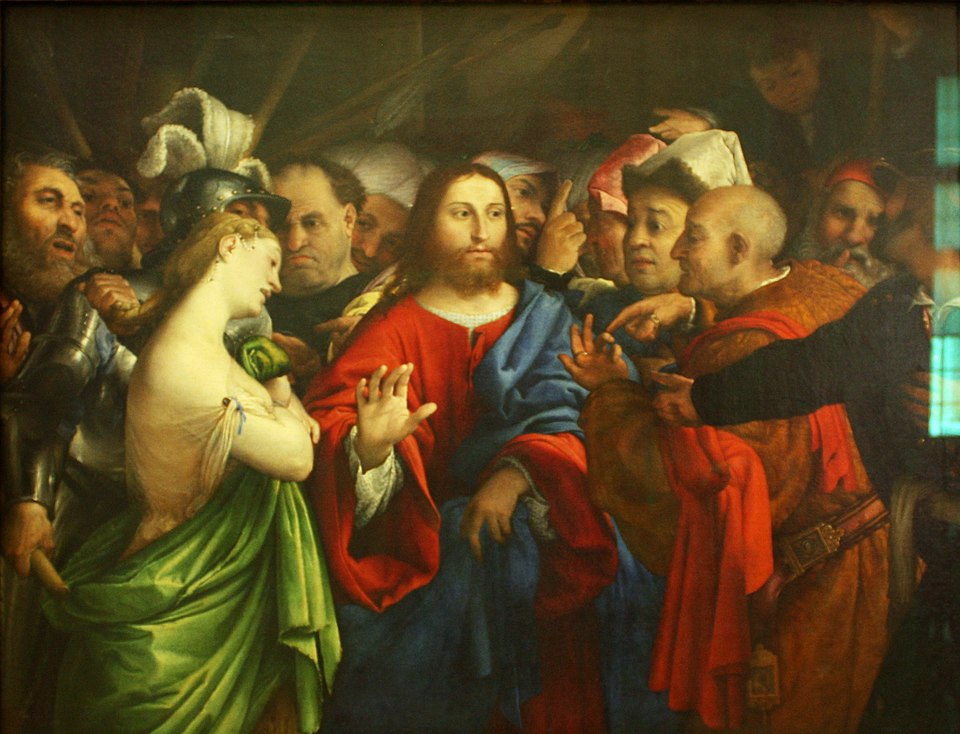
Painting: La Femme adultère “The woman Taken in Adultery” by Lorenzo Lotto

Jesus returned to the Mount of Olives, but early the next morning he was back again at the Temple. A crowd soon gathered, and he sat down and taught them. As he was speaking, the teachers of religious law and the Pharisees brought a woman who had been caught in the act of adultery. They put her in front of the crowd.

“Teacher,” they said to Jesus, “this woman was caught in the act of adultery. The law of Moses says to stone her. What do you say?”

They were trying to trap him into saying something they could use against him, but Jesus stooped down and wrote in the dust with his finger. They kept demanding an answer, so he stood up again and said, “All right, but let the one who has never sinned throw the first stone!” Then he stooped down again and wrote in the dust.

When the accusers heard this, they slipped away one by one, beginning with the oldest, until only Jesus was left in the middle of the crowd with the woman. 10 Then Jesus stood up again and said to the woman, “Where are your accusers? Didn’t even one of them condemn you?”

11 “No, Lord,” she said.

And Jesus said, “Neither do I. Go and sin no more.”

John 8:1-11

Dear God, I don’t think this story gets enough time. It’s quite remarkable. My wife and I were talking about something last night and this story came up. I can’t remember what we were saying or the context in which we talked about it, but she mentioned this painting by Lorenzo Lotto to me. It gave me an interesting thought: What would it be like to follow this woman after she left Jesus that day? What was the rest of that day like for her? So I decided to take a little creative break from my 1 Samuel series and spend a little time with this woman this morning.

First, I want to back up and set the context. There was a festival going on in Jerusalem when this happened. It was the Festival of Shelters (John 7:1-10). I Googled that festival and found it was a seven-day commemoration of the years the Israelites spent in tents in the wilderness. That made me think of the book I read last year, The Year of Living Biblically: One Man’s Humble Quest to Follow the Bible as Literally as Possible by A.J. Jacobs. I remembered he had done something that seemed to line up with this so I looked it up. He called in the “Feast of Ingathering–or Sukkoth.” His description seems to indicate it’s the same thing and he said Orthodox Jewish people still celebrate it by building huts and sleeping in them (he was in New York City so he had to build one in his living room). So that’s the context. An annual festival in Jerusalem where a lot of extra people are in town. In fact, this is part of the story when Jesus’s brothers told him to go to Jerusalem and show himself off and he told them he wasn’t going to go, but then he went secretly until starting to teach in the Temple halfway through the festival.

Now, back to this passage. After I read it this morning, I had some thoughts. Let me stress here that ALL of this is my speculation and there is a great likelihood that I’m completely wrong about it. With that disclaimer said, I wonder what the previous 12 hours were like for this woman and then what were the next 12 hours like. What were the circumstances under which she was caught? Who was she? Was she the one who was married to someone else or had she slept with someone who was married to someone else but she was single? Was she a prostitute? In that culture, if she was a prostitute, would they have cared? I believe there were a lot of prostitutes running around and sleeping with married men so my guess is that she was the on who was married and caught. Perhaps her husband caught her that night before and brought her to the Temple for punishment for stoning.

It occurs to me as I write this that this could have been Jesus’s own mother, Mary, when she was pregnant with him. Wow! What a thought. The husband could easily have been Joseph, taking her to the Temple for judgment and stoning. But “Joseph, to whom she was engaged, was a righteous man and did not want to disgrace her publicly, so he decided to break the engagement quietly.” I wonder if Jesus had this same thought that morning. If this had happened to his own mother while she was pregnant with him, it would have been a disaster.

As I’m sitting here (and I think I’m going to have a lot of disjointed, random thoughts this morning), I wonder why stoning was the chosen method of execution for so many sins. Was it because it wasn’t a hands-on approach? Back then, I suppose their options were to physically touch the person and kill them with some sort of blade or do something from a distance like throw stones or shoot an arrow.

Now that I think about it, the Jews under Rome didn’t have the right to execute people (that’s why they needed Pilate to sign off on Jesus’s execution). Was there an exception for stoning? I just Googled that too. Apparently, to compare it with modern American law, there were federal crimes (crimes against the Roman Empire) and state crimes (in this case, crimes against the Jewish religious law). Jesus’s crime was a federal crime because he claimed to be king while adultery or Stephen’s crime in Acts would be against Jewish law and could be executed by the Sanhedrin.

So back to our story. There’s a festival. I’m guessing that the woman’s husband catches her sleeping with someone else during the festival (maybe in someone’s special tent?) and takes her to the Temple for judgment and execution. Lots of anger. Lots of fear. As I’ve heard said in movies and other places before, “Women need a reason to have sex. Men just need a place.” (City Slickers) So perhaps this woman had a reason to not be faithful to her husband. I don’t know. But now she’s here, and she must be both terrified and humiliated. Regretful too. What’s going to happen now?

Then Jesus shows up in the Temple and starts teaching halfway through the Festival. I won’t go into the days he spent talking and everything he said, but, suffice it to say, the Pharisees were none too pleased. Then, on the last day of the festival, what John describes in John 7:37 as “the climax of the festival,” Jesus did one last big provocation about being living water. The Pharisees apparently sent the Temple guards to arrest him but they didn’t. Nicodemus, one of my heroes, tries to defend Jesus with, “Is it legal to convict a man before he is given a hearing?” and he gets jumped on and accused of being a Jesus defender: “Are you from Galilee, too?”

So now our scene takes place on the morning after the festival. Everyone might be a little hungover. This woman might have gotten caught up in the revelry of the night. And now she is standing in front of Jesus. The men (there are likely few if any women present) are simultaneously indignantly ready to stone her and wondering what it would be like to have sex with her (let’s be real, some of them were thinking that–that’s probably the most confident I am about any guesses I’ve made this morning), and she watches Jesus through a bowed head out of the upper part of her peripheral vision. What’s he going to do. So he bends down to write on the ground.

Here’s a new thought. Maybe he bent down to write on the ground so that she could see what he was writing. Maybe he wrote it for her. We assume he was writing to her judges and accusers, but maybe her face was so downcast that he knew this was the only way to communicate love and a new life to her.

So we know this next part. He stands up and affirms they are right that she should be stoned according to the law of Moses. But then he makes an interesting statement that (and again, this is a brand new thought to me) indicates humans don’t have the authority to commit capital punishment: “Let the one who has never sinned throw the first stone!” This statement could be applied to any sin such as murder that we think deserves the death penalty. As sinful creatures, do we have the authority to take a life–even the most heinous life, as the result of a crime? Wars are different animals that I won’t get into right now, but in this area, I think it helps convince me more than ever that capital punishment does not align with Jesus’s teaching.

So now everyone eventually admits they aren’t able to live up to the standard Jesus has now set for capital punishment and walks away, leaving only the woman, to whom Jesus famously says, “Where are your accusers? Didn’t even one of them condemn you?” She says no, and he closes the scene saying, “Neither do I. Go and sin no more.” End scene.

So what happened next? That’s the first thought I had last night when my wife brought up this story. What was the rest of her day like as a forgiven woman? Was her husband one of the people who dropped his stone and walked away? Did he divorce her? Did she have to move in with a friend? And what was the state of her heart from that day forward? If it was a long-term affair, did she break up with the guy? Did she take her freedom from her sin and turn over a new leaf? Did she earnestly start to follow you? Who did she become as a result of this absolution from her sin?

Father, I am not without sin. I have no stones to throw. Jesus taught such a unique…what’s the word I’m looking for? He taught a unique perspective on who we are as humans and who you are as God. Oh, Father, help me to “go and sin no more” and to offer this same opportunity of your unique perspective on who we can be through following you to others. Help me to make this the evangelism that brings your kingdom into this world and drives the hell out of people.

I pray this in Jesus and with your Holy Spirit,

Amen

 
Leave a comment

Posted by on June 6, 2025 in John


Tags: , , , , , , , , , , , , , ,

John 3:10-21

10 Jesus answered and said to him, “Are you the teacher of Israel, and do not know these things? 11 Most assuredly, I say to you, We speak what We know and testify what We have seen, and you do not receive Our witness. 12 If I have told you earthly things and you do not believe, how will you believe if I tell you heavenly things? 13 No one has ascended to heaven but He who came down from heaven, that is, the Son of Man who is in heaven. 14 And as Moses lifted up the serpent in the wilderness, even so must the Son of Man be lifted up, 15 that whoever believes in Him should [c]not perish but have eternal life. 16 For God so loved the world that He gave His only begotten Son, that whoever believes in Him should not perish but have everlasting life. 17 For God did not send His Son into the world to condemn the world, but that the world through Him might be saved.

18 “He who believes in Him is not condemned; but he who does not believe is condemned already, because he has not believed in the name of the only begotten Son of God. 19 And this is the condemnation, that the light has come into the world, and men loved darkness rather than light, because their deeds were evil. 20 For everyone practicing evil hates the light and does not come to the light, lest his deeds should be exposed. 21 But he who does the truth comes to the light, that his deeds may be clearly seen, that they have been done in God.”

John 3:10-21

Dear God, following up on the impromptu prayer I did last night in the chapel, I want to talk a little about the book I finished reading: What is Jesus was Serious about Judgment? by Skye Jethani. I’ve been curious about Skye’s view of how Jesus would address everything from treating people fairly and forgiveness to heaven and hell and what the cut-line is for either destination.

And to be clear, I’m not sure how much stock I put into Jethani’s theological position. I think we are all wrong and none of us can know exactly what life will look like on the other side. Of all of the possibilities, Jethani’s view could be it. If I were putting money on a theological position given all of the options different teacher’s have, I’d put my money most closely to his. I tend to really agree with a lot of his positions. But the truth is, I simply don’t know. I simply don’t know. I am certain there will be a sorting one day. Jesus was clear about that in several parables. But what happens to the goats? It’s a hazy mystery to me. I hope they don’t really suffer for all eternity. As Jethani put it, that does not seem like proportional punishment for the crimes committed.

But I also think the temptation is to get too wrapped up in heaven, hell, the apocalypse, etc., and we forget to live in justice now. Jesus did care about justice in the here and now. And, frankly, although I read the book in order and didn’t skip ahead to the heaven/hell chapters towards the end, I was still distracted by their existence and looking back I don’t remember much of what his other real points were. So let me go back and look at the table of contents to see if that will help some thoughts stick out. Here are some elected chapter titles:

  • If Jesus was serious about justice, then evil empires will always misunderstand God’s justice.
  • If Jesus was serious about justice, then God hears the cries of the oppressed.
  • If Jesus was serious about justice, then experiencing oppression should give us compassion for others.
  • If Jesus was serious about justice, then evil will consume those who practice it.
  • If Jesus was serious about justice, then just laws will lead to community flourishing.
  • If Jesus was serious about justice, then true worship lifts up Christ by lifting up the oppressed.
  • If Jesus was serious about justice, then a heart far from God lacks mercy, not emotions.
  • If Jesus was serious about justice, then justice is about our identity, not the other person’s.
  • If Jesus was serious about justice, then God can be both merciful and angry.
  • If Jesus was serious about justice, then mercy and justice are partners, not enemies.
  • If Jesus was serious about justice, then justice alone won’t rescue us from our sins.
  • If Jesus was serious about justice, then God’s mercy comes with a condition.

Everything else starts getting into your wrath and how that will ultimately be handled, and I don’t want to go there this morning. I just want to sit with how I handle justice in my life. How I handle mercy.

I think the place to start is my own sinfulness and how I handle that. Before I can look at the speck in my neighbor’s eye, I need to look at the log in my own. And the more I truly address my own sins, failures, and foibles, the more empathy and mercy I have for others. To whom much is given much is required. I have been given a lot of mercy. Should I not give a lot in return?

Father, help me to find that line between mercy and justice. There should obviously be consequences for sin. David paid terrible consequences for his sin even though you loved him and cared for him. You forgave me. You even carried your path to Jesus through the woman he stole and murdered for. Maybe you did that more for her than him, now that I think about it. You had choices. You chose the victim to redeem through Solomon and his line. Nice. Help me to love victims, love sinners (who are sinners themselves–we all are), and carry your mercy into this world.

I pray this in Jesus and with your Holy Spirit,

Amen

 
Leave a comment

Posted by on May 26, 2025 in John


Tags: , , , , , , , ,

Judas and Barabbas Revisited

Judas and Barabbas

Matthew

26 When Jesus had finished saying all these things, he said to his disciples, “As you know, Passover begins in two days, and the Son of Man will be handed over to be crucified.”

At that same time the leading priests and elders were meeting at the residence of Caiaphas, the high priest, plotting how to capture Jesus secretly and kill him. “But not during the Passover celebration,” they agreed, “or the people may riot.”

Meanwhile, Jesus was in Bethany at the home of Simon, a man who had previously had leprosy. While he was eating, a woman came in with a beautiful alabaster jar of expensive perfume and poured it over his head.

The disciples were indignant when they saw this. “What a waste!” they said. “It could have been sold for a high price and the money given to the poor.”

10 But Jesus, aware of this, replied, “Why criticize this woman for doing such a good thing to me? 11 You will always have the poor among you, but you will not always have me. 12 She has poured this perfume on me to prepare my body for burial. 13 I tell you the truth, wherever the Good News is preached throughout the world, this woman’s deed will be remembered and discussed.”

14 Then Judas Iscariot, one of the twelve disciples, went to the leading priests 15 and asked, “How much will you pay me to betray Jesus to you?” And they gave him thirty pieces of silver. 16 From that time on, Judas began looking for an opportunity to betray Jesus.

Matthew 26:1-16

27 Very early in the morning the leading priests and the elders of the people met again to lay plans for putting Jesus to death. Then they bound him, led him away, and took him to Pilate, the Roman governor.

When Judas, who had betrayed him, realized that Jesus had been condemned to die, he was filled with remorse. So he took the thirty pieces of silver back to the leading priests and the elders. “I have sinned,” he declared, “for I have betrayed an innocent man.”

“What do we care?” they retorted. “That’s your problem.”

Then Judas threw the silver coins down in the Temple and went out and hanged himself.

Matthew 27:1-5

15 Now it was the governor’s custom each year during the Passover celebration to release one prisoner to the crowd—anyone they wanted. 16 This year there was a notorious prisoner, a man named Barabbas. 17 As the crowds gathered before Pilate’s house that morning, he asked them, “Which one do you want me to release to you—Barabbas, or Jesus who is called the Messiah?” 18 (He knew very well that the religious leaders had arrested Jesus out of envy.)

19 Just then, as Pilate was sitting on the judgment seat, his wife sent him this message: “Leave that innocent man alone. I suffered through a terrible nightmare about him last night.”

20 Meanwhile, the leading priests and the elders persuaded the crowd to ask for Barabbas to be released and for Jesus to be put to death. 21 So the governor asked again, “Which of these two do you want me to release to you?”

The crowd shouted back, “Barabbas!”

22 Pilate responded, “Then what should I do with Jesus who is called the Messiah?”

They shouted back, “Crucify him!”

23 “Why?” Pilate demanded. “What crime has he committed?”

But the mob roared even louder, “Crucify him!”

24 Pilate saw that he wasn’t getting anywhere and that a riot was developing. So he sent for a bowl of water and washed his hands before the crowd, saying, “I am innocent of this man’s blood. The responsibility is yours!”

25 And all the people yelled back, “We will take responsibility for his death—we and our children!”

26 So Pilate released Barabbas to them. He ordered Jesus flogged with a lead-tipped whip, then turned him over to the Roman soldiers to be crucified.

Matthew 27:15-26

Mark

14 It was now two days before Passover and the Festival of Unleavened Bread. The leading priests and the teachers of religious law were still looking for an opportunity to capture Jesus secretly and kill him. “But not during the Passover celebration,” they agreed, “or the people may riot.”

Meanwhile, Jesus was in Bethany at the home of Simon, a man who had previously had leprosy. While he was eating, a woman came in with a beautiful alabaster jar of expensive perfume made from essence of nard. She broke open the jar and poured the perfume over his head.

Some of those at the table were indignant. “Why waste such expensive perfume?” they asked. “It could have been sold for a year’s wages and the money given to the poor!” So they scolded her harshly.

But Jesus replied, “Leave her alone. Why criticize her for doing such a good thing to me? You will always have the poor among you, and you can help them whenever you want to. But you will not always have me. She has done what she could and has anointed my body for burial ahead of time. I tell you the truth, wherever the Good News is preached throughout the world, this woman’s deed will be remembered and discussed.”

10 Then Judas Iscariot, one of the twelve disciples, went to the leading priests to arrange to betray Jesus to them. 11 They were delighted when they heard why he had come, and they promised to give him money. So he began looking for an opportunity to betray Jesus.

Mark 14:1-11

Now it was the governor’s custom each year during the Passover celebration to release one prisoner—anyone the people requested. One of the prisoners at that time was Barabbas, a revolutionary who had committed murder in an uprising. The crowd went to Pilate and asked him to release a prisoner as usual.

“Would you like me to release to you this ‘King of the Jews’?” Pilate asked. 10 (For he realized by now that the leading priests had arrested Jesus out of envy.) 11 But at this point the leading priests stirred up the crowd to demand the release of Barabbas instead of Jesus. 12 Pilate asked them, “Then what should I do with this man you call the king of the Jews?”

13 They shouted back, “Crucify him!”

14 “Why?” Pilate demanded. “What crime has he committed?”

But the mob roared even louder, “Crucify him!”

15 So to pacify the crowd, Pilate released Barabbas to them. He ordered Jesus flogged with a lead-tipped whip, then turned him over to the Roman soldiers to be crucified.

Mark 15:6-15

Luke

22 The Festival of Unleavened Bread, which is also called Passover, was approaching. The leading priests and teachers of religious law were plotting how to kill Jesus, but they were afraid of the people’s reaction.

Then Satan entered into Judas Iscariot, who was one of the twelve disciples, and he went to the leading priests and captains of the Temple guard to discuss the best way to betray Jesus to them. They were delighted, and they promised to give him money. So he agreed and began looking for an opportunity to betray Jesus so they could arrest him when the crowds weren’t around.

Luke 22:1-6

13 Then Pilate called together the leading priests and other religious leaders, along with the people, 14 and he announced his verdict. “You brought this man to me, accusing him of leading a revolt. I have examined him thoroughly on this point in your presence and find him innocent. 15 Herod came to the same conclusion and sent him back to us. Nothing this man has done calls for the death penalty. 16 So I will have him flogged, and then I will release him.”

18 Then a mighty roar rose from the crowd, and with one voice they shouted, “Kill him, and release Barabbas to us!” 19 (Barabbas was in prison for taking part in an insurrection in Jerusalem against the government, and for murder.) 20 Pilate argued with them, because he wanted to release Jesus. 21 But they kept shouting, “Crucify him! Crucify him!”

22 For the third time he demanded, “Why? What crime has he committed? I have found no reason to sentence him to death. So I will have him flogged, and then I will release him.”

23 But the mob shouted louder and louder, demanding that Jesus be crucified, and their voices prevailed. 24 So Pilate sentenced Jesus to die as they demanded. 25 As they had requested, he released Barabbas, the man in prison for insurrection and murder. But he turned Jesus over to them to do as they wished.

Luke 23:13-25

John

12 Six days before the Passover celebration began, Jesus arrived in Bethany, the home of Lazarus—the man he had raised from the dead. A dinner was prepared in Jesus’ honor. Martha served, and Lazarus was among those who ate[a] with him. Then Mary took a twelve-ounce jar of expensive perfume made from essence of nard, and she anointed Jesus’ feet with it, wiping his feet with her hair. The house was filled with the fragrance.

But Judas Iscariot, the disciple who would soon betray him, said, “That perfume was worth a year’s wages. It should have been sold and the money given to the poor.” Not that he cared for the poor—he was a thief, and since he was in charge of the disciples’ money, he often stole some for himself.

Jesus replied, “Leave her alone. She did this in preparation for my burial. You will always have the poor among you, but you will not always have me.”

John 12:1-8

It was time for supper, and the devil had already prompted Judas, son of Simon Iscariot, to betray Jesus.

John 13:2

38 “What is truth?” Pilate asked. Then he went out again to the people and told them, “He is not guilty of any crime. 39 But you have a custom of asking me to release one prisoner each year at Passover. Would you like me to release this ‘King of the Jews’?”

40 But they shouted back, “No! Not this man. We want Barabbas!” (Barabbas was a revolutionary.)

John 18:38-40

Dear God, I came across this prayer from December 2023 recently, and I wondered if it wouldn’t make a good Sunday school lesson. I’m teaching this Sunday and then I’m also starting a weekly Bible study next Monday the 14th so I want to dust this off and sit with it again for a bit.

The prayer I did back in December 2023 was long. Honestly, I’m surprised I spent that much time with it. I wonder how long it took me to put all of the scriptures together from all four gospels. Regardless, it’s interesting to think about and then compare the world then and the world now. Are we really that much different? Does the perceived weakness in Jesus then still frustrate us today. Is his way (read: your way) too soft? Don’t you realize the only way to get things done is to do this like Barabbas tried, but with your power?

I was talking with a guy on Friday, and he was rattling off presidents he thought were too week and wimpy. It was basically everyone since Reagan with the exception of the current president. H.W. and W. were to wimpy. I pushed back a little on W., saying I hadn’t heard that or thought that about him, but he was saying W. was too nice.

Oh, Father, help us. I get the feeling that’s what the church now thinks is true: nice gets you nowhere. Nice leaves you vulnerable. Nice is weak. Nice will lead to your destruction. We need tough. We need warriors. We need to fight. I said a couple of years ago that the logical fulfillment of Christian Nationalism is the Spanish Inquisition and, ultimately, the Crusades. As I look at what is happening now and how we are trying to nationalize Christianity and punish our allies for not being more like us I think it’s happening faster than I thought it would. And oh, how it will destroy trust in you. The first- and second-century churches were seen as loving and caring. That’s all they had to offer, and that’s still all we should have to offer because that’s who you are. You are loving and caring. Do you judge? Sure. Do you condemn? Yes. But that’s up to you to do. Our job is to love you with everything we have and love our neighbors as our selves. That includes our enemies. So help me to do that today. And help me to take that attitude into the world. I love you. I want to love like you.

I pray this in Jesus and with your Holy Spirit,

Amen
 
Leave a comment

Posted by on May 5, 2025 in John, Luke, Mark, Matthew


Tags: , , , , ,

John 21:18-25

18 Truly, truly, I say to you, when you were younger, you used to gird yourself and walk wherever you wished; but when you grow old, you will stretch out your hands and someone else will gird you, and bring you where you do not wish to go.” 19 Now this He said, signifying by what kind of death he would glorify God. And when He had spoken this, He *said to him, “Follow Me!”

20 Peter, turning around, *saw the disciple whom Jesus loved following them; the one who also had leaned back on His bosom at the supper and said, “Lord, who is the one who betrays You?” 21 So Peter seeing him *said to Jesus, “Lord, and what about this man?” 22 Jesus *said to him, “If I want him to remain until I come, what is that to you? You follow Me!” 23 Therefore this saying went out among the brethren that that disciple would not die; yet Jesus did not say to him that he would not die, but only, “If I want him to remain until I come, what is that to you?”

24 This is the disciple who is testifying to these things and wrote these things, and we know that his testimony is true.

25 And there are also many other things which Jesus did, which if they *were written in detail, I suppose that even the world itself *would not contain the books that *would be written.

John 21:18-25

Dear God, I want to sit with John towards the end of his life for a moment. He could have sat down and told these stories for someone to write a long time ago. He could have done it immediately. But he didn’t. The end of John actually gives us, or at least I think it gives me, a little image of him sitting on the Island of Patmos deciding to get all of this down before he died (I know there are debates about when he wrote this, but I’m sitting with the “old John” as the author).

What’s always struck me about this book is that almost a third of it is spent on the Last Supper and that it ends so abruptly. Why not finish Jesus’s earthly life or end on a more grand scale. Matthew ends with the “Great Commission.” Mark and Luke end with a quick reference to the ascension (although Luke also starts Acts with a more detailed description of the ascension). But John just tells this story about Peter’s restoration and conversation with Jesus. It’s almost like the last thing he wanted to do was ensure everyone knew that Peter was the leader.

It makes me think of the stories that involve just Peter and John. The two that come to mind immediately where it’s just the two of them without James is when they run to the tomb, John gets there first, but Peter goes in first. Then there’s the story in Acts of the time they are walking about the fountain, the beggar cries out to them, and Peter answers, “Silver and gold have I none…” The common denominator in these stories is that Peter is the leader. Peter is the one willing to go into the tomb. Peter is the one who speaks to the beggar. Even during the Transfiguration, Peter is the one who is foolish and tries to say something in the midst of the amazing situation. And John loved him.

I think John loved a lot of people. I think he loved Nicodemus since the first story of Nicodemus is gentle,, and every reference to Nicodemus after that is flattering towards him. I think, to a certain extent, he loved Pilate. In my opinion, he paints the most gentle image of Pilate of any of the gospels. And he loved Peter. He knew the story of Peter’s betrayal of Jesus was out there. He wanted to make sure the restoration picture was out there too. He’s the only one who tells it.

Father, as I search for a takeaway for myself today, I think what I see is the need to love really love people. John is generous in how he portrays others to us. Help me to be that generous as I portray people I know to others. Help me to build up. And that includes people I don’t like or people who are against me. Help me to be generous of spirit to them. Help me to be kind to them. Help me to love them. Help me to give them the benefit of the doubt. Help me to be curious and not judgmental. Help me to not be jealous, but instead to delight in their good.

I pray all of this in Jesus and with your Holy Spirit,

Amen

 
Leave a comment

Posted by on May 4, 2025 in John


Tags: , , , ,

John 20:19-29

19 That Sunday evening the disciples were meeting behind locked doors because they were afraid of the Jewish leaders. Suddenly, Jesus was standing there among them! “Peace be with you,” he said. 20 As he spoke, he showed them the wounds in his hands and his side. They were filled with joy when they saw the Lord! 21 Again he said, “Peace be with you. As the Father has sent me, so I am sending you.” 22 Then he breathed on them and said, “Receive the Holy Spirit. 23 If you forgive anyone’s sins, they are forgiven. If you do not forgive them, they are not forgiven.”

24 One of the twelve disciples, Thomas (nicknamed the Twin), was not with the others when Jesus came. 25 They told him, “We have seen the Lord!”

But he replied, “I won’t believe it unless I see the nail wounds in his hands, put my fingers into them, and place my hand into the wound in his side.”

26 Eight days later the disciples were together again, and this time Thomas was with them. The doors were locked; but suddenly, as before, Jesus was standing among them. “Peace be with you,” he said. 27 Then he said to Thomas, “Put your finger here, and look at my hands. Put your hand into the wound in my side. Don’t be faithless any longer. Believe!”

28 “My Lord and my God!” Thomas exclaimed.

29 Then Jesus told him, “You believe because you have seen me. Blessed are those who believe without seeing me.”

John 20:19-29

Dear God, this is the gospel reading for many churches today so I thought I would spend some time with it. I guess I noticed a couple of things as I read this:

  • It was eight days after your first visit, and the disciples were still behind a locked door hiding. What was their plan? What were they thinking? Why were they still there? What were their conversations with each other like? Where did they think Jesus was for those eight days? It’s easy to read over those eight days quickly, but it was eight days. As it turned out, they wouldn’t really get out of the locked room until the Holy Spirit came at Pentecost. Jesus breathed on them to receive the Holy Spirit, but the Holy Spirit hadn’t quite come yet.
  • This isn’t exactly a hot take, but Thomas was disillusioned and hopeless. He was hanging with these guys because he had so much invested with them and he was part of their tribe. If he was suffering, at least he knew they were suffering too. To paraphrase Ted Lasso, there is something worse than being sad, and that is to be alone and be sad. At least he wasn’t alone. But he was still hopeless and directionless.
  • You came and loved him. You showed him. You gave him his belief and hope back. In fact, you took that pain and made it count for your glory. He recognized you as his God immediately. And you had grace for him. You understood his disillusionment. You understood why he needed to touch and see. You gave him space for that.

There are times when I see people who have walked away from faith, church, or whatever, and a lot of it is over pain I know they’ve experienced. I have to think that there is something in your nature that recognizes that in them and makes an allowance for it. Kind of like me. I’m sure there are parts of my theology that are based on what I’ve been taught over the years, or what my own pain and trauma has steered me towards or whatever that are wrong. But I think you make allowances for that. I think you are nudging me and guiding me.

I was listening to a podcast this morning, and the two people are both pro-life and have been involved in the pro-life movement at various levels over the years. But they are now coming to the conclusion that you don’t stop abortion by bullying women into not getting an abortion. You love them into it. You do it from the bottom up, not the top down. They feel like your Holy Spirit has moved their hearts on that issue. I hope you will move my heart through these times we spend together as well.

Father, I don’t want to be paralyzed by fear like the disciples seemingly were, even after they saw you. I also don’t want to get out ahead of you. They could have jumped out and started going before the Holy Spirit came. Maybe that’s what they were waiting on. My point is, I don’t want to get ahead of you, but I also don’t want to be paralyzed into inaction. I also want your mercy and I want to give that same mercy to others. I know I’ve been disillusioned about you in the past, and it might happen again. But the illusion is mine, what I wanted to create in my own mind or what has been taught to me. You aren’t responsible for the illusion. What your Holy Spirit is doing for me is helping me see through the illusion and into your true nature. So keep me on the right path. Keep me moving closer to the inside of you and not diverting by my own foolishness or prejudices.

I pray this in Jesus and with your Holy Spirit,

Amen

 
Leave a comment

Posted by on April 27, 2025 in John


Tags: , , , , , , , , , ,

John 10:22-33

22 It was now winter, and Jesus was in Jerusalem at the time of Hanukkah, the Festival of Dedication. 23 He was in the Temple, walking through the section known as Solomon’s Colonnade. 24 The people surrounded him and asked, “How long are you going to keep us in suspense? If you are the Messiah, tell us plainly.”

25 Jesus replied, “I have already told you, and you don’t believe me. The proof is the work I do in my Father’s name. 26 But you don’t believe me because you are not my sheep. 27 My sheep listen to my voice; I know them, and they follow me. 28 I give them eternal life, and they will never perish. No one can snatch them away from me, 29 for my Father has given them to me, and he is more powerful than anyone else. No one can snatch them from the Father’s hand. 30 The Father and I are one.”

31 Once again the people picked up stones to kill him. 32 Jesus said, “At my Father’s direction I have done many good works. For which one are you going to stone me?”

33 They replied, “We’re stoning you not for any good work, but for blasphemy! You, a mere man, claim to be God.”

John 10:22-33

Dear God, sometimes we’ve just made up our minds and no answer will suffice. The group of people around Jesus that day already had their minds made up. No answer Jesus gave would have sufficed and made them believe. If he had said, “Yes, I am the Messiah. Get behind me and let’s make Israel great again,” they would have stoned him. If he had said, “Yes, I am the Messiah, but it’s not what you’ve always thoughts. I am here to die and come back to life for the redemption of the world’s sins and reconciliation of Jews and Gentiles to the Father,” they would have stoned him. The only answer that would have gotten him out of danger would have been a lie: “Who me? No, I’m not the Messiah!”

There are so many areas in life where I’ve already made up my mind. My heart is hard. Sometimes it’s easier to just walk away than go through the hard work of reconciliation. Or maybe I’ve developed a way of doing business at work that is out of date, but I keep doing it because it is comfortable, it is what I know, and it’s how it worked in the past.

Father, I need your Holy Spirit to speak to me gently but clearly. Well, maybe not even so gently if that’s what it takes. But I need to know when my thinking is stubborn and harmful. When I put a ceiling on people or opportunities. When I can’t see the whole picture through my limitations, so I shut down and decide to not see at all. I don’t want to be the people in the Temple from this story (I assume it’s largely the Pharisees). I want to love. I want to care about others and the work you have for me to do. I told my wife yesterday that, with Lent over and the Lenten meditations I was putting up daily on Facebook done, I feel like I need a new project. So then I set about trying to find something new on my own instead of waiting on your timing. Kind of like Peter looking for Judas’s replacement in Matthias instead of waiting on you to bring Paul around. So help me to wait. And help me to hear. Help me to learn. Help me to see.

I pray this in Jesus and with your Holy Spirit,

Amen

 
Leave a comment

Posted by on April 21, 2025 in John


Tags: , , , ,

John 30b

Jesus said, “It is finished.” With that, he bowed his head and gave up his spirit.

John 30b

Dear God, I normally rush into typing when I read the passage of the day, but I want to slow down this morning and really think about these three English words. I don’t know the Aramaic Jesus would have spoken, but the New Living Translation translators gave me the words, “It is finished.” In fact, I just looked up several translations, and all but The Message had those three words. For his part, Eugene Peterson wrote in The Message, “It is done…complete.” What are all of the implications of those words?

  • All of the triaging of the Old Testament sinning is finished. I heard someone describe the Old Testament as you responding to the sins of Israel. That was over now.
  • The separation of Jews and Gentiles was finished. We are all invited into your kingdom.
  • The path to reconciliation between all of us and yourself was finished.
  • Jesus’s earthly mission was finished.
  • The painful Passion was finished. Jesus was dreading it so much. Now, it was done. Finished. Oh, I’m so sorry he had to do that for me. I truly am sorry.

From Sister Miriam today in Restore: A Guided Lent Journal for Prayer and Meditation: “Good Friday. The great equalizer of human kind. Rich, poor, young, old, powerful, weak–all kneel before the Cross of Jesus Christ. There are no words. In the noisy chaos of Jerusalem, crowds, political struggles, and the lament of Calvary, a silence reigns midafternoon on that great and terrible day. What can be said as we gaze upon him? What can be said as we behold the Man, broken and bloodied?”

Father, the idea that I have come along on this earth 2,000 years after this moment is humbling. Honestly, my little American life in 2025 almost seems way too easy. I am humbled by Jesus. I am humbled by the generations and generations that have come before me. I am humbled by the people in my current world, even in my community, who suffer now. I am humbled, Father. I am simply humbled. Teach me to love you and love others.

I pray this in Jesus and with your Holy Spirit,

Amen


Tags: , , , , , , , , ,

John 13:36-37

36 Simon Peter asked, “Lord, where are you going?”

And Jesus replied, “You can’t go with me now, but you will follow me later.”

37 “But why can’t I come now, Lord?” he asked. “I’m ready to die for you.”

John 13:36-37

Dear God, Peter gets a bad rap when it comes to chickening out after Jesus was arrested. It’s true. After Jesus was arrested, Peter caved, but before the arrest, he was ready to go. He was wielding a sword. He was ready to go down swinging. He had been emotionally preparing himself for this. It was go time!

But how would it have helped Jesus if Peter had turned himself in after the arrest? Jesus was beyond saving at that point, and Peter knew it. I’m not saying what Peter did was right. I’m not saying he shouldn’t have been ashamed of himself when he did it. I’m just saying I get it, and what he did is not, in my opinion, a mark of cowardice.

In Restore: A Guided Lent Journal for Prayer and Meditation, Sister Miriam concludes today’s entry with, “Jesus is so good to Peter and so attentive to his heart and the damage he did to himself by his own denial that Jesus will set up another scene by a charcoal fire, this one leading to a threefold affirmation of love and restoration (see John 21:9-19). Nothing is wasted on Jesus. Jesus uses everything in our lives to bring about restoration if we allow him to do so.” I like the image of “nothing wasted.” It reminds me of the prayer someone taught me years ago about making the pain count. Don’t let it be wasted.

Father, Jesus experienced unbelievable pain 2,000 years ago, but, oh, how you made it count! And there is a lot of pain in the world that is greater than the pain I experience. Please don’t let it be wasted. Make it count. The world is a big place. Bigger than I can fathom. And time is long. Longer than I can imagine. You are moving things in the world and nudging them here and there in ways that are way beyond my ability to comprehend. So I won’t try. I’ll just thank you, worship you, love you, and serve you. “Take my life, Lord. Let it be consecrated, Lord, to thee.”

I pray this in Jesus and with your Holy Spirit,

Amen


Tags: , , , , , , ,

John 11:45-54

45 Many of the people who were with Mary believed in Jesus when they saw this happen. 46 But some went to the Pharisees and told them what Jesus had done. 47 Then the leading priests and Pharisees called the high council together. “What are we going to do?” they asked each other. “This man certainly performs many miraculous signs. 48 If we allow him to go on like this, soon everyone will believe in him. Then the Roman army will come and destroy both our Temple and our nation.”

49 Caiaphas, who was high priest at that time, said, “You don’t know what you’re talking about! 50 You don’t realize that it’s better for you that one man should die for the people than for the whole nation to be destroyed.”

51 He did not say this on his own; as high priest at that time he was led to prophesy that Jesus would die for the entire nation. 52 And not only for that nation, but to bring together and unite all the children of God scattered around the world.

53 So from that time on, the Jewish leaders began to plot Jesus’ death. 54 As a result, Jesus stopped his public ministry among the people and left Jerusalem. He went to a place near the wilderness, to the village of Ephraim, and stayed there with his disciples.

John 11:45-54

Dear God, I don’t know where Sister Miriam is going to go with this passage in today’s entry in Restore: A Guided Lent Journal for Prayer and Meditation, but I had a thought as I read it. You made this plan Caiaphas-proof. Caiaphas was wrong. He thought Jesus was here to lead a revolution. He thought the people were stupid enough to follow him into a hopeless revolution. He thought he was protecting everyone. He thought he was doing the right thing.

I wonder what would have happened if Caiaphas had gone to Jesus in the night like Nicodemus did back in John 3 and just asked him flat out, “Jesus, you’re obviously special. Please explain to me what you’re up to.” In retrospect, that’s what he should have done although that would have changed your plan. Yeah, everything worked the way it was supposed to. Maybe it was because Jesus had been so insulting of the Pharisees up to that point. Maybe Caiaphas’s heart was already hardened, much like Pharoah’s. Little did he know the Temple was already going to be destroyed in a few years. Nothing lasts forever.

In her writing for today, Sister Miriam is still talking about forgiveness, both accepting it and offering it to others. I still don’t quite understand how she links it to this passage except that Jesus’s real purpose was to offer forgiveness to us. But she has a line that made me think of Caiaphas: “We offer to Jesus our pain, agony, bitterness, and hardened hearts, and he takes our offering, brings it to his heart upon the Cross on which he hangs, and in return offers us mercy for the forgiveness of our own sins, healing from the sins others have committed against us, and the restoration of our lives.” Just the fact that I had mentioned Caiaphas’s hardened heart and she included “hardened hearts” in her writing made me curious about Caiaphas. What were his hurts? What were his fears? What needed forgiven in his life. Whom did he need to forgive?

Father, I am sorry. I have been arrogant. I have been judgmental. I have been harsh. I have been selfish and self-indulgent. Oh, my Jesus, as I sit here now, imagining you on the Cross, I am grateful. And I’m so sorry. I have no right to expect anything out of life, including the kindness of others to me. I already have it so much better than I deserve because you are with me. You love me. You forgive me. Thank you. Help me to release others from what I think they owe me and to simply live in the gratitude of what you’ve done for me and then offer that same gift from you to them.

I pray this in Jesus and with your Holy Spirit,

Amen


Tags: , , , , , , , ,