RSS

Tag Archives: The Year of Living Biblically

John 8:1-11

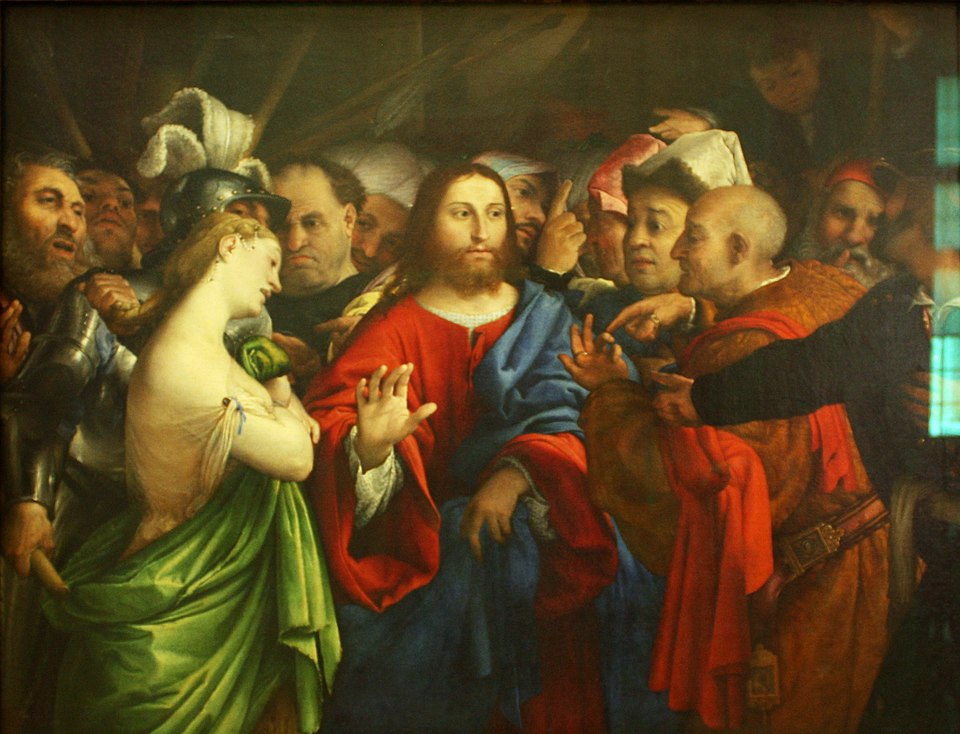
Painting: La Femme adultère “The woman Taken in Adultery” by Lorenzo Lotto

Jesus returned to the Mount of Olives, but early the next morning he was back again at the Temple. A crowd soon gathered, and he sat down and taught them. As he was speaking, the teachers of religious law and the Pharisees brought a woman who had been caught in the act of adultery. They put her in front of the crowd.

“Teacher,” they said to Jesus, “this woman was caught in the act of adultery. The law of Moses says to stone her. What do you say?”

They were trying to trap him into saying something they could use against him, but Jesus stooped down and wrote in the dust with his finger. They kept demanding an answer, so he stood up again and said, “All right, but let the one who has never sinned throw the first stone!” Then he stooped down again and wrote in the dust.

When the accusers heard this, they slipped away one by one, beginning with the oldest, until only Jesus was left in the middle of the crowd with the woman. 10 Then Jesus stood up again and said to the woman, “Where are your accusers? Didn’t even one of them condemn you?”

11 “No, Lord,” she said.

And Jesus said, “Neither do I. Go and sin no more.”

John 8:1-11

Dear God, I don’t think this story gets enough time. It’s quite remarkable. My wife and I were talking about something last night and this story came up. I can’t remember what we were saying or the context in which we talked about it, but she mentioned this painting by Lorenzo Lotto to me. It gave me an interesting thought: What would it be like to follow this woman after she left Jesus that day? What was the rest of that day like for her? So I decided to take a little creative break from my 1 Samuel series and spend a little time with this woman this morning.

First, I want to back up and set the context. There was a festival going on in Jerusalem when this happened. It was the Festival of Shelters (John 7:1-10). I Googled that festival and found it was a seven-day commemoration of the years the Israelites spent in tents in the wilderness. That made me think of the book I read last year, The Year of Living Biblically: One Man’s Humble Quest to Follow the Bible as Literally as Possible by A.J. Jacobs. I remembered he had done something that seemed to line up with this so I looked it up. He called in the “Feast of Ingathering–or Sukkoth.” His description seems to indicate it’s the same thing and he said Orthodox Jewish people still celebrate it by building huts and sleeping in them (he was in New York City so he had to build one in his living room). So that’s the context. An annual festival in Jerusalem where a lot of extra people are in town. In fact, this is part of the story when Jesus’s brothers told him to go to Jerusalem and show himself off and he told them he wasn’t going to go, but then he went secretly until starting to teach in the Temple halfway through the festival.

Now, back to this passage. After I read it this morning, I had some thoughts. Let me stress here that ALL of this is my speculation and there is a great likelihood that I’m completely wrong about it. With that disclaimer said, I wonder what the previous 12 hours were like for this woman and then what were the next 12 hours like. What were the circumstances under which she was caught? Who was she? Was she the one who was married to someone else or had she slept with someone who was married to someone else but she was single? Was she a prostitute? In that culture, if she was a prostitute, would they have cared? I believe there were a lot of prostitutes running around and sleeping with married men so my guess is that she was the on who was married and caught. Perhaps her husband caught her that night before and brought her to the Temple for punishment for stoning.

It occurs to me as I write this that this could have been Jesus’s own mother, Mary, when she was pregnant with him. Wow! What a thought. The husband could easily have been Joseph, taking her to the Temple for judgment and stoning. But “Joseph, to whom she was engaged, was a righteous man and did not want to disgrace her publicly, so he decided to break the engagement quietly.” I wonder if Jesus had this same thought that morning. If this had happened to his own mother while she was pregnant with him, it would have been a disaster.

As I’m sitting here (and I think I’m going to have a lot of disjointed, random thoughts this morning), I wonder why stoning was the chosen method of execution for so many sins. Was it because it wasn’t a hands-on approach? Back then, I suppose their options were to physically touch the person and kill them with some sort of blade or do something from a distance like throw stones or shoot an arrow.

Now that I think about it, the Jews under Rome didn’t have the right to execute people (that’s why they needed Pilate to sign off on Jesus’s execution). Was there an exception for stoning? I just Googled that too. Apparently, to compare it with modern American law, there were federal crimes (crimes against the Roman Empire) and state crimes (in this case, crimes against the Jewish religious law). Jesus’s crime was a federal crime because he claimed to be king while adultery or Stephen’s crime in Acts would be against Jewish law and could be executed by the Sanhedrin.

So back to our story. There’s a festival. I’m guessing that the woman’s husband catches her sleeping with someone else during the festival (maybe in someone’s special tent?) and takes her to the Temple for judgment and execution. Lots of anger. Lots of fear. As I’ve heard said in movies and other places before, “Women need a reason to have sex. Men just need a place.” (City Slickers) So perhaps this woman had a reason to not be faithful to her husband. I don’t know. But now she’s here, and she must be both terrified and humiliated. Regretful too. What’s going to happen now?

Then Jesus shows up in the Temple and starts teaching halfway through the Festival. I won’t go into the days he spent talking and everything he said, but, suffice it to say, the Pharisees were none too pleased. Then, on the last day of the festival, what John describes in John 7:37 as “the climax of the festival,” Jesus did one last big provocation about being living water. The Pharisees apparently sent the Temple guards to arrest him but they didn’t. Nicodemus, one of my heroes, tries to defend Jesus with, “Is it legal to convict a man before he is given a hearing?” and he gets jumped on and accused of being a Jesus defender: “Are you from Galilee, too?”

So now our scene takes place on the morning after the festival. Everyone might be a little hungover. This woman might have gotten caught up in the revelry of the night. And now she is standing in front of Jesus. The men (there are likely few if any women present) are simultaneously indignantly ready to stone her and wondering what it would be like to have sex with her (let’s be real, some of them were thinking that–that’s probably the most confident I am about any guesses I’ve made this morning), and she watches Jesus through a bowed head out of the upper part of her peripheral vision. What’s he going to do. So he bends down to write on the ground.

Here’s a new thought. Maybe he bent down to write on the ground so that she could see what he was writing. Maybe he wrote it for her. We assume he was writing to her judges and accusers, but maybe her face was so downcast that he knew this was the only way to communicate love and a new life to her.

So we know this next part. He stands up and affirms they are right that she should be stoned according to the law of Moses. But then he makes an interesting statement that (and again, this is a brand new thought to me) indicates humans don’t have the authority to commit capital punishment: “Let the one who has never sinned throw the first stone!” This statement could be applied to any sin such as murder that we think deserves the death penalty. As sinful creatures, do we have the authority to take a life–even the most heinous life, as the result of a crime? Wars are different animals that I won’t get into right now, but in this area, I think it helps convince me more than ever that capital punishment does not align with Jesus’s teaching.

So now everyone eventually admits they aren’t able to live up to the standard Jesus has now set for capital punishment and walks away, leaving only the woman, to whom Jesus famously says, “Where are your accusers? Didn’t even one of them condemn you?” She says no, and he closes the scene saying, “Neither do I. Go and sin no more.” End scene.

So what happened next? That’s the first thought I had last night when my wife brought up this story. What was the rest of her day like as a forgiven woman? Was her husband one of the people who dropped his stone and walked away? Did he divorce her? Did she have to move in with a friend? And what was the state of her heart from that day forward? If it was a long-term affair, did she break up with the guy? Did she take her freedom from her sin and turn over a new leaf? Did she earnestly start to follow you? Who did she become as a result of this absolution from her sin?

Father, I am not without sin. I have no stones to throw. Jesus taught such a unique…what’s the word I’m looking for? He taught a unique perspective on who we are as humans and who you are as God. Oh, Father, help me to “go and sin no more” and to offer this same opportunity of your unique perspective on who we can be through following you to others. Help me to make this the evangelism that brings your kingdom into this world and drives the hell out of people.

I pray this in Jesus and with your Holy Spirit,

Amen

 
Leave a comment

Posted by on June 6, 2025 in John


Tags: , , , , , , , , , , , , , ,

Galatians 1:13-24

13 You know what I was like when I followed the Jewish religion—how I violently persecuted God’s church. I did my best to destroy it. 14 I was far ahead of my fellow Jews in my zeal for the traditions of my ancestors.

15 But even before I was born, God chose me and called me by his marvelous grace. Then it pleased him 16 to reveal his Son to me so that I would proclaim the Good News about Jesus to the Gentiles.

When this happened, I did not rush out to consult with any human being. 17 Nor did I go up to Jerusalem to consult with those who were apostles before I was. Instead, I went away into Arabia, and later I returned to the city of Damascus.

18 Then three years later I went to Jerusalem to get to know Peter, and I stayed with him for fifteen days. 19 The only other apostle I met at that time was James, the Lord’s brother. 20 I declare before God that what I am writing to you is not a lie.

21 After that visit I went north into the provinces of Syria and Cilicia. 22 And still the churches in Christ that are in Judea didn’t know me personally. 23 All they knew was that people were saying, “The one who used to persecute us is now preaching the very faith he tried to destroy!” 24 And they praised God because of me.

Galatians 1:13-24

Dear God, what strikes me about this passage this morning is the end in verses 23 and 24. It intimates the struggle of Christians in Syria and Cilicia of the time. They were being persecuted for their beliefs. They knew there were people they shouldn’t trust. They were pressed but not crushed (2 Corinthians 4:8). They were worshiping you. They were figuring out their faith. And then they heard about this miracle. One of the people they would have been told to fear in the past was now not only safe to be around, but was also being persecuted himself.

I think this gave these people two things. First, it showed them how powerful you are. They God they were worshiping was amazing. Second, it taught them that if someone who had worked so hard to destroy belief in Jesus had so thoroughly had his mind changed, then it must be real. Paul had an incredible testimony to share.

Frankly, everything you do really is amazing. I finally finished the A.J. Jacobs’s book, The Year of Living Biblically: One Man’s Humble Quest to Follow the Bible as Literally as Possible. It took me a while, but I really feel like I savored it. It was interesting to see where he came to at the end of it. I look forward to listening to some of his talks about the book on YouTube now that I’ve finished it. By the end, a Jewish man who considered himself agnostic before the project ended the project still agnostic, but maybe a little less so. Here’s what he said about his belief in you at the end of his year:

Do I believe in a traditional biblical God? Well, not in the sense that the ancient Israelites believed in Him. I could never make the full leap to accepting a God who rolls up His sleeves and fiddles with our lives like a novelist does his characters. I’m still agnostic. But in the words of Elton Richards, I’m not a reverent agnostic. Which isn’t an oxymoron, I swear. I now believe that whether or not there’s a God, there is such a thing as sacredness. Life is sacred. The Sabbath can be a sacred day. Prayer can be a sacred ritual. There is something transcendent, beyond the everyday. it’s possible that humans created this sacredness ourselves, but that doesn’t take away from its power or importance.”

Father, I don’t know where I’m really going with this prayer this morning except to say that I really appreciate the journey you have us all on. I can appreciate my own journey. It is a mixture of success and sorrow. I do know that the closer I get to you the more I have love in my heart for others and the less I judge. I also realize there is less and less I feel like I know for sure. You are so much bigger than me. Life is so much bigger than me. My job today is to simply love you and then love others. You’ll figure out the rest.

I pray this in Jesus and with your Holy Spirit,

Amen

 
Leave a comment

Posted by on October 8, 2024 in Galatians


Tags: ,

James 3:13

13 If you are wise and understand God’s ways, prove it by living an honorable life, doing good works with the humility that comes from wisdom. 

James 3:13

Dear God, I was thinking about this while I was in church yesterday. The New Testament reading was from James, and I was thinking about how James gets a bad rap because some accuse him of being “works-based.” But I tend to see it more like the Sermon on the Mount. In the Sermon on the Mount, Jesus is raising the bar and setting a high standard, but he isn’t saying that we have to do those things for our redemption and justification before you. He is saying that we should be doing those things out of our relationship with you and growing into being more and more like you. And they are for our good.

I was reading more of The Year of Living Biblically last night (I know, I’m a slow reader and I haven’t been making much progress lately), and A.J. Jacobs finally got to the New Testament. What surprised me was how nervous he was about it. He is culturally Jewish, so I think there is a natural thought he grew up with that Jesus is dangerous. He is a false prophet and not the Messiah. And he has spend the first eight or nine months being so dogmatic about the commands of the Old Testament, he is now trying to figure out how he will unravel some of it and replace it with Jesus. I have a feeling this might be my favorite part of the book. Watching someone come to you with fresh eyes. Feeling you out. Truly and thoughtfully exploring the difference between what he has spent the better part of a year experiencing and now the unexpected twist you added to the equation 2,000 years ago.

Father, I don’t love others because I have to. It’s because I get to. I don’t avoid temptation because I have to. It’s because I get to. And the closer I get to you the more…well, the words of “Turn Your Eyes Upon Jesus” fit pretty well.

Turn your eyes upon Jesus
Look full in His wonderful face
And the things of earth
Will grow strangely dim
In the light of His glory and grace

Help me, Father, to remember to turn my eyes upon you today.

I pray this in Jesus and with your Holy Spirit,

Amen

 
Leave a comment

Posted by on September 16, 2024 in James, Uncategorized


Tags: , ,

Colossians 1:25-27

25 God has given me the responsibility of serving his church by proclaiming his entire message to you. 26 This message was kept secret for centuries and generations past, but now it has been revealed to God’s people. 27 For God wanted them to know that the riches and glory of Christ are for you Gentiles, too. And this is the secret: Christ lives in you. This gives you assurance of sharing his glory.

Colossians 1:25-27

Dear God, Jesus lives in me. This gives me assurance of sharing his glory. That’s the secret, according to Paul. That’s the secret to share with people. Everyone, everywhere.

I had a couple of interesting exchanges with two different people yesterday. One was with a woman I greatly respect and admire. The conversation rolled around to the Olympics and the little sketch that was done at the opening ceremony seemingly mocking the Leonardo DaVinci’s representation of the Last Supper, with drag queens playing the roles of Jesus and the disciples. I told her I was disappointed in the global church’s response to them. It was outrage and disdain. “How dare they?!?” But I don’t think that is how Jesus would have reacted. Basically, they were inviting a Christian response into their lives. They were hoping for outrage and disdain, and that is what they got. But what if we had taken that opportunity to say, “What a great reminder that was of what Jesus was doing the night before he gave everything for all of us, including the wonderful people in that sketch! I hope they will know that he is God and the peace they are looking for.” How might those words have touched one of them.

The other conversation is with a friend who is an atheist. I suggested he read the book I’ve talked a lot about over the last few months, The Year of Living Biblically: One Man’s Humble Quest to Follow the Bible as Literally as Possible, by A.J. Jacobs. He emailed me yesterday to say he finished it. He came to a lot of the same conclusions I came to with the exception of believing in you. Maybe one day you can introduce yourself to him through me or someone else. Maybe you’ve planted a seed that will fester. Or maybe nothing will change. It certainly won’t change how much I love and care about this friend.

Father, help me to share your Good News today. I know I’ll be having dinner with some people I don’t know well, and I believe most or all of them worship you and love you. But I still want to be who you want me to be for them. I also want them to be what you want them to be for me. I am sure I have much to learn from them. From what I can tell, they are good people. So with everything I do today, help me to love you with all my heart, soul, mind, and strength and love my neighbor as myself. For your glory, oh Lord, not mine.

I pray this in Jesus and with your Holy Spirit,

Amen

 
Leave a comment

Posted by on September 7, 2024 in Colossians


Tags: , ,

Romans 14:1-4

14 Accept other believers who are weak in faith, and don’t argue with them about what they think is right or wrong. For instance, one person believes it’s all right to eat anything. But another believer with a sensitive conscience will eat only vegetables. Those who feel free to eat anything must not look down on those who don’t. And those who don’t eat certain foods must not condemn those who do, for God has accepted them. Who are you to condemn someone else’s servants? Their own master will judge whether they stand or fall. And with the Lord’s help, they will stand and receive his approval.

Romans 14:1-4

Dear God, wow! How have I never paid attention to these verses before. I know I’ve read them. I know I’ve journaled on them and prayed to you about them. But now, today, this is quite something.

I’ve mentioned the book The Year of Living Biblically: One Man’s Humble Quest to Follow the Bible as Literally as Possible by A.J. Jacobs. One of the things I’ve learned from it is that we have all, without exception, as Christians or even Jewish people, chosen what we want to follow from the Bible and what we refuse to. What we think applies to our lives today and what is out of date and applies only to the cultures from 2,000 to 6,000 years ago. I do it. Even the most “Authority-of-Scripture” Fundamentalist does it. Certainly the most liberal of Christians do it. So what is Paul giving us here as guidance?

Verse 4 seems to say it. If we are worshipping you then it is up to you to convict us of behavior. We are your servants, and no one else’s. And you have certainly convicted me of bad behavior, thoughts, actions, and attitudes before. The act of praying to you each day. The act of letting you channel my thoughts through these prayers, through listening to Christians I trust and let them convict me. In fact, I was listening to a sermon yesterday via podcast and was convicted of something I did 36 years ago to someone else. The pastor was talking about us making amends with the person we wronged. If I were to see that person or talk to that person, I don’t think I would have trouble apologizing to them for it. I am certainly sorry before you for it. But if I sought them out today, would I do more harm than good. Step 9 of the 12 Steps of Alcoholics Anonymous is “making amends,” but with the caveat that you shouldn’t do it if it would do harm. I don’t know if it would do harm or not. Guide me in that.

I think, for at least a little while, I want to check out what the Hawai’i Pidgin translation has to say for the passage I’m focusing on each day. In this case, here is its translation:

No Judge Yoa Brudda-Sista Guys

14 Wen get one guy dat trus God but he not strong inside yet, dass okay. But no go make argue bout wat he tinking. Jus let um hang out wit you guys. Get some peopo, dey trus God, an dey shua dat dey can eat any kine, meat o watevas. Get odda peopo dat no stay strong fo trus God, an dey no eat meat, ony vegable kine stuff. Eh! da guy dat eat any kine stuffs jalike meat an watevas, he betta not ack like he mo betta den da guy dat no eat meat. Same ting, dat guy dat no eat meat, he betta not go tell da guy dat eat meat, “Eh, az wrong fo you do dat, you know.” Cuz God wen let um come be his guy awready!

I love it. I think this just might be my new thing. What a breath of fresh air for seeing your Word through another, beautiful lens. I included the section heading as well because it was just too good.

Father, convict me where I need to be convicted. Direct me in repentance where I need to repent. Love others through me. I worship you. I praise you. I know I’ve drawn the lines of what I will and won’t do in the wrong places. Help me to, day by day, get closer to drawing the line that is the best for me to become the man you need me to be. For my sake and for your glory, oh, Lord.

I pray this in Jesus and with your Holy Spirit,

Amen


Tags: ,

Matthew 5:17-20

17 “Do not think that I have come to abolish the Law or the Prophets; I have not come to abolish them but to fulfill them. 18 For truly I tell you, until heaven and earth disappear, not the smallest letter, not the least stroke of a pen, will by any means disappear from the Law until everything is accomplished. 19 Therefore anyone who sets aside one of the least of these commands and teaches others accordingly will be called least in the kingdom of heaven, but whoever practices and teaches these commands will be called great in the kingdom of heaven. 20 For I tell you that unless your righteousness surpasses that of the Pharisees and the teachers of the law, you will certainly not enter the kingdom of heaven.

Matthew 5:17-20

Dear God, the “Law” in interesting. What do we mean by “Law”? Jesus uses this as a set up to start going into the higher standard you have for murder and adultery than even the Pharisees had. But when we read this today in 21st-Century American churches I would imagine a good majority of Evangelical Christians would first think of LGBTQ+ issues. They would look at verse 19 and say that some people are trying to set aside that command and water it down. But there is so much more! It’s like being worried about the emotional health of children by worrying about 2% issue of the books of questionable content in the library instead of looking at the other 98% of things that are attacking our children (and us as adults).

So, again, it is easy for me to sit and think–and judge–other Christians for how they are approaching this, and another to look inward and consider how I might be setting aside your commands.

I’m in the middle of reading an interesting book by A.J. Jacobs that I’ve mentioned in these prayers before called The Year of Living Biblically: One Man’s Humble Quest to Follow the Bible as Literally as Possible. It’s been a great look at taking every command you gave in the Old and New Testaments, whether through Moses, the Prophets, Jesus, or the Apostles, and do his best to live by each one. Some of it is extreme. Some of it is impossible. But some of it is so good and so healthy. I’m a third of the way through it right now, and I am fascinated to see how it will end. Who will this agnostic Jewish man become after spending a year within your sphere of influence.

Father, I don’t want to set aside any of your commands or the Prophets. In fact, one of Jacobs’s pastoral advisors through this process encourages him to focus on the Prophets, which I should probably do more. I also don’t want to miss what you might have for me through the teachings of Jesus because I am so myopic on being legalistic. Help me to sink into this today. Help me to consider it. Help me to stew on it a little. Help this passage to soak into my soul. And it’s not so I can be great in your kingdom after this life. It is just so I can be pleasing to you, my life will be worth something to your kingdom, and I might become the man you have for me to be. And thank you for the grace, Jesus, as I fail and struggle to know you. And thank you for the comfort, guidance, and counsel, Holy Spirit, as I move through each day.

I pray all of this in Jesus and with your Holy Spirit,

Amen


Tags: , ,