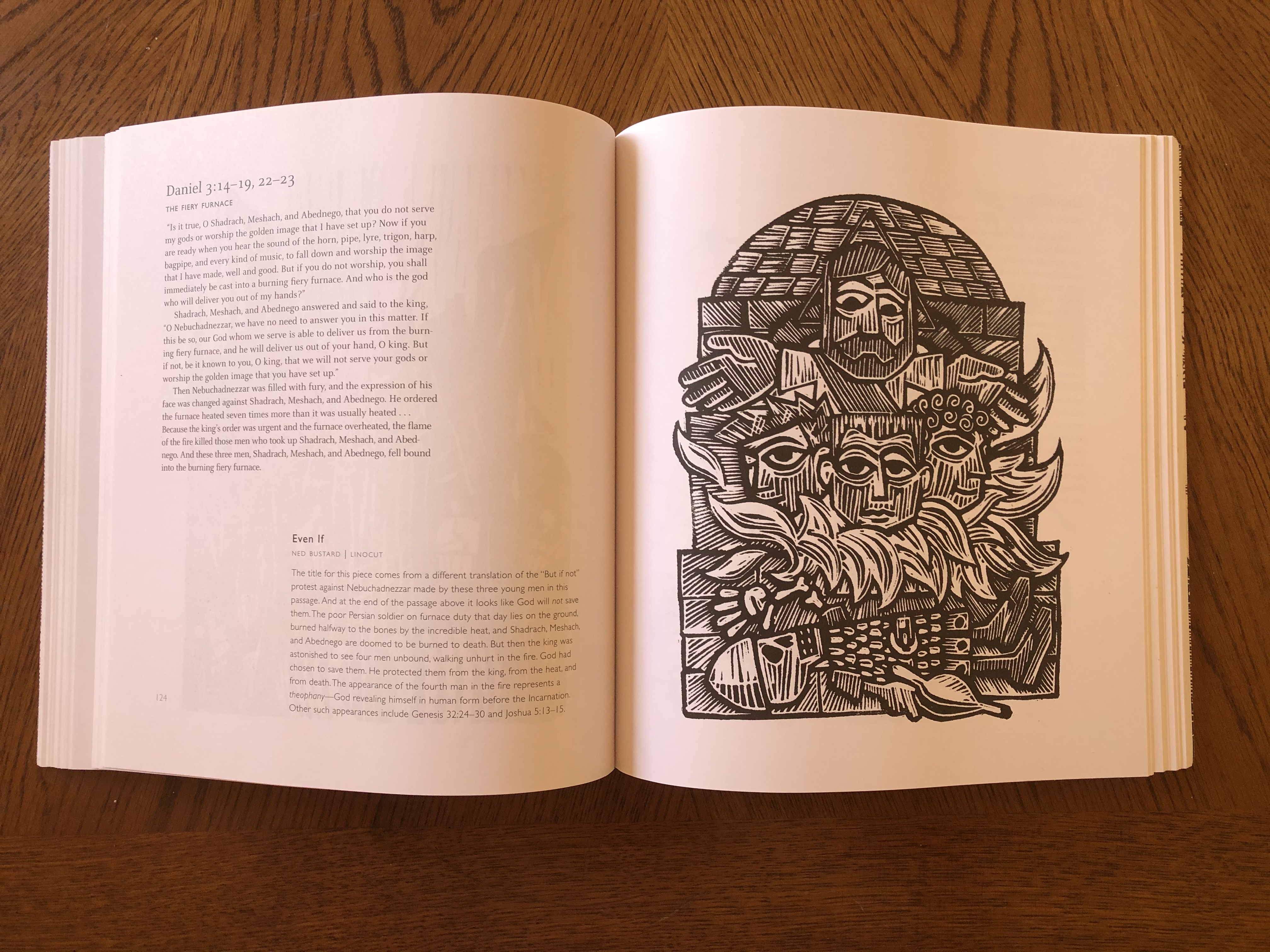
RSS

Tag Archives: Revealed: A Storybook Bible for Grown-Ups

Acts 1:6-14

The above image is from Revealed: A Storybook Bible for Grown-Ups compiled and written by Ned Bustard. The image is “Ascension (after “It is Well with My Soul”) by Wayne Forte.

So when the apostles were with Jesus, they kept asking him, “Lord, has the time come for you to free Israel and restore our kingdom?”

He replied, “The Father alone has the authority to set those dates and times, and they are not for you to know. But you will receive power when the Holy Spirit comes upon you. And you will be my witnesses, telling people about me everywhere—in Jerusalem, throughout Judea, in Samaria, and to the ends of the earth.”

After saying this, he was taken up into a cloud while they were watching, and they could no longer see him. 10 As they strained to see him rising into heaven, two white-robed men suddenly stood among them. 11 “Men of Galilee,” they said, “why are you standing here staring into heaven? Jesus has been taken from you into heaven, but someday he will return from heaven in the same way you saw him go!”

12 Then the apostles returned to Jerusalem from the Mount of Olives, a distance of half a mile. 13 When they arrived, they went to the upstairs room of the house where they were staying.

Here are the names of those who were present: Peter, John, James, Andrew, Philip, Thomas, Bartholomew, Matthew, James (son of Alphaeus), Simon (the zealot), and Judas (son of James). 14 They all met together and were constantly united in prayer, along with Mary the mother of Jesus, several other women, and the brothers of Jesus.

Acts 1:6-14

Dear God, as with most of the other pictures I look at from this book, I’ve read the passage (there’s a typo in the book, by the way. The title on the page says it goes through verse 18, but it is really 14), and I have some thoughts. But first I want to take my recent reading of the passage and look to see what the artist, Wayne Forte, put in his image for me to see:

  • Jesus with his arms open wide
  • The dove/Holy Spirit above him (I think that’s what it is)
  • The two angels who speak to the disciples in the story are pictured with trumpets as Jesus ascends.
  • The unraveling scroll is a bridge. Or is Jesus floating and the scroll is representing Jesus being “The Word?”
  • Is the scroll transparent and the white marks are clouds?
  • The white marks below the scroll look like hills (like the hill Jesus ascended from)

Okay, I just read Bustard’s description of the image, and it mentions something I thought about but didn’t say: “This print about the departure of Christ alludes to his return: the dove descending from heaven (as he did at the baptism of Christ), the angels blowing trumpets of judgment, and the ‘clouds be rolled back as a scroll,’ as it says in the old hymn (referencing Revelation 6:14).”

So now back to what I noticed when I read the story for myself.

  • They were still linking all of this to Israel’s liberation and return to power/glory. That’s really something. That was a concept that was really baked into their psyches. They seemingly couldn’t break free from it. They really, really wanted to overcome being trod upon. Because this was such a big deal to even these close followers of you who knew you intimately, I guess it makes sense that it should be so baked into our collective consciences as well. In our country, we have those who have the power who will do absolutely everything they can to keep it. We also have those who want that power and will do what they can to take it. And it’s nearly all of us. It’s the Christian church, the atheists, the socialists, the right-wing conservatives–everyone. Everyone is going for that power. We want to make sure our country has the most power in the world (economically, militarily, and politically), and we want to make sure our “group” is the one wielding that power, both within the country and outside of it.
  • Jesus doesn’t admonish them for thinking about the restoration of Israel, but simply says that they’ll never know when.
  • Jesus goes a different direction and tells them about the Holy Spirit coming. I have to say, there are times when I wonder, given the Trinity, if the three of you aren’t so intertwined that “praying in Jesus’s name” isn’t also “praying in the name of the Holy Spirit and the Father” as well. Hence some denominations start and end their prayers with, “In the name of the Father, the Son, and the Holy Spirit.” When Jesus comes into my heart (as a Baptist would say), is that more accurately represented as the Holy Spirit coming into my heart? Is there a difference?
  • Jesus sends them to Jerusalem, all of Judea, Samaria (did I hear that right–the Samaritans?), and the ends of the earth (hold it, what?!?).
  • The angels (I’m assuming they are angels) told them Jesus would return the same way he left (hence Forte’s depiction of a scene that could represent either Jesus’s ascension or return).
  • The place where they were was only about half a mile (a Sabbath’s day journey) from where they were staying.
  • The remaining 11 were with other disciples plus Mary, Jesus’s mother, and Jesus’s brothers. The other disciples included women.
  • They spent a lot of their time in prayer. I wonder what kinds of things they prayed for. Were they following the “Lord’s Prayer” template Jesus taught them? Were they praying for clarity of mission, protection from persecution, and daily provision?

Father, as I think about this, I think the lessons I’m leaving with are that I need to not worry about power/influence (they are idols), not worry about trying to understand you or your plan (ignorance is my ally), and simply worship you, spending time in prayer. Help me to do all of these things. And going back to what I prayed about earlier this week, help me to embrace the tools you have given me to impact the world: prayer, service, persuasion, and suffering.

I pray all of this in the name of the Father, the Son, and the Holy Spirit,

Amen


Tags: , , ,

Esther 2:12-18

The above image is from Revealed: A Storybook Bible for Grown-Ups written and compiled by Ned Bustard. The image is called “Esther and the King (after marc Chagall)” and is a combination of two Marc Chagall images done by Bustard.

Before each young woman was taken to the king’s bed, she was given the prescribed twelve months of beauty treatments—six months with oil of myrrh, followed by six months with special perfumes and ointments. When it was time for her to go to the king’s palace, she was given her choice of whatever clothing or jewelry she wanted to take from the harem. That evening she was taken to the king’s private rooms, and the next morning she was brought to the second harem, where the king’s wives lived. There she would be under the care of Shaashgaz, the king’s eunuch in charge of the concubines. She would never go to the king again unless he had especially enjoyed her and requested her by name. Esther was the daughter of Abihail, who was Mordecai’s uncle. (Mordecai had adopted his younger cousin Esther.) When it was Esther’s turn to go to the king, she accepted the advice of Hegai, the eunuch in charge of the harem. She asked for nothing except what he suggested, and she was admired by everyone who saw her. Esther was taken to King Xerxes at the royal palace in early winter of the seventh year of his reign. And the king loved Esther more than any of the other young women. He was so delighted with her that he set the royal crown on her head and declared her queen instead of Vashti. To celebrate the occasion, he gave a great banquet in Esther’s honor for all his nobles and officials, declaring a public holiday for the provinces and giving generous gifts to everyone.
Esther 2:12-18

Dear God, I don’t know that I have much to say about the story of Esther in this, but I was thumbing through this book this morning, and I noticed something in Bustard’s image of King Ahasuerus. He looks pensive and unassuming. He looks nervous and gentle. He looks unsure of himself. I haven’t yet read Bustard’s description of his work, but what it makes me think of is a man who, no matter what he looks like on the outside is something totally different on the inside. I guess it’s not common for people, men or women, to be completely transparent and let people see what they are experiencing on the inside. The veneer is too important.

It also makes me think of dogmatic Christians. It finally occurred to me a few months ago that the more confident someone appears that they are right about something–especially theologically, but it applies across topics–the more they are likely unsure about that very thing. For example, if I am the type of person that says every word in the Bible has to be factually accurate then it is likely that my brain needs that to be true because I am afraid everything I believe about you will unravel if it’s not true. So the fact that there are two creation stories in Genesis 1 and Genesis 2 just needs to be ignored. Who was the woman Cain married and where did she come from? I shouldn’t stop and consider that either. When and how did Davis meet Saul? Was it the Goliath story (1 Samuel 17:55) or had he met him before as his harpist (1 Samuel 16:21)?

So now that I’ve pointed the finger at others, how am I like the king in this picture? How am I like the dogmatic Christian whose faith might be more fragile than even they realize? I think the biggest mistake I sometimes make is thinking that I need to understand you to worship you. I need to understand myself completely before I can live effectively for you. Frankly, that’s not what Jesus tells me I need to do. Who are usually the most carefree people? Unless they’ve experienced some sort of trauma, it is children. They don’t understand their parents. They don’t even understand themselves or their motivations. And sure, they aren’t good at loving their neighbors as themselves, but whenever they learn to do it they are happy. And they are happy when they love their parents.

Father, Jesus, Holy Spirit, I don’t even understand how the Trinity of your consubstantial oneness works. But I don’t have to to worship you. The king in this image with Esther is depicted as unsure of himself even though he probably did not physically portray that in his body language. Help me to reduce the facades I have built as much as possible. Not that it’s not appropriate to have some things about me I don’t show others, but for the most part my life is the most useful to you when I am the most transparent. So help me to be that. Forgive me for my pride. For my arrogance. For not loving you and loving others the way I should. Lead me today. Do it all for your glory.

I pray all of them through the mercy afforded to my by Jesus’s blood,

Amen

 
Leave a comment

Posted by on July 4, 2023 in Esther


Tags: , , , ,

Romans 7:21-8:2, 35-39

The above image is from Revealed: A Storybook Bible for Grown-Ups compiled by Ned Bustard. The image by Bustard is called Simul Justus et Peccator.

21 So I find it to be a law that when I want to do right, evil lies close at hand. 22 For I delight in the law of God, in my inner being, 23 but I see in my members another law waging war against the law of my mind and making me captive to the law of sin that dwells in my members. 24 Wretched man that I am! Who will deliver me from this body of death? 25 Thanks be to God through Jesus Christ our Lord! So then, I myself serve the law of God with my mind, but with my flesh I serve the law of sin.

There is therefore now no condemnation for those who are in Christ Jesus. For the law of the Spirit of life has set you free in Christ Jesus from the law of sin and death.

35 Who shall separate us from the love of Christ? Shall tribulation, or distress, or persecution, or famine, or nakedness, or danger, or sword? 36 As it is written,

“For your sake we are being killed all the day long;
    we are regarded as sheep to be slaughtered.”

37 No, in all these things we are more than conquerors through him who loved us. 38 For I am sure that neither death nor life, nor angels nor rulers, nor things present nor things to come, nor powers, 39 nor height nor depth, nor anything else in all creation, will be able to separate us from the love of God in Christ Jesus our Lord.

Romans 7:21-8:2, 35-39

Dear God, this is a complete coincidence and not why I chose this today, but I heard the end of this passage read at a funeral yesterday. So as I think about this passage and Ned Bustard’s artistic interpretation of it through his work Simul Justus et Peccator (At Once Justified and a Sinner), I wonder what there might be for here this morning.

First, here is what I’m noticing about Bustard’s image:

  • The face in the mirror seems to be a fairly accurate reflection of the face we see outside of the mirror. He didn’t make it look worse that it is.
  • Bustard’s publishing company is called “Square Halo Books.” Bustard says on his web page, “In Christian art, the square halo identified a living person presumed to be a saint.” So the man in the mirror is presumed to be a saint.
  • The square halo is not represented in the mirrored image. It is only seen by us, not the man himself.
  • I seen apple with a bite out of it on the desk. I presume this is original sin.
  • I see a crow looking at the man. The crow can represent both the good and the bad. A duality.
  • I see what appears to be a bag of money on the ground, but it is marked with “xxx.” I assume this indicates that they money is more of a problem than a solution.
  • The man’s head is resting in his hands. It gives the appearance of despair.
  • The man is frowning and his eyes are sad.
  • In the mirrored image, the mans clothes have horizontal stripes, making it seem like he feels imprisoned.
  • I don’t see a significance to it, but the candle on the table seems to be what is illuminating the room.
  • The man is barefoot and appears to be in his pajamas. This is either at the end of the day or the beginning of the day. He is either regretting his day or dreading his day. There is no optimism in his eyes.

So those are my observations before reading Bustard’s description of the image. Here is what he said: “The print conveys the idea of being both sinful and righteous through symbols from Christian art. The black bird, the Adam’s apple, and the thirty pieces of silver [oh, that’s what the money was supposed to be] represent sin. The candle and mirror are God’s Word. The man is clothed in Christ’s righteousness–in the form of the robe and sash ubiquitous in Sunday school pictures of Jesus [I don’t see the robe and sash]. The square halo indicates that he is a living saint.”

Okay, I have to say that I feel pretty good about the things I noticed. I didn’t the candle and mirror as your Word. I missed the money reference to the 30 pieces of silver Judas received for betraying Jesus. And I still don’t see the robe and sash he mentions. But overall, I think I got it.

So what do I do with it? Well, how do I see myself when I look in the mirror? The truth is, I am as much of a dichotomy as anyone in the world. I am sinful. I am redeemed. I do good. I do bad. I am a living saint. I deserve death, but you have offered me life.

Father, help me to see this for myself today and to see others this way too. Help me to offer them the same benefits of your redemption that you offer me. And may those who see me as a failed man be able to maybe extend some of that mercy as well. Not for my sake as much as for theirs.

I pray all of this through the mercy and grace of Jesus that makes me, of all people, a saint,

Amen

 
Leave a comment

Posted by on July 2, 2023 in Romans


Tags: ,

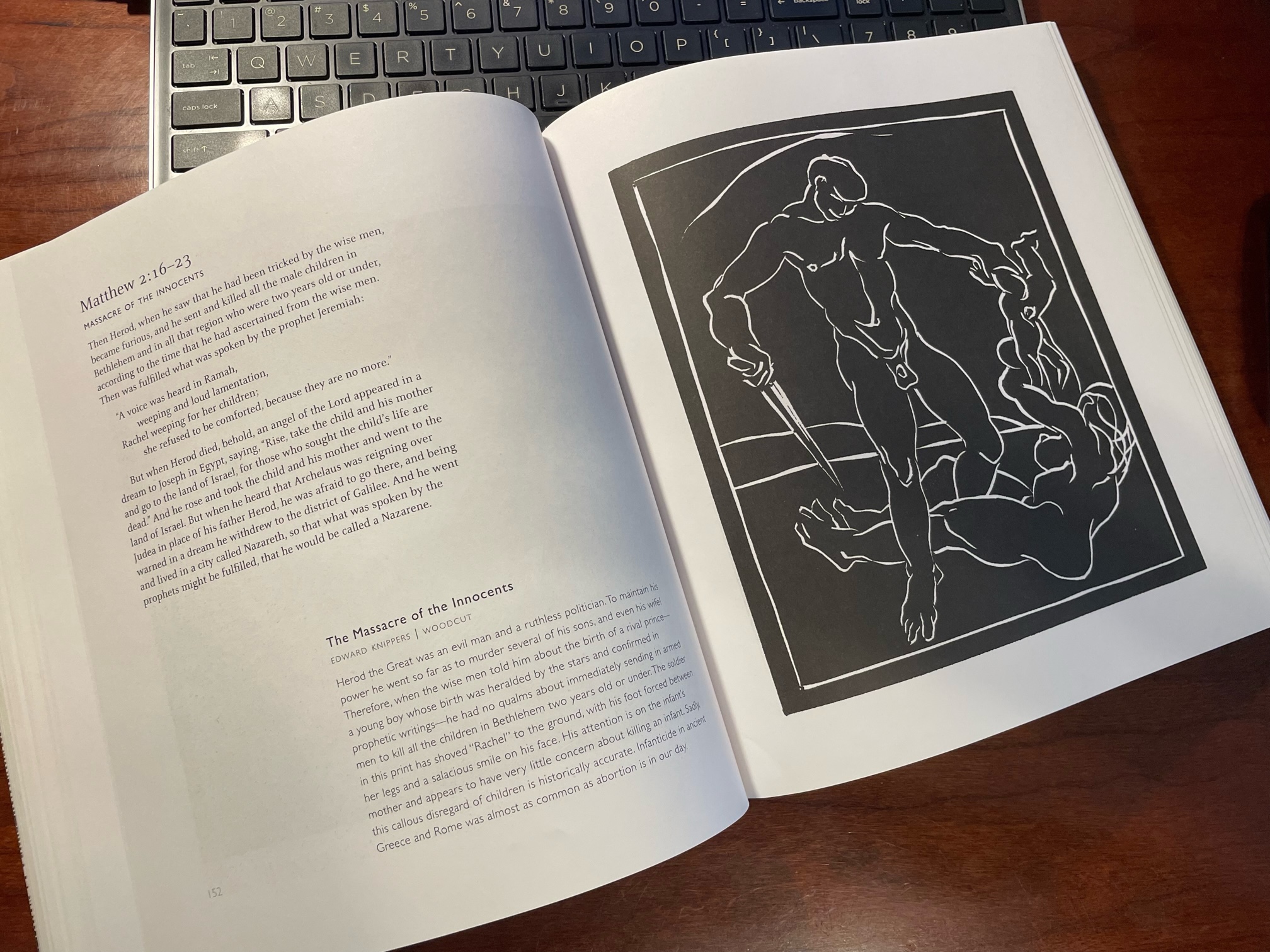
Matthew 2:16-18

The above image is from Revealed: A Storybook Bible for Grown-Ups compiled and written by Ned Bustard. The image is called “The Massacre of the Innocents” and was done by Edward Knippers.

16 Herod was furious when he realized that the wise men had outwitted him. He sent soldiers to kill all the boys in and around Bethlehem who were two years old and under, based on the wise men’s report of the star’s first appearance. 17 Herod’s brutal action fulfilled what God had spoken through the prophet Jeremiah:

18 “A cry was heard in Ramah—
    weeping and great mourning.
Rachel weeps for her children,
    refusing to be comforted,
    for they are dead.”

Matthew 2:16-18

Dear God, as I am sitting with this story this morning, it occurs to me that there are a lot more people involved in it that I have always thought. Sure, there are Herod, the soldiers, the mothers, and the children, but that’s not the extent of it. Everyone is in this story.

Mary, Joseph, and Jesus are in this story. I wonder what Mary’s and Joseph’s reaction was when they first heard the news. Did they weep? Did they pray? Did they feel survivors guilt? Did they become more determined? Did they despair? Did they thank you for warning Joseph to leave? And how old was Jesus when he first heard about this? How old was he when he realized that it was meant for him. How did he internalize that information and respond to it?

I’m going to ignore Herod because he was just unhinged, jealous and fearful. He had made an idol out of his power and was willing to kill his own children, much less the children of others, to keep his position (okay, so I guess I didn’t ignore him). But the soldiers. Strangers in a foreign land. Likely racist. Resentful. Disrespectful. Vengeful. I wonder if there is any part of me that is like them. Do I hold things inside and then take advantage when I have an opportunity to let my anger spew out?

In terms of the parents, I can’t even imagine their helplessness. I mean, really, I’ve never had to feel that helpless. I remember hearing stories 25 years ago about Syrian refugee camps and what was happening to families there. Raiders were coming in and taking children, raping women, etc. I remember thinking about the men and how helpless they must feel to protect their children and wives. Themselves. No help was coming from the government either. No police. No military. Just helpless. I guess there are times when I’ve felt helpless to protect or provide for my children. Frankly, I feel pretty helpless now.

There are the older siblings of the children who died. A lot of the murdered children had older siblings who were traumatized by this. Did they ask how a loving God could let this happen? Did it make them long for Rome’s destruction and Israel’s restoration even more? When Jesus came along when they were in their mid- to late-30s, did they think back on this as one of the reasons they wanted him to me a conqueror and not a forgiver? Do I allow the pain from my past and traumas in my life influence my anger and sense of vengeance now?

There was the community, both locally and throughout the nation. No one was untouched by this. It’s a little like 9/11. If you were in New York or D.C., you probably knew someone or were related to someone affected by it. If you lived in the rest of the U.S., you at a minimum felt attacked and vulnerable. I know I did. That’s why we watched the news and sat in front of our televisions so shocked and dismayed. This killing of the children in Israel 2,000 years ago, was a national tragedy, and I’m sure it influenced their feelings about Rome and the need to make Israel great again.

Father, then there was you. There was “Rachel, weeping for her children, refusing to be comforted.” There was all of heaven weeping and hell celebrating (although the opportunity was missed to kill Jesus when they could, but they probably knew this plan wouldn’t work anyway). There was the spiritual realm that we humans cannot see. But this was another move in this way the earth is playing out. This didn’t happen so that the prophecy could be fulfilled. The prophecy existed because this would one day happen. But you had a plan to redeem all of this. As Jesus grew and matured, he understood that this event did not need to be avenged. It needed to be forgiven. He understood that each of the people I mentioned above, including his own parents, needed to be reconciled to you completely. Help me, Father, Jesus, Holy Spirit. Help me to live in that wisdom today as I worship you, forgive others, and love my neighbor as myself.

I pray all of this under your Holy Authority and in you Name,

Amen


Tags: , , , ,

Matthew 26:36-46

The above image is title “Christ on the Mount of Olives” and was created by Ernst Barlach. It is picture here as part of Revealed: A Storybook Bible for Grown-Ups by Ned Bustard.

36 Then Jesus went with them to the olive grove called Gethsemane, and he said, “Sit here while I go over there to pray.” 37 He took Peter and Zebedee’s two sons, James and John, and he became anguished and distressed. 38 He told them, “My soul is crushed with grief to the point of death. Stay here and keep watch with me.”

39 He went on a little farther and bowed with his face to the ground, praying, “My Father! If it is possible, let this cup of suffering be taken away from me. Yet I want your will to be done, not mine.”

40 Then he returned to the disciples and found them asleep. He said to Peter, “Couldn’t you watch with me even one hour? 41 Keep watch and pray, so that you will not give in to temptation. For the spirit is willing, but the body is weak!”

42 Then Jesus left them a second time and prayed, “My Father! If this cup cannot be taken away[f] unless I drink it, your will be done.” 43 When he returned to them again, he found them sleeping, for they couldn’t keep their eyes open.

44 So he went to pray a third time, saying the same things again. 45 Then he came to the disciples and said, “Go ahead and sleep. Have your rest. But look—the time has come. The Son of Man is betrayed into the hands of sinners. 46 Up, let’s be going. Look, my betrayer is here!”

Matthew 26:36-46

Dear God, since I just came from a marriage conference this weekend and I came across this image this morning, I can’t help but go to Ephesians 5:25

25 For husbands, this means love your wives, just as Christ loved the church. He gave up his life for her.

This picture embodies what I am supposed to do for my wife. Everyone focuses on the other verses in Ephesians 5 and freaks out over the instructions for wives (which are probably misinterpreted to some extent), but they don’t think about this image. I should love my wife so much that I’m willing to be put in this position for her. Jesus gave no excuse. I have no excuse. No matter what, this is what you call me to do. Who you call me to be. This is my duty regardless of what my emotions tell me. In fact, for husbands, this might be the most important image in this book.

As I look closely at the image I see vague images of people strewn through it. They are probably intended to be the disciples sleeping while Jesus is in anguish. I thought they could also represent the people of the world for whom he is submitting to this pain, anguish and torment. He will literally be separated from his consubstantiality with you at some point. His physical human body will not longer be part of the divine. For that moment, he will be giving it all for me. For his church. For his bride.

And what if my wife doesn’t get it? What if she is like the disciples who are sleeping in the background, completely unappreciative of what Jesus is doing? Not that my wife is any of these things, because she really is the best. But what if? Am I called to be any less than Jesus was in this moment?

Father, it was a really good conference. I pray now that your Holy Spirit will move in our community through it. Move from the bottom up. It’s obvious not many of the pastors or spiritual leaders in our community were interested in this. So this movement will depend upon those whom you led to come. Help them to carry you into their hearts, minds, souls, and bodies today. Help them to carry you and what we learned into their marriages and give them new insights into not only their own lives, but also the lives of friends and loved ones. Let the older women teach the younger. The older men teach the younger men as well. And may the man my daughter ultimately marries be Jesus for her. Let that be her standard for the man who is good enough for her. The man she deserves. And may my son learn to be Jesus for his eventual wife. And, oh yeah, let’s not forget about me. Help me to be exactly who you need me to be for my wife as well.

I offer all of this under the power and authority granted to me by the grace of Jesus,

Amen


Tags: , , ,

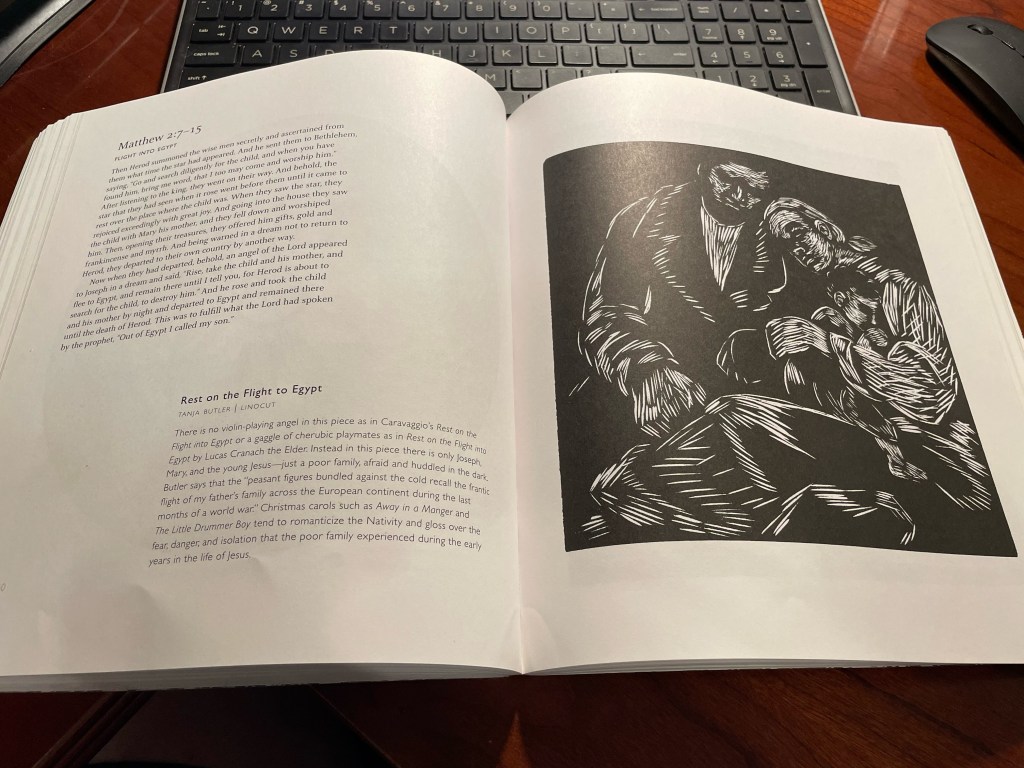
Matthew 2:7-15

“Rest on the Flight to Egypt” by Tanja Butler from Revealed: A Storybook Bible for Grown-Ups y Ned Bustard

Then Herod called for a private meeting with the wise men, and he learned from them the time when the star first appeared. Then he told them, “Go to Bethlehem and search carefully for the child. And when you find him, come back and tell me so that I can go and worship him, too!”

After this interview the wise men went their way. And the star they had seen in the east guided them to Bethlehem. It went ahead of them and stopped over the place where the child was. 10 When they saw the star, they were filled with joy! 11 They entered the house and saw the child with his mother, Mary, and they bowed down and worshiped him. Then they opened their treasure chests and gave him gifts of gold, frankincense, and myrrh.

12 When it was time to leave, they returned to their own country by another route, for God had warned them in a dream not to return to Herod.

13 After the wise men were gone, an angel of the Lord appeared to Joseph in a dream. “Get up! Flee to Egypt with the child and his mother,” the angel said. “Stay there until I tell you to return, because Herod is going to search for the child to kill him.”

14 That night Joseph left for Egypt with the child and Mary, his mother, 15 and they stayed there until Herod’s death. This fulfilled what the Lord had spoken through the prophet: “I called my Son out of Egypt.”

Matthew 2:87-15

Dear God, I figured that, on Father’s Day, I would spend some time with you and my favorite father of the Bible. If you were to ask most Christians who their favorite father of the Bible is, it would probably be Joseph, Jesus’s earthly father. I mean, really, there isn’t much competition here. Frankly, it’s hard to think of another good one. You have to do some deep cuts and maybe consider Samson’s dad, Manoah. He was simple, but seemingly good. And it’s hard to find anything wrong with John the Baptist’s dad, Zechariah, but we don’t get to see him in action as much. But Joseph…well, Joseph is worth of his own book, in my opinion.

This story is just one of several we get of Joseph being obedient to you. But perhaps my favorite story about him is the first time we see him in Matthew 1:18-19.

18 This is how Jesus the Messiah was born. His mother, Mary, was engaged to be married to Joseph. But before the marriage took place, while she was still a virgin, she became pregnant through the power of the Holy Spirit. 19 Joseph, to whom she was engaged, was a righteous man and did not want to disgrace her publicly, so he decided to break the engagement quietly.

Since this isn’t a story about him being a father, I didn’t start here, but it’s remarkable. In the midst of pain, hurt, and betrayal–in the midst of having his reputation destroyed–he “did not want to disgrace her publicly, so he decided to break the engagement quietly.” Wow. That’s a special man.

But back to him as a father. This is a remarkable story because he believed the dream and didn’t wait until morning to act on it. I wonder if Mary protested. I wonder if Jesus fussed. I don’t know what kind of life he had built in Bethlehem at that point, but he threw it all away to keep this boy–God’s son–safe.

As I look at this picture by Tanja Butler, I notice that it is made completely of lines and shadows. Frankly, the lines make me think of straw (almost like the Scarecrow in the Wizard of Oz). That makes me think of the manger in which Jesus was laid. The shadows give the impression that it’s dark and the white are the scant reflections of just enough light to give us the picture. Jesus is in Mary’s arms, sucking his thumb. Mary has her head against Joseph’s shoulder. Perhaps she’s resting. Perhaps he’s comforting her. Maybe both. I cannot tell if her eyes are open or not. The one line on her left eye makes me think they are closed. And Joseph is there. The design of his coat is almost a more modern look with lapels. Perhaps Butler is trying to make me think of his as a professional who has given up his business for this journey. Perhaps she is trying to communicate that the weather demands a coat. But Jesus appears to be barefoot, so maybe I’m wrong about all of that. The depiction of Joseph’s face actually makes him look a little like Abraham Lincoln to me. I wonder if that was intentional as well.

Looking at Bustard’s commentary on this piece, he says:

There is no violin-playing angel in this piece as in Caravaggio’s “Rest on the Flight into Egypt” or a gaggle of cherubic playmates as in “Rest on the Flight into Egypt by Lucas Cranach the Elder. Instead in this piece there is only Joseph, Mary, and the young Jesus–just a poor family, afraid and huddled in the dark. Butler says that the peasant figures buddled against the cold [maybe I was right about the coat] recall the frantic flight of my father’s family across the European continent during the last months of the world war.” Christmas carols such as “Away in a Manger” and “The Little Drummer Boy” tend to romanticize the Nativity and gloss over the fear, danger, and isolation that the poor family experienced during the early years in the life of Jesus.

Father, I don’t know what is coming for my children. I don’t know what plans Satan has. I don’t know what plans he has for me. But I know that I love you, I worship you, and I want to be everything you need me to be for them regardless of what it costs me. Oh, help me to be the man my children need me to be.

In Jesus’s name I pray,

Amen


Tags: , , ,

Acts 5:1-11

From Revealed: A Storybook Bible for Grown-Ups by Ned Bustard. Image is “Ananias and Sapphira” by Micah Bloom.

But there was a certain man named Ananias who, with his wife, Sapphira, sold some property. He brought part of the money to the apostles, claiming it was the full amount. With his wife’s consent, he kept the rest.

Then Peter said, “Ananias, why have you let Satan fill your heart? You lied to the Holy Spirit, and you kept some of the money for yourself. The property was yours to sell or not sell, as you wished. And after selling it, the money was also yours to give away. How could you do a thing like this? You weren’t lying to us but to God!”

As soon as Ananias heard these words, he fell to the floor and died. Everyone who heard about it was terrified. Then some young men got up, wrapped him in a sheet, and took him out and buried him.

About three hours later his wife came in, not knowing what had happened. Peter asked her, “Was this the price you and your husband received for your land?”

“Yes,” she replied, “that was the price.”

And Peter said, “How could the two of you even think of conspiring to test the Spirit of the Lord like this? The young men who buried your husband are just outside the door, and they will carry you out, too.”

10 Instantly, she fell to the floor and died. When the young men came in and saw that she was dead, they carried her out and buried her beside her husband. 11 Great fear gripped the entire church and everyone else who heard what had happened.

Acts 5:1-11

Dear God, this can be any act of duplicity, not just money. Decrying pornography, but secretly looking at it. Decrying single-parent homes, but secretly fathering several children out of wedlock. Coming out against abortion while paying for abortions for women you got pregnant. Admonishing people to not drink or do drugs while secretly indulging your own vices. As I sit here this morning, I want to be cognizant of my own sin in this area, and not just sit in judgment over these two duplicitous people.

The image by Micah Bloom is interesting. Sapphira is obviously the center of it. She is seen with simple dress, earrings, and no shoes. In fact, everyone pictured is barefoot. I’m not sure why Bloom chose to not put sandals or something on them. She had money in both hands–the right for Peter, the left presumably for herself. Peter has his hand out for the money in the right, but your angel of death is grabbing her left wrist and her death is exposing the money hidden in her left hand. Looking out the door, we presumably see the bare feet of Ananias, who is already dead. Someone is attending to his body.

Bustard quotes C.H. Spurgeon in his commentary on the left:

“The nearer we come to God the more truly shall we find that he is a jealous God who will not wink at sin. It was not Peter’s word, but the judgement of God, which slew Ananias. [Sapphira] had time for reflection, yet she stuck to the falsehood. It is a sad thing when husband and wife go hand in hand to hell, and most of all so when they make a profession of religion…The chaff was driven out, and kept out, but the true saints were all the more ready to join the church. Holy discipline does not diminish the church, it is the sure means of increasing it with the right people.”

Reading this made me think of an article I read about the “Road to Majority” conference happening in Nashville right now. This is billed as a conservative Christian political conference in Nashville, US Senator Rick Scott said, “It is time to rescue America. God favors those who are bold.” The mixing of my faith in you and the desire for political power makes me really uncomfortable. There is a difference between saying, “I want to have the majority of our country as Christians because that means more people are worshipping God,” and “I want the majority of the country to be Christians so we can impose our will on the rest of the country.” Jesus did not seem to care that Caesar and Rome were in charge of Israel, but he did care about what the Pharisees were teaching. He didn’t want to make Israel great again, but he did want to shed light on sin and invite repentance.

Father, it can be tempting to point fingers in all of this, but I have to start with myself. I am truly sorry for my sin. For my hypocrisy and duplicitousness. I acknowledge it before you. I do truly love you. I do truly want to do better. I do truly want to be the man you need me to be. Help me to bring you and your presence into the world with the highest integrity so that I might not cause anyone else to stumble and allow any cancers to grow in my own soul.

In Jesus’s name I pray,

Amen


Tags: , , ,

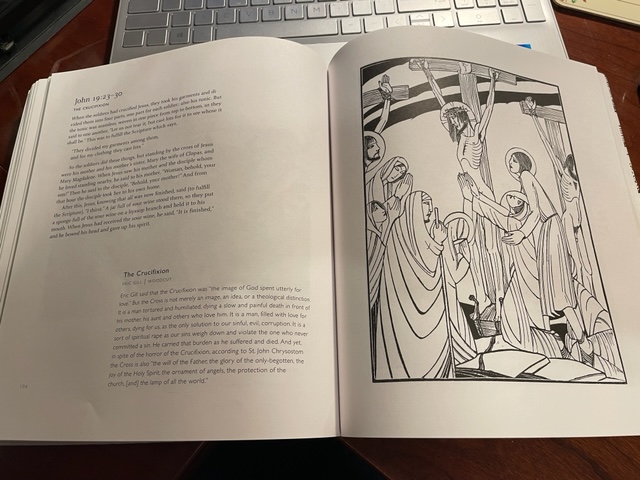
John 19:23-30 — “The Crucifixion” by Eric Gill

The above image called “The Crucifixion” and was created by Eric Gill. It is from Revealed: A Storybook Bible for Grown-Ups by Ned Bustard.

23 When the soldiers had crucified Jesus, they divided his clothes among the four of them. They also took his robe, but it was seamless, woven in one piece from top to bottom. 24 So they said, “Rather than tearing it apart, let’s throw dice for it.” This fulfilled the Scripture that says, “They divided my garments among themselves and threw dice for my clothing.” So that is what they did.

25 Standing near the cross were Jesus’ mother, and his mother’s sister, Mary (the wife of Clopas), and Mary Magdalene. 26 When Jesus saw his mother standing there beside the disciple he loved, he said to her, “Dear woman, here is your son.” 27 And he said to this disciple, “Here is your mother.” And from then on this disciple took her into his home.

28 Jesus knew that his mission was now finished, and to fulfill Scripture he said, “I am thirsty.” 29 A jar of sour wine was sitting there, so they soaked a sponge in it, put it on a hyssop branch, and held it up to his lips. 30 When Jesus had tasted it, he said, “It is finished!” Then he bowed his head and gave up his spirit.

John 19:23-30 (NLT)

Dear God, as I sat down to look at this image this morning, even before reading the passage from John, I noticed something interesting. I noticed the circles around some of the characters’ heads–indicating they were saints, sanctified, or holy. One was Jesus. Two were obviously women (bottom of cross to the right). One was a man. At first I thought this might be the thief whom Jesus assured would be in paradise, but the face is clean and looking up–not dying. No, this is apparently John, the disciple whom Jesus loved. There is a fifth circle for the person on their knees to the left of the cross. It kind of looks like a woman, but I cannot be sure. Again, after reading the passage, I assume it is one of the other two Mary’s or Jesus’s mother Mary’s sister.

Other things I noticed that the artist, Eric Gill, chose to share with us (side note–I just looked up the artist for a link to share here and found that he apparently sexually abused his daughters. Completely heinous! But does it inform the art a little in that, while he allowed Jesus some modesty, he showed one of the thieves completely naked?): He portrays Jesus’s feet separately and not nailed together–I wonder why. He shows women and men who aren’t sanctified–no circles. I understand the man could represent the Pharisees, but who are the two women in front on John (in Gill’s mind). Who do they represent? It’s a reminder to me that it was likely both men and women who were glad to see Jesus die.

I confess, Father, that I know I would have been one of them had I been there at the time. I would not have believed. I don’t know that I’d have followed all of the way to the cross, but when I heard that the troublemaker, Jesus, had died I would have been happy. I am a fool, but knowing this about myself and how much I still love you gives me mercy for the non-sanctified people in the picture. I am sure you have mercy for them too. How do I know? Because Jesus asked you to. He did that so that every head in that picture would have a circle around it. So I join him in asking that you forgive me for what I am doing. Please allow for my foolishness and sinfulness in your plan.

In Jesus’s name, his wonderful, merciful, powerful, glorious name I pray,

Amen


Tags: , ,

Ehud

“Ehud” by Ryan Stander.

Dear God, this is such an interesting story, and the artist’s interpretation of it is something I would not have considered. It really is a bit like a plot you’d see in a movie. In this case, Stander is comparing Eglon to Jabba the Hut. Ehud is James Bond. There’s a toilet. A lock and key. A watch to indicate the amount of time the servants waited for Eglon to finish what they thought he was doing. There is the line, “Lefties have rights too.” I’m not exactly sure what the device on the left is, but it looks like some sort of press. And then there is the 007 with the gun logo on the bottom left. Yeah, I guess it’s all there.

So what else is in this story that’s not in the artwork? Howa bout the Israelites crying out. They also sent a tribute to Eglon through Ehud. They have a gun instead of a sword. And the artist doesn’t show the violence done to Eglon. It tells the parts of the story around the violence. And then the story in Bustard’s book stops before it gets to the part where Ehud leads them to freedom from and dominance over the Moabites. It doesn’t mention the 80 years of peace or the fact that after Ehud died the Israelites went back to their old ways.

In this case, I wonder what their old ways looked like. Worshiping physical idols? Not worshiping you? Not loving the poor? It’s a little vague, but I am, once again, reminded that we read these stories quickly, but they last over the course of a lifetime. People lived and died during this 80-year period.

Father, I’m not sure where they application is for me, but I do know that Stander’s art here made me think of the secret agent-style tale that this is. There is everything from clandestine attacks to snarky comedy. It’s amazing what’s in the Bible. I guess my request from you as I conclude this time is to ask that you please show me how I am like the Israelites without Ehud and make me like an Israelite who lived under Ehud’s leadership.

In Jesus’s name I pray,

Amen

 
Leave a comment

Posted by on November 21, 2021 in Judges


Tags: , , ,

“The Faithfulness of God” — Lamentations 3:14-24


The above image is from
Revealed: A Storybook Bible for Grown-Ups by Ned Bustard. The image itself is called “Lamentations: Send Your Rain” and was created by Steve Prince.

My own people laugh at me. All day long they sing their mocking songs. He has filled me with bitterness and given me a bitter cup of sorrow to drink. He has made me chew on gravel. He has rolled me in the dust. Peace has been stripped away, and I have forgotten what prosperity is. I cry out, “My splendor is gone! Everything I had hoped for from the Lord is lost!” The thought of my suffering and homelessness is bitter beyond words. I will never forget this awful time, as I grieve over my loss. Yet I still dare to hope when I remember this: The faithful love of the Lord never ends! His mercies never cease. Great is his faithfulness; his mercies begin afresh each morning. I say to myself, “The Lord is my inheritance; therefore, I will hope in him!”
Lamentations 3:14-24

Dear God, yesterday, over lunch with a friend, I talked about how I’ve been disappointed with you in the past. I felt like you let me down when I had done my best to be faithful to you. My path got harder and more painful than I thought I deserved. What a beautiful portrait of that kind of pain this passage from Lamentations is! It expresses exactly what I was describing to my friend yesterday. I was filled with bitterness and felt you had given me a bitter cup to swallow. My peace (which I treasure from my relationship with you more than anything) was gone. “Everything I had hoped for from the Lord [was] lost!” But you used that experience to help me enter into a completely new place. I haven’t arrived. I’m not perfect. And I still can revel in self-pity with the best of them. Yet you taught me through that time to still “dare to hope.” You taught me to turn loose of what I thought I deserved at every level. Marriage. Children. Work. Money. Okay, like I said, I still fall into the traps of feeling like I deserve those things, but I can feel the progress I’ve made, and I’m grateful.

As for this image by Steve Prince, let me spend some time with it and see what be noticed and put into it.

  • It appears to be a tribals-type woman who is not fully clothed.
  • There is something ominous behind her. I originally thought she held the umbrella, but it is the mysterious figure behind her that holds the umbrella for her.
  • She has her right hand around her abdomen. Is she pregnant?
  • The train is not only falling, but it is blowing in from an angle. This isn’t just a shower. It’s a storm that requires the umbrella to be held against it.
  • It looks like umbrella is made of some time of leaves or thatch.
  • The man holding the umbrella has his left hand (with pretty gnarled fingers) around the woman’s waist.
  • The man is under the umbrella with her.
  • The man’s clothes cover more of him than her clothes cover of her. He even has a head covering while she has none.
  • Her scarf is blowing in the wind to support the idea of a storm.
  • It looks like she is trying to help with the umbrella, but it’s obvious that he is the one with control over it.
  • Her eyes are closed and she looks like she is just surviving, while the man looks confident and sure. His left arm around her indicates care.
  • The more I look at the picture the less ominous the man looks. He is becoming more noble in my eyes.
  • The piece is titled “Send Your Rain.” Is this storm from you for my good? Is this a rain that actually nurtures while it challenges? I like that thought.

Here is what Bustard says about the image:

This print is from the same series as Exodus: Bread from Heaven and therefore is intended to be a look at an Old Testament passage through the lens of a love story. This image shows a couple walking through a storm, which is symbolic of the suffering, pain, and destruction documented in the book of Lamentations. The husband clings to his wife as they move in faith through the storm. In the midst of the raindrops three elongated figures forms (alluding to the Trinity/Holy Spirit) create a covering over the couple. The woman clutching her abdomen is a symbol of hope and renewal as it represents the imminent arrival of a child. The presence of the Cross is created by the subtle placement of the woman’s finger overlapping the rod of the umbrella. It is by faith they walk, and the Holy Spirit amplifies their love through the storms of life.

So, I never thought of them as being a couple. I was thinking more of the woman representing your people and the man representing you. We are your bride. But you are in the umbrella? Hmm. That’s interesting. I have to admit, I really like the idea of this depicting my wife and me going through this together. Over the last 10 years, we’ve really needed each other in ways we never imagined. And we’ve needed you.

Father, help me to hold on to you. You don’t have to take away the storm for me to have faith in you. I’m slowly learning that. And help me to really believe and have faith in the fact that your steadfast love never ceases and your mercies never come to an end. You renew me every morning through your faithfulness to me. Great is your faithfulness, oh Lord. You are my portion, and I will hope in you.

In Jesus’s name I pray,

Amen


Tags: , , ,