2 Jesus was born in Bethlehem in Judea, during the reign of King Herod. About that time some wise men from eastern lands arrived in Jerusalem, asking, 2 “Where is the newborn king of the Jews? We saw his star as it rose, and we have come to worship him.”
3 King Herod was deeply disturbed when he heard this, as was everyone in Jerusalem. 4 He called a meeting of the leading priests and teachers of religious law and asked, “Where is the Messiah supposed to be born?”
5 “In Bethlehem in Judea,” they said, “for this is what the prophet wrote:
6 ‘And you, O Bethlehem in the land of Judah, are not least among the ruling cities of Judah, for a ruler will come from you who will be the shepherd for my people Israel.’”
7 Then Herod called for a private meeting with the wise men, and he learned from them the time when the star first appeared. 8 Then he told them, “Go to Bethlehem and search carefully for the child. And when you find him, come back and tell me so that I can go and worship him, too!”
9 After this interview the wise men went their way. And the star they had seen in the east guided them to Bethlehem. It went ahead of them and stopped over the place where the child was. 10 When they saw the star, they were filled with joy! 11 They entered the house and saw the child with his mother, Mary, and they bowed down and worshiped him. Then they opened their treasure chests and gave him gifts of gold, frankincense, and myrrh.
12 When it was time to leave, they returned to their own country by another route, for God had warned them in a dream not to return to Herod.
Matthew 2:1-12
Dear God, it’s always interesting when we meet these characters in stories and then we don’t hear from them again. In this case, we get these guys from the East, and they were following some sort of sign. I don’t think we are ever told the source of their knowledge for the sign, but here they are, and they are right. Now, they are a little clumsy about it. They just kind of brazenly go in making it a public thing when you had kind of gone out of your way to make it more low-key, and their clumsiness tipped off Herod which caused problems of tragic proportions, but they were just earnestly looking for this child. Why they wanted to worship him, I don’t know. In fact, I checked different translations, and they all use the word “worship.”
So they found him. The worshipped him. The gave him/Mary gifts. And then they left. It’s important to note here that you spoke to them and warned them to go home a different way. You knew they were there, and they were worthy of your attention and care. Of course, you were also protecting Jesus, Mary, and Joseph by keeping them away from Herod as well, but still, this is just another example of how you loved Gentiles, spoke to Gentiles, and let Gentiles know about your plans. Jesus was for them too.
Father, I’m a Gentile sitting here grateful to be your servant. Worshipping you, Three in One. My Father. My Jesus. My Holy Spirit. As Christmas comes to a close, I thank you and commit to walking with you this year. Beyond Christmas. You are my God. I am your grateful child. Part of your creation. You have my worship. Show me how to love you and how to love others.
22 Then it was time for their purification offering, as required by the law of Moses after the birth of a child; so his parents took him to Jerusalem to present him to the Lord. 23 The law of the Lord says, “If a woman’s first child is a boy, he must be dedicated to the Lord.” 24 So they offered the sacrifice required in the law of the Lord—“either a pair of turtledoves or two young pigeons.”
25 At that time there was a man in Jerusalem named Simeon. He was righteous and devout and was eagerly waiting for the Messiah to come and rescue Israel. The Holy Spirit was upon him 26 and had revealed to him that he would not die until he had seen the Lord’s Messiah. 27 That day the Spirit led him to the Temple. So when Mary and Joseph came to present the baby Jesus to the Lord as the law required, 28 Simeon was there. He took the child in his arms and praised God, saying,
29 “Sovereign Lord, now let your servant die in peace, as you have promised. 30 I have seen your salvation, 31 which you have prepared for all people. 32 He is a light to reveal God to the nations, and he is the glory of your people Israel!”
33 Jesus’ parents were amazed at what was being said about him. 34 Then Simeon blessed them, and he said to Mary, the baby’s mother, “This child is destined to cause many in Israel to fall, and many others to rise. He has been sent as a sign from God, but many will oppose him. 35 As a result, the deepest thoughts of many hearts will be revealed. And a sword will pierce your very soul.”
36 Anna, a prophet, was also there in the Temple. She was the daughter of Phanuel from the tribe of Asher, and she was very old. Her husband died when they had been married only seven years. 37 Then she lived as a widow to the age of eighty-four. She never left the Temple but stayed there day and night, worshiping God with fasting and prayer. 38 She came along just as Simeon was talking with Mary and Joseph, and she began praising God. She talked about the child to everyone who had been waiting expectantly for God to rescue Jerusalem.
39 When Jesus’ parents had fulfilled all the requirements of the law of the Lord, they returned home to Nazareth in Galilee. 40 There the child grew up healthy and strong. He was filled with wisdom, and God’s favor was on him.
Luke 2:22-40
Dear God, I want to spend some time with Simeon and Anna this morning. Why them? Why did you lead them in this way? Why did you promise Simeon he would not die until he had seen the Messiah? Why Anna in this moment?
It’s so interesting to me that Simeon was right and wrong at the same time. He was right in that he could foresee how Jesus would be a stumbling block to others. How he would be divisive. How Mary’s own soul would be pierced. But he was wrong because he still had the idea that the Messiah was coming to make Israel great again (MIGA). His preconceived notions of your plans for Israel and the world through Israel’s power were not big enough to include the truth. That you would be reconciling the entire world to yourself through Jesus. He got words of truth, but they were still tainted by his human conflict of interest that longed for security, power, and certainty for Israel and himself.
When it comes to Anna, I think of her as a fixture of the temple that had been there for over 60 years, worshipping you, praying, and fasting. I like to think that Mary had seen her when she was a little girl and her family visited the temple for Passover. So now Mary and her new baby were the center of Anna’s attention, and Anna was saying remarkable things about Mary’s baby. But back to Anna. She was widowed young, and it seems to me the way she survived was by making her home at the temple and throwing herself into worshipping you. That’s how she used her life. Almost like a nun before there were nuns. It’s seemingly how she processed her pain. By just dedicating her life to worshipping and loving you.
I wonder what the Pharisees of the day thought of all of this. I’m sure they must have gotten some wind of what Simeon and Anna were saying about this baby. Did they question it? Did they question Mary and Joseph? Did they ignore it? It’s difficult to say.
Just as a side note, I think it’s interesting that Luke and Matthew tell two different stories of what happened with Jesus from here. Matthew tells us that they stayed in Bethlehem for a while, fled to Egypt, and then finally settled in Nazareth several years later. Luke indicates they went straight home to Nazareth. The discrepancy doesn’t invalidate any of Jesus’s story or the fact that he is your son and our Messiah. But it does remind me that nothing is really giving me a complete picture of what happened all those years ago.
Father, I have a small life to live. I’m one of 7 billion-ish people on this planet and one of over 100 billion that have lived on it at one point. But if my life can positively impact just ten people, and then each of those ten impacts five, and even of those five impacts two, and each of those two impacts one then all of a sudden my life has touched a lot of others. And who knows where it ends? So I offer this day to you. I’m going to get to see my niece and her husband and their friends. Help my wife and me to simply be your messengers today. Help us to be your examples. Your love. Your glory. And help me to love our donors today. Do it all for your glory, Lord.
13 After the wise men were gone, an angel of the Lord appeared to Joseph in a dream. “Get up! Flee to Egypt with the child and his mother,” the angel said. “Stay there until I tell you to return, because Herod is going to search for the child to kill him.”
14 That night Joseph left for Egypt with the child and Mary, his mother, 15 and they stayed there until Herod’s death. This fulfilled what the Lord had spoken through the prophet: “I called my Son out of Egypt.”
16 Herod was furious when he realized that the wise men had outwitted him. He sent soldiers to kill all the boys in and around Bethlehem who were two years old and under, based on the wise men’s report of the star’s first appearance. 17 Herod’s brutal action fulfilled what God had spoken through the prophet Jeremiah:
18 “A cry was heard in Ramah— weeping and great mourning. Rachel weeps for her children, refusing to be comforted, for they are dead.”
19 When Herod died, an angel of the Lord appeared in a dream to Joseph in Egypt. 20 “Get up!” the angel said. “Take the child and his mother back to the land of Israel, because those who were trying to kill the child are dead.”
21 So Joseph got up and returned to the land of Israel with Jesus and his mother. 22 But when he learned that the new ruler of Judea was Herod’s son Archelaus, he was afraid to go there. Then, after being warned in a dream, he left for the region of Galilee. 23 So the family went and lived in a town called Nazareth. This fulfilled what the prophets had said: “He will be called a Nazarene.”
Matthew 2:13-23
Dear God, I’m not sure I’ve ever really pondered the idea that Joseph’s intent seems to have been to return to Bethlehem instead of going home to Nazareth. I guess from a practical standpoint it was easier to get to from Egypt (I think they are 80 or 90 miles apart). But I also wonder if there were just fewer questions in Bethlehem than Nazareth. Fewer people whispering about the timing of their marriage and Jesus’s age. But this would also seemingly put Jesus closer to John the Baptist, and Mary closer to Elizabeth, as they all grew and aged.
I honestly don’t know where I’m going with any of this except appreciating the lives that Joseph and Mary had to live, the decisions they had to make, and the warnings they had to follow as they raised Jesus. I don’t think that we, in general, appreciate the sacrifices they made for our savior and our salvation. I can certainly understand why Catholics venerate Mary. She made all these sacrifices and she carried Jesus. He is flesh of her flesh. But I want to throw Joseph in there too. He offered his life as a living sacrifice for your plan. He considered his life worth nothing to him. He did it right. I know he wasn’t perfect, but I have him as my favorite biblical character for a reason.
Father, I was talking with my brother yesterday about what it means to be a man for your wife, and how it is hard as you age to not be able to be those things for her anymore. I see friends who are older than me who can no longer be what their wives need. They need care instead of being able to care. Or their limitations make them less than they were just a few years ago. And now I’m at a point where I can still be a man and husband for my wife. I can care for her. But the day will come when I won’t be able to do it, and that will be hard. It will be hard for her, but it will also be hard for my ego. So guide us. Thank you for the example you’ve preserved here in Matthew of Joseph and the kind of man he was for Mary and Jesus. Thank you for the salvation you give me/us through Jesus. Thank you for your love and wanting a relationship with me. Help me to be who you need me to be today.
Dear God, as I sat down this Christmas Eve morning to enter this time with you, I struggled with what scriptures to use as my base. Then I started thinking about friends who are struggling right now. I have a friend who just lost her mother-in-law a month ago (I found out yesterday). It was difficult. The family relationships with the woman who died were complicated. There is pain this morning. Maybe even some regrets on the parts of some. It can all be so confusing and overwhelming. I ask that you please be with this friend, her husband who lost his mother, his sister, the grandchildren, and anyone else affected by this loss. Father, in your mercy, hear my prayer.
I have another friend who texted me yesterday about her mother being taken by helicopter to a hospital because of a stroke. I don’t know what the outcome will be, but I know that relationships with this woman are similarly complicated as the ones with the woman I just talked about. There has been a lot of pain and hurt between people. No one is innocent. No one is completely guilty. It’s just the pain we cause each other when we are hurt. The old saying: “Hurt people hurt people.” And some awful things have happened. But our human love and sense of loyalty that you put into us–that is part of your nature–is still there drawing us to each other. So I ask that you make this pain count. Don’t let it be wasted. For the woman who is sick, do exactly what you need to be doing in her life. Love her. I know she worships you although I’m not sure she knows what discipleship looks like. But I think there is mercy for that. Heal her relationships with her children, grandchildren, and everyone else around her. Use this pain as an opportunity to heal relationships, draw each person into a deeper relationship with you, and make this family a beacon of light that draws others around them into your presence and relationship with you as well. Father, in your mercy, hear my prayer.
I have a list of friends who are facing challenges. Health challenges. Relationship challenges. End-of-life challenges. Loss of a loved one. Long-term care challenges for their aging spouses or themselves as they age. I know people who are struggling financially. Struggling in their careers. Struggling to make sense of life. Use these, please. Heal. Guide. Provide. Comfort. Strengthen. Support. Father, in your mercy, hear my prayer.
Of course, I have my own pain, sorrow, concerns, needs, etc. For my wife. For my children. For my relatives, friends, work, community service, etc. It can all seem so big, and I can feel so small. Maybe that’s where these two songs are coming in this morning. Confusion with your plan or what to do next isn’t anything new. Sorrow, pain, and hurt aren’t new. Doubt. Fear. Anxiety. They have all existed for a long time. And Mary and Joseph were no strangers to them. Two thousand-ish years ago, they were sitting next to a manger with a tiny baby wondering how this would all work out. And while you sent them affirmations in the form of angel visits, shepherds, and later Simeon and Anna, they were still left to take it all one step at a time. That’s us now. That will be us for as long as this timeline marches on. Wars and rumors of war. The sorrow, pain, hurt, doubt, fear, and anxiety. They will always be with us. But there is something you uniquely add to the equation. Hope. Peace. Somehow, you pierce through the darkness and give us a hope that there is something bigger than all of this. An existence with you that transcends the mess we create here. Help me to embrace this process now. I don’t want to kick against the goads. I just want to flow through this river with you as my guide. Steer me around the rocks so that the boat of my life might be there for the other boats in the water. Thank you for being the one constant. Thank you for being the same God in the Old Testament as the one that Jesus described in the Prodigal Son parable. Thank you for being that God today.
18 This is how Jesus the Messiah was born. His mother, Mary, was engaged to be married to Joseph. But before the marriage took place, while she was still a virgin, she became pregnant through the power of the Holy Spirit. 19 Joseph, to whom she was engaged, was a righteous man and did not want to disgrace her publicly, so he decided to break the engagement quietly.
20 As he considered this, an angel of the Lord appeared to him in a dream. “Joseph, son of David,” the angel said, “do not be afraid to take Mary as your wife. For the child within her was conceived by the Holy Spirit. 21 And she will have a son, and you are to name him Jesus, for he will save his people from their sins.”
22 All of this occurred to fulfill the Lord’s message through his prophet:
23 “Look! The virgin will conceive a child! She will give birth to a son, and they will call him Immanuel, which means ‘God is with us.’”
24 When Joseph woke up, he did as the angel of the Lord commanded and took Mary as his wife. 25 But he did not have sexual relations with her until her son was born. And Joseph named him Jesus.
Matthew 1:18-24
Dear God, I have two thoughts as I read this story for the umpteenth time this morning. First, like Mary, the angel is keeping Joseph on a need-to-know basis. All Joseph needs to know right now is that it’s okay to take Mary as his wife. He doesn’t need to know about the trials and tribulations of the road ahead. He doesn’t need to know the whole plan.
I went to a funeral yesterday for an 84-year-old woman who had her first date with her husband 70 years ago when they were both 14 years old and lived three houses down from each other in Pittsburg. I like to joke I haven’t had a “first date” since I was 19. Well, I don’t think either of these two ever had more than one “first date.” The 14-year-old dreamers never knew what life would hold for them. They didn’t know that the end of her life would involved Alzheimer’s Disease and cancer. They were on a need-to-know basis, and they didn’t need to know. The same is true for all of us.
The other thought occurred to me during her funeral yesterday. I wonder how many people Gabriel might have appeared to that wasn’t reported. We get Zechariah, Mary, and Joseph (in that order). But were there others? There are a couple I hope got visits just to give Mary and Joseph the support they needed. I hope Mary’s parents got a visit. I hope Gabriel told them they could believe Mary. And I hope Mary’s sister who was with her at the crucifixion got a visit at some point. I would like to think you gave Mary at least one person who was completely supportive and as confused as anyone when Jesus died. I hate to think Mary was standing there at the foot of the cross with a sister who was judging her and her son. I prefer to think she was at least almost as devastated as Mary was when Jesus breathed his last and then as vindicated and joyous as Mary was after the resurrection.
Father, I thank you that you didn’t give me the gift of prophecy. I thank you for ignorance. I thank you for my weakness. I have experienced great provision from you lately. I feel a little guilty about it, but maybe it’s something you want us to have so that we can be good stewards of it to others. So help me to be a good steward in real time so that you are glorified in everything my life stands for and everything I do. For your glory, Father, Jesus, and Holy Spirit, and not mine.
26 In the sixth month of Elizabeth’s pregnancy, God sent the angel Gabriel to Nazareth, a village in Galilee, 27 to a virgin named Mary. She was engaged to be married to a man named Joseph, a descendant of King David. 28 Gabriel appeared to her and said, “Greetings, favored woman! The Lord is with you!”
29 Confused and disturbed, Mary tried to think what the angel could mean. 30 “Don’t be afraid, Mary,” the angel told her, “for you have found favor with God! 31 You will conceive and give birth to a son, and you will name him Jesus. 32 He will be very great and will be called the Son of the Most High. The Lord God will give him the throne of his ancestor David. 33 And he will reign over Israel forever; his Kingdom will never end!”
34 Mary asked the angel, “But how can this happen? I am a virgin.”
35 The angel replied, “The Holy Spirit will come upon you, and the power of the Most High will overshadow you. So the baby to be born will be holy, and he will be called the Son of God. 36 What’s more, your relative Elizabeth has become pregnant in her old age! People used to say she was barren, but she has conceived a son and is now in her sixth month. 37 For the word of God will never fail.”
38 Mary responded, “I am the Lord’s servant. May everything you have said about me come true.” And then the angel left her.
Luke 1:26-38
Dear God, I’ve read this passage and journaled on this passage so many times that it’s hard for me to look at it in a fresh way. But when I looked at it this morning, I thought of Gabriel and these jobs he was given by you. Now I want to be clear that there is no way I can even pretend to see anything from Gabriel’s perspective. Nor should I be able to. He is an archangel. I am at the bottom of the creation food chain. It’s like my dog understanding how to get to Europe by leaving our home and traveling by plane. She just has no frame of reference for that. And I have no frame of reference for what Gabriel saw and knew at that point.
However, I can observe what I have the benefit of knowing that he left out of his speech to Mary (and Zechariah and Joseph for that matter). In fact, before I go down this road, let me just consider that he was the messenger to all three of them in this. From heaven’s standpoint, this must have been an amazing inflection point in the space/time continuum.
But back to what he left out, he left out the difficult physical circumstances when Mary gave birth. He left out the flight to Egypt, the boys in Bethlehem being murdered, the difficulty in raising a perfect child, the conflict between Jesus and his siblings and hometown, the doubts about his sanity, the brutal death, and the ultimate losing of Jesus to the ascension. This was not an easy path for Mary to walk. It didn’t lead to power and wealth in her earthly life. It didn’t lead to ease. Simeon was the first one to tell her that her soul would be pierced through this child’s life. That he would cause people in Israel to stumble. Gabriel left all of that out here. Why? Because she was on a need-to-know basis, and it would not have blessed her to know that path ahead.
Father, I’m on a need-to-know basis too. Help me stay in the moment. Help me to look for you in the moment. Help me to be at peace. You know what my hopes are. You know the desires of my heart. But I know that my desires and your plans might not overlap, and I am willing to lay my desires at the foot of your cross and say, “Let your will be done on earth as it is in heaven.” I just ask for my daily bread and that you will forgive me and help me to forgive others. Please keep me from temptation and give me the strength to walk away from it.
1 This is a record of the ancestors of Jesus the Messiah, a descendant of David and of Abraham:
2 Abraham was the father of Isaac. Isaac was the father of Jacob. Jacob was the father of Judah and his brothers. 3 Judah was the father of Perez and Zerah (whose mother was Tamar). Perez was the father of Hezron. Hezron was the father of Ram. 4 Ram was the father of Amminadab. Amminadab was the father of Nahshon. Nahshon was the father of Salmon. 5 Salmon was the father of Boaz (whose mother was Rahab). Boaz was the father of Obed (whose mother was Ruth). Obed was the father of Jesse. 6 Jesse was the father of King David. David was the father of Solomon (whose mother was Bathsheba, the widow of Uriah). 7 Solomon was the father of Rehoboam. Rehoboam was the father of Abijah. Abijah was the father of Asa. 8 Asa was the father of Jehoshaphat. Jehoshaphat was the father of Jehoram. Jehoram was the father of Uzziah. 9 Uzziah was the father of Jotham. Jotham was the father of Ahaz. Ahaz was the father of Hezekiah. 10 Hezekiah was the father of Manasseh. Manasseh was the father of Amon. Amon was the father of Josiah. 11 Josiah was the father of Jehoiachin and his brothers (born at the time of the exile to Babylon). 12 After the Babylonian exile: Jehoiachin was the father of Shealtiel. Shealtiel was the father of Zerubbabel. 13 Zerubbabel was the father of Abiud. Abiud was the father of Eliakim. Eliakim was the father of Azor. 14 Azor was the father of Zadok. Zadok was the father of Akim. Akim was the father of Eliud. 15 Eliud was the father of Eleazar. Eleazar was the father of Matthan. Matthan was the father of Jacob. 16 Jacob was the father of Joseph, the husband of Mary. Mary gave birth to Jesus, who is called the Messiah.
17 All those listed above include fourteen generations from Abraham to David, fourteen from David to the Babylonian exile, and fourteen from the Babylonian exile to the Messiah.
Matthew 1:1-17
Dear God, Tamar, Rahab, Ruth, Bathsheba, Mary. The five women Matthew calls out as being part of Jesus’s lineage:
Tamar: Judah’s daughter-in-law who had to pretend to be a prostitute to get him to sleep with her and conceive a child because her husband had died and Judah wouldn’t follow through on his responsibility to have one of his sons marry her.
Rahab: I’m assuming this is the prostitute who hid the spies before Joshua led the Israelites against Jericho (although the lineage doesn’t quite fit with Boaz because of the gap in years, but there seem to be a lot of gaps in years here).
Ruth: The Moabite widow who followed her mother-in-law Naomi back to Bethlehem and ended up marrying Boaz. Frankly, the most obviously noble of the women so far, although that’s probably an unfair judgment of Tamar and Rahab.
Bathsheba: Should never have been part of this lineage if David hadn’t sinned so greatly, slept with her, killed her husband, and then married her. It’s interesting that the baby she got pregnant with died and so it was another baby (Solomon) who became part of the lineage when it was the baby Tamar had by tricking Judah who is part of the lineage.
Mary: Probably the youngest of the four. The most innocent. The virgin given an incredible assignment.
So what does this tell me this morning. The first thing I see is that none of these women had things turn out the way they dreamed. Tamar widowed and desperate. Rahab afraid of being killed by the Israelites and betraying her people. Ruth, widowed and having to leave her home. Mary, a dream of a normal life with Joseph. But look what you did with all of these lives. You redeemed mistakes. You loved. You provided. Most of it is so ugly, but that’s what you do. You take the ugly and turn it into something beautiful.
I heard about a young man yesterday morning who is walking a difficult path. He’s 18, still finishing his senior year in high school, but he’s been kicked out of the house by an alcoholic father. My wife and I reached out to the couple helping him to give them some support, but what he needs is so much more. Father, move in his story and redeem it. Redeem it and make the pain count for everyone he touches. For him. For his parents. For the family helping him. For those I cannot see.
Father, there are all kinds of stories that need redeemed. I have a story and pain that needs redeemed. Be with me and help me with this pain. Comfort me and everyone involved. Love others through me. Use this pain and make it count. Help me to lean into this pain and grow from it. Don’t let any of it be wasted. Use the scars from this pain and use them to make us all stronger.
26 In the sixth month of Elizabeth’s pregnancy, God sent the angel Gabriel to Nazareth, a village in Galilee, 27 to a virgin named Mary. She was engaged to be married to a man named Joseph, a descendant of King David. 28 Gabriel appeared to her and said, “Greetings, favored woman! The Lord is with you!”
29 Confused and disturbed, Mary tried to think what the angel could mean. 30 “Don’t be afraid, Mary,” the angel told her, “for you have found favor with God! 31 You will conceive and give birth to a son, and you will name him Jesus. 32 He will be very great and will be called the Son of the Most High. The Lord God will give him the throne of his ancestor David. 33 And he will reign over Israel forever; his Kingdom will never end!”
34 Mary asked the angel, “But how can this happen? I am a virgin.”
35 The angel replied, “The Holy Spirit will come upon you, and the power of the Most High will overshadow you. So the baby to be born will be holy, and he will be called the Son of God. 36 What’s more, your relative Elizabeth has become pregnant in her old age! People used to say she was barren, but she has conceived a son and is now in her sixth month. 37 For the word of God will never fail.”
38 Mary responded, “I am the Lord’s servant. May everything you have said about me come true.” And then the angel left her.
Luke 1:26-38
Dear God, this is a story I’ve read so many times, but I suppose there’s always something new to be found. Today, what’s occurring to me is that Mary had this great affirmation in the moment that she was completely in your will, favored by you, and be part of your plan for Israel and the world. Not bad for a young, poor woman.
It makes me think about the few times in my life when I felt like I was right in the middle of your will. So many times–almost all of the time–I feel like I’m just guessing, but there have been a few times when I knew I was doing what you wanted me to do, and you were blessing my work. It actually left me afraid of doing something that would get outside of your will. It’s like Peter walking on water. He was doing great until he wasn’t. Oh, how I would like for my “great” moments to last. And when I say “great,” I mean doing exactly what you would have me to do.
Father, I am overwhelmed by the work in front of me. Help me to do it well. I am overwhelmed by the friends who need prayer. The coworker with a sick child. The cousin with a sick daughter. My niece with a significant medical procedure today. My friend who just lost her husband. My other friend who is recovering from surgery. And these are just a few friends from this week. Help them. Help me help them. Comfort. Heal. Love. Forgive. Redeem. Teach.
26 In the sixth month of Elizabeth’s pregnancy, God sent the angel Gabriel to Nazareth, a village in Galilee, 27 to a virgin named Mary. She was engaged to be married to a man named Joseph, a descendant of King David. 28 Gabriel appeared to her and said, “Greetings, favored woman! The Lord is with you!”
29 Confused and disturbed, Mary tried to think what the angel could mean. 30 “Don’t be afraid, Mary,” the angel told her, “for you have found favor with God! 31 You will conceive and give birth to a son, and you will name him Jesus. 32 He will be very great and will be called the Son of the Most High. The Lord God will give him the throne of his ancestor David. 33 And he will reign over Israel forever; his Kingdom will never end!”
34 Mary asked the angel, “But how can this happen? I am a virgin.”
35 The angel replied, “The Holy Spirit will come upon you, and the power of the Most High will overshadow you. So the baby to be born will be holy, and he will be called the Son of God. 36 What’s more, your relative Elizabeth has become pregnant in her old age! People used to say she was barren, but she has conceived a son and is now in her sixth month. 37 For the word of God will never fail.”
38 Mary responded, “I am the Lord’s servant. May everything you have said about me come true.” And then the angel left her.
Luke 1:26-38
Dear God, I’ve read this story so many times that it’s hard to get a new feel for it, but what stood out to me this morning was the idea that you had Mary on a need-to-know basis, and there was a lot she didn’t need to know. If you had given her a vision for how the next 33 years would play out, she probably would have crumbled in tears. Bethlehem. Egypt. Mocking. Crucifixion. Even the ascension after resurrection. This visit by Gabriel tells her what will happen in the unseen world, but she thinks it’s what’s going to happen in this world. But she doesn’t need to know.
Neither do I. Oh, how it’s so much better that I don’t know what’s next. I can make my plans, but I need to just do my best to serve you in the moment. To put my head down and embrace the path. To worship you, which Mary did. To love others, which Mary did. And then take life as it comes, which Mary did. A sword out pierce her soul (thank you, Simeon [Matthew 2:35]), but she didn’t need to know that right now. And my life will play out in ways that I don’t need to know either. It reminds me of the Garth Brooks song “The Dance.” The chorus: “And now, I’m glad I didn’t know the way it all would end. The way it all would go. Our lives are better left to chance. I could have missed the pain, but I’d have had to miss the dance.”
Father, here I am. I’m here to worship and to embrace the words Mary spoke in response to all of this: “I am the Lord’s servant. May everything you have said about me come true.” Whatever that truth is, I embrace it as your path for the little life you have given me.
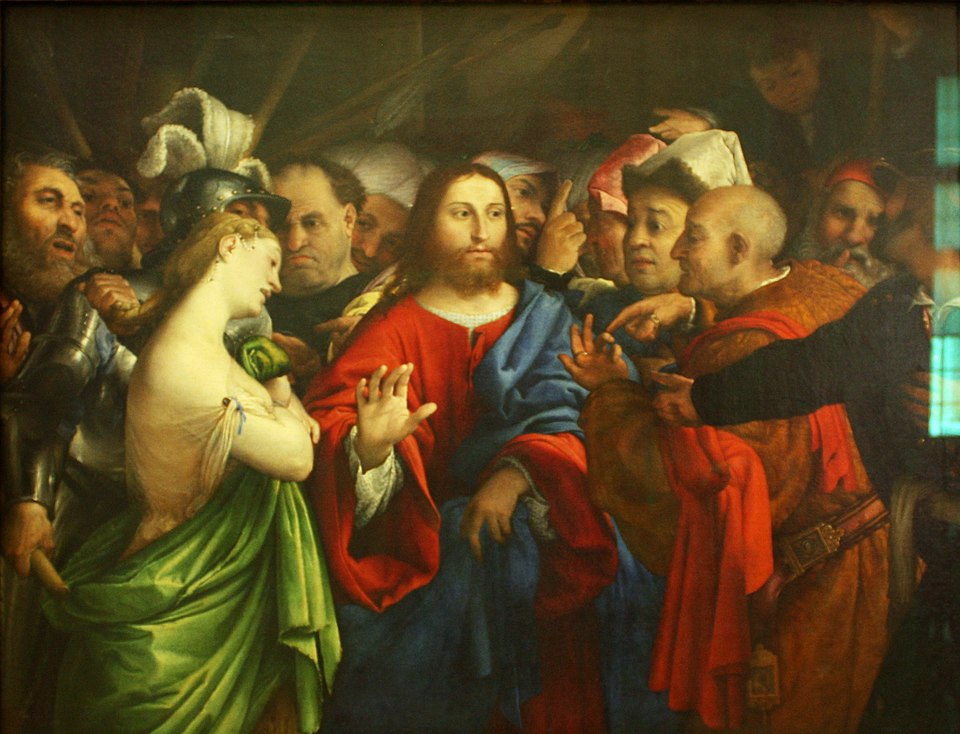
Painting: La Femme adultère “The woman Taken in Adultery” by Lorenzo Lotto
8 Jesus returned to the Mount of Olives, 2 but early the next morning he was back again at the Temple. A crowd soon gathered, and he sat down and taught them. 3 As he was speaking, the teachers of religious law and the Pharisees brought a woman who had been caught in the act of adultery. They put her in front of the crowd.
4 “Teacher,” they said to Jesus, “this woman was caught in the act of adultery. 5 The law of Moses says to stone her. What do you say?”
6 They were trying to trap him into saying something they could use against him, but Jesus stooped down and wrote in the dust with his finger. 7 They kept demanding an answer, so he stood up again and said, “All right, but let the one who has never sinned throw the first stone!” 8 Then he stooped down again and wrote in the dust.
9 When the accusers heard this, they slipped away one by one, beginning with the oldest, until only Jesus was left in the middle of the crowd with the woman. 10 Then Jesus stood up again and said to the woman, “Where are your accusers? Didn’t even one of them condemn you?”
11 “No, Lord,” she said.
And Jesus said, “Neither do I. Go and sin no more.”
John 8:1-11
Dear God, I don’t think this story gets enough time. It’s quite remarkable. My wife and I were talking about something last night and this story came up. I can’t remember what we were saying or the context in which we talked about it, but she mentioned this painting by Lorenzo Lotto to me. It gave me an interesting thought: What would it be like to follow this woman after she left Jesus that day? What was the rest of that day like for her? So I decided to take a little creative break from my 1 Samuel series and spend a little time with this woman this morning.
First, I want to back up and set the context. There was a festival going on in Jerusalem when this happened. It was the Festival of Shelters (John 7:1-10). I Googled that festival and found it was a seven-day commemoration of the years the Israelites spent in tents in the wilderness. That made me think of the book I read last year, The Year of Living Biblically: One Man’s Humble Quest to Follow the Bible as Literally as Possible by A.J. Jacobs. I remembered he had done something that seemed to line up with this so I looked it up. He called in the “Feast of Ingathering–or Sukkoth.” His description seems to indicate it’s the same thing and he said Orthodox Jewish people still celebrate it by building huts and sleeping in them (he was in New York City so he had to build one in his living room). So that’s the context. An annual festival in Jerusalem where a lot of extra people are in town. In fact, this is part of the story when Jesus’s brothers told him to go to Jerusalem and show himself off and he told them he wasn’t going to go, but then he went secretly until starting to teach in the Temple halfway through the festival.
Now, back to this passage. After I read it this morning, I had some thoughts. Let me stress here that ALL of this is my speculation and there is a great likelihood that I’m completely wrong about it. With that disclaimer said, I wonder what the previous 12 hours were like for this woman and then what were the next 12 hours like. What were the circumstances under which she was caught? Who was she? Was she the one who was married to someone else or had she slept with someone who was married to someone else but she was single? Was she a prostitute? In that culture, if she was a prostitute, would they have cared? I believe there were a lot of prostitutes running around and sleeping with married men so my guess is that she was the on who was married and caught. Perhaps her husband caught her that night before and brought her to the Temple for punishment for stoning.
It occurs to me as I write this that this could have been Jesus’s own mother, Mary, when she was pregnant with him. Wow! What a thought. The husband could easily have been Joseph, taking her to the Temple for judgment and stoning. But “Joseph, to whom she was engaged, was a righteous man and did not want to disgrace her publicly, so he decided to break the engagement quietly.” I wonder if Jesus had this same thought that morning. If this had happened to his own mother while she was pregnant with him, it would have been a disaster.
As I’m sitting here (and I think I’m going to have a lot of disjointed, random thoughts this morning), I wonder why stoning was the chosen method of execution for so many sins. Was it because it wasn’t a hands-on approach? Back then, I suppose their options were to physically touch the person and kill them with some sort of blade or do something from a distance like throw stones or shoot an arrow.
Now that I think about it, the Jews under Rome didn’t have the right to execute people (that’s why they needed Pilate to sign off on Jesus’s execution). Was there an exception for stoning? I just Googled that too. Apparently, to compare it with modern American law, there were federal crimes (crimes against the Roman Empire) and state crimes (in this case, crimes against the Jewish religious law). Jesus’s crime was a federal crime because he claimed to be king while adultery or Stephen’s crime in Acts would be against Jewish law and could be executed by the Sanhedrin.
So back to our story. There’s a festival. I’m guessing that the woman’s husband catches her sleeping with someone else during the festival (maybe in someone’s special tent?) and takes her to the Temple for judgment and execution. Lots of anger. Lots of fear. As I’ve heard said in movies and other places before, “Women need a reason to have sex. Men just need a place.” (City Slickers) So perhaps this woman had a reason to not be faithful to her husband. I don’t know. But now she’s here, and she must be both terrified and humiliated. Regretful too. What’s going to happen now?
Then Jesus shows up in the Temple and starts teaching halfway through the Festival. I won’t go into the days he spent talking and everything he said, but, suffice it to say, the Pharisees were none too pleased. Then, on the last day of the festival, what John describes in John 7:37 as “the climax of the festival,” Jesus did one last big provocation about being living water. The Pharisees apparently sent the Temple guards to arrest him but they didn’t. Nicodemus, one of my heroes, tries to defend Jesus with, “Is it legal to convict a man before he is given a hearing?” and he gets jumped on and accused of being a Jesus defender: “Are you from Galilee, too?”
So now our scene takes place on the morning after the festival. Everyone might be a little hungover. This woman might have gotten caught up in the revelry of the night. And now she is standing in front of Jesus. The men (there are likely few if any women present) are simultaneously indignantly ready to stone her and wondering what it would be like to have sex with her (let’s be real, some of them were thinking that–that’s probably the most confident I am about any guesses I’ve made this morning), and she watches Jesus through a bowed head out of the upper part of her peripheral vision. What’s he going to do. So he bends down to write on the ground.
Here’s a new thought. Maybe he bent down to write on the ground so that she could see what he was writing. Maybe he wrote it for her. We assume he was writing to her judges and accusers, but maybe her face was so downcast that he knew this was the only way to communicate love and a new life to her.
So we know this next part. He stands up and affirms they are right that she should be stoned according to the law of Moses. But then he makes an interesting statement that (and again, this is a brand new thought to me) indicates humans don’t have the authority to commit capital punishment: “Let the one who has never sinned throw the first stone!” This statement could be applied to any sin such as murder that we think deserves the death penalty. As sinful creatures, do we have the authority to take a life–even the most heinous life, as the result of a crime? Wars are different animals that I won’t get into right now, but in this area, I think it helps convince me more than ever that capital punishment does not align with Jesus’s teaching.
So now everyone eventually admits they aren’t able to live up to the standard Jesus has now set for capital punishment and walks away, leaving only the woman, to whom Jesus famously says, “Where are your accusers? Didn’t even one of them condemn you?” She says no, and he closes the scene saying, “Neither do I. Go and sin no more.” End scene.
So what happened next? That’s the first thought I had last night when my wife brought up this story. What was the rest of her day like as a forgiven woman? Was her husband one of the people who dropped his stone and walked away? Did he divorce her? Did she have to move in with a friend? And what was the state of her heart from that day forward? If it was a long-term affair, did she break up with the guy? Did she take her freedom from her sin and turn over a new leaf? Did she earnestly start to follow you? Who did she become as a result of this absolution from her sin?
Father, I am not without sin. I have no stones to throw. Jesus taught such a unique…what’s the word I’m looking for? He taught a unique perspective on who we are as humans and who you are as God. Oh, Father, help me to “go and sin no more” and to offer this same opportunity of your unique perspective on who we can be through following you to others. Help me to make this the evangelism that brings your kingdom into this world and drives the hell out of people.


 Emails to God