7 When Herod Antipas, the ruler of Galilee, heard about everything Jesus was doing, he was puzzled. Some were saying that John the Baptist had been raised from the dead. 8 Others thought Jesus was Elijah or one of the other prophets risen from the dead.
9 “I beheaded John,” Herod said, “so who is this man about whom I hear such stories?” And he kept trying to see him.
Luke 9:7-9
Dear God, Jesus does this interesting dance with Herod in Luke’s gospel. He knows he needs to die. I probably knew John the Baptist needed to die. He didn’t make a move to save John. He doesn’t make a move to confront Herod. But one of the women supporting him financially is married to someone in Herod’s court (Joanna from Luke 8:3). Later he will egg Herod on in Luke 13:31-32, call him a fox, and dare Herod to kill him. Interestingly, Herod, like Pilate, will live in infamy throughout time. He has a legacy few get. It’s not a good legacy. He married his brother’s wife. He killed John the Baptist. He was complicit in killing Jesus. He had issues.
As I read this passage this morning, I wondered why none of the things the people thought Jesus might be was “the Messiah.” John the Baptist raised from the dead? They were alive at the same time. Elijah? Well, okay. But I guess that also goes back to what Jesus asked the disciples later in this chapter after they feed the 5,000, “Who do people say that I am?” They replied the same things the people are telling Herod. It’s Peter in Luke 9:20 that calls him the Messiah. That’s a whole different label. I wonder if Jesus wasn’t confrontational or macho enough for the people’s definition of what the Messiah would be.
Father, I guess what I’m getting from this passage this morning is that I often don’t know the right thing to do. I don’t know if I should be confrontational in one situation. I don’t know if I should be nurturing and merciful in another. I don’t know if I should help and intervene or let someone struggle. I don’t know if I should hire this person or that person. I don’t know if I should ask this person or that person for money. It’s quite amazing, actually, how much ignorance I have as I make my way through the day. So for the people I encounter today. The people who are on my heart as I sit and pray right now. The family members who are struggling. The family members needing healing. The friends needing the same. The families our agency serves. The leaders of our community and nation. The leaders of the world. I simply pray that your kingdom will come and your will will be done on earth as it is in heaven. Use me however you will, and keep me from accidentally getting in your way.
11 The crowd was listening to everything Jesus said. And because he was nearing Jerusalem, he told them a story to correct the impression that the Kingdom of God would begin right away. 12 He said, “A nobleman was called away to a distant empire to be crowned king and then return. 13 Before he left, he called together ten of his servants and divided among them ten pounds of silver, saying, ‘Invest this for me while I am gone.’ 14 But his people hated him and sent a delegation after him to say, ‘We do not want him to be our king.’
15 “After he was crowned king, he returned and called in the servants to whom he had given the money. He wanted to find out what their profits were.
Luke 19:11-15
Dear God, I want to spend some time with this parable this morning because I learned something about it yesterday that, if I ever knew it, I had forgotten. Basically, Jesus is comparing himself with Herod for those who are listening. When he said a nobleman went to have himself crowned king and there were people who protested his appointment, he was referencing Herod and how he came to power, but in this case, he was putting himself in the place of Herod and letting them know that 1.) there would be a delay between the present time and what they wanted and 2.) his rule and his edicts would be as final as Herod’s were. To quote the commentary I used this morning: “Jesus is telling a contemporary story in veiled terms. In the parable, the nobleman was given the kingdom and he returned to slay those who didn’t want him in power. A Christians, we believe that Jesus is the King and that in the last days He will return to His Kingdom. Whether you are an atheist, a skeptic, or one who practices any brand of non-Christian religion doesn’t change that reality. Jesus tells us through this parable, “Right now you are free to debate and argue, but when the final curtain is closed, I am Lord!” (Communicator’s Commentary: Luke by Bruce Larson)
I guess this whole thing challenges me because, at some level, I do want to see you as a “pushover God.” I want to put you in my box and have you do what I want you to do and behave how I want you to behave. I don’t want to think of Jesus as exercising authority the way Herod would. I’ve sometimes wondered what it would have been like to be around Jesus a lot like the disciples were. I don’t think I would have liked it. I think I prefer to have the ideas in my head but then make my own rules and live by my own opinions throughout each day. Even though a lot of those rules and opinions are wrong.
Father, I’m not sure exactly what to take from this except to be more in awe of you and more sober about how I interact with you. Even these times of prayer should not be approached lightly. I am address the God of the universe. My God. Can I possibly be as casual as I normally am? I’m sorry for ever treating you as less than you are. You are my God. I am your servant. Thank you for your loving heart towards me.
3 King Herod was deeply disturbed when he heard this, as was everyone in Jerusalem.
Matthew 2:3
Dear God, before I read Piper’s commentary on this verse, I want to sit with the last five words: as was everyone in Jerusalem. As word spread about the magi being in town and looking for the newly born “King of the Jews,” what were they thinking? And I want to put a pin in these people for if we talk about the flight to Egypt and the killing of all the young boys, but for now I want to consider what their hope and fears were. Herod’s are pretty easy to figure out. He just saw a threat. A threat to himself. A threat to his bosses in Rome. A threat to his lineage.
But for “everyone in Jerusalem,” what were they “deeply disturbed” by? Did they even want a Messiah, or was the status quo more comfortable? Were they afraid of war? Were they willing to possibly pay the price they thought they would be asked to pay in following a Messiah into battle against the Romans? This is what I assume they were thinking.
And then there is the reality. If they had recognized what Jesus actually came to do–to offer a path to the controlled burn I talked about yesterday–would they have rejoiced instead? Would they too have sought out the baby? What kept all of them from going to Bethlehem and following the magi?
There is so much here that is me. Afraid of the word it will take to follow you. Afraid of risking what I have. Afraid of what would be new. Yes, I might be living in a pit, but the pit is home now. I’ve made it work. What would my life look like if I were to upset all of that to do something you’re calling me to do?
Okay, I just read Piper’s commentary, and it lines up remarkably with what I just said except he was more articulate about it:
There are two kinds of people who do not want to worship Jesus the Messiah. The first kind is the people who simply do nothing about Jesus. He is a non-entity in their lives. This group is represented by the chief priests and scribes: “Assembling all the chief priests and scribes of the people, [Herod] inquired of them where the Christ was to be born.” Well, they told him, and that was that–back to business as usual. The sheer silence and inactivity of the religious leaders are overwhelming given the magnitude of what was happening
Compare that with the reaction Herod and the rest of Jerusalem: “When Herod the king heard this, he was troubled, and all Jerusalem with him.” In other words, the rumor was going around that someone thought the Messiah was born, and everyone but the chief priests took note. Why did they not go with the magi? There were not interested. They did not want to worship the true God.
The second kind of people who do not want to worship Jesus are those who are deeply threatened by him. Herod was deeply afraid–so much so that he schemed and lied and then committed mass murder just to get rid of Jesus.
Father, I think I am going to lean on the serenity prayer this morning. Grant me the serenity to accept the things I cannot change, the courage to change the things I can, and the wisdom to know the difference.
14 One day when Samson was in Timnah, one of the Philistine women caught his eye. 2 When he returned home, he told his father and mother, “A young Philistine woman in Timnah caught my eye. I want to marry her. Get her for me.”
3 His father and mother objected. “Isn’t there even one woman in our tribe or among all the Israelites you could marry?” they asked. “Why must you go to the pagan Philistines to find a wife?”
But Samson told his father, “Get her for me! She looks good to me.” 4 His father and mother didn’t realize the Lord was at work in this, creating an opportunity to work against the Philistines, who ruled over Israel at that time.
5 As Samson and his parents were going down to Timnah, a young lion suddenly attacked Samson near the vineyards of Timnah. 6 At that moment the Spirit of the Lord came powerfully upon him, and he ripped the lion’s jaws apart with his bare hands. He did it as easily as if it were a young goat. But he didn’t tell his father or mother about it. 7 When Samson arrived in Timnah, he talked with the woman and was very pleased with her.
8 Later, when he returned to Timnah for the wedding, he turned off the path to look at the carcass of the lion. And he found that a swarm of bees had made some honey in the carcass. 9 He scooped some of the honey into his hands and ate it along the way. He also gave some to his father and mother, and they ate it. But he didn’t tell them he had taken the honey from the carcass of the lion.
10 As his father was making final arrangements for the marriage, Samson threw a party at Timnah, as was the custom for elite young men. 11 When the bride’s parents saw him, they selected thirty young men from the town to be his companions.
12 Samson said to them, “Let me tell you a riddle. If you solve my riddle during these seven days of the celebration, I will give you thirty fine linen robes and thirty sets of festive clothing. 13 But if you can’t solve it, then you must give me thirty fine linen robes and thirty sets of festive clothing.”
“All right,” they agreed, “let’s hear your riddle.”
14 So he said:
“Out of the one who eats came something to eat; out of the strong came something sweet.”
Three days later they were still trying to figure it out. 15 On the fourth[b] day they said to Samson’s wife, “Entice your husband to explain the riddle for us, or we will burn down your father’s house with you in it. Did you invite us to this party just to make us poor?”
16 So Samson’s wife came to him in tears and said, “You don’t love me; you hate me! You have given my people a riddle, but you haven’t told me the answer.”
“I haven’t even given the answer to my father or mother,” he replied. “Why should I tell you?” 17 So she cried whenever she was with him and kept it up for the rest of the celebration. At last, on the seventh day he told her the answer because she was tormenting him with her nagging. Then she explained the riddle to the young men.
18 So before sunset of the seventh day, the men of the town came to Samson with their answer:
“What is sweeter than honey? What is stronger than a lion?”
Samson replied, “If you hadn’t plowed with my heifer, you wouldn’t have solved my riddle!”
19 Then the Spirit of the Lord came powerfully upon him. He went down to the town of Ashkelon, killed thirty men, took their belongings, and gave their clothing to the men who had solved his riddle. But Samson was furious about what had happened, and he went back home to live with his father and mother. 20 So his wife was given in marriage to the man who had been Samson’s best man at the wedding.
Judges 14
Dear God, I find the Samson story interesting because it shows me that you sometimes do things that are completely counterintuitive to me. How could you use this profane, ungodly man? How could you condone so much pure awfulness in a leader? How could you select him? What are you doing? I like this description of his parents in verse 4 because it would have to be said of me a lot of times, including today: 4His father and mother didn’t realize the Lord was at work in this, creating an opportunity to work against the Philistines, who ruled over Israel at that time.
There’s a Rich Mullins song called “Who God is Gonna Use.”
At the beginning of this video, Rich talks about how you used Balaam’s donkey to save him (Numbers 22:21-35), and that story inspired the rest of the song. You use all kinds of people and all kinds of things. And not necessarily the holy ones. And not necessarily to do holy things. You used Pilate and Herod to kill Jesus. But what the disciples couldn’t see at the time is that it was taking one step back to take five steps forward. They killed Stephen, which seemed like a huge setback, but you used it to spread the church throughout the world (Acts 8). Stephen’s death is one of the reasons I am here today.
I have a friend who lost her father last week, and then was in an unfortunate accident yesterday that sent her to the ER. She loves you. She worships you. It seems like awful timing. Why would this happen? Why would you let this happen? Well, maybe there are just things I cannot see. Please be with her and her mother today as she recovers and they mourn the loss of a great, godly man.
As I type this email this morning, we now know who won the election yesterday for POTUS. There are some Christians who are delighted. Some are devastated. If the winner had been different, the roles would have been reversed. I talked with both sides over the last few weeks, and I told them, “Whoever wins, I will not let it be my idol. I am not putting my faith in either candidate. I am putting my faith in God and the things he is doing that I cannot see. So the day after the election, regardless of who wins, I will wake up, worship God, pray, and then go about loving everyone I can that day.”
Father, use President-elect Trump to do your will in this world whether he even knows your doing it or not, and regardless of what your will is for our country or this world. And my prayer would be the same if Kamala Harris won. I don’t know what you have for our country. I don’t know what you have for the people within it and around the world. I don’t know what you have for me. I know that I have no demands on you. I know that I consider my life worth nothing to me, if only I may finish the race and complete the task you’ve given me–the task of testifying to the gospel of your grace through Jesus. So help me to live into that today. For those who will be impacted materially by policies of a new administration, both foreign and domestic, I pray. Find your remnant and strongly support them. Use everything going on this world to draw us closer to you. I pray that the American church my find true faith in you and turn loose of the idols we look to for our certainty. I pray that I will do the same. I am here to offer you my worship, my life, and my service. Use me as you will.
9 One day Jesus called together his twelve disciples and gave them power and authority to cast out all demons and to heal all diseases. 2 Then he sent them out to tell everyone about the Kingdom of God and to heal the sick. 3 “Take nothing for your journey,” he instructed them. “Don’t take a walking stick, a traveler’s bag, food, money, or even a change of clothes. 4 Wherever you go, stay in the same house until you leave town. 5 And if a town refuses to welcome you, shake its dust from your feet as you leave to show that you have abandoned those people to their fate.”
6 So they began their circuit of the villages, preaching the Good News and healing the sick.
7 When Herod Antipas, the ruler of Galilee, heard about everything Jesus was doing, he was puzzled. Some were saying that John the Baptist had been raised from the dead. 8 Others thought Jesus was Elijah or one of the other prophets risen from the dead.
9 “I beheaded John,” Herod said, “so who is this man about whom I hear such stories?” And he kept trying to see him.
10 When the apostles returned, they told Jesus everything they had done. Then he slipped quietly away with them toward the town of Bethsaida.
Dear God, I want to focus on verses 7-9 this morning, but I wanted them in their context. Luke tells us this story of the disciples going out and doing great things, but he also gives us a little bit of insight into what’s happening with Herod. Luke told us about Joanna, the wife of Herod’s business manager Chuza being one of Jesus’s supporters. Was that his source. It’s certainly plausible that she was. I’m sure Herod was learning things about Jesus from Chuza, and Jesus and the disciples were learning things about Herod from Joanna.
I would love to be able to get inside of Herod’s head and see what he is thinking. I think there was actually something about John the Baptist that touched him. He didn’t want to kill him. And now there was this Jesus guy. I don’t think he saw Jesus as a revolutionary threat, which is ironic because that is what the Jewish people wanted him to be. Yeah. I don’t know. I could be completely wrong here, but I almost get the sense that this generation of Herod was a little Jesus-curious. Would Jesus be someone who could bring him a peace he was striving for but couldn’t attain?
I wonder what kept Herod from actually seeing Jesus at this point. Surely he could have just summoned him through Joanna and he would have come. Did he have too much pride to let others know he had this curiosity? Was he afraid Herodias would have Jesus arrested? Was he afraid Jesus would confront him like John did?
It’s important to note how Luke eventually represented Herod’s and Jesus’s interaction when they finally did meet during the Passion:
8 Herod was delighted at the opportunity to see Jesus, because he had heard about him and had been hoping for a long time to see him perform a miracle. 9 He asked Jesus question after question, but Jesus refused to answer. 10 Meanwhile, the leading priests and the teachers of religious law stood there shouting their accusations. 11 Then Herod and his soldiers began mocking and ridiculing Jesus. Finally, they put a royal robe on him and sent him back to Pilate.
Luke 23:8-11
He was excited to meet Jesus, but then when Jesus let him down and didn’t answer any of his questions, he mocked him and condemned him to what he thought was death.
Father, Herod was just a man. He was sinful. He had needs. He had an ego. He was everything I am. And I have a choice to make. Will I be prideful, or will I die to myself, take up my cross, and follow you? Herod had more to lose that I do, so the choice should be easier for me. And I do. I come before you to lay down my life, take up my cross and follow you. Here I am to worship. Here I am to bow down. Here I am to say that you are my God.
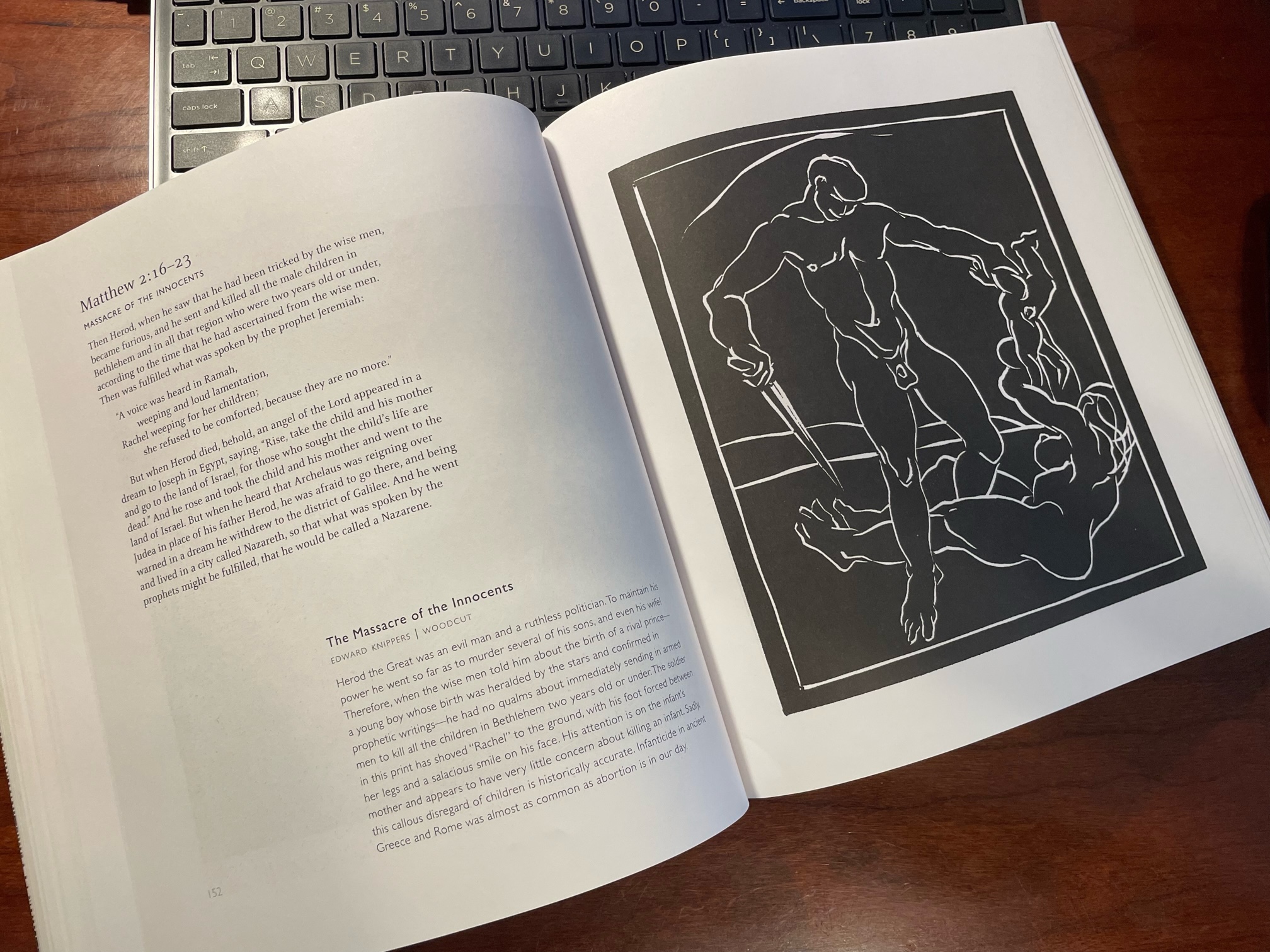
16 Herod was furious when he realized that the wise men had outwitted him. He sent soldiers to kill all the boys in and around Bethlehem who were two years old and under, based on the wise men’s report of the star’s first appearance. 17 Herod’s brutal action fulfilled what God had spoken through the prophet Jeremiah:
18 “A cry was heard in Ramah— weeping and great mourning. Rachel weeps for her children, refusing to be comforted, for they are dead.”
Matthew 2:16-18
Dear God, as I am sitting with this story this morning, it occurs to me that there are a lot more people involved in it that I have always thought. Sure, there are Herod, the soldiers, the mothers, and the children, but that’s not the extent of it. Everyone is in this story.
Mary, Joseph, and Jesus are in this story. I wonder what Mary’s and Joseph’s reaction was when they first heard the news. Did they weep? Did they pray? Did they feel survivors guilt? Did they become more determined? Did they despair? Did they thank you for warning Joseph to leave? And how old was Jesus when he first heard about this? How old was he when he realized that it was meant for him. How did he internalize that information and respond to it?
I’m going to ignore Herod because he was just unhinged, jealous and fearful. He had made an idol out of his power and was willing to kill his own children, much less the children of others, to keep his position (okay, so I guess I didn’t ignore him). But the soldiers. Strangers in a foreign land. Likely racist. Resentful. Disrespectful. Vengeful. I wonder if there is any part of me that is like them. Do I hold things inside and then take advantage when I have an opportunity to let my anger spew out?
In terms of the parents, I can’t even imagine their helplessness. I mean, really, I’ve never had to feel that helpless. I remember hearing stories 25 years ago about Syrian refugee camps and what was happening to families there. Raiders were coming in and taking children, raping women, etc. I remember thinking about the men and how helpless they must feel to protect their children and wives. Themselves. No help was coming from the government either. No police. No military. Just helpless. I guess there are times when I’ve felt helpless to protect or provide for my children. Frankly, I feel pretty helpless now.
There are the older siblings of the children who died. A lot of the murdered children had older siblings who were traumatized by this. Did they ask how a loving God could let this happen? Did it make them long for Rome’s destruction and Israel’s restoration even more? When Jesus came along when they were in their mid- to late-30s, did they think back on this as one of the reasons they wanted him to me a conqueror and not a forgiver? Do I allow the pain from my past and traumas in my life influence my anger and sense of vengeance now?
There was the community, both locally and throughout the nation. No one was untouched by this. It’s a little like 9/11. If you were in New York or D.C., you probably knew someone or were related to someone affected by it. If you lived in the rest of the U.S., you at a minimum felt attacked and vulnerable. I know I did. That’s why we watched the news and sat in front of our televisions so shocked and dismayed. This killing of the children in Israel 2,000 years ago, was a national tragedy, and I’m sure it influenced their feelings about Rome and the need to make Israel great again.
Father, then there was you. There was “Rachel, weeping for her children, refusing to be comforted.” There was all of heaven weeping and hell celebrating (although the opportunity was missed to kill Jesus when they could, but they probably knew this plan wouldn’t work anyway). There was the spiritual realm that we humans cannot see. But this was another move in this way the earth is playing out. This didn’t happen so that the prophecy could be fulfilled. The prophecy existed because this would one day happen. But you had a plan to redeem all of this. As Jesus grew and matured, he understood that this event did not need to be avenged. It needed to be forgiven. He understood that each of the people I mentioned above, including his own parents, needed to be reconciled to you completely. Help me, Father, Jesus, Holy Spirit. Help me to live in that wisdom today as I worship you, forgive others, and love my neighbor as myself.
I pray all of this under your Holy Authority and in you Name,
After they were gone, an angel of the Lord appeared to Joseph in a dream, saying, “Get up! Take the child and his mother, flee to Egypt, and stay there until I tell you. For Herod is about to search for the child to kill him.” So he got up, took the child and his mother during the night, and escaped to Egypt. He stayed there until Herod’s death, so that what was spoken by the Lord through the prophet might be fulfilled: Out of Egypt I called my Son.
Matthew 2:13-15
Dear God, other than Simeon’s prophecy at the temple, I think this might be Mary’s first inkling that there could be scary parts of being Jesus’s mother. What was that conversation between her and Joseph like?
Joseph: Mary! Mary, wake up!
Mary: What? What is it?
Joseph: We have to go.
Mary: What do you mean, “We have to go”? Go where?
Joseph: Egypt.
Mary: Egypt?!? What are you talking about? Can’t we talking about this in the morning?
Joseph: No. The angel said we have to go immediately.
Mary: You saw an angel?
Joseph: Yes, the angel came to me like he did before and told me, “Get up! Take the child and his mother, flee to Egypt, and stay there until I tell you. For Herod is about to search for the child to kill him.”
Mary: What?!? Are you sure that’s what he said?
Joseph: As sure as I was when he visited me last time and told me to marry you.
Mary: Okay, let’s go!
What was that trip like? Was it frantic? Did they finance it with the gold from the wise men? I wonder what plans they had for their lives that they now had to scrap to follow the angel’s instructions. Had she made friends? Had he hit his stride with his work? Were they planning on raising Jesus in Bethlehem?
Your call to them to raise Jesus was a call to a difficult life. I like to joke that I think Noah got one of the worst deals in the Bible because of the work he had to go through and it would probably have been easier to just die in the flood, but Mary and Joseph had some real obstacles of their own. It feels like their lives were all about sacrificing to fulfill this call.
Then they probably heard about this after they arrived in Egypt:
Herod was furious when he realized that the wise men had outwitted him. He sent soldiers to kill all the boys in and around Bethlehem who were two years old and under, based on the wise men’s report of the star’s first appearance.
Matthew 2:16
Survivors remorse? Guilt over their son’s existence having incited Herod into murdering those children? The anguish on behalf of all of those parents? Relief that they were safe in Egypt? I’m sure Mary had all of these things. I wonder how this whole event changed how protective she was of Jesus for the rest of his life.
Father, parenting can be scary. You can call us to sacrifice everything for the good of our children. Even when they are adults, their good can outweigh our own. And as we age into the end of our years, we need to consider our our own ending lives will impact them and die to ourselves for their benefit. So show me at any given moment what you are calling me to do for my children. Give me great discernment between what you need them to have from me and what you don’t need them to have from me. And everything you do for them or for me, make it something that is really for you and your glory, whatever it might cost me (and help me to be willing and ready to live up to those last words I just prayed).
After Jesus was born in Bethlehem of Judea in the days of King Herod, wise men from the east arrived in Jerusalem, saying, “Where is he who has been born king of the Jews? For we saw his star at its rising and have come to worship him.” When King Herod heard this, he was deeply disturbed, and all Jerusalem with him. So he assembled all the chief priests and scribes of the people and asked them where the Christ would be born. “In Bethlehem of Judea,” they told him, “because this is what was written by the prophet: And you, Bethlehem, in the land of Judah, are by no means least among the rulers of Judah: Because out of you will come a ruler who will shepherd my people Israel. ” Then Herod secretly summoned the wise men and asked them the exact time the star appeared. He sent them to Bethlehem and said, “Go and search carefully for the child. When you find him, report back to me so that I too can go and worship him.” After hearing the king, they went on their way. And there it was—the star they had seen at its rising. It led them until it came and stopped above the place where the child was. When they saw the star, they were overwhelmed with joy. Entering the house, they saw the child with Mary his mother, and falling to their knees, they worshiped him. Then they opened their treasures and presented him with gifts: gold, frankincense, and myrrh. And being warned in a dream not to go back to Herod, they returned to their own country by another route. After they were gone, an angel of the Lord appeared to Joseph in a dream, saying, “Get up! Take the child and his mother, flee to Egypt, and stay there until I tell you. For Herod is about to search for the child to kill him.” So he got up, took the child and his mother during the night, and escaped to Egypt. He stayed there until Herod’s death, so that what was spoken by the Lord through the prophet might be fulfilled: Out of Egypt I called my Son.
Matthew 2:1-15
Dear God, here’s a question that I think isn’t asked enough, but has a simple answer. Why did you pick someone like Joseph? Why not a Person of prominence to be Jesus’s dad? Why not a religious leader? Why not a king? Why was the Messiah born to a carpenter and his fiancé?
I think there are actually several answers. The obvious ones are that those fathers would have been a bad influence on him. We’ve seen how the sons of kings turn out (well, maybe except for Jonathan). We’ve seen how the sons of religious leaders like Eli and Samuel turn out. We’ve seen how Abraham’s, Isaac’s and Jacob’s sons turned out. No, there is certainly no guarantee that someone will turn out well based on who their parents are. All of us are fallible.
In this case, I think you 1.) picked the parents based on their character, regardless of what their status was. But 2,) I think it actually did matter because a person of position would have had much more to lose than Joseph did I think it was probably easier to obey you to take Mary and then do all of this moving around because he didn’t have a lot of encumbrances from his position in life. He had less to lose by going ahead and taking her as his wife. He had less to lose by waking up and deciding to obey and take Mary and Jesus to Egypt.
To relate this to myself, I’ve often wondered how much I’ve allowed myself to not obey something you’ve called me to do because of the things I’ve achieved and/or acquired. I have a lovely wife. Do I want to drag her just anywhere? I have a nice home in a safe town. Am I ready to trade that security in for physical insecurity? I have a job that pays me a nice middle class wage. Am I ready to jeopardize that for uncertainty and a life of truly living on my daily bread? No, I would never have made a good father for Jesus for a lot of reasons, but the biggest one is that I wouldn’t have been prepared to pay the price that Joseph had to pay. I wonder what it would look like if I were ready to pay that kind of price now, and what would you possibly call me to do if I were willing to completely open myself up to any possibilities?
Father, even now, I want to pray and tell you that I am willing to go wherever you want me to go and do whatever you want me to do, but I’m scared. I’m scared what you might call me to do. But I’m going to say it anyway. Father, I am willing to go, I am willing to do whatever you are calling me to do. I’m just going to tell you that you are going to have to make it very obvious because my natural inclination will be to miss anything you call me to do that is out of my comfort zone. So make your plan for me John-proof. Help me to make each decision correctly in the moment and then have this decisions and choices add up to your will.
When Herod heard about Jesus, he said, “John, the man I beheaded, has come back from the dead.” For Herod had sent soldiers to arrest and imprison John as a favor to Herodias. She had been his brother Philip’s wife, but Herod had married her. John had been telling Herod, “It is against God’s law for you to marry your brother’s wife.” So Herodias bore a grudge against John and wanted to kill him. But without Herod’s approval she was powerless, for Herod respected John; and knowing that he was a good and holy man, he protected him. Herod was greatly disturbed whenever he talked with John, but even so, he liked to listen to him. Herodias’s chance finally came on Herod’s birthday. He gave a party for his high government officials, army officers, and the leading citizens of Galilee. Then his daughter, also named Herodias, came in and performed a dance that greatly pleased Herod and his guests. “Ask me for anything you like,” the king said to the girl, “and I will give it to you.” He even vowed, “I will give you whatever you ask, up to half my kingdom!” She went out and asked her mother, “What should I ask for?” Her mother told her, “Ask for the head of John the Baptist!” So the girl hurried back to the king and told him, “I want the head of John the Baptist, right now, on a tray!” Then the king deeply regretted what he had said; but because of the vows he had made in front of his guests, he couldn’t refuse her. So he immediately sent an executioner to the prison to cut off John’s head and bring it to him. The soldier beheaded John in the prison, brought his head on a tray, and gave it to the girl, who took it to her mother. When John’s disciples heard what had happened, they came to get his body and buried it in a tomb.
Mark 6:16-29
Dear God, for a short time I debated whether or not to include Herod and Herodias in my “Parents of the Bible” series, but I decided that we see them interacting with their daughter and making decisions with her as their parent so I guess they count. You put them and their story in here for us so let’s see what we can learn from them.
Herod
Here is a list of what we see Herod do in this story:
He takes his brother’s wife.
He didn’t necessarily want to arrest John the Baptist (JTB), but he did it at the behest of his wife.
JTB made him uncomfortable by presenting Herod’s sin to Heron any chance he got, but he “respected John; and knowing that he was a good and holy man, he protected him.”
This part is interesting. I saw a movie about Jesus one time that showed this story. It had an adult daughter dancing seductively for her father, him getting turned on, and then making a foolish, drunken vow to her. While that could be an interpretation, that’s not what the story says. It just says his daughter “came in and performed a dance that greatly pleased Herod and his guests.” That’s it. She could have been a 10-year-old that he was proud of. His vow was stupid, but it wasn’t necessarily made out of lust for his daughter. It could have been simple pride in her.
He makes a foolish vow, but “because of the vows he had made in front of his guests, he couldn’t refuse her.” We’ll come back to that.
He had JTB’s head given to the girl.
I guess my big thing for Herod is that he simply allowed his pride to impact his parenting. What will others think? That was a teachable moment for him with his daughter. We can’t ask for illegal and immoral things and expect to get them. But to say that to her in front of his guests would have been too much for him to swallow. In relating this to my own life, I can see where I might allow what others will say/think to influence my parenting decisions. Yes, this is part of Herod’s cautionary tale.
Herodias
Ah, Herodias. Her actions all come back to a very familiar motive: Shame. I won’t speculate as to what her role was in being Herod’s wife instead of Philip’s. But JTB’s rebukes obviously bothered her more than they did Herod so I’ll assume (and it’s a fairly big assumption) she felt some responsibility and guilt over it.
Then her daughter, perhaps unwittingly, gets involved. She does something that pleases her father, she is granted a huge favor and she doesn’t know how to respond. “Mom, what should I ask for?!? Servants? A city? Gold? Jewelry?” Then Herodias (the mother) sees an opportunity. She’s been trying to get Herod to get rid of JTB for a long time, but he’s refused. She didn’t have that much leverage over him. But now her daughter did so she used her daughter for her own gain. All to deal with her own shame.
I’d like to think I’m above ever doing anything like that, but am I? Have I ever used my children to get my way with my spouse? Just this week, I saw a divorced couple using their children to get back at each other. I’d love to judge Herodias ruthlessly for thinking of herself and her own wants/needs before her child’s, but I know I’ve done it and I’ve seen nearly every other parent do it as well.
Father, I’m glad I didn’t skip over these two parents I could seem myself in them as much as I have seen myself in any of these other biblical parents. I am sorry for the times when I put my own needs ahead of my child’s. Maybe it’s even as simple as a need to be liked by them instead of making a hard decision that will be for their best but cause them to be angry with me. Maybe it’s doing something mean out of revenge for a hurt they did to me. Guilty, guilty, guilty. I am guilty and I am sorry. Help me to be better.
Acts 12:1-5 [NLT]
About that time King Herod Agrippa began to persecute some believers in the church. 2 He had the apostle James (John’s brother) killed with a sword. 3 When Herod saw how much this pleased the Jewish people, he also arrested Peter. (This took place during the Passover celebration.) 4 Then he imprisoned him, placing him under the guard of four squads of four soldiers each. Herod intended to bring Peter out for public trial after the Passover. 5 But while Peter was in prison, the church prayed very earnestly for him.
Dear God, this had to have been a terrifying time for the original 11 disciples who witnessed Jesus’ resurrection. As far as I can tell, James was the first one of them to be martyred, and he was one of the “big three.” It’s sad that the new church had to experience so much fear, but I think you used that to refine them, make them stronger, and spread them out into the world.
My wife and I have had up and down years since 2010. Well, 2009 really. Okay, there were years of unemployment scattered in before that. Then there was the miscarriage in the 90s. Yes, we’ve had some hard times. But we were talking yesterday morning about how many positive things happened to us in 2018. I had some hard things to deal with at work, but in the end things worked out very well and we enter 2019 in a stronger position than we did in 2018. Things with our family are as good as they have been in almost 10 years. But even as we sat and talked together this morning, we were able to see some of the lessons we learned during some really hard years and even some things that happened to us this year.
I was at a family Christmas event last night with mostly people I don’t know or only tangentially know because they are very distant relatives. One of the families experienced a terrible tragedy this year with the loss of an adult son in his 20s (maybe 30s). I was talking with the wife and I had forgotten about their loss and we talked about how things were going with my wife and me. I was able to tell her that we have had a remarkably good year and she said, “I’m so glad this year could be good for someone. I’m just ready to get to 2019.” I immediately felt terrible for being so thoughtless and insensitive to what she has been through this year. I don’t know that there is any redemption in this process for her as she and her husband move forward into 2019, but I pray that you will use this tragedy and redeem it to make it something that counts.
Father, I don’t know what today holds, much less tomorrow. But I know that challenges will come. Please use each one to grow me and to bring you glory through me. Help me to not be distracted by my own “wisdom,” but to hear your still, small voice and follow your leading. Peter, John, and the rest of the apostles had some decisions to make after James’ death. They now knew that their earthly lives were not untouchable. Help me to face my path with the same faith that Peter, John, and the others had.


 Emails to God
Luke 19:11-15
11 The crowd was listening to everything Jesus said. And because he was nearing Jerusalem, he told them a story to correct the impression that the Kingdom of God would begin right away. 12 He said, “A nobleman was called away to a distant empire to be crowned king and then return. 13 Before he left, he called together ten of his servants and divided among them ten pounds of silver, saying, ‘Invest this for me while I am gone.’ 14 But his people hated him and sent a delegation after him to say, ‘We do not want him to be our king.’
15 “After he was crowned king, he returned and called in the servants to whom he had given the money. He wanted to find out what their profits were.
Luke 19:11-15
Dear God, I want to spend some time with this parable this morning because I learned something about it yesterday that, if I ever knew it, I had forgotten. Basically, Jesus is comparing himself with Herod for those who are listening. When he said a nobleman went to have himself crowned king and there were people who protested his appointment, he was referencing Herod and how he came to power, but in this case, he was putting himself in the place of Herod and letting them know that 1.) there would be a delay between the present time and what they wanted and 2.) his rule and his edicts would be as final as Herod’s were. To quote the commentary I used this morning: “Jesus is telling a contemporary story in veiled terms. In the parable, the nobleman was given the kingdom and he returned to slay those who didn’t want him in power. A Christians, we believe that Jesus is the King and that in the last days He will return to His Kingdom. Whether you are an atheist, a skeptic, or one who practices any brand of non-Christian religion doesn’t change that reality. Jesus tells us through this parable, “Right now you are free to debate and argue, but when the final curtain is closed, I am Lord!” (Communicator’s Commentary: Luke by Bruce Larson)
I guess this whole thing challenges me because, at some level, I do want to see you as a “pushover God.” I want to put you in my box and have you do what I want you to do and behave how I want you to behave. I don’t want to think of Jesus as exercising authority the way Herod would. I’ve sometimes wondered what it would have been like to be around Jesus a lot like the disciples were. I don’t think I would have liked it. I think I prefer to have the ideas in my head but then make my own rules and live by my own opinions throughout each day. Even though a lot of those rules and opinions are wrong.
Father, I’m not sure exactly what to take from this except to be more in awe of you and more sober about how I interact with you. Even these times of prayer should not be approached lightly. I am address the God of the universe. My God. Can I possibly be as casual as I normally am? I’m sorry for ever treating you as less than you are. You are my God. I am your servant. Thank you for your loving heart towards me.
I pray this in Jesus and with your Holy Spirit,
Amen
Posted by John D. Willome on January 23, 2025 in Luke
Tags: bible, Bruce Larson, christianity, Faith, God, Herod, Jesus, Luke, Parable of the Ten Servants, The Communicator's Commentary