RSS

Elijah Stands Before the Lord – 1 Kings 19:11-18


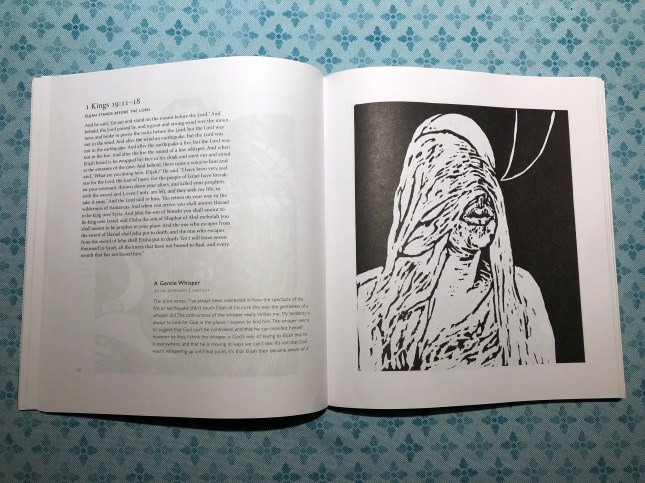
The above image is from Revealed: A Storybook Bible for Grown-Ups by Ned Bustard. The image is called “A Gentle Whisper” and was created by Justin Sorensen.

1 Kings 19:11-18

“Go out and stand before me on the mountain,” the Lord told him. And as Elijah stood there, the Lord passed by, and a mighty windstorm hit the mountain. It was such a terrible blast that the rocks were torn loose, but the Lord was not in the wind. After the wind there was an earthquake, but the Lord was not in the earthquake. And after the earthquake there was a fire, but the Lord was not in the fire. And after the fire there was the sound of a gentle whisper. When Elijah heard it, he wrapped his face in his cloak and went out and stood at the entrance of the cave. And a voice said, “What are you doing here, Elijah?” He replied again, “I have zealously served the Lord God Almighty. But the people of Israel have broken their covenant with you, torn down your altars, and killed every one of your prophets. I am the only one left, and now they are trying to kill me, too.” Then the Lord told him, “Go back the same way you came, and travel to the wilderness of Damascus. When you arrive there, anoint Hazael to be king of Aram. Then anoint Jehu grandson of Nimshi to be king of Israel, and anoint Elisha son of Shaphat from the town of Abel-meholah to replace you as my prophet. Anyone who escapes from Hazael will be killed by Jehu, and those who escape Jehu will be killed by Elisha! Yet I will preserve 7,000 others in Israel who have never bowed down to Baal or kissed him!”

Dear God, Bustard didn’t include verse 10 in this lesson, but I think it’s important because it starts with you asking Elijah a question and then Elijah answers. It is after this exchange that you decide to “pass by.”

There he came to a cave, where he spent the night. But the Lord said to him, “What are you doing here, Elijah?” Elijah replied, “I have zealously served the Lord God Almighty. But the people of Israel have broken their covenant with you, torn down your altars, and killed every one of your prophets. I am the only one left, and now they are trying to kill me, too.”

Elijah passively accuses you of the same thing I have accused you of. He feels like you have let him down. You have disappointed him. I have felt disappointed by you too. For Elijah, I think he felt like he “zealously served” you and you still didn’t come through with the people falling into line. After he did such a great job, why should his life be on the line?

Then you told him to get ready because you were going to come by. And you did some things that would physically scare him. A huge wind that crumbled rocks. An earthquake. Fire. Were you showing him that you could take his life in a minute? Were you making that point to him?

What I’ve always liked about this story is that when you showed up you were gentle. A gentle whisper is what you used to once again ask your question of Elijah: “What are you doing here, Elijah?” His answer didn’t change, but I wonder if his tone of voice did. Was there anger in his first answer? Were there tears in the second?

My wife and I were talking this morning about the fine line we often cross between feeling close to you and living in the Spirit and being completely fallen. Thank you that you give us people like Elijah who experienced the same thing.

Now, regarding this image, here we have Elijah with the cloak he put over his own eyes, and I assume that is your presence approaching his face. Is that a knife? A claw? A feather? I don’t know. Here is what the artist, Justin Sorensen, says about this story:

I’ve always been interested in how the specs tackle of the fire or earthquake didn’t touch Elijah at his core the way the gentleness of a whisper did. The ordinariness of the whisper really strikes me. My tendency is always to look for God in the places I expect to find him. The whisper seems always to suggest that God can’t be controlled, and that he can manifest himself however he likes. I think the whisper is God’s way of saying to Elijah that he is everywhere, and that he is moving in ways we can’t see. It’s not that God wasn’t whispering up until that point, it’s that Elijah then became aware of it.

Father, help me to consider my life worth nothing to me. Help me to simply finish the race and complete the task you have given me–the task of testifying to your grace.

In Jesus’ name I pray,

Amen


Tags: , , , , , ,

Proverbs 8:1-4

Proverbs 8:1-4 [NLT]
1 Listen as Wisdom calls out!
Hear as understanding raises her voice!
2 On the hilltop along the road,
she takes her stand at the crossroads.
3 By the gates at the entrance to the town,
on the road leading in, she cries aloud,
4 “I call to you, to all of you!
I raise my voice to all people.

Dear God, I don’t think I seek out “wisdom” enough. I seek out answers. I seek out intelligence. I seek out reason. I seek out all kinds of things that I mistake for wisdom, but I don’t seek out wisdom itself.

So what is wisdom? Let me see if I can put words to it. I think wisdom is a combination of several things. It starts with hearing your still small voice telling me to think differently. It involves taking my own gain out of the picture. It looks beyond the surface of a situation and back into the underlying roots. It plays the tape all of the way to the end and considers all of the dominoes that a course of action will knock over. And then after all of the prayers have been prayed, I have died to myself and my own self-interests, and I have considered everything, I come back to that still small voice. And at the end of the day it might tell me to do the thing that is foolish in my eyes. But I do it anyway because that is where you are guiding my heart.

The problem in tapping into wisdom regularly is multi-fold. On a basic level, I cannot have it unless I am continuously plugged into you. I can’t just show up and ask for it when I think I need it. Then there is the rapid-fire nature at which things come at me throughout the day. A situation can require wisdom at the drop of a hat, and 98% of the time I solve the problem with my own intellect instead of stopping to consider you.

Father, I could go on and on, but at the end of the day I will say that I am sorry for living so foolishly so much of the time. I am sorry I miss the opportunities you put in front of me, and I make the wrong decisions when given the opportunity to serve you. Continue to soften my heart and grow me into being someone who will at least only miss you 97% of the time. Then maybe in a month I’ll be down to 96%. Who knows? By the time I get to the end of my life, I might be down into the 80’s. I love you, Father, and I am sorry for the things I have done and the things I have failed to do, through my fault, through my fault, through my most grievous fault.

In Jesus’s name I pray,

Amen


Leave a comment

Posted by on May 10, 2019 in Proverbs


Tags: ,

Mark 12:38-44

Mark 12:38-44
Jesus also taught: “Beware of these teachers of religious law! For they like to parade around in flowing robes and receive respectful greetings as they walk in the marketplaces. And how they love the seats of honor in the synagogues and the head table at banquets. Yet they shamelessly cheat widows out of their property and then pretend to be pious by making long prayers in public. Because of this, they will be more severely punished.” Jesus sat down near the collection box in the Temple and watched as the crowds dropped in their money. Many rich people put in large amounts. Then a poor widow came and dropped in two small coins. Jesus called his disciples to him and said, “I tell you the truth, this poor widow has given more than all the others who are making contributions. For they gave a tiny part of their surplus, but she, poor as she is, has given everything she had to live on.”

Dear God, I think one of the biggest obstacles for people as we try to read the Bible is the same obstacle we have when we read a text from a friend–tone of voice can be everything. This story about the widow is a great example. I’ve read it countless times. Most Christians are familiar with it. If I say the words “The Widow’s Mite” to a group of Christians, they immediately know what I mean. But how much do we miss in this story?

Several years ago, I had a revelation from you that this widow likely never knew that Jesus saw her faithfulness that day, and she likely went home that day as poor as she was when the day started. She likely died however many years later as poor as she was when she dropped in those coins. There was no monetary reward for her faithfulness. There was provision from you. There was peace. And there was the immortality of me even knowing about her 2,000 years later. But here were no earthly riches for her.

So that’s a pretty good revelation. But then I read Fred Smith’s blog post this morning, and he pointed out another aspect of this story. Because of story headings, chapter breaks, and verses that translators of the Bible have given us so that we can more easily find things, we often make the mistake of separating stories in the middle. This one is an example.

Fred pointed out that Mark tells us two stories back to back. Jesus has just finished a rant about the Pharisees taking from widows (among others) and then he goes over to the offerings and seems to wait for a widow to come by to make his point. Fred mentioned that this widow was giving to the very group that Jesus said had held her down and even taken from her. This add even another layer to this story. How do I keep myself from being a Pharisee that 1.) takes advantage of widows and 2.) doesn’t squander the offerings the give to you?

I’m in a unique position as the director of a nonprofit that takes donations from hundreds of people each year, including some widows. This story is not just a reminder for me to be a giver of my personal resources, but also reminds me to make sure I am being fair to and loving each donor and then using their donations to reach out and help everyone we can.

Father, help me to hear your voice when I read my Bible. Help me to hear your tone of voice in the words. Reveal to me the things I’ve missed over the years. Help me to break away from the erroneous teaching that has been accidentally (or perhaps intentionally) passed down from each preceding generation. Love through me, and help me to decrease so that you will increase. Of course, the ultimate goal for my life is that you will use it however you need to so that you kingdom will come and your will will be done on earth as it is in heaven.

In Jesus’s name I pray,

Amen

 
Leave a comment

Posted by on May 9, 2019 in Mark


Tags: , , , ,

1 Thessalonians 5:16-18

Always be joyful. Never stop praying. Be thankful in all circumstances, for this is God’s will for you who belong to Christ Jesus.
1 Thessalonians 5:16-18

Dear God, I need more faith today. I need more peace. I have something big happening at work today. I feel pressure for it to go well, and I am just going over and over it again in my head. But as I’ve prayed about this, you’ve told me that I need to change my perspective a little.

I’m being vague. Let me be direct. We have our most important fundraising event of the year for our nonprofit tonight. My temptation is to make this a time of trying to get as much money from the attendees as I can. But you reminded me of something recently. Our organization has a vision statement that says that ministering to our donors and volunteers is as important as ministering to our clients. Well, tonight, we will have about 260 people in a room and they need to feel a sense of your presence and love as much as the 59-year-old man who was in my office yesterday needed a sense of your presence. The outcomes for the attendees are as important as the outcomes for our clients. Really, the financial outcome for the Center is secondary. This is a chance to bless people.

Father, keep my head in this space all day. Help me to live these verses of being joyful, thankful, and continuously prayerful.

In Jesus’s name I pray,

Amen

 
Leave a comment

Posted by on May 7, 2019 in 1 Thessalonians


Tags: , , ,

James 5:16
Confess your sins to each other and pray for each other so that you may be healed. The earnest prayer of a righteous person has great power and produces wonderful results.

Dear God, it can be very difficult to confess my sins to someone else. What if they think less of me? How can I face that shame?

I have a guy that I talk to nearly every week. He has struggles, and I have them too. I think he is better about telling me about his failures than I am mine. In fact, I know he is. Why is that? What am I afraid of? I know this friend will still love me. I know he won’t think less of me. I think it just comes down to shame.

I heard someone say at a retreat a few months ago that guilt seeks forgiveness, but shame hides. I can feel myself hiding part of my life even though I know that Satan’s power is in the secret. I know that it gives him a foothold in my life. I am a fool.

Father, help me to embrace repentance and vulnerability. Help me to be your child. Help me to love you and turn loose of myself just a little more.

In Jesus’ name I pray,

Amen

 
Leave a comment

Posted by on May 6, 2019 in James


Tags: , , , , ,

Nicodemus Part 3 — John 19:38-42

John 19:38-42
Afterward Joseph of Arimathea, who had been a secret disciple of Jesus (because he feared the Jewish leaders), asked Pilate for permission to take down Jesus’ body. When Pilate gave permission, Joseph came and took the body away. With him came Nicodemus, the man who had come to Jesus at night. He brought about seventy-five pounds of perfumed ointment made from myrrh and aloes. Following Jewish burial custom, they wrapped Jesus’ body with the spices in long sheets of linen cloth. The place of crucifixion was near a garden, where there was a new tomb, never used before. And so, because it was the day of preparation for the Jewish Passover and since the tomb was close at hand, they laid Jesus there.

Dear God, this is the story that made me love and appreciate Nicodemus. John seems to have a soft spot in his heart for Nicodemus (and Pilate for that matter, but that is a subject for another prayer journal). John 3 never references anyone being with Jesus and Nicodemus but Jesus, although it’s feasible that John and some other disciples could have been there. But the story in chapter 7 about Nicodemus trying to passively defend Jesus must have been relayed to John by someone else. Perhaps Nicodemus himself after Jesus’s death and resurrection. I assume John and Nicodemus had a personal relationship. Otherwise, why would John be the only Gospel writer to mention him? And why did he go to great pains in chapters 7 and 19 to not only call Nicodemus by name, but intentionally reference his conversation with Jesus in chapter 3?

So now for this story. Why do I like it so much? Mainly because It is Nicodemus at his lowest point, and yet he shows so much love for Jesus. His anger and anguish drives him into action. He loves this man he believed to be your Messiah, and he is going to show it to the world regardless of the consequences. And although we never read his name again after this story, I’m sure this act cost him his place in the temple and in the community. I would bet that this was his last Passover as a Pharisee.

Afterward Joseph of Arimathea, who had been a secret disciple of Jesus (because he feared the Jewish leaders), asked Pilate for permission to take down Jesus’ body. When Pilate gave permission, Joseph came and took the body away.

First, however, let’s talk about Joseph of Arimathea. Luke and Mark tell us that Joseph was a prominent member of the council, but he did not consent to the death sentence Jesus had received. He was a secret disciple of Jesus. Did he and Nicodemus know this about each other all along, or was this something they figured out over the previous 12 hours?

With him came Nicodemus, the man who had come to Jesus at night. He brought about seventy-five pounds of perfumed ointment made from myrrh and aloes.

John is careful to tell us that Nicodemus brought 75 pounds of perfumed ointment with him. I don’t know how this worked, but I would imagine they did the work right there at the foot of the cross. I would think that they would want to put the ointment on the body and wrap it up before they transported it to the tomb. I have this image in my mind of Nicodemus, grief stricken, disillusioned, and angry carrying this ointment in silence. Then he and Joseph take the body and start to handle the bloody mess. Where would you start? Blood would have to be everywhere. Did they clean the body with the ointment? But they did it.

Following Jewish burial custom, they wrapped Jesus’ body with the spices in long sheets of linen cloth.

This is where I want to spend some time with the other Pharisees. This scene is amazing to me. I picture it completely silent except for hushed murmurs between the Pharisees, wondering what Joseph and Nicodemus were doing. And why were they doing it. Then I imagine no words between Joseph and Nicodemus themselves. Just looks. Glances. Tears. Confusion. I would imagine that the Pharisees were furious and there was hell to pay on Sunday–especially after the resurrection. Joseph was highly respected. Did his exhibited love for Jesus make any of them doubt? How about Nicodemus? Did his demonstration of discipleship and belief make them second guess their own beliefs, if only for a moment? Joseph and Nicodemus said more through their actions than they could ever have said through words.

The place of crucifixion was near a garden, where there was a new tomb, never used before. And so, because it was the day of preparation for the Jewish Passover and since the tomb was close at hand, they laid Jesus there.

I wonder what it was like that night and the rest of the Sabbath and Passover for both Nicodemus and Joseph. Were they afraid? If not for their lives, for their careers and standing in the community? Did they talk to their wives? Their children? Were their families mad at them, or had they already told them how they felt about Jesus? And what about after the resurrection? Did the two men who had lost their standing in the community as well as, likely, their livelihoods join “The Way?” Did Nicodemus and John become friends. Did Joseph get to know all of the apostles? So many unanswerable questions. But I am certain that they both had to pay a price. The questions is, how big?

Father, I have followed you in the past and been disappointed. Even now, part of my soul is comforted by you through these prayer journals. I find camaraderie with characters like Nicodemus. We are all sojourners on this road. We are community, even though 2,000 years separates our earthly lives. Thank you for that. Thank you for loving me even when I question you and half-heartedly acknowledge my love for you. Thank you for forgiving me.

In Jesus’s name I pray,

Amen

Nicodemus Part 1
Nicodemus Part 2

 
Leave a comment

Posted by on May 4, 2019 in John, Nicodemus


Tags: , , , , , ,

Nicodemus Part 2 — John 7:32, 45-52

John 7:32, 45-52
32 When the Pharisees heard that the crowds were whispering such things, they and the leading priests sent Temple guards to arrest Jesus.

45 When the Temple guards returned without having arrested Jesus, the leading priests and Pharisees demanded, “Why didn’t you bring him in?”
46 “We have never heard anyone speak like this!” the guards responded.
47 “Have you been led astray, too?” the Pharisees mocked. 48 “Is there a single one of us rulers or Pharisees who believes in him? 49 This foolish crowd follows him, but they are ignorant of the law. God’s curse is on them!”
50 Then Nicodemus, the leader who had met with Jesus earlier, spoke up. 51 “Is it legal to convict a man before he is given a hearing?” he asked.
52 They replied, “Are you from Galilee, too? Search the Scriptures and see for yourself—no prophet ever comes from Galilee!”

Dear God, I kind of missed something in yesterday’s journal that I want to touch on before I get into this passage today. What was the context within which Nicodemus talked to Jesus at night back in chapter 3? Well, according to John, Jesus was in Jerusalem for the Passover, and he had just cleared the temple of the money changers and such and had told the “Jews” who asked for a miracle that if they destroyed “this temple” he would raise it again in three days. Nicodemus was just trying to make sense of what he was seeing and hearing.

32 When the Pharisees heard that the crowds were whispering such things, they and the leading priests sent Temple guards to arrest Jesus.

Now, for this part of the story, we find Nicodemus again. Jesus goes back to Jerusalem for the Feast of Tabernacles and he upsets the Pharisees. So much so that by the time we get to verse 32 they decide to send temple guards to arrest him.

45 When the Temple guards returned without having arrested Jesus, the leading priests and Pharisees demanded, “Why didn’t you bring him in?”
46 “We have never heard anyone speak like this!” the guards responded.
47 “Have you been led astray, too?” the Pharisees mocked. 48 “Is there a single one of us rulers or Pharisees who believes in him? 49 This foolish crowd follows him, but they are ignorant of the law. God’s curse is on them!”

It wasn’t that the guards couldn’t arrest Jesus. They intentionally chose not to. And they admitted as much to the Pharisees. And the Pharisees’ response? They basically tell the guards that God’s curse is on them and John tells us they ask an interesting question: “Is there a single one of us rulers or Pharisees who believes in him?” In showing their intellectual and spiritual superiority while shaming the guards, they push Nicodemus to a moral dilemma that pushes him just a little out of hiding.

50 Then Nicodemus, the leader who had met with Jesus earlier, spoke up. 51 “Is it legal to convict a man before he is given a hearing?” he asked.

No, it’s not the strongest defense in the world, but it’s enough of an admission of sympathy to reveal some of his inner feelings to his fellow Pharisees. He’s been completely in the closet up until now. He met with Jesus in chapter 3 at night, when no one knew about it. But now he couldn’t keep silent any longer. He was trying to do it in a way that wouldn’t completely reveal his hand. He brought in “the law.” But just saying even the slightest thing in Jesus’s defense provoked their wrath.

52 They replied, “Are you from Galilee, too? Search the Scriptures and see for yourself—no prophet ever comes from Galilee!”

The Pharisees are so flabbergasted by Nicodemus’s defense of Jesus that they accuse him of being a “homer.” They see that he has sympathy for Jesus and their only explanation is to accuse him not of believing in Jesus, but of hoping for the best for him for other emotional reasons.

So in looking back on this story, Nicodemus is on a journey of faith. He is working it out with literal fear and trembling (Philippians 2:12). He tested the waters in this story, and he got smacked down. Did he fail Jesus? Perhaps? Did he ultimately decided on this day to save his own skin rather than argue with his colleagues? Yes. But he definitely progressed on his journey. He hadn’t arrived yet. He hadn’t entered into a stage of worship that would cause him to risk it all out of his love for you and belief in Jesus. He did, however, grow and prepare himself for a day that would ask more from him.

Father, help me to be a little better today than I was yesterday. Help me to have eyes to see my own weaknesses and address them. Give me the serenity to accept the things I cannot change, the courage to change the things I can, and the wisdom to know the difference.

In Jesus’s name I pray,

Amen

Nicodemus Part 1
Nicodemus Part 3

 
Leave a comment

Posted by on May 4, 2019 in John, Nicodemus


Tags: , , ,

Nicodemus Part 1 — John 3:1-21

John 3:1-21 [NLT]
There was a man named Nicodemus, a Jewish religious leader who was a Pharisee. 2 After dark one evening, he came to speak with Jesus. “Rabbi,” he said, “we all know that God has sent you to teach us. Your miraculous signs are evidence that God is with you.”
3 Jesus replied, “I tell you the truth, unless you are born again, you cannot see the Kingdom of God.”
4 “What do you mean?” exclaimed Nicodemus. “How can an old man go back into his mother’s womb and be born again?”
5 Jesus replied, “I assure you, no one can enter the Kingdom of God without being born of water and the Spirit. 6 Humans can reproduce only human life, but the Holy Spirit gives birth to spiritual life. 7 So don’t be surprised when I say, ‘You must be born again.’ 8 The wind blows wherever it wants. Just as you can hear the wind but can’t tell where it comes from or where it is going, so you can’t explain how people are born of the Spirit.”
9 “How are these things possible?” Nicodemus asked.
10 Jesus replied, “You are a respected Jewish teacher, and yet you don’t understand these things? 11 I assure you, we tell you what we know and have seen, and yet you won’t believe our testimony. 12 But if you don’t believe me when I tell you about earthly things, how can you possibly believe if I tell you about heavenly things? 13 No one has ever gone to heaven and returned. But the Son of Man has come down from heaven. 14 And as Moses lifted up the bronze snake on a pole in the wilderness, so the Son of Man must be lifted up, 15 so that everyone who believes in him will have eternal life.
16 “For this is how God loved the world: He gave his one and only Son, so that everyone who believes in him will not perish but have eternal life. 17 God sent his Son into the world not to judge the world, but to save the world through him.
18 “There is no judgment against anyone who believes in him. But anyone who does not believe in him has already been judged for not believing in God’s one and only Son. 19 And the judgment is based on this fact: God’s light came into the world, but people loved the darkness more than the light, for their actions were evil. 20 All who do evil hate the light and refuse to go near it for fear their sins will be exposed. 21 But those who do what is right come to the light so others can see that they are doing what God wants.”

Dear God, I want to take apart this conversation a little bit because I think it is important that John is the only Gospel writer who told us about Nicodemus. There is obviously something about him that John wants us to know. Much like good story telling, I think one of the things John is doing is giving us something early in the story that he will pay off in the end at the crucifixion.

So let’s start at the beginning:

There was a man named Nicodemus, a Jewish religious leader who was a Pharisee. 2 After dark one evening, he came to speak with Jesus. “Rabbi,” he said, “we all know that God has sent you to teach us. Your miraculous signs are evidence that God is with you.”

John sets up that Nicodemus is one of the dreaded Pharisees that are so ridiculed throughout the Gospels, but he immediately lets us know there is something different about this one. He didn’t come to publicly challenge, trap, and, hopefully, humiliate and disprove Jesus. He came to get to know him a little. He came with an open mind. He came to learn. And he doesn’t lead with a question. He comes “after dark” to speak directly with Jesus, one-on-one, and acknowledges that he recognizes that Jesus is from God.

3 Jesus replied, “I tell you the truth, unless you are born again, you cannot see the Kingdom of God.”
4 “What do you mean?” exclaimed Nicodemus. “How can an old man go back into his mother’s womb and be born again?”

According to John’s account, Jesus immediately initiates the conversation, ignoring the flattery that Nicodemus gave him. He seems to want to challenge Nicodemus–to test him and see why he is really there.

We take the phrase “born again” and put it into the context of this passage, but Nicodemus didn’t have this passage. He was really trying to understand. Jesus is like one of those teachers who asks the vague, esoteric question that is hard to answer, or, in this case, says the provocative thing that will either send someone away or draw them in deeper. In this case, he drew Nicodemus in. Jesus had a lot more to say, but he wanted to first know if Nicodemus was ready to hear it. Would he scoff at Jesus’s statement and leave, or was he really there to learn? Apparently, Nicodemus was there to learn.

5 Jesus replied, “I assure you, no one can enter the Kingdom of God without being born of water and the Spirit. 6 Humans can reproduce only human life, but the Holy Spirit gives birth to spiritual life. 7 So don’t be surprised when I say, ‘You must be born again.’ 8 The wind blows wherever it wants. Just as you can hear the wind but can’t tell where it comes from or where it is going, so you can’t explain how people are born of the Spirit.”
9 “How are these things possible?” Nicodemus asked.

Water and Spirit. That’s the answer to Nicodemus’s question. Jesus acknowledges that, no, you can’t go back into your mother’s womb, but there is a new baptism that is of water and the Spirit. The problem is, the concept of being born of the Spirit is something that can’t be explained in words. So Jesus tells him that being born again means being born of water and the Spirit, but it’s a process that Jesus can’t put into words. But Nicodemus doesn’t give up. He wants to understand: “How are these things possible?”

10 Jesus replied, “You are a respected Jewish teacher, and yet you don’t understand these things? 11 I assure you, we tell you what we know and have seen, and yet you won’t believe our testimony. 12 But if you don’t believe me when I tell you about earthly things, how can you possibly believe if I tell you about heavenly things? 13 No one has ever gone to heaven and returned. But the Son of Man has come down from heaven. 14 And as Moses lifted up the bronze snake on a pole in the wilderness, so the Son of Man must be lifted up, 15 so that everyone who believes in him will have eternal life.

I’m going to break Jesus’s little speech to Nicodemus up into parts. I think this first part is about setting the context. Jesus is basically saying forthrightly to Nicodemus, “I am the Messiah.” Skipping verses 10-12 where he exhibits his exasperation with Nicodemus, Jesus goes on in verse 13 to say that he has come from God in heaven. Then in verse 14 he compares himself with the snake that was sent to save the Israelites from their sin and the snake bites that resulted in Numbers 21:4-9. But then he says that he, Jesus, will be the one lifted up so that everyone who believes in him will have eternal life.

We never get Nicodemus’s reaction to this little speech, but I can only imagine what it was like to hear it in that context. Who does this guy think he is? On the other hand, Nicodemus entered this conversation earnestly trying to get an answer to that question, and now he was getting it. This guy claims to be the Messiah.

16 “For this is how God loved the world: He gave his one and only Son, so that everyone who believes in him will not perish but have eternal life. 17 God sent his Son into the world not to judge the world, but to save the world through him.

Now Jesus gives us a glimpse into your heart. You love us. How much? Well, so much that you gave us Jesus, your one and only son, so that we would have the opportunity to commune with you for eternity. Your heart is to give us a pathway to salvation. He is saying, “Nicodemus, you need to understand that this God that you worship as all powerful is everything you can imagine and so much more. But don’t miss this one fact that might be hard to believe. He loves you and he wants you. He loves and wants you so much that he sacrificed for it. God gave out of his own being and love just so that you and your fellow humans, Jew or Gentile, will be with him.”

18 “There is no judgment against anyone who believes in him. But anyone who does not believe in him has already been judged for not believing in God’s one and only Son. 19 And the judgment is based on this fact: God’s light came into the world, but people loved the darkness more than the light, for their actions were evil. 20 All who do evil hate the light and refuse to go near it for fear their sins will be exposed. 21 But those who do what is right come to the light so others can see that they are doing what God wants.”

And finally, the wrap-up. You are doing your best to not judge me, but I have to at least love the light more than the darkness. I have to let go of my sin. I have to take the hand that is reaching out to me. You care about me, but as much as Nicodemus had to come to terms with his pride, as a Pharisee and as a man, so I must come to the end of my own pride and love the light more than the darkness.

Father, help me to not only internalize the words that John shared in this passage, but to reflect them to the world as well. Help me to be your ambassador. Help me to take your hand, receive your light, and the humbly share it with the world.

In Jesus’s name I pray,

Amen

Nicodemus Part 2
Nicodemus Part 3
 
Leave a comment

Posted by on May 3, 2019 in John, Nicodemus


Tags: , , , , , ,

1 John 5:14-15

1 John 5:14-15 (NLT)
14 And we are confident that he hears us whenever we ask for anything that pleases him. 15 And since we know he hears us when we make our requests, we also know that he will give us what we ask for.


Dear God, what does it look like to ask for things that please you? The NIV states verse 14 as asking for things according to your will. So what does that look like?

I think the first thing I have to come to terms with is that you are more interested in my soul than my comfort. You are more interested in who I am becoming as a person that what I have. You are more about how my life can be used in your world than you are about what this world can do for me. So when I make my requests, I need to be mindful of this before I start.

So as I pray for my own life, or for my children, or my parents/siblings/friends/etc., what do I pray for? What will please you? I think there are a few things you want me to pray for:

  • My ability to commune with you and see the world with your eyes (Love the Lord your God…)
  • My willingness to love and serve others (Love your neighbor…)

From there, it is about what I hope for for others:

  • That they would commune with you and see the world with your eyes (Love the Lord your God…)
  • That they would willingly love and serve others (Love your nieghbor…)

Finally, there are situations in each life that I hope you can cover. Health issues. Financial provision. Meeting human needs. Relationships being restored.

So when I pray, especially on this National Day of Prayer, I suppose I should pray like this:

My Father, who is in Heaven. Hallowed be your name. Your kingdom come, your will be done on Earth as it is in Heaven. Give me this day my daily bread, and forgive me of my sins as I forgive those who sin against me. And lead me not into temptation, but deliver me from evil. For yours in the kingdom, and the power, and the glory forever.

In Jesus’ name I pray,

Amen

 
Leave a comment

Posted by on May 2, 2019 in 1 John


Tags: ,

Hebrews 11:1

Hebrews 11:1
Faith shows the reality of what we hope for; it is the evidence of things we cannot see.

Dear God, sometimes you come through when I don’t even know I have to have faith for something.

I made a hard decision at work a couple of months ago that impacted a lot of people negatively. It hurt me and it hurt others, but I knew it was the right thing to do. It was what needed to be done. And now, two months later, for reasons completely unrelated to why I made the decision, I can see a broader picture of why it had to be made. You knew that something was coming down the track that I couldn’t see, and it seems to me from my earthly, human perspective that you have provided for the need that our organization has. Thank you.

And now my life of trying to have faith in you continues. There are people and things for whom/which I pray every day. Sometimes it feels like the prayers are going unanswered, but my faith tells me to keep praying. My faith tells me that you are listening, but that you plan is bigger, deeper, and more complicated than I can imagine. My faith tells me to be at peace, press on in my pursuit of you, and keep praying.

Father, please just be with me today. Help me to avoid mistakes. In the penitent prayer, I say that I have sinned in what I have done and what I have failed to do. Help me to not only do the right things, but also help me to not miss the right thing to do as well. Do it all for your glory and not mine.

In Jesus’ name I pray,

Amen

 
Leave a comment

Posted by on May 1, 2019 in Hebrews


Tags: ,