RSS

Category Archives: Revealed: A Storybook Bible for Grown-Ups

He Has Borne Our Griefs — Isaiah 53:1-6

IMG_1692
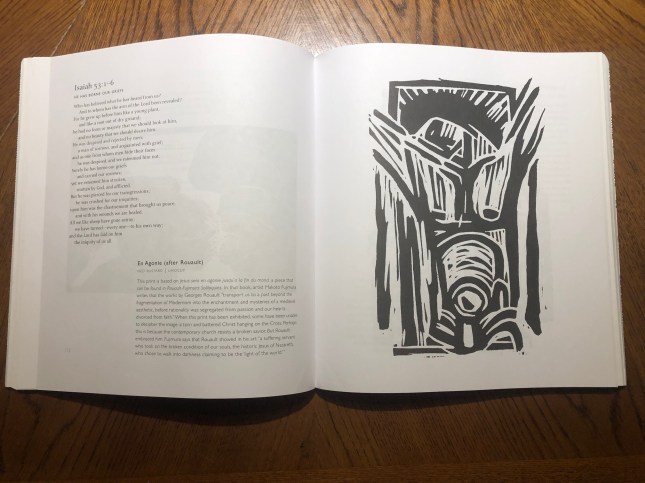
The above image is from Revealed: A Storybook Bible for Grown-Ups by Ned Bustard. The image was created by Ned Bustard and is called “En Agonie (after Rouault).”

Isaiah 53:1-6 [NLT]

1 Who has believed our message?
    To whom has the Lord revealed his powerful arm?
My servant grew up in the Lord’s presence like a tender green shoot,
    like a root in dry ground.
There was nothing beautiful or majestic about his appearance,
    nothing to attract us to him.
He was despised and rejected—
    a man of sorrows, acquainted with deepest grief.
We turned our backs on him and looked the other way.
    He was despised, and we did not care.

Yet it was our weaknesses he carried;
it was our sorrows that weighed him down.
And we thought his troubles were a punishment from God,
a punishment for his own sins!
But he was pierced for our rebellion,
crushed for our sins.
He was beaten so we could be whole.
He was whipped so we could be healed.
All of us, like sheep, have strayed away.
We have left God’s paths to follow our own.
Yet the Lord laid on him
the sins of us all.

Dear God, in so many ways I feel like a failure. I normally write these at the beginning of each day, but I ran out of time this morning and I was having trouble finding a scripture upon which to meditate, so I just went to work. Then something happened this afternoon that has caused me a lot of sorrow and even some fear. My tendency is to try to push through this pain and solve my problems in my own wisdom. But there is no peace in that. There is usually only foolishness.

So I sat down and opened up my new favorite book to find a Bible story and see what I can learn from how an artist has interpreted this passage. The passage itself is familiar to evangelical Christians, especially charismatic ones. The last part of verse 5 is often translated, “by his stripes we were healed,” and a lot of people praying for healing will quote this passage, although I personally believe they are using it out of context.

Anyway, the part of this passage that struck me this evening was verse 4: “Yet is was our weaknesses he carried; it was our sorrows that weighed him down. And we thought his troubles were a punishment from God, a punishment for his own sins!”

I had someone give me a compliment tonight that I absolutely felt like I did not deserve. He complimented what I consider to be a weakness, and I think if he knew me better he wouldn’t have complimented me at all. In fact, I told him as much. But it was that weakness that Jesus carried too. It was this sorrow I feel tonight that He carried as well. It wasn’t His sin. He had no sin. No, it was all about me and all of us.

Now, I want to turn my attention to the image that Ned Bustard did for this passage. It took me a while to see it, but it’s Jesus on the cross, from the waist up–or maybe just below the waist. It’s rough. Jesus arms are up on the cross, but his head is down. If He is not yet dead, he will be soon. His arm and pectorals are represented as being straight and stretched. There is a small horizontal cross in the middle of His chest. Is that intentional? His abdomen is done in circles as are his nipples. And I think His nakedness is showing. How often we forget that there was no loin cloth for modesty. Our God was hung naked for this sorrow. For my wickedness.

Father, this is the cross at which I am supposed to lay my burdens. This is the cross that is there to hold my sorrows and fears. I’ve been talking to people about how much you did for us last year, and how providential your timing was in some of our needs. Do I believe you can do that again? Am I prepared to seek you as much now as I did then? Well, it starts now. I give you this pain. I pray also for the others involved who are also in pain. Help them. I give you my fear. I pray also for the others involved who are fearful. I give you my worship. I pray that the others involved will worship you as well.

In Jesus’ name I pray,

Amen


Tags: , , , ,

The Redemption of Gomer — Hosea 3

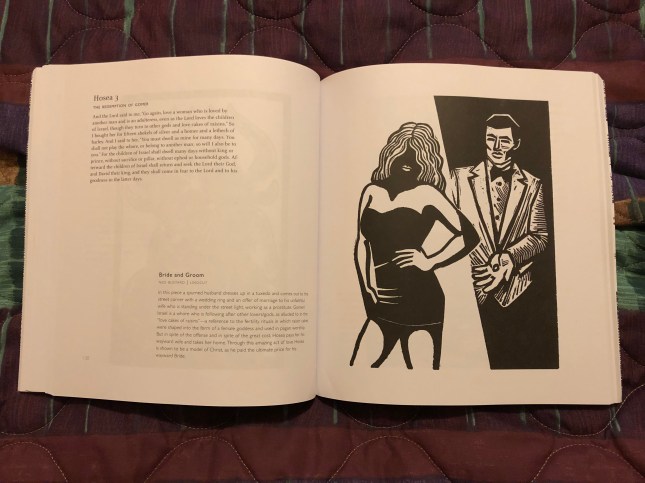
The image above was done by Ned Bustard and is part of a book he put together called Revealed: A Storybook Bible for Grown-Ups. I am using it for my Bible studies on Saturdays as a way of integrating the arts into my Bible study.

Hosea 3 NIV
[1] The Lord said to me, “Go, show your love to your wife again, though she is loved by another man and is an adulteress. Love her as the Lord loves the Israelites, though they turn to other gods and love the sacred raisin cakes. ” [2] So I bought her for fifteen shekels of silver and about a homer and a lethek of barley. [3] Then I told her, “You are to live with me many days; you must not be a prostitute or be intimate with any man, and I will behave the same way toward you.” [4] For the Israelites will live many days without king or prince, without sacrifice or sacred stones, without ephod or household gods. [5] Afterward the Israelites will return and seek the Lord their God and David their king. They will come trembling to the Lord and to his blessings in the last days.


Dear God, this is a hard story. Why did Hosea have to go through this to make your point? Was his sacrifice necessary for us to read all of these years later?

Of the image that Ned Bustard made, he wrote: “In this piece a spurned husband dresses up in a tuxedo and comes out to the street corner with a wedding ring and an offer of marriage to his unfaithful wife who is standing under the street light, working as a prostitute.” As I look at his image, her face is expressionless–only lips. Her dress appears to be torn–perhaps from her customers tearing at her clothes. Her hair is not particularly smooth, but unkempt. And as he said, she is “under the streetlight.” She is showing off the merchandise, her body being the only thing that is important–not her face.

On the other hand, the husband has brought her her wedding ring that she left behind. He has made himself up as nice as he possibly could for her. His face if visible, and his hair is perfect, in contrast to her invisible face and unkempt hair. He wants to love her and take care of her. Will she accept his love?

Father, thank you for loving me. I have been the whore who has left you for others. I have pursued my own interests and sold out for advancement. I have also taken advantage of others for my gain. I am so sorry. I know I’ve repented of these things before, and you probably don’t remember what I’m talking about, but things like this bring them to mind again. And I am also reminded that, just like Hosea was called to a life of pain and sacrifice, I have no right to expect any different. I am amazed I have as much as I have. I am amazed you have answered my prayers in such powerful ways. You have been doubly good to me when I didn’t even deserve for you to be single-y good. Really, thank you!

In Jesus’ name I pray,

Amen


Tags: , , , ,

The Wife of Your Youth — Proverbs 5:15-23

IMG_1662
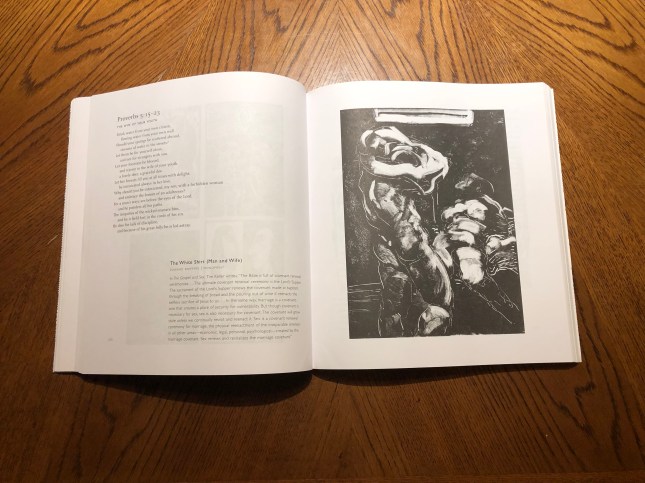
Image: “The White Shirt (Man and Wife)” by Edward Knippers from Revealed: A Biblestory Book for Grown-Ups by Ned Bustard

Proverbs 5:15-23 [NLT]
15 Drink water from your own well—
share your love only with your wife.
16 Why spill the water of your springs in the streets,
having sex with just anyone?
17 You should reserve it for yourselves.
Never share it with strangers.
18 Let your wife be a fountain of blessing for you.
Rejoice in the wife of your youth.
19 She is a loving deer, a graceful doe.
Let her breasts satisfy you always.
May you always be captivated by her love.
20 Why be captivated, my son, by an immoral woman,
or fondle the breasts of a promiscuous woman?
21 For the Lord sees clearly what a man does,
examining every path he takes.
22 An evil man is held captive by his own sins;
they are ropes that catch and hold him.
23 He will die for lack of self-control;
he will be lost because of his great foolishness.


Dear God, can it be ironic to me that Solomon wrote this (I assume Solomon wrote it)? With his hundreds of wives and concubines, did he know what he was missing and wished it wasn’t too late for him? Did he wish for something simpler and more pure?

It feels like I could go in a lot of different directions with this passage and image this morning. There’s promiscuity before marriage. Of course, the obvious is adultery. But then there is prostitution and sex trafficking (including minors) and also pornography (the gateway drug for it all–not that all of this didn’t happen before pornography existed).

Verses 22 and 23 are a great crux of this whole passage for me: “An evil man is held captive by his own sins; they are ropes that catch and hold him. He will die for lack of self-control; he will be lost because of his great foolishness.”

Before I get too judgmental towards others, let me first, once again, apologize to you for the ways in which I have failed you sexually. You know that, since I was a teen, there have been times when I’ve failed in this area when it comes to pornography. Nearly 30 years ago, in one of my first deep conversations with my wife (then girlfriend), I told her that I had struggled with that. Satan’s power is in the secret and I didn’t want it to be a secret. I didn’t want to pretend to be some puritan that I’m not. Even now, the image that accompanies this passage that I put above could be considered pornographic in a way. But when reading the context it becomes not dirty and what sex is supposed to be.

I heard one time that almost no one hears about sex for the first time in a healthy way. Maybe not everyone, but almost everyone’s first exposure to sex is unbiblical. It might be bad information from another kid on the playground or from an older sibling. It might be porn. It might be a TV show that depicts a negative sex act or reference to sex.

When our children were small, I would screen movies for them not based on language or even violence, but I found myself being very sensitive to how it depicted sex. As a friend of mine once said, “We only get our innocence once.” I wanted them to keep their innocence as long as possible. My wife and I even went to the Christian bookstore when our oldest was about five years old and looked for a book that would be age-appropriate for us to talk about with our son. I don’t know if we did the right thing or not, but we were doing our best to make his FIRST exposure to sex to be what you intend sex to be.

So now, on to what I think the artist is trying to communicate to me in this picture.

  • First, he has “man and wife” in the title, so we are given a frame of reference. This is what you intended.
  • It looks like there is an air conditioning unit at the top of the wall. If that’s what it is, then it’s a fairly modern portrayal.
  • There are two people, with the woman on the bed and the man standing. What I notice about the woman is that she appears to be on her elbows. She isn’t just lying there waiting for it to happen. She seems to be anticipating it.
  • The husband is standing and taking off his shirt (apparently last). They aren’t in the throws of passion, lying in bed and ripping each other’s clothes off. This is a marriage. This is something they’ve done before. This is an experience for both of them.

In the little blurb on the bottom left side of the picture, Bustard quotes from Tim Keller’s piece, The Gospel and Sex.

The Bible is full of covenant renewal ceremonies….The ultimate covenant renewal ceremony is the Lord’s Supper. The sacrament of the Lord’s Supper renews the covenant made at baptism; through the breaking of bread and the pouring out of wine it reenacts the selfless sacrifice of Jesus to us….In the same way, marriage is a covenant, one that creates a place of security for vulnerability. But though covenant is necessary for sex, sex is also necessary for covenant. The covenant will grow stale unless we continually revisit and reenact it. Sex is a covenant renewal ceremony for marriage, the physical reenactment of the inseparable oneness in all other areas–economic, legal, personal, psychological–created by the marriage covenant. Sex renews and revitalizes the marriage covenant.

Father, help me to be pure today. Help me to be pure in my thoughts and in my words. Help me to be pure in what I do, and help me to fail to do nothing that you have called me to. Help me to hear your voice and clearly see your path ahead for me. Help me to love my wife the way to which you called me, and help us to live our lives as a couple in the way you need us to. Do it all for your glory and so that your kingdom will come and your will will be done on Earth as it is in Heaven.

In Jesus’ name I pray,

Amen


Tags: , , , , , , , , ,

The Lord Feeds His People — Exodus 16:13-17, 31-35


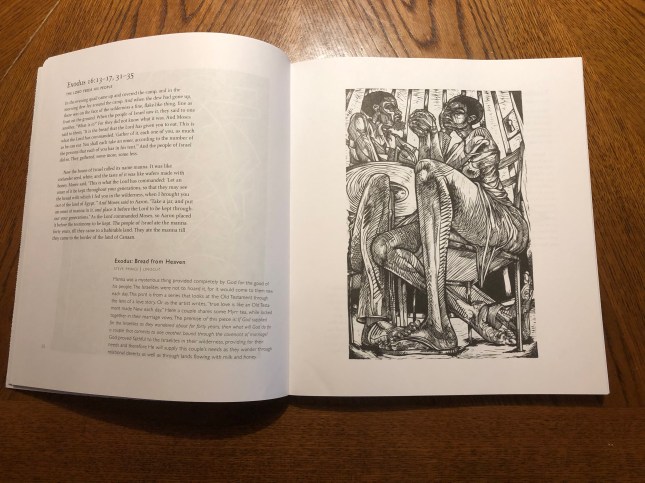
This picture is from the book Revealed: A Storybook Bible for Grown-ups by Ned Bustard. The piece of art is done by Steve Prince.

Exodus 16:13-17,31-35 NIV
[13] That evening quail came and covered the camp, and in the morning there was a layer of dew around the camp. [14] When the dew was gone, thin flakes like frost on the ground appeared on the desert floor. [15] When the Israelites saw it, they said to each other, “What is it?” For they did not know what it was. Moses said to them, “It is the bread the Lord has given you to eat. [16] This is what the Lord has commanded: ‘Everyone is to gather as much as they need. Take an omer for each person you have in your tent.’ ” [17] The Israelites did as they were told; some gathered much, some little. [31] The people of Israel called the bread manna. It was white like coriander seed and tasted like wafers made with honey. [32] Moses said, “This is what the Lord has commanded: ‘Take an omer of manna and keep it for the generations to come, so they can see the bread I gave you to eat in the wilderness when I brought you out of Egypt.’ ” [33] So Moses said to Aaron, “Take a jar and put an omer of manna in it. Then place it before the Lord to be kept for the generations to come.” [34] As the Lord commanded Moses, Aaron put the manna with the tablets of the covenant law, so that it might be preserved. [35] The Israelites ate manna forty years, until they came to a land that was settled; they ate manna until they reached the border of Canaan.

Dear God, I’ve heard and read this story since I was a kid, but I’ve always just heard it through my own ears. The great thing about an artist’s interpretation is that I get to see that same story through someone else’s eyes. So as I look at this picture, it is interesting to see what the artist has chosen to show me.

Before I get into the image, here is what is written in the caption to the bottom left of the image.

Manna was a mysterious thing provided completely by God for the good of his people. The Israelites were not to hoard it, for it would come to them new each day. This print is from a series that looks at the Old Testament through the lens of a love story. Or as the artist writes, “true love is like an Old Testament made New each day.” Here a couple shares some Myrr tea, while locked together in their marriage vows. The premise of this piece is: If God supplied for the Israelites as they wandered about for forty years, then what will God do for a couple that commits to one another, bound through the convenient of marriage?” God proved faithful to the Israelites in their wilderness, providing for their needs and therefore He will supply this couple’s needs as they wander through relational deserts as well as through lands flowing with milk and honey.

See what I mean? I had never thought about tying the Israelites wandering in the wilderness to the journey of marriage.

Given that as our cypher to decrypt the artist’s message, let’s see what I can see he did for us:

  • The people look African or maybe even Aboriginal from Australia. If African, I suppose this makes sense since the Israelites had just come from Egypt, which was in Africa.
  • The woman’s leg and feet seem to dominate the picture. Both of their legs are drawn to kind of reveal the bone underneath, suggesting to me that they are thin and malnourished.
  • Of the four feet in the picture, only one has a sandal. The other three are bare.
  • They look tired.
  • There are three signs of tenderness being expressed from the man to the woman. 1.) His right foot is resting gently on her left foot. 2.) He is looking at her while she looks off. And 3.) his left hand is touching her face. I wonder how hard it was for the men at the time to feel like they weren’t capable of providing for their families. Was it humiliating to have to collect manna every day? Was it frustrating to see their wife’s fear and be limited in their ability to assuage it? I suppose there are certainly times in my marriage when I feel unable to give my wife what she needs.
  • She has on a dress and he is wearing a shirt with a collar and pants. These are not Israelites.
  • What I’m really curious about this that keyhole on the wall over her left shoulder. What is that about?

Interestingly, today is World Marriage Day for the Catholic Church. As part of that celebration and emphasis this morning, my wife and I were invited to get up and talk about a couples group we joined through our church over five years ago. Part of my sharing was that that group came along at a time when my wife and I were walking through the darkest, most confusing valley of our 26 years of marriage (back then it was 21 years). We couldn’t tell up from down at that point, and it was good for us to get into intentional community with six other couples, all of whom were at different stages in their lives. Some were younger than us and just starting to have children, some were our age or close to our age, and some were older and experiencing multiple grandchildren.

Father, as I look at this image and I think about my marriage and the manna you have provided to my wife and me over the years, my prayer is that I will know how to show her the tenderness that you need her to have from me, but also that you will meet those needs of hers that I simply cannot meet. It was almost 20 years ago that I finally started to come to terms with the fact that I couldn’t (and shouldn’t) be everything she needs. If I was, and if she was that for me, why would we need you? No, you have put me here to nurture and love her with your love and affection. But I am also here to support the path she is walking in pursuing you. That’s one of the reasons I attend Catholic Church with her even though I am not Catholic. So guide me today. Give us this day our daily bread.

In Jesus’ name I pray,

Amen


Tags: , , ,

Hannah and Peninnah (and Elkanah) – 1 Samuel 1:1-8

[Photo from Revealed: A Storybook Bible for Grown-Ups By Ned Bustard. The artist is Erin Cross]

1 Samuel 1:1-8 NIV
[1] There was a certain man from Ramathaim, a Zuphite from the hill country of Ephraim, whose name was Elkanah son of Jeroham, the son of Elihu, the son of Tohu, the son of Zuph, an Ephraimite. [2] He had two wives; one was called Hannah and the other Peninnah. Peninnah had children, but Hannah had none. [3] Year after year this man went up from his town to worship and sacrifice to the Lord Almighty at Shiloh, where Hophni and Phinehas, the two sons of Eli, were priests of the Lord. [4] Whenever the day came for Elkanah to sacrifice, he would give portions of the meat to his wife Peninnah and to all her sons and daughters. [5] But to Hannah he gave a double portion because he loved her, and the Lord had closed her womb. [6] Because the Lord had closed Hannah’s womb, her rival kept provoking her in order to irritate her. [7] This went on year after year. Whenever Hannah went up to the house of the Lord, her rival provoked her till she wept and would not eat. [8] Her husband Elkanah would say to her, “Hannah, why are you weeping? Why don’t you eat? Why are you downhearted? Don’t I mean more to you than ten sons?”

Dear God, the first time I journaled on this story, I remember journaling about Elkanah’s ignorance of how women feel and how important things like this are. His question, “Don’t I mean more to you than ten sons?” is absolutely foolish, but he really just didn’t know any better.

But the artist for this story is giving me something else. There is a focus on the meanness and vindictiveness of Peninnah that I’ve never spent much time with. And it’s interesting that I just used the word “vindictiveness.” Why did I use that word? Why does that word fit this story?

It is easy to make Peninnah the villain in this story, but in a lot of ways, as I sit here and think about it, she was really set up for failure. Was her attitude towards Hannah really that different than Sarah’s towards Hagar? Or probably Hagar towards Sarah for that matter. Marriage to multiple wives must have created some terrible dynamics. In this case:

  • Elkanah felt bad for Hannah so he gave her extra portions. Hannah was also probably more available to him because she didn’t have any kids impeding her life, so that might have helped her to be a favorite to Elkanah as well. Then there is Elkanah’s obvious need to be appreciated, as is evidenced by his last question.
  • Peninnah had the children, but she didn’t have Elkanah’s favor. And he apparently made that clear. The artist shows this with Peninnah holding the children while Elkanah holds a despondent Hannah.
  • Then there is Hannah. In a time when worth for women was measured by an ability to have children, she had no worth in society’s eyes (but she still had at least one thing in Peninnah’s eyes that Peninnah didn’t have), and Peninnah used Hannah’s weakness to get a little revenge for the pain she felt. Elkanah could not be everything Hannah needed.
  • In my own life, I see rivalries among coworkers, children, siblings…in fact, they are all around me. We all look for some sort of validation that affirms our place in the world, but rarely do we just look to you for that.
  • I used to think I could be everything my wife needed and I thought that she could be everything that I needed. I entered marriage in a very needy way, and it was oppressive to my wife. She could never meet all of my insecure needs. Then I started to figure out (I’m still learning) how to tap into you and derive my peace and joy from you. What would it have looked like if Peninnah and Hannah had been able to do the same? How much better will I be when I have completely learned to dive into you?
  • Father, help me to be sensitive to the motivations of others. When I see someone acting like Peninnah, help be to see the reason for their vindictiveness and not just assume they are evil and mean. Show me how I might take that knowledge and use it to be your minister to them and heal the hurts that are down deep. And help me to also examine my own heart when I find myself wanting to lash out. Show me the hurt that needs addressed and then help me to take that hurt, give it to you for your complete healing, and then strike back in love.
  • In Jesus’ name I pray,
  • Amen
  •  

    Tags: , , , , ,

    Samson & Delilah — Judges 16:4-22

    img_1607

    Judges 16:4-22 [NLT]
    4 Some time later Samson fell in love with a woman named Delilah, who lived in the valley of Sorek. 5 The rulers of the Philistines went to her and said, “Entice Samson to tell you what makes him so strong and how he can be overpowered and tied up securely. Then each of us will give you 1,100 pieces[b] of silver.”
    6 So Delilah said to Samson, “Please tell me what makes you so strong and what it would take to tie you up securely.”
    7 Samson replied, “If I were tied up with seven new bowstrings that have not yet been dried, I would become as weak as anyone else.”
    8 So the Philistine rulers brought Delilah seven new bowstrings, and she tied Samson up with them. 9 She had hidden some men in one of the inner rooms of her house, and she cried out, “Samson! The Philistines have come to capture you!” But Samson snapped the bowstrings as a piece of string snaps when it is burned by a fire. So the secret of his strength was not discovered.
    10 Afterward Delilah said to him, “You’ve been making fun of me and telling me lies! Now please tell me how you can be tied up securely.”
    11 Samson replied, “If I were tied up with brand-new ropes that had never been used, I would become as weak as anyone else.”
    12 So Delilah took new ropes and tied him up with them. The men were hiding in the inner room as before, and again Delilah cried out, “Samson! The Philistines have come to capture you!” But again Samson snapped the ropes from his arms as if they were thread.
    13 Then Delilah said, “You’ve been making fun of me and telling me lies! Now tell me how you can be tied up securely.”
    Samson replied, “If you were to weave the seven braids of my hair into the fabric on your loom and tighten it with the loom shuttle, I would become as weak as anyone else.”
    So while he slept, Delilah wove the seven braids of his hair into the fabric. 14 Then she tightened it with the loom shuttle.[c] Again she cried out, “Samson! The Philistines have come to capture you!” But Samson woke up, pulled back the loom shuttle, and yanked his hair away from the loom and the fabric.
    15 Then Delilah pouted, “How can you tell me, ‘I love you,’ when you don’t share your secrets with me? You’ve made fun of me three times now, and you still haven’t told me what makes you so strong!” 16 She tormented him with her nagging day after day until he was sick to death of it.
    17 Finally, Samson shared his secret with her. “My hair has never been cut,” he confessed, “for I was dedicated to God as a Nazirite from birth. If my head were shaved, my strength would leave me, and I would become as weak as anyone else.”
    18 Delilah realized he had finally told her the truth, so she sent for the Philistine rulers. “Come back one more time,” she said, “for he has finally told me his secret.” So the Philistine rulers returned with the money in their hands. 19 Delilah lulled Samson to sleep with his head in her lap, and then she called in a man to shave off the seven locks of his hair. In this way she began to bring him down,[d] and his strength left him.
    20 Then she cried out, “Samson! The Philistines have come to capture you!”
    When he woke up, he thought, “I will do as before and shake myself free.” But he didn’t realize the Lord had left him.
    21 So the Philistines captured him and gouged out his eyes. They took him to Gaza, where he was bound with bronze chains and forced to grind grain in the prison.
    22 But before long, his hair began to grow back.

    Dear God, before I start talking about this story, I just have to comment on verse 22. It’s a little cliffhanger like at the end of the old Batman television show from the 60s with Adam West: “But before long, his hair began to grow back.” Love it. I suppose I should also mention that the image above is from Revealed: A Storybook Bible for Grown-Ups by Ned Bustard, and the picture itself was actually created by Ned Bustard.

    It the midst of our #metoo wave that is currently happening and changing our perspectives on how men treat women, I can’t help but read this story this morning through a different lens–the lens of her perspective. Why did she do what she did?

    It wasn’t for the money. Samson had no qualms about taking and/or killing anything he wanted. If she had said, “Samson, I could really use 1,100 pieces of silver,” he would have gone and killed those same Philistines and taken it from them. No, the money wasn’t the deal-maker–unless…

    She wanted freedom. That money gave her freedom from a boorish man who probably did not treat her very well. And we aren’t told what she did after this story, but I would imagine she had to move into the center of Philistine territory where she would have been treated like a hero. If she had stayed in Israel, the people would probably have killed her for her role in Samson’s demise.

    So how does this apply to my life? Well, beyond the obvious questions of whether or not I am ever a Samson (driving people to betray me) or a Delilah (betraying others for my own gain), I think one thing that is important to do is to look at betrayals that I see and try to look beyond the surface and find a deeper reason.

    For example, very few people are actually evil. Even when they have done something that I find reprehensible, they usually see it as morally justified from their own perspective. And then there are addictions to things like alcohol, drugs, and even pornography that can make a person do things they wouldn’t normally do. Where I work, we see that with domestic violence all of the time. And of course, there are always two sides to every story.

    Father, make me more thoughtful in my assessment of others. Make me more aware when I am doing something that others perceive as evil. Help me to give people the benefit of the doubt and understand how to be an instrument of your peace.

    In Jesus’ name I pray,

    Amen


    Tags: , , , , , ,

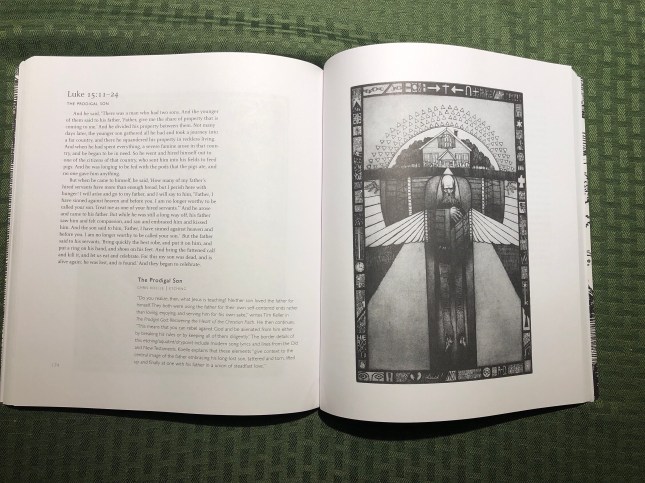
    The Prodigal Son — Luke 14:11-24

    Luke 15:11-24 NIV
    [11] Jesus continued: “There was a man who had two sons. [12] The younger one said to his father, ‘Father, give me my share of the estate.’ So he divided his property between them. [13] “Not long after that, the younger son got together all he had, set off for a distant country and there squandered his wealth in wild living. [14] After he had spent everything, there was a severe famine in that whole country, and he began to be in need. [15] So he went and hired himself out to a citizen of that country, who sent him to his fields to feed pigs. [16] He longed to fill his stomach with the pods that the pigs were eating, but no one gave him anything. [17] “When he came to his senses, he said, ‘How many of my father’s hired servants have food to spare, and here I am starving to death! [18] I will set out and go back to my father and say to him: Father, I have sinned against heaven and against you. [19] I am no longer worthy to be called your son; make me like one of your hired servants.’ [20] So he got up and went to his father. “But while he was still a long way off, his father saw him and was filled with compassion for him; he ran to his son, threw his arms around him and kissed him. [21] “The son said to him, ‘Father, I have sinned against heaven and against you. I am no longer worthy to be called your son.’ [22] “But the father said to his servants, ‘Quick! Bring the best robe and put it on him. Put a ring on his finger and sandals on his feet. [23] Bring the fattened calf and kill it. Let’s have a feast and celebrate. [24] For this son of mine was dead and is alive again; he was lost and is found.’ So they began to celebrate.

    Dear God, before I get into this story, I want to do my best to identify all of the art panels, small as they are, in the border of this artwork. Starting at the top left:

    • Broken chains
    • “HOME” or, if you look at it the right way, “LOVE”
    • Two arrows pointing to the cross
    • U-turn
    • Cross
    • “My son was dead and alive again”
    • “He was lost and is found”
    • “!!!!!!!!!!” [kind of cool to have those following the two lines from the father.]
    • “You went after worth [??] and become worthless”
    • Star of David [before a psalm]
    • “Before I formed you in the womb I knew year”
    • “Only remember and be satisfied.” [this seems to be the last of three messages from God to the son.]
    • Three tears
    • A dove [images of God’s forgiveness and of the Holy Spirit before the son’s response]
    • “We believe and we are blessed.”
    • A running figure
    • “If I ascend to heaven you are there. If I make my bed in hell you are there.” [YOU ARE THERE emphasized both times. Interesting that he is bringing the psalms into the son’s thoughts with this and the part about the womb.]
    • Crown
    • “The children the promise [??] as offspring” [couldn’t tell what that third part said, but I think it comes from “The children of the promise are regarded as Abraham’s offspring.”]
    • A key
    • A lock
    • “And I run down that aisle”
    • Musical notes
    • Regular star surrounded by circles [other stars]
    • “[??] mute or deaf or seeing or blind” [I think this is a reference to Exodus 4:11 Exodus 4:11 NIV
      [11] The Lord said to him, “Who gave human beings their mouths? Who makes them deaf or mute? Who gives them sight or makes them blind? Is it not I, the Lord?]
    • Alpha and Omega in Greek letters
    • “The greatest of these is LOVE”
    • Heart with an infinity sign in the middle of it.
    • “Wonderful counselor, almighty God, everlasting father, prince of peace.”
    • “No!”
    • “Please” [If read clockwise, No! is first. If read left to right, please is first.]
    • Broken heart
    • “And I will make a new covenant with you.”
    • “!” [exclamation points on opposite corners of the border]
    • Crying eyes
    • ?? [Can’t tell if this is dove or flame, but I’m pretty sure it is the Holy Spirit either way]
    • “And those he predestined he also justified and those who he called he also justified and those whom he justified he also glorified [Romans 8:30]
    • “And the curtain of the temple was torn in two”
    • Clock pointing to 3:00
    • A cross and I think it says, “Here!!” across it.
    • Arrows all pointing to the middle of the image
    • A heart that says, “Give,” in the middle
    • ??satisfied by the call of others less wild.” [I think I found this reference. It’s from a song called “Wedding Dress” by Derek Webb. The phrase from the song is, “I am so easily satisfied by the call of lovers less wild.” The chorus says, “I’m a prodigal with no way home…” so I’m pretty sure this is the artist’s reference.”] [a second note is that this part about being satisfied is across the image from the part about being “satisfied” on the other side of the border.]
    • “Son you are always with me and all that is mine is yours.”
    • A flower
    • A cross in the middle of something I can quite make out
    • An image of crying eyes that says, “Tears stream down your face,” with an arrow at the bottom of the image pointing upwards and the word, “UP!”

    So that takes care of the border. Now what did this artist decide to show me in the image itself?

    • A lot of triangles over the house [I wish I knew if there is a significance to the triangles over the house. A bunch of representations of the Trinity?]
    • The father’s house [It’s a fairly modern representation of a house. I’m surprised it doesn’t have a more prominent front porch.]
    • There are several people cheering
    • The father seems to be represented in motion with arms outspread and then arms around the boy
    • It almost looks like there are angel wings as part of the father’s arms.
    • The boys hair melds into the father’s beard
    • The boy is in modern clothes
    • The boy’s jeans are dirty and the bottoms are frayed.
    • I think the boy is barefoot.
    • The boy’s head is buried in the father’s chest.

    What the artist has done to communicate so much through not only the main image, but also through the border is great.

    It was about 17 years ago that I sat down and tried to find a father/husband in the Bible who was worth emulating. After looking at all of the men I could find, I ultimately landed on Joseph, Jesus’ earthly father, and the father in this story. Since this is a parable in which the father represents you, I just focused on Joseph. But maybe I should focus on this father since it gives me an insight into you and your nature.

    As I look at this story, I notice the part where Jesus says, “Not many days later.” I know this isn’t a real story–it’s a parable–but I wonder what those days between the bequeathing and the leaving would have been like. Was the money not enough for the boy? Did it not bring him the happiness he thought it would.

    Ultimately, the story is about the father letting the boy go. That is one of the hardest things to do as a parent. Let them go and then wait. And sometimes we have to wait a long time.

    There is a DC Talk song called “The Hard Way” that’s chorus says it all: “Some people gotta learn the hard way. I guess I’m the kind of guy that trying to find out for myself. I had to learn the hard way, Father. I’m on my knees and I’m crying for help.”

    Father, for the prodigals out there, make their paths to you as straight as possible. And for the fathers (and mothers), help them to believe.

    In Jesus’ name I pray,

    Amen


    Tags: , , , ,

    Enoch Walked with God — Genesis 5:1-8, 21-29

    Genesis 5:1-8,21-29 NIV
    [1] This is the written account of Adam’s family line. When God created mankind, he made them in the likeness of God. [2] He created them male and female and blessed them. And he named them “Mankind” when they were created. [3] When Adam had lived 130 years, he had a son in his own likeness, in his own image; and he named him Seth. [4] After Seth was born, Adam lived 800 years and had other sons and daughters. [5] Altogether, Adam lived a total of 930 years, and then he died. [6] When Seth had lived 105 years, he became the father of Enosh. [7] After he became the father of Enosh, Seth lived 807 years and had other sons and daughters. [8] Altogether, Seth lived a total of 912 years, and then he died. [21] When Enoch had lived 65 years, he became the father of Methuselah. [22] After he became the father of Methuselah, Enoch walked faithfully with God 300 years and had other sons and daughters. [23] Altogether, Enoch lived a total of 365 years. [24] Enoch walked faithfully with God; then he was no more, because God took him away. [25] When Methuselah had lived 187 years, he became the father of Lamech. [26] After he became the father of Lamech, Methuselah lived 782 years and had other sons and daughters. [27] Altogether, Methuselah lived a total of 969 years, and then he died. [28] When Lamech had lived 182 years, he had a son. [29] He named him Noah and said, “He will comfort us in the labor and painful toil of our hands caused by the ground the Lord has cursed. ”

    Dear God, My thoughts on this story really just flow around the lives we live. We are here, we are a small part of the world, and then we die, leaving behind the little ways in which our lives caused ripples in the pool. A little George Bailey-esque, if you will. Enoch’s tale is unique because he wasn’t that old when compared with his contemporaries describe in these verses, but he was apparently taken up whole to be with you. I wish I knew more details about this story. It’s all pretty vague.

    Bot the fun part of going through Revealed: A Storybook Bible for Grown-ups is getting to look at the art as well. What do I see in this piece that the artist might want to tell me?

    • The first thing I notice is the size difference. God is too big for the frame and cannot be fully seen.
    • The road that Enoch is walking is not smooth, but apparently paved with stones, over which Enoch might stumble.
    • God is carrying a shepherd’s crook, but dressed in modern clothes. I don’t know that this image was specifically drawn for the Enoch story or if it just fit with the Enoch story, but the image is obviously for me as well. The picture’s title is “Walking with God” by Rick Beerhorst. Going back to the shepherd’s crook, I think the artist is intimating that you are ready to catch us at any time. And you are also ready to nudge us along the right path.
    • I suppose those are fields next to the path, but it could conceivably be a river as well. Either way, there is something to the left that the man can see, but is not interacting with.
    • I guess the last thing I noticed is that the mountains are in the distance, so this picture is taken of the man while he is in the valley, where most of life is lived. Mr. Beerhorst could have placed the man anywhere and given the picture any background, but he chose to show us “Walking with God” in the valley.

    I heard a speaker one time try to make the point that all of our lives are smaller than we think they are by asking us a series of questions.

    • How many of you know what your father did/does for a living?
    • How many of you know what your grandfather did/does for a living?
    • How many of you know what your great grandfather did for a living?
    • Great-great grandfather?

    He then went on to indicated that, for our great-great grandfather, his life was complicated and could be overwhelming. His problems seemed so big to him, but now with the passage of time his work is largely forgotten. What remains of our great-great grandfather’s legacy are the relationships he affected while he was living and how his touch on them ripples through to time to our lives. It was a great reminder then, and seeing the legacy and lineage around Enoch is also a good reminder that, at the end of the day, Enoch’s biggest contribution to history was to be part of Noah’s family tree and then getting out of the way.

    Father, help my life to ripple through time for your glory. I don’t know what will be left of my physical work when this world is all said and done, but I hope that, even after people have forgotten my name, that the love that I showed someone today will be there for someone else through someone else tomorrow.

    In Jesus’ name I pray,

    Amen


    Tags: , , , ,

    Revealed: A Storybook Bible for Grown-Ups by Ned Bustard

    Revealed: A Storybook Bible for Grown-Ups by Ned Bustard

    Dear God, I came in this room this morning expecting to continue on with my series on Peter and John when I found the book of an artist I met this weekend. He has taken different pieces of biblical art from various artists (including his own) and compiled them with the stories they portray. I really liked the guy and I had been wanting to pick up his book to check it out.

    I just flipped it open, and the page I turned to struck me immediately. The art piece was titled “Isaac Blesses Jacob.” I didn’t even have to read the corresponding verses. I just wanted to dive into the picture, which was done by Wayne Forte. After only a couple of moments, I noticed so much in the picture (I should mention that this image is copyrighted and I hope that my publishing it here isn’t a violation of a copyright by him or Square Halo Books):

    2019-01-13 07-49

    * The goat skin on Jacob’s arms
    * Esau in the background has hair on his arms
    * The food is prepared while Esau is still hunting
    * Rebekah is looking on, not only approving of the deception, but leading/participating
    * Isaac is in bed, weak and gullible

    And that’s just with a cursory look. If a picture is worth a thousand words, I’ll bet I could spend some time with this one image and come up with well over 1,000 words on what you might be saying to be about this story through the artists.

    I am sorry for underestimating art for so much of my life. My wife helped to expand my horizons a bit, but it was my daughter being involved in theater that really made me appreciate the value of art in human development. And I might think, “Hey, I’m 48. I am already developed.” Well, obviously I’m not. My daughter needed it while she was growing up, but I need it too. You are still teaching me. I’m still growing.

    Father, use whatever you need to use to reveal yourself to me. It might be a conversation, a secular song, a thought that passes through my head while I’m in the shower that you don’t want me to forget, or the things you have revealed to others that they can share with me. Put me in a position to hear, see, and understand, and then help me to not miss you in both the sacred and the secular that is around me.

    In Jesus’ name I pray,

    Amen


    Tags: , , , , , ,