RSS

Category Archives: Revealed: A Storybook Bible for Grown-Ups

Revealed: A Storybook Bible for Grown-Ups — The Threshing Floor (Ruth 3:6-13)


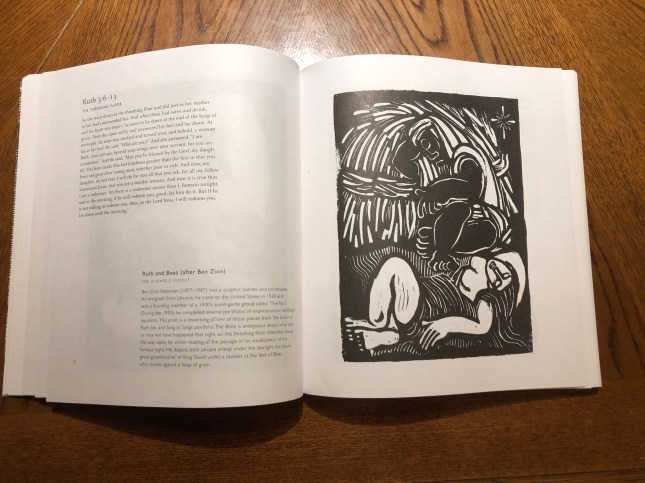
The above image is from Revealed: A Storybook Bible for Grown-Ups by Ned Bustard. The image itself is called “Ruth and Boaz (after Ben Zion)” and was created by Ned Bustard. 

So she went down to the threshing floor that night and followed the instructions of her mother-in-law. After Boaz had finished eating and drinking and was in good spirits, he lay down at the far end of the pile of grain and went to sleep. Then Ruth came quietly, uncovered his feet, and lay down. Around midnight Boaz suddenly woke up and turned over. He was surprised to find a woman lying at his feet! “Who are you?” he asked. “I am your servant Ruth,” she replied. “Spread the corner of your covering over me, for you are my family redeemer.” “The Lord bless you, my daughter!” Boaz exclaimed. “You are showing even more family loyalty now than you did before, for you have not gone after a younger man, whether rich or poor. Now don’t worry about a thing, my daughter. I will do what is necessary, for everyone in town knows you are a virtuous woman. But while it’s true that I am one of your family redeemers, there is another man who is more closely related to you than I am. Stay here tonight, and in the morning I will talk to him. If he is willing to redeem you, very well. Let him marry you. But if he is not willing, then as surely as the Lord lives, I will redeem you myself! Now lie down here until morning.”
Ruth 3:6-13

Dear God, I’ve spent some time looking at Ruth and Boaz, but I don’t know remember spending too much time thinking about Boaz himself. You know, trying to get into his skin. To do that, we have to go back to his introduction in chapter 2. Here are some verses in chapter 2 that are striking me about him and his character:

Boaz went over and said to Ruth, “Listen, my daughter. Stay right here with us when you gather grain; don’t go to any other fields Stay right behind the young women working in my field. See which part of the field they are harvesting, and then follow them. I have warned the young men not to treat you roughly. And when you are thirsty, help yourself to water they have drawn from the well.” (Ruth 2:8-9)

Not only did Boaz provide food for her, but he also cast a net of physical protection over her. I have been reminded over and over again how vulnerable women are to physical harm. I was talking with a friend yesterday morning about our daughters and wishing we could protect them better. My wife and I have talked about her uneasiness walking in crowds and fear of being groped by an anonymous man walking by. These just aren’t fears that I have, but they are real and legitimate fears for women. In fact, until this morning, I don’t think I’ve ever given much thought to the physical danger Ruth was in by going out to glean in the fields. But Boaz thought about it.  Why did he care so much? What was it about Ruth that got his attention?

“Yes, I know,” Boaz replied. “But I also know about everything you have done for your mother-in-law since the death of your husband. I have heard how you left your father and mother and your own land to live here among complete strangers. May the LORD, the God of Israel, under whose wings you have come to take refuge, reward you fully for what you have done.” (Ruth 2:11-12)

I think that speaks for itself. So I guess my question is, were Ruth and Naomi manipulating Boaz in chapter 3? At the end of the day, I suppose this was part of the culture at the time. In fact, I don’t know that I’ll ever fully understand this story because I don’t understand the culture of that time and place enough. But I do know that this ended up being part of your plan because these two people became David’s great-grandparents. Boaz did a lot of wonderful things, but he never knew he had done this. He was faithful in what you had given to him to steward, and the results would have been beyond anything he ever would have dreamed.

I suppose I would be remiss if I didn’t go back to this image by Bustard and at least say what he had to say about it in his book:

Ben-Zion Weinman (1897-1987) was a sculptor, painter, and printmaker. An emigrant from Ukraine, he came to the United States in 1920 and was a founding member of a 1930’s avant-garde group called “The Ten.” Curing the 1950s he completed several portfolios of expressionistic etchings/aquatints. This print is a reworking of one of those pieces from The Books of Ruth, Job, and Song of Songs portfolio. The Bible is ambiguous about what may or may not have happened that night on the threshing floor: Weinman leaves the way open for either reading of the passage in his visualization of the famous night. He depicts both people asleep under the starlight, the future great-grandmother of King David under a blanket at the feed of Boaz, who snores against a heap of grain.

I looked for the original, and I couldn’t be sure which image was the one that Bustard used as the inspiration, but it’s interesting to consider that the author of Ruth left the events of that night vague. I’d never considered that before. I just took it for what was written on the page. Perhaps I’m naïve.

Father, help me to be faithful this day. Help me to not look to my legacy or my future because I have zero idea how you might be using me. The author Gary Thomas said in one of his books (it might have been Sacred Parenting) that our role in history is to be born, possibly procreate, and then get out of the way. What you do with our lives after that is up to you. Help me to embrace that simplicity and to offer you this one life that I get on earth to further your kingdom and your glory.

In Jesus’s name I pray,

Amen
 

Tags: , , , , ,

The Drunkeness of Noah – Genesis 9:8-15, 20-23


The image above is from Revealed: A Storybook Bible for Grown-Ups by Ned Bustard. The image is called “Failed Savior” and was created by Ned Bustard.

Then God said to Noah and to his sons with him: “I now establish my covenant with you and with your descendants after you 10 and with every living creature that was with you—the birds, the livestock and all the wild animals, all those that came out of the ark with you—every living creature on earth. 11 I establish my covenant with you: Never again will all life be destroyed by the waters of a flood; never again will there be a flood to destroy the earth.”

12 And God said, “This is the sign of the covenant I am making between me and you and every living creature with you, a covenant for all generations to come: 13 I have set my rainbow in the clouds, and it will be the sign of the covenant between me and the earth. 14 Whenever I bring clouds over the earth and the rainbow appears in the clouds, 15 I will remember my covenant between me and you and all living creatures of every kind. Never again will the waters become a flood to destroy all life…

20 Noah, a man of the soil, proceeded to plant a vineyard. 21 When he drank some of its wine, he became drunk and lay uncovered inside his tent. 22 Ham, the father of Canaan, saw his father naked and told his two brothers outside. 23 But Shem and Japheth took a garment and laid it across their shoulders; then they walked in backward and covered their father’s naked body. Their faces were turned the other way so that they would not see their father naked.
Genesis 9:8-15, 20-23

Dear God, when I opened Revealed: A Storybook Bible for Grown-Ups this morning, this is the first image I turned to. I’ve never liked this story, and I almost turned away. But then I got to thinking that perhaps I should explore this story more. Why does it hit me that way?

I’ve never liked the image of the human Noah. Why tell us this story? Why not just leave it at verse 19 and the part about you putting your bow in the sky as a reminder of your covenant with us? I really don’t need to know about Noah getting blackout drunk and being discovered by his son. Or do I?

My first inclination was to focus on Noah’s shame in this image and the reaction of his sons (and then his subsequent response to them). When I looked at Bustard’s image, I saw:

  • A fat old man passed out.
  • An umbrella. I thought it was a clever nod to the rain and a way to use it to give Noah a little modesty. Obviously, Bustard wasn’t going for a period piece.
  • The wine bottle and glass are also obviously not period, but communicate that the subject of the image is drunk and passed out.
  • The life preserver was a nice nod to the ark.

That’s what I saw. But here’s Bustard’s description of the piece:

Hebrews 11:7 states that “By faith Noah, being warned by God concerning events as yet unseen, in reverent fear constructed an ark for the saving of his household. By this he condemned the world and became an heir of the righteousness that comes by faith.” But although he was instrumental in saving all of the living, Noah was not the promised Savior. Noah is shown here drunk, lying in a cruciform, and with a life preserver forming a halo of sorts around his head. He is an inebriated old man, and the symbol of his saving work is broken and covers him as poorly as the fig leaves covered the shame of Adam and Eve.

Hmm. I had never thought about comparing Jesus and Noah. I hadn’t thought about Noah being your “savior” for the remnant of humanity and comparing that with Jesus being our Savior. The halo. The cruciform. The fact that the umbrella is broken. I had missed all of that. Interesting.

Father, there is none righteous, no not one (Romans 3:10). Except for Jesus, of course. Thank you for a complete savior. Thank you for an inclusive savior. Noah was an exclusive savior, sent by you to preserve the remnant of mankind. Jesus was sent to rip away the veil between you and us and present all of us to you as an unblemished bride. Help me to live into that and to carry that to others who need you today.

In Jesus’s name I pray,

Amen


Tags:

The Flood – Genesis 7:17-24


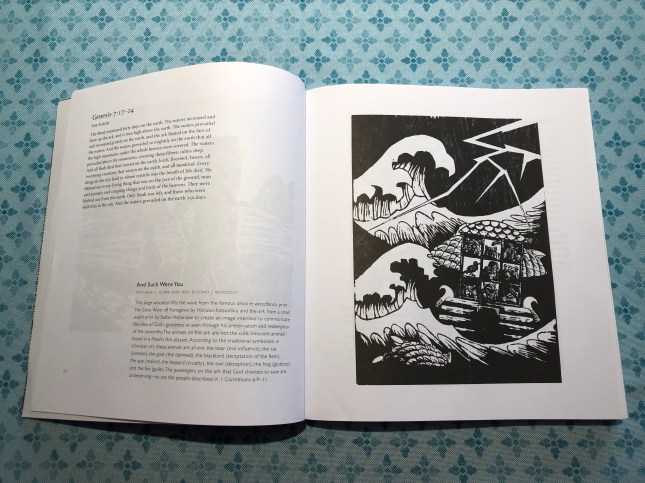
The image above is from Revealed: A Storybook Bible for Grown-Ups by Ned Bustard. The image itself is called “And Such Were You” and was created by Matthew L. Clark and Ned Bustard.

Dear God, I looked at this passage this morning and looked at the picture for a while and, frankly, I was having trouble getting anything from it. Then I read Bustard’s commentary in the bottom paragraph on the left. It says:

This large woodcut lifts the wave from the famous Ulithi-e woodblock print The Great Wave off Kanagawa by Hokusai Katsushika and the ark from a small Washington print by Saadi Watanabe to create an image intended to communicate the idea of God’s goodness as seen through the preservation and redemption of the unworthy. The animals on this ark are not the cute, innocent animals found in a Noah’s Ark play set. According to the traditional symbolism in Christian art, these animals are all evil: the bear (evil influence), the cat (laziness), the goat (the damned), the blackbird (temptation of the flesh), the ape (malice), the leopard (cruelty), the owl (devotion), the hog (gluttony) and the fox (guile). The passengers on the ark that God chooses to save are undeserving–as are the people described in 1 Corinthians 6:9-11.

So, of course, after I read that, I went to 1 Corinthians 6:9-11:

Do you not know that the wicked will not inherit the kingdom of God? Do not be deceived. Neither the sexually immoral nor idolators nor adulterers nor male prostitutes nor homosexual offenders nor thieves nor greedy nor dunkards nor slanderers nor swindlers will inherit the kingdom of God. And that is what some of you were. But you were washed, you were sanctified, you were justified in the name of the Lord Jesus Christ and by the Spirit of our God. (NIV)

Yes, I like this. I like Bustard’s idea that you saved the unworthy with the ark and you saved me, the unworthy, with Jesus. The trick is, how do I stop grieving you with wickedness in my heart. And it’s not just the obvious that sticks out on the Corinthians passage like the idolatry and sexual immorality, but it’s the seemingly little things like slander, drunkenness and stealing. No one is innocent. We love to judge others, but none of us are pure.

Father, help me to embrace your forgiveness and pursue you. Help me to forgive others as you have forgiven me, extend grace when it isn’t deserved and being your light of love, joy, peace, gentleness, faithfulness, kindness and self control into the world.

In Jesus’s name I pray,

Amen


Tags: , , , ,

The Sower — Mark 4:1-20


The image above is from
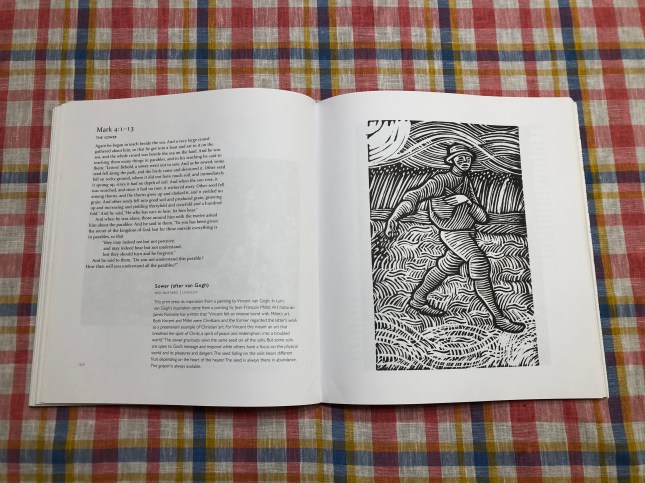
Revealed: A Storybook Bible for Grown-Ups by Ned Bustard. The image itself is called “Sower (after Van Gogh)” and was created by Ned Bustard.

Mark 4:1-20
Once again Jesus began teaching by the lakeshore. A very large crowd soon gathered around him, so he got into a boat. Then he sat in the boat while all the people remained on the shore. He taught them by telling many stories in the form of parables, such as this one: “Listen! A farmer went out to plant some seed. As he scattered it across his field, some of the seed fell on a footpath, and the birds came and ate it. Other seed fell on shallow soil with underlying rock. The seed sprouted quickly because the soil was shallow. But the plant soon wilted under the hot sun, and since it didn’t have deep roots, it died. Other seed fell among thorns that grew up and choked out the tender plants so they produced no grain. Still other seeds fell on fertile soil, and they sprouted, grew, and produced a crop that was thirty, sixty, and even a hundred times as much as had been planted!” Then he said, “Anyone with ears to hear should listen and understand.” Later, when Jesus was alone with the twelve disciples and with the others who were gathered around, they asked him what the parables meant. He replied, “You are permitted to understand the secret of the Kingdom of God. But I use parables for everything I say to outsiders, so that the Scriptures might be fulfilled: ‘When they see what I do, they will learn nothing. When they hear what I say, they will not understand. Otherwise, they will turn to me and be forgiven.’” Then Jesus said to them, “If you can’t understand the meaning of this parable, how will you understand all the other parables? The farmer plants seed by taking God’s word to others. The seed that fell on the footpath represents those who hear the message, only to have Satan come at once and take it away. The seed on the rocky soil represents those who hear the message and immediately receive it with joy. But since they don’t have deep roots, they don’t last long. They fall away as soon as they have problems or are persecuted for believing God’s word. The seed that fell among the thorns represents others who hear God’s word, but all too quickly the message is crowded out by the worries of this life, the lure of wealth, and the desire for other things, so no fruit is produced. And the seed that fell on good soil represents those who hear and accept God’s word and produce a harvest of thirty, sixty, or even a hundred times as much as had been planted!”

Dear God, I used to pray this parable a lot when my children were little. I prayed that the seeds my wife and I were planting each day would find good soil. I prayed that we would be able to plant good seeds in the first place. I loved this illustration.

Now that they are in their 20’s, my prayer has shifted a little. They are on their own paths now. They struggle. They succeed. They have revelations and they have blinders. Just like me. I have all of those things in my life as well. But my prayer for them is slightly different. I am not the one doing much planting in their lives so I end up praying over the seeds that were planted long ago, some of which I am hoping are still there, but dormant with roots that are reaching for good soil. I pray for those who are planting seeds in their lives today. I pray for the soil in their heart.

Sometimes I have the presence of mind to pray about the soil in my own heart. Am I able to listen to those who bring your word to me, or do I dismiss them? Does Satan steal away the seed? Do I allow selfishness and pleasures of the world to choke it the seeds that get through? Do I intentionally cultivate the soil of my heart and make it seed-ready?

Now, for this image from Bustard. I guess one thing about this story is that the sower is not very discriminating. He is very generous with his seeds, scattering them everywhere. He doesn’t seem to care what kind of soil it finds. He’ll put some on the path. He’ll put some on shallow soil. He’ll put some in the thorns. And it seems that, just as randomly, some will find good soil. But the sower doesn’t seem to care. He just throws it out there. I should probably be more conscious of how I sow seeds. Am I stingy with them, or do I just spread them everywhere?

Another thing about this image is that I can see a big crop in the background. I think Bustard must have thought about what a 100-fold crop looked like and included it in the image. The Sun and the sky are there. The ground where the sower is walking is there. But the crop in the background is our goal.

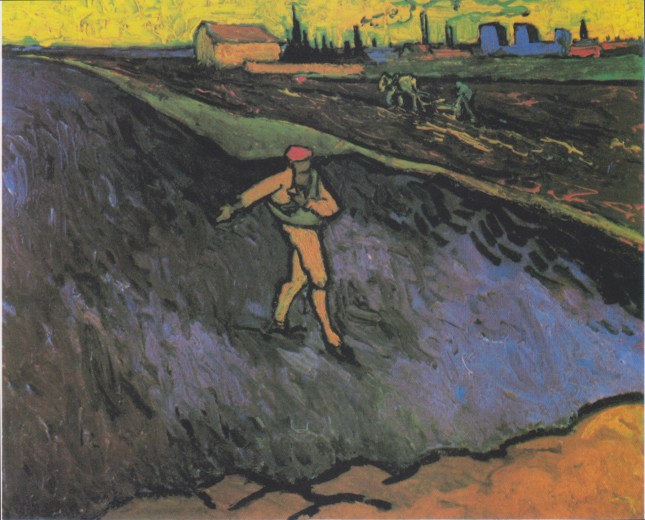
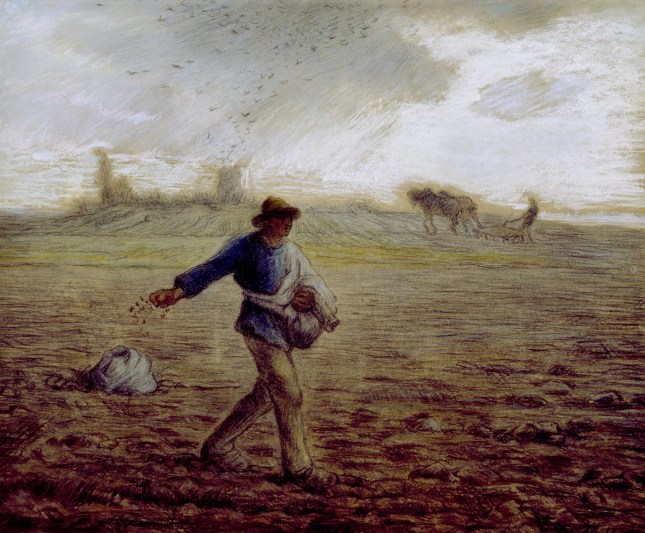
Bustard says that his rendition of this story is inspired by Vincent van Gogh’s painting. Here it is for reference.

Apparently, according to Bustard, van Gogh’s piece was inspired by Jean Francois Millet’s piece describing the same parable Here is Millet’s image.

I guess the last thing I will notice about all of the art is that none of them created an image set in Jesus’s time. They are all more modern than that. I suppose Millet is the one who started with that concept. This isn’t just a story with a lesson for 2,000 years ago. It is a modern story.

Father, I will have opportunities to spread some seeds today. I will also have opportunities to prepare the soil of my heart to receive the seeds you have for me. Help me to be mindful of that. Help me to embrace this whole concept. Help me to give you a great harvest that will help your kingdom to come and your will to be done on Earth as it is in Heaven.

In Jesus’s name I pray,

Amen


Tags: , ,

Yet I Will Rejoice — Habakkuk 3:17-19

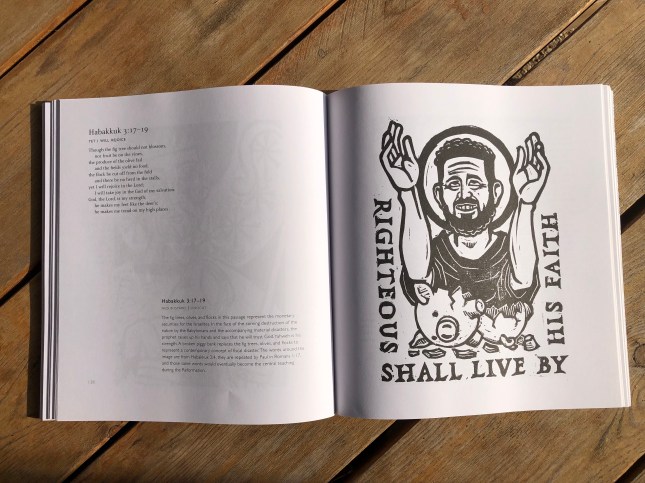
The above image is from Revealed: A Storybook Bible for Grown-Ups by Ned Bustard. The image was created by Ned Bustard and is called “Habakkuk 3:17-19.”

Habakkuk 3:17-19
Even though the fig trees have no blossoms, and there are no grapes on the vines; even though the olive crop fails, and the fields lie empty and barren; even though the flocks die in the fields, and the cattle barns are empty, yet I will rejoice in the Lord! I will be joyful in the God of my salvation! The Sovereign Lord is my strength! He makes me as surefooted as a deer, able to tread upon the heights.

Dear God, I was flipping through the Revealed book this morning and this image struck me. It was the broken piggy bank that got my attention. My first thought head, Oh, I’ll bet there’s a story in this.

Then I read the passage. Once again, this seems to go with the theme of my prayers to you lately about how we just don’t know what the future holds, and even though my circumstances might look bad to me my worship of you will remain.

In this case, Habakkuk is praying and he is worshipping. This whole chapter is actually a prayer to you. These last three verses bring it all together. Basically, even if everything around me is falling apart, I will rejoice in you. I will take joy in you because you are God and the God of my salvation. You are my strength and my security, even if my earthly security seems in doubt.

As for this image, here are a few things I notice. First, I doubt Habakkuk had a piggy bank, so this is given to me to make a point that I get as a 21st-century American. Habakkuk would have looked at this image and not understood the shattered pig, but I get what Bustard is communicating to me here. My money is gone. My earthly security is gone. The last of my back-up plan is gone. I didn’t just take money out of the bank. I irrevocably broke the piggy bank as a last resort. Now it’s all gone. And yet, Habakkuk is worshipping. His arms could be up in despair, but the key is in the expression on the face that Bustard gave Habakkuk here. He is smiling (I think) and his eyes are looking at heaven. He has the halo around his head to signify that he is a holy man/saint/prophet.

And then there are the words that Bustard chose to you: Righteous//Shall Live By//His Faith. This is a call back to Habakkuk 2:4 when he says, “Look at the proud! They trust in themselves, and their lives are crooked. But the righteous will live by their faithfulness to God.” By including part of this passage in the image, I think Bustard is also contrasting this image with the actions of the proud. A proud person would be sitting in front of a broken piggy bank with their head down in despair, weeping. But Habakkuk is advocating that the righteous person will live by his/her faith. When the piggy bank is broken and all of the earthly resources are exhausted, the righteous person will be found worshipping you.

Father, there have been several times over the last year when I’ve turned to you in faith. There were some instances when I hand’t even gotten around to bringing the need to you yet, and you were providing anyway. But there have also been times when I was at the end of my resources and I was discouraged and depressed. There have been times when I didn’t live by my faith and worship you. Thank you for this image by Ned Bustard. Thank you for reminding me this morning that you are sovereign and my hope. Thank you for reminding me that there is more to my life than what I see with my eyes and can process with my brain. There is faith, and when I live by that then I don’t need to understand what is happening around me. I just need to worship you.

In Jesus’s name I pray,

Amen


Tags: ,

The Definition of Insanity

2019-01-13 07-49
The above image is from Revealed: A Storybook Bible for Grown-Ups by Ned Bustard. It is called “Isaac Blesses Jacob” and was created by Wayne Forte.


Dear God, I’ve heard this definition of insanity attributed to several people and I don’t know who exactly said it, but the idea is that insanity is doing the same thing over and over again and expecting different results. That’s what I think of when I think about the ritual in many cultures that the eldest child is assumed to be the head of the children for that generation. The problem with that logic is that all one has to do is look at the Old Testament and see that it hardly ever worked out that way.

  • Abel was younger than Cain and yet he was the one who pleased you more with his heart and his worship.
  • Isaac was the son you wanted to bless even though Ishmael was Abraham’s first-born.
  • Jacob was famously second to Esau and yet he received an unbelievable blessing from you that I still can’t believe.
  • Joseph was not the oldest by a long shot, but he ended up being the most useful.
  • Skipping forward, David was the youngest of his brothers and he was obviously the one you called for Israel.
  • Solomon wasn’t anywhere near the oldest of David’s sons.

The list goes on and on. There is a flaw in our logic. I think I saw that Prince Harry’s new son is 7th in line to the throne of England. What? Picking your line of succession that way is like playing roulette. How can you possibly know through birth order who will be the next best king?

But let’s slow down. How often does our logic and intuition fail us as well? How many times have I hired the wrong person? How many times have I trusted the wrong person? How many times have a voted for the wrong person? In terms of King David, he certainly wasn’t Samuel’s first choice, and Samuel was really wise and clued into you.

No, at the end of the day, I think I need to 1.) seek your wisdom more and not lean on my own, and 2.) be prepared to walk down the road you have for me regardless of what it might hold. I remember when I was about to be a freshman in college I had been assigned a three-person dorm room with two other random guys. My mother had a friend whose son was going to my university and they decided to set us up as roommates. I remember protesting at the time, even telling her that I didn’t want to force anything, but let things play out the way you had set them up. But she did it and I ended up with a great roommate. The she go a little Rebekah on me and upset the natural order of things? Probably. But much like Rebekah’s decision, it probably worked out for the best.

Father, help me to first and foremost be sensitive to you and what you have to say to me. Love through me. Help me to give good counsel when asked and to know when to remain silent and admit that I don’t know. Give me your peace. Give me your discernment. But most importantly, give me your love, joy, peace, patience, gentleness, faithfulness, kindness, etc. in all situations.

In Jesus’ name I pray,

Amen


Elijah Stands Before the Lord – 1 Kings 19:11-18


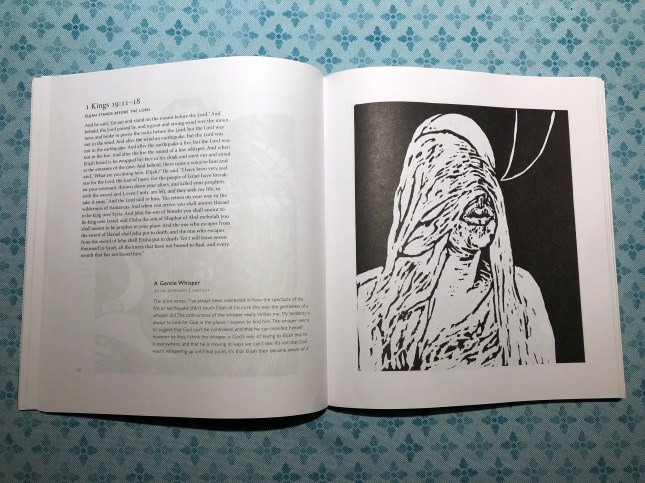
The above image is from Revealed: A Storybook Bible for Grown-Ups by Ned Bustard. The image is called “A Gentle Whisper” and was created by Justin Sorensen.

1 Kings 19:11-18

“Go out and stand before me on the mountain,” the Lord told him. And as Elijah stood there, the Lord passed by, and a mighty windstorm hit the mountain. It was such a terrible blast that the rocks were torn loose, but the Lord was not in the wind. After the wind there was an earthquake, but the Lord was not in the earthquake. And after the earthquake there was a fire, but the Lord was not in the fire. And after the fire there was the sound of a gentle whisper. When Elijah heard it, he wrapped his face in his cloak and went out and stood at the entrance of the cave. And a voice said, “What are you doing here, Elijah?” He replied again, “I have zealously served the Lord God Almighty. But the people of Israel have broken their covenant with you, torn down your altars, and killed every one of your prophets. I am the only one left, and now they are trying to kill me, too.” Then the Lord told him, “Go back the same way you came, and travel to the wilderness of Damascus. When you arrive there, anoint Hazael to be king of Aram. Then anoint Jehu grandson of Nimshi to be king of Israel, and anoint Elisha son of Shaphat from the town of Abel-meholah to replace you as my prophet. Anyone who escapes from Hazael will be killed by Jehu, and those who escape Jehu will be killed by Elisha! Yet I will preserve 7,000 others in Israel who have never bowed down to Baal or kissed him!”

Dear God, Bustard didn’t include verse 10 in this lesson, but I think it’s important because it starts with you asking Elijah a question and then Elijah answers. It is after this exchange that you decide to “pass by.”

There he came to a cave, where he spent the night. But the Lord said to him, “What are you doing here, Elijah?” Elijah replied, “I have zealously served the Lord God Almighty. But the people of Israel have broken their covenant with you, torn down your altars, and killed every one of your prophets. I am the only one left, and now they are trying to kill me, too.”

Elijah passively accuses you of the same thing I have accused you of. He feels like you have let him down. You have disappointed him. I have felt disappointed by you too. For Elijah, I think he felt like he “zealously served” you and you still didn’t come through with the people falling into line. After he did such a great job, why should his life be on the line?

Then you told him to get ready because you were going to come by. And you did some things that would physically scare him. A huge wind that crumbled rocks. An earthquake. Fire. Were you showing him that you could take his life in a minute? Were you making that point to him?

What I’ve always liked about this story is that when you showed up you were gentle. A gentle whisper is what you used to once again ask your question of Elijah: “What are you doing here, Elijah?” His answer didn’t change, but I wonder if his tone of voice did. Was there anger in his first answer? Were there tears in the second?

My wife and I were talking this morning about the fine line we often cross between feeling close to you and living in the Spirit and being completely fallen. Thank you that you give us people like Elijah who experienced the same thing.

Now, regarding this image, here we have Elijah with the cloak he put over his own eyes, and I assume that is your presence approaching his face. Is that a knife? A claw? A feather? I don’t know. Here is what the artist, Justin Sorensen, says about this story:

I’ve always been interested in how the specs tackle of the fire or earthquake didn’t touch Elijah at his core the way the gentleness of a whisper did. The ordinariness of the whisper really strikes me. My tendency is always to look for God in the places I expect to find him. The whisper seems always to suggest that God can’t be controlled, and that he can manifest himself however he likes. I think the whisper is God’s way of saying to Elijah that he is everywhere, and that he is moving in ways we can’t see. It’s not that God wasn’t whispering up until that point, it’s that Elijah then became aware of it.

Father, help me to consider my life worth nothing to me. Help me to simply finish the race and complete the task you have given me–the task of testifying to your grace.

In Jesus’ name I pray,

Amen


Tags: , , , , , ,

The Mockery of Baal — 1 Kings 18:25-29, 36-39


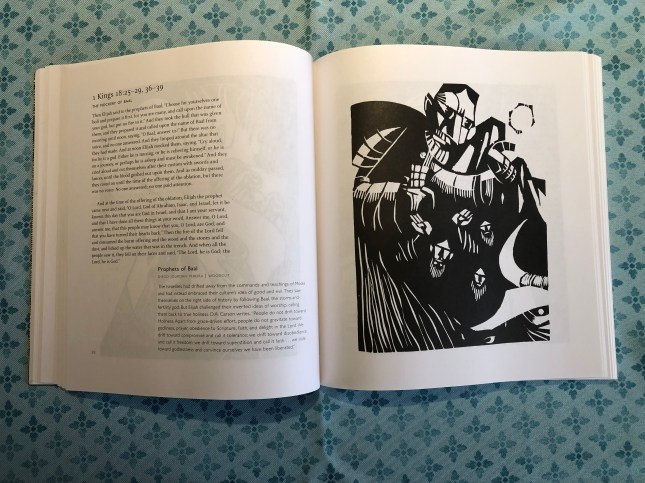
The image above is from Revealed: A Storybook Bible for Grown-Ups by Ned Bustard. The image is called “Prophets of Baal” as was created by Diego Jourdan Pereira.

1 Kings 18:25-29,36-39
Then Elijah said to the prophets of Baal, “You go first, for there are many of you. Choose one of the bulls, and prepare it and call on the name of your god. But do not set fire to the wood.” So they prepared one of the bulls and placed it on the altar. Then they called on the name of Baal from morning until noontime, shouting, “O Baal, answer us!” But there was no reply of any kind. Then they danced, hobbling around the altar they had made. About noontime Elijah began mocking them. “You’ll have to shout louder,” he scoffed, “for surely he is a god! Perhaps he is daydreaming, or is relieving himself. Or maybe he is away on a trip, or is asleep and needs to be wakened!” So they shouted louder, and following their normal custom, they cut themselves with knives and swords until the blood gushed out. They raved all afternoon until the time of the evening sacrifice, but still there was no sound, no reply, no response. At the usual time for offering the evening sacrifice, Elijah the prophet walked up to the altar and prayed, “O Lord, God of Abraham, Isaac, and Jacob, prove today that you are God in Israel and that I am your servant. Prove that I have done all this at your command. O Lord, answer me! Answer me so these people will know that you, O Lord , are God and that you have brought them back to yourself.” Immediately the fire of the Lord flashed down from heaven and burned up the young bull, the wood, the stones, and the dust. It even licked up all the water in the trench! And when all the people saw it, they fell face down on the ground and cried out, “The Lord —he is God! Yes, the Lord is God!”

Dear God, before I get into the image the Pereira created to go with this story, I want to focus for a minute on something that struck me while I was reading it. The prophets of Baal went to the links of cutting “themselves with knives and swords until the blood gushed out.” The thought that I had that I don’t think I have had before is, how many times have I sacrificed myself waiting for an idol to pay off? Yes, looking back it seems like their custom was ridiculous, but is it any different than what I do when I expect my money, my job, my marriage, or my kids to do something for me. When I give and give and give to them not out of love but out of expectation of them, isn’t that just as foolish?

Now, back to this image, I’ll be rank and SA that I cannot make heads or tails of it. Is the large man in the picture Elijah? Are those images of Baal or the prophets of Baal under his arms? I see the bull’s horns on the bottom right. I see the Sun. But I’m not sure what else it is I’m seeing.

Father, at the end of the day, I just need to be reminded that It is easy for me to make idols–even an idol of you. Not the real you, of course, but of the you that my mind wants to create. The you that I expect to give me what I want and do what I want you to do. Making an idol of that image of you is as bad as making an idol out of anything else. I want to worship the real you. The powerful you. Not the you that does what I want you to do. I certainly need a God whom I serve, not one that serves me.

In Jesus’ name I pray,

Amen


Tags: , , , , ,

Passion Week – The Resurrection of Christ: John 20:1-10

The above image is from Revealed: A Storybook Bible for Grown-Ups by Ned Bustard. It is titled “Christ Risen” and was created by Edward Knippers.

John 20:1-10 [ESV]
And the soldiers twisted together a crown of thorns and put it on his head and arrayed him in a purple robe. Now on the first day of the week Mary Magdalene came to the tomb early, while it was still dark, and saw that the stone had been taken away from the tomb. So she ran and went to Simon Peter and the other disciple, the one whom Jesus loved, and said to them, “They have taken the Lord out of the tomb, and we do not know where they have laid him.” So Peter went out with the other disciple, and they were going toward the tomb. Both of them were running together, but the other disciple outran Peter and reached the tomb first. And stooping to look in, he saw the linen cloths lying there, but he did not go in. Then Simon Peter, who was behind him, arrived and went into the tomb. He saw the strips of linen lying there, as well as the burial cloth that had been around Jesus’s head. The cloth was folded up by itself, separate from the linen. Then the other disciple, who had reached the tomb first, also went in, and he saw and believed; for as yet they did not understand the Scripture, that he must rise from the dead. Then the disciples went back to their homes.

Dear God, I’m so grateful this morning. I’ve spent the week trying to sink into the depths of this Passion. Sure, I didn’t really go all the way. I had work. I had other things that took my attention. But I can say that this is likely the most thoughtful I’ve ever been about Holy Week. And here we are.

When I woke up this morning and made my breakfast, I played four songs. “Sunday’s on the Way” by Carman, “He’s Alive” by Don Francisco, “Easter Song” by Keith Green, and then “Gotta Tell Somebody” by Don Francisco. The first three were about Easter and Jesus’s resurrection in one way or another while the fourth was about a grateful father who just had to tell somebody what Jesus did for him. It was fun and worshipful. You are alive! And you have done great things for me.

Father do I “gotta tell somebody?” Have I counted my blessings and shared your greatness and mercy with others? Do I live with the joy that you are alive? Help me to do better. Live through me. Love through me. Let you kingdom come and your will be done on Earth as it is in Heaven.

In Jesus’s name I pray,

Amen


Tags: , , , , , , , , , , , ,

Passion Week – The Descent from the Cross: John 19:38-40

The above image is from Revealed: A Storybook Bible for Grown-Ups by Ned Bustard. The image was created by Rembrandt Harmenszoon Van Rijn and is called “Descent from the Cross by Torchlight.”

John 19:38-42 [ESV]
After these things Joseph of Arimathea, who was a disciple of Jesus, but secretly for fear of the Jews, asked Pilate that he might take away the body of Jesus, and Pilate gave him permission. So he came and took away his body. Nicodemus also, who earlier had come to Jesus by night, came bringing a mixture of myrrh and aloes, about seventy-five pounds in weight. So they took the body of Jesus and bound it in linen cloths with the spices, as is the burial custom of the Jews. Now in the place where he was crucified there was a garden, and in the garden a new tomb in which no one had yet been laid. So because of the Jewish day of Preparation, since the tomb was close at hand, they laid Jesus there.

Dear God, I’ve been thinking about this story all day long. It’s the Saturday between Good Friday and Easter morning. As I right this, it is a little less than three hours until midnight. I’ll be the first to admit that I don’t know much about the Passover traditions of the Jewish people, but a couple of things strike me about this story:

  • Bustard actually pairs this image in the book with Mark 15:37-47, but I chose John’s telling of the story instead because he gives us a character the other three Gospels don’t give: Nicodemus. John is the only one who ever mentions Nicodemus at all, but he brings him up three times: chapters 3, 7, and 19. In chapter 3, he asks Jesus how someone can be born again and Jesus goes on his rant that includes several things including the now-famous John 3:16. In chapter 7, the Pharisees are trying to arrest and ultimately kill Jesus, and Nicodemus is there to subtly defend him (verses 50-51). And now he appears again. He went from seeker in chapter 3, to closet disciple and defender in chapter 7, to open disciple and lover in chapter 19. And it was at the lowest moment of defeat and despair that he came out. He and Joseph both. These verses in chapter 19 are my favorite Bible story because John tells us so much in just 11 verses.
  • Each man probably worked very silently as they handled the body. Their grief and anger must have been unbearable. John basically shows us a lot of anger towards the Pharisees in this scene. Pilate is angry with them and puts “Jesus of Nazareth: The King of the Jews” (19:19) on the cross, in Aramaic, Latin, and Greek, no less (19:20) just to goad them (19:22). Now he shows two men whose grief an anger drives them to change their earthly lives forever. There was no turning back now. The love they had for Jesus in that moment is something that I have to question about myself when I hold myself up to their example. Do I love you that much?
  • What was that Sabbath night like for them? After they lay Jesus in the tomb and went home, what happened next? That’s what I mostly thought about today. How much pain were they in? How much anger or support did they receive from their wives/families? What did Saturday night look like after the Sabbath was over? There were a couple of times today when I just tried to get my head into theirs just a little.
  • How hard was it to remove Jesus from that cross? Did they have to pull the nails. This image shows one of Jesus’s feet still nailed to the cross while they lowered him. It also shows presumably Joseph preparing the linen shroud on which the men will place him. Did Rembrandt think about Nicodemus being there? Is he one of the men shown?

Father, tomorrow morning is Easter. To quote a Christian singer from the 80s and 90s, Carman, “It might seem like Friday night, but Sunday’s on the way.” Tomorrow morning is where we find our victory. It’s where we find the power in your mercy. It’s where we find our relief and our peace. I’m sure that Joseph and Nicodemus couldn’t believe it when they heard Jesus was alive. Did they get to see him over those next 40 days before he ascended? Were they there when Peter gave is great sermon and the Holy Spirit descended? As for me, I just hope I can live up to their legacy and be the one to show you love, regardless of what form you take in my life, and regardless of how confident I am that everything is working out the way you want it to.

In Jesus’s name I pray,

Amen


Tags: , , , , ,