4 While Peter and John were speaking to the people, they were confronted by the priests, the captain of the Temple guard, and some of the Sadducees. 2 These leaders were very disturbed that Peter and John were teaching the people that through Jesus there is a resurrection of the dead. 3 They arrested them and, since it was already evening, put them in jail until morning. 4 But many of the people who heard their message believed it, so the number of men who believed now totaled about 5,000.
Acts 4:1-4
Dear God, this goes back to the winning and losing thing again. The Sadducees and priests felt like they were losing to “The Way,” so they imprisoned Peter and John. They needed to feel like they were getting control of this. Like they were winning. But what happened? More and more people believed. Maybe they made Peter and John more sympathetic figures and softened people’s hearts towards them. Either way, in the moment, Peter and John might have felt like they were losing and they weren’t. The leaders of the temple might have felt like they were taking back the momentum and power and starting to win, but they were only digging themselves a deeper hole.
Father, as I go into this day, help me to let go of the idea of winning and losing. Help me to simply not care. If it seems like I’m decreasing, my influence is waning, or things are going badly for me, help me to just sink into worshipping you more. On the other side, if I find myself getting praise, having influence, or things are going well for me, help me to deflect all glory to you and sink into the joy of worshipping you and loving you with all my heart, soul, mind, and strength.
I pray all of this in Jesus and with your Holy Spirit,
9 Meanwhile, Saul was uttering threats with every breath and was eager to kill the Lord’s followers. So he went to the high priest. 2 He requested letters addressed to the synagogues in Damascus, asking for their cooperation in the arrest of any followers of the Way he found there. He wanted to bring them—both men and women—back to Jerusalem in chains.
3 As he was approaching Damascus on this mission, a light from heaven suddenly shone down around him. 4 He fell to the ground and heard a voice saying to him, “Saul! Saul! Why are you persecuting me?”
5 “Who are you, lord?” Saul asked.
And the voice replied, “I am Jesus, the one you are persecuting! 6 Now get up and go into the city, and you will be told what you must do.”
7 The men with Saul stood speechless, for they heard the sound of someone’s voice but saw no one! 8 Saul picked himself up off the ground, but when he opened his eyes he was blind. So his companions led him by the hand to Damascus. 9 He remained there blind for three days and did not eat or drink.
Acts 9:1-9
Dear God, somehow, I’ve never thought about the men who were with Saul before. What were they like before, during, and after this experience? What happened to them after this? Did they become part of The Way? Did their families think they were crazy? What did this seemingly routine trip to Damascus do to them as well. We know what it did to Saul, but what did it do to them?
I guess this is a reminder to me that none of us, including Paul on that fateful day, go through life alone where what happens to us doesn’t impact others. I had my unique experience with you in the summer of 1987 at an FCA Leadership Conference, but it didn’t stop with me. It dominoed into some of my friends’ lives too, one of whom became an international missionary. Almost exactly 24 years ago, I had another significant moment with you at Laity Lodge when I was inspired by you to start doing these prayer journals. These have changed how I relate to you, and I know they have touched some others as well. And Paul’s life and his experience that day not only touched the men who were with him, but then Ananias later, and then the world. Amazing. In the words of Kurt Kaiser, “It only takes a spark to get a fire going, and soon all those around can warm up to its glowing. That’s how it is with God’s love once you’ve experienced it. You’ll spread His love to everyone. You’ll want to pass it on.”
26 As for Philip, an angel of the Lord said to him, “Go south down the desert road that runs from Jerusalem to Gaza.” 27 So he started out, and he met the treasurer of Ethiopia, a eunuch of great authority under the Kandake, the queen of Ethiopia. The eunuch had gone to Jerusalem to worship, 28 and he was now returning. Seated in his carriage, he was reading aloud from the book of the prophet Isaiah.
29 The Holy Spirit said to Philip, “Go over and walk along beside the carriage.”
30 Philip ran over and heard the man reading from the prophet Isaiah. Philip asked, “Do you understand what you are reading?”
31 The man replied, “How can I, unless someone instructs me?” And he urged Philip to come up into the carriage and sit with him.
32 The passage of Scripture he had been reading was this:
“He was led like a sheep to the slaughter. And as a lamb is silent before the shearers, he did not open his mouth. 33 He was humiliated and received no justice. Who can speak of his descendants? For his life was taken from the earth.”
34 The eunuch asked Philip, “Tell me, was the prophet talking about himself or someone else?” 35 So beginning with this same Scripture, Philip told him the Good News about Jesus.
36 As they rode along, they came to some water, and the eunuch said, “Look! There’s some water! Why can’t I be baptized?” 38 He ordered the carriage to stop, and they went down into the water, and Philip baptized him.
39 When they came up out of the water, the Spirit of the Lord snatched Philip away. The eunuch never saw him again but went on his way rejoicing. 40 Meanwhile, Philip found himself farther north at the town of Azotus. He preached the Good News there and in every town along the way until he came to Caesarea.
Acts 8:26-40
Dear God, something different caught my eye this morning in this story. I don’t know that I’ve ever thought about the difference in position in life (or even cleanliness) between the Ethiopian eunuch and Philip. I am sure Philip was not clean or dressed in fine clothes. I’m sure he was sweaty and dirty from walking the road. Meanwhile, the Ethiopian eunuch was a court official who was in charge of the treasury of Ethiopia. He was riding in a chariot, and since he was reading it implies that it’s not like a chariot I saw in Ben Hur, but a large one with a place to sit and a driver. He also had the book of Isaiah with him somehow. Not a cheap thing to have in his possession. Yet, he must have been Jewish for him to have been in Jerusalem to worship.
So, I’m going to work with the assumption that you prompted a dirty peasant to go and share your news of Jesus with a leader in Ethiopia. What dominoes did this one encounter knock over? We don’t get to know what happened in Ethiopia as a result of Philip’s visit with the man, but I would bet it was critical in your plan.
And I want to give some credit to the Ethiopian too. He was not royalty, but he was royalty adjacent. To allow this man into his chariot and then humble himself enough to be taught by Philip is quite a remarkable thing. I am thinking that the Holy Spirit also put a hunger in him to want to learn at all costs.
Father, help me to follow all of your promptings. I also have some friends and family who need you. Prompt their hearts and help them to follow those promptings as well. Help me to know what my role is and is not in their lives. Love them. Love through me. Thank you for what you are doing that I cannot see.
8 Saul was one of the witnesses, and he agreed completely with the killing of Stephen.
A great wave of persecution began that day, sweeping over the church in Jerusalem; and all the believers except the apostles were scattered through the regions of Judea and Samaria. 2 (Some devout men came and buried Stephen with great mourning.) 3 But Saul was going everywhere to destroy the church. He went from house to house, dragging out both men and women to throw them into prison.
4 But the believers who were scattered preached the Good News about Jesus wherever they went. 5 Philip, for example, went to the city of Samaria and told the people there about the Messiah. 6 Crowds listened intently to Philip because they were eager to hear his message and see the miraculous signs he did. 7 Many evil spirits were cast out, screaming as they left their victims. And many who had been paralyzed or lame were healed. 8 So there was great joy in that city.
Acts 8:1-8
Dear God, this passage from Acts actually plays into the verse of the day from Bible Gateway:
The message of the cross is foolish to those who are headed for destruction! But we who are being saved know it is the very power of God (1 Corinthians 1:18).
We are all foolish and we have no idea what you are up to, whether we believe in you or not. For Saul and the other Jewish leaders at the time, Jesus’s message as carried by his followers was foolish, but those who were being saved through that message knew what was coming from you out of it.
What strikes me about this passage is how those who thought they were winning were actually losing, and those who thought they were losing were actually winning. None of them had any idea in real time what what happening around them.
I know that Paul would look back on this time (when he was still Saul) with tremendous regret (1 Corinthians 15:9). I am sure he was horrified at what he did to persecute Christians before his own encounter with Jesus. And, frankly, I’m not sure anything less than the encounter he had on the road to Damascus would have converted him. When he was Saul, he thought he was winning and fighting the good fight for you. He was ignorant. In fact, he was losing because he was scattering your believers out of Jerusalem and spreading the message farther.
The people who were being persecuted probably felt like they were losing. I can imagine conversations between husbands and wives or friends and how they made their decisions to leave Jerusalem. I’m sure there was a lot of fear. Children were being uprooted and moved. Their friends were in prison and likely beaten or tortured.
So I’ve made that point there. The question for me today is what in my life feels like loss but is actually accomplishing your goals, and are there things where it feels to me like I’m “winning” when I’m actually losing? There are certainly sorrows that I lament every day. Are those “losses” somehow being used and redeemed by you? There are also areas of great success. Are any of those actually pitfalls that I should not embrace but discerningly question?
Father, at the end of the day, well, I just have no idea. I’m too small-minded. I’m too ignorant. But I’m here to worship you this morning. I’m here to submit to you. I’m here to try to do what you want me to do today. For the things that look like losses, I will look to you and see if there is anything for which I need to repent or if they are situations I should simply submit to. For the things that look like wins, I will try to critically look at them and discern if there is anything I need to do to see through any personal benefit I’m receiving (whether materially or emotionally) and determine how to worship you best through it. Holy Spirit, please help mem with all of this today.
I pray all of this in Jesus and with your Holy Spirit,
6 So when the apostles were with Jesus, they kept asking him, “Lord, has the time come for you to free Israel and restore our kingdom?”
7 He replied, “The Father alone has the authority to set those dates and times, and they are not for you to know. 8 But you will receive power when the Holy Spirit comes upon you. And you will be my witnesses, telling people about me everywhere—in Jerusalem, throughout Judea, in Samaria, and to the ends of the earth.”
9 After saying this, he was taken up into a cloud while they were watching, and they could no longer see him. 10 As they strained to see him rising into heaven, two white-robed men suddenly stood among them. 11 “Men of Galilee,” they said, “why are you standing here staring into heaven? Jesus has been taken from you into heaven, but someday he will return from heaven in the same way you saw him go!”
12 Then the apostles returned to Jerusalem from the Mount of Olives, a distance of half a mile. 13 When they arrived, they went to the upstairs room of the house where they were staying.
Here are the names of those who were present: Peter, John, James, Andrew, Philip, Thomas, Bartholomew, Matthew, James (son of Alphaeus), Simon (the zealot), and Judas (son of James). 14 They all met together and were constantly united in prayer, along with Mary the mother of Jesus, several other women, and the brothers of Jesus.
Acts 1:6-14
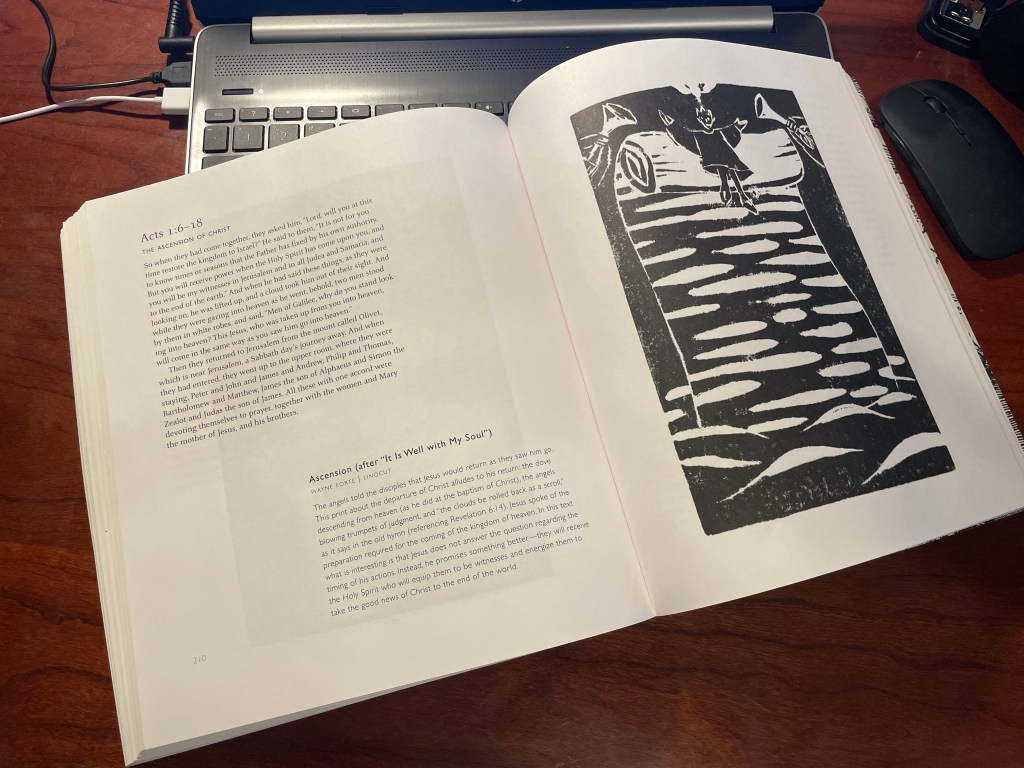
Dear God, as with most of the other pictures I look at from this book, I’ve read the passage (there’s a typo in the book, by the way. The title on the page says it goes through verse 18, but it is really 14), and I have some thoughts. But first I want to take my recent reading of the passage and look to see what the artist, Wayne Forte, put in his image for me to see:
Jesus with his arms open wide
The dove/Holy Spirit above him (I think that’s what it is)
The two angels who speak to the disciples in the story are pictured with trumpets as Jesus ascends.
The unraveling scroll is a bridge. Or is Jesus floating and the scroll is representing Jesus being “The Word?”
Is the scroll transparent and the white marks are clouds?
The white marks below the scroll look like hills (like the hill Jesus ascended from)
Okay, I just read Bustard’s description of the image, and it mentions something I thought about but didn’t say: “This print about the departure of Christ alludes to his return: the dove descending from heaven (as he did at the baptism of Christ), the angels blowing trumpets of judgment, and the ‘clouds be rolled back as a scroll,’ as it says in the old hymn (referencing Revelation 6:14).”
So now back to what I noticed when I read the story for myself.
They were still linking all of this to Israel’s liberation and return to power/glory. That’s really something. That was a concept that was really baked into their psyches. They seemingly couldn’t break free from it. They really, really wanted to overcome being trod upon. Because this was such a big deal to even these close followers of you who knew you intimately, I guess it makes sense that it should be so baked into our collective consciences as well. In our country, we have those who have the power who will do absolutely everything they can to keep it. We also have those who want that power and will do what they can to take it. And it’s nearly all of us. It’s the Christian church, the atheists, the socialists, the right-wing conservatives–everyone. Everyone is going for that power. We want to make sure our country has the most power in the world (economically, militarily, and politically), and we want to make sure our “group” is the one wielding that power, both within the country and outside of it.
Jesus doesn’t admonish them for thinking about the restoration of Israel, but simply says that they’ll never know when.
Jesus goes a different direction and tells them about the Holy Spirit coming. I have to say, there are times when I wonder, given the Trinity, if the three of you aren’t so intertwined that “praying in Jesus’s name” isn’t also “praying in the name of the Holy Spirit and the Father” as well. Hence some denominations start and end their prayers with, “In the name of the Father, the Son, and the Holy Spirit.” When Jesus comes into my heart (as a Baptist would say), is that more accurately represented as the Holy Spirit coming into my heart? Is there a difference?
Jesus sends them to Jerusalem, all of Judea, Samaria (did I hear that right–the Samaritans?), and the ends of the earth (hold it, what?!?).
The angels (I’m assuming they are angels) told them Jesus would return the same way he left (hence Forte’s depiction of a scene that could represent either Jesus’s ascension or return).
The place where they were was only about half a mile (a Sabbath’s day journey) from where they were staying.
The remaining 11 were with other disciples plus Mary, Jesus’s mother, and Jesus’s brothers. The other disciples included women.
They spent a lot of their time in prayer. I wonder what kinds of things they prayed for. Were they following the “Lord’s Prayer” template Jesus taught them? Were they praying for clarity of mission, protection from persecution, and daily provision?
Father, as I think about this, I think the lessons I’m leaving with are that I need to not worry about power/influence (they are idols), not worry about trying to understand you or your plan (ignorance is my ally), and simply worship you, spending time in prayer. Help me to do all of these things. And going back to what I prayed about earlier this week, help me to embrace the tools you have given me to impact the world: prayer, service, persuasion, and suffering.
I pray all of this in the name of the Father, the Son, and the Holy Spirit,
Note on April 22, 2024: I originally wrote this prayer in the summer of 2023. This evening, I was listening to the Bible Project Podcast, and in the midst of their series on the Sermon on the Mount, they had a whole episode dedicated to the Word “hypocrite.” They redefined it for me, and I found that I have apparently either been misinformed or misunderstood the definition of the word the translators used to convey Jesus’s message. Apparently, a more accurate definition would be someone who is doing the things they say they (and you) should do, but they are only doing them for show. So it’s not what I thought, which is the old “do as I say, not as I do” definition, but it’s actually something that only God can tell if we are doing it or not. Only God can see our hearts and motives as we do what we do and say what we say. So this is another example of how my interpretation of scripture can be influenced by misunderstandings and my own lack of education.With that said, her is the prayer I prayed with the wrong definition in mind.
Dear God, I noticed that the New Testament reading for today for the Catholic church had the word “hypocrite” a couple of times. Both times, it was Jesus talking. I decided to take the New Living Translation and find out how many times the word is used in the Bible. As it turns out, it came up 21 times. Three times in the Old Testament (one in Psalms and two in Isaiah) and then 18 in the New Testament (13 in Matthew, one in Mark, two in Luke, one in Acts and one in 1 Timothy). So Matthew really seems to have zeroed in on this word and Jesus’s use of it. Therefore, I thought I would look at the instances when Matthew quotes Jesus as using it, courtesy of Bible Gateway.
Matthew 6:2 When you give to someone in need, don’t do as the hypocrites do—blowing trumpets in the synagogues and streets to call attention to their acts of charity! I tell you the truth, they have received all the reward they will ever get. In Context | Full Chapter | Other Translations
Matthew 6:5 Teaching about Prayer and Fasting“When you pray, don’t be like the hypocrites who love to pray publicly on street corners and in the synagogues where everyone can see them. I tell you the truth, that is all the reward they will ever get. In Context | Full Chapter | Other Translations
Matthew 6:16 “And when you fast, don’t make it obvious, as the hypocrites do, for they try to look miserable and disheveled so people will admire them for their fasting. I tell you the truth, that is the only reward they will ever get. In Context | Full Chapter | Other Translations
Matthew 23:13 “What sorrow awaits you teachers of religious law and you Pharisees. Hypocrites! For you shut the door of the Kingdom of Heaven in people’s faces. You won’t go in yourselves, and you don’t let others enter either. In Context | Full Chapter | Other Translations
Matthew 23:15 “What sorrow awaits you teachers of religious law and you Pharisees. Hypocrites! For you cross land and sea to make one convert, and then you turn that person into twice the child of hell you yourselves are! In Context | Full Chapter | Other Translations
Matthew 23:23 “What sorrow awaits you teachers of religious law and you Pharisees. Hypocrites! For you are careful to tithe even the tiniest income from your herb gardens, but you ignore the more important aspects of the law—justice, mercy, and faith. You should tithe, yes, but do not neglect the more important things. In Context | Full Chapter | Other Translations
Matthew 23:25 “What sorrow awaits you teachers of religious law and you Pharisees. Hypocrites! For you are so careful to clean the outside of the cup and the dish, but inside you are filthy—full of greed and self-indulgence! In Context | Full Chapter | Other Translations
Matthew 23:27 “What sorrow awaits you teachers of religious law and you Pharisees. Hypocrites! For you are like whitewashed tombs—beautiful on the outside but filled on the inside with dead people’s bones and all sorts of impurity. In Context | Full Chapter | Other Translations
Matthew 23:29 “What sorrow awaits you teachers of religious law and you Pharisees. Hypocrites! For you build tombs for the prophets your ancestors killed, and you decorate the monuments of the godly people your ancestors destroyed. In Context | Full Chapter | Other Translations
Jesus seemed to have very little tolerance for hypocrites. Perhaps this is something I should be careful about as I move through this life. Are there areas where I am hypocritical?
I guess hypocrisy is something that requires self-awareness because I know of very few people who are able to see their own hypocrisy in real time. Even now, as I try to search my heart, I try to think of areas where I might be hypocritical, but I can’t think of any. Am I a hypocrite? Almost certainly. Can I identify how? Apparently not.
I think hypocrisy starts with a spirit of judging others. Maybe that’s where I should start. Do I judge others and how do I judge others? If I am judging them for this thing or that, then the odds are probably good that I have some work to do on myself in that area–oh, and I need to stop the judging.
Father, there are six instances in Matthew 23 that includes the phrases “What sorry awaits you…” and “Hypocrites!” I recognize that this is partially Jesus getting the Pharisees riled up so they will crucify him. It’s also getting his last words in with them while he can. But the message is still true. If it is true with me, please reveal it to me. Holy Spirit, please reveal it to me. Jesus, please forgive me.
I pray all of this in the name of the Father, the Son, and the Holy Spirit,
On the day of Pentecost all the believers were meeting together in one place. Suddenly, there was a sound from heaven like the roaring of a mighty windstorm, and it filled the house where they were sitting. Then, what looked like flames or tongues of fire appeared and settled on each of them. And everyone present was filled with the Holy Spirit and began speaking in other languages, as the Holy Spirit gave them this ability. At that time there were devout Jews from every nation living in Jerusalem. When they heard the loud noise, everyone came running, and they were bewildered to hear their own languages being spoken by the believers. They were completely amazed. “How can this be?” they exclaimed. “These people are all from Galilee, and yet we hear them speaking in our own native languages! Here we are—Parthians, Medes, Elamites, people from Mesopotamia, Judea, Cappadocia, Pontus, the province of Asia, Phrygia, Pamphylia, Egypt, and the areas of Libya around Cyrene, visitors from Rome (both Jews and converts to Judaism), Cretans, and Arabs. And we all hear these people speaking in our own languages about the wonderful things God has done!” Acts 2:1-11
Dear God, the first thing I thought of when I read this passage this morning was the first: “…all the believers were meeting together in one place.” Together. Community.
I’ve never liked church services. You know this. I’ve told many people this. The act of me going to church is an act of pure self-discipline. I remember when my kids were little and they said they didn’t want to go, claiming they didn’t get anything out of it. I would respond that maybe there was someone there that morning who needed them. For my own part, there are times when I go that I am actually very moved. There are times when someone really blesses me. And there are times when I am able to visit with someone who needs someone to talk to or to maybe just say hi to them. If I am not there to greet that visitor who comes looking for you, and everyone else takes my attitude then who will be.
Just think of the people who weren’t there that morning 2,000 years ago. Was there anyone who intended to be with the disciples and didn’t make it? Did they miss you?
Father, I need to wrap this up, because I need to board a plane, but I just want to say that I’m sorry for the times I was too lazy and I either missed you and what you had for me or I missed what you had to do through me for someone else. Thank you for community. I pray for community for those I love.
In the name of the Father, the Son, and the Holy Spirit,
When we arrived in Rome, Paul was permitted to have his own private lodging, though he was guarded by a soldier. Three days after Paul’s arrival, he called together the local Jewish leaders. He said to them, “Brothers, I was arrested in Jerusalem and handed over to the Roman government, even though I had done nothing against our people or the customs of our ancestors. The Romans tried me and wanted to release me, because they found no cause for the death sentence. But when the Jewish leaders protested the decision, I felt it necessary to appeal to Caesar, even though I had no desire to press charges against my own people. I asked you to come here today so we could get acquainted and so I could explain to you that I am bound with this chain because I believe that the hope of Israel—the Messiah—has already come.” They replied, “We have had no letters from Judea or reports against you from anyone who has come here. But we want to hear what you believe, for the only thing we know about this movement is that it is denounced everywhere.” So a time was set, and on that day a large number of people came to Paul’s lodging. He explained and testified about the Kingdom of God and tried to persuade them about Jesus from the Scriptures. Using the law of Moses and the books of the prophets, he spoke to them from morning until evening. Some were persuaded by the things he said, but others did not believe. And after they had argued back and forth among themselves, they left with this final word from Paul: “The Holy Spirit was right when he said to your ancestors through Isaiah the prophet,
‘Go and say to this people:When you hear what I say,you will not understand.When you see what I do,you will not comprehend. For the hearts of these people are hardened,and their ears cannot hear,and they have closed their eyes—so their eyes cannot see,and their ears cannot hear,and their hearts cannot understand,and they cannot turn to meand let me heal them.’
So I want you to know that this salvation from God has also been offered to the Gentiles, and they will accept it.” For the next two years, Paul lived in Rome at his own expense. He welcomed all who visited him, boldly proclaiming the Kingdom of God and teaching about the Lord Jesus Christ. And no one tried to stop him. Act 28:16-31
Dear God, this is such an amazing book by Luke, and then it comes to this abrupt end.
But beyond all of that, I don’t think I ever noticed this last line before: “And no one tried to stop him.” What an interesting thing for Luke to point out. What it says to me is that you put him in a unique position, through being imprisoned on house arrest, to share the gospel in a way he probably wouldn’t otherwise have been able to do. For two years, he preached, taught, and debated unfettered. He was already arrested and awaiting his appeal. What else could those who didn’t like him do to him.
It reminds me of other people in the Bible who were living through difficult situations, but they ultimately ended up accomplishing amazing things through them. Hagar comes to mind. Through Sarah’s anger and Abraham’s weakness, she was sent off with Ishmael into the desert to die. But you were actually freeing her from her slavery and setting her and her son up for a brand new life. In the moment, I’m sure it looked like she was losing, but you were orchestrating it for something better.
Jesus’s death is another example. To everyone in the moment, Jesus’s death looked like losing. But it was part of something so much bigger—the grace you would offer to all of humanity.
Going back to Abraham, I have no respect for him given the way this story portrays his interactions with Sarah and Hagar. He could have done a lot of things, and to me he chose the weakest path. He did that a lot. With Pharaoh. With another king. Telling both of them that Sarah was his sister because he was afraid for himself. He just made so many bad decisions. But you made allowance for that in your plan. You used it. It makes me think about some of the mistakes I’ve made and how you’ve redeemed them. It makes me think of some of my pain now and how you might be working to do something wonderful through something that seems like a loss to me.
Father, Jesus, Holy Spirit, I’m doing something interesting today. I’m doing something that demonstrates my faith in you and what I think is obeying your Holy Spirit. Use this not for me but for you and your plans. For your glory. Help me to decrease so that you might increase in this world.
But when we landed at Miletus, he sent a message to the elders of the church at Ephesus, asking them to come and meet him. When they arrived he declared, “You know that from the day I set foot in the province of Asia until now I have done the Lord’s work humbly and with many tears. I have endured the trials that came to me from the plots of the Jews. I never shrank back from telling you what you needed to hear, either publicly or in your homes. I have had one message for Jews and Greeks alike—the necessity of repenting from sin and turning to God, and of having faith in our Lord Jesus. “And now I am bound by the Spirit to go to Jerusalem. I don’t know what awaits me, except that the Holy Spirit tells me in city after city that jail and suffering lie ahead. But my life is worth nothing to me unless I use it for finishing the work assigned me by the Lord Jesus—the work of telling others the Good News about the wonderful grace of God. “And now I know that none of you to whom I have preached the Kingdom will ever see me again. I declare today that I have been faithful. If anyone suffers eternal death, it’s not my fault, for I didn’t shrink from declaring all that God wants you to know. Acts 20:17-27
Dear God, this is the New Testament reading for the Catholic church today, but it plays into what I’ve been praying lately. I’ve even referenced verse 24 a couple of times (…my life is worth nothing to me…).
So I just finished watching an episode of a very secular television show (Ted Lasso), but it is one that does its best to emulate what I would call your values of loving others and forgiveness. It recognizes that that is the right thing to do and it knows that there is healing. At one point tonight, one character told another character about the power of forgiveness. And it’s not really for the other person. Its for the forgiver maybe even more than the forgiven.
I was telling my wife earlier tonight that I still have some forgiveness issues that I’m not totally sure how to address. I’ve worked on it with you. I’ve tried to do the right things. But I have to say that I’m not sure what it looks like beyond this point.
I think this fits because, on a much smaller level than what Paul was dealing with here, a lack of forgiveness is NOT considering my life worth nothing to me. When I hold on, well, then I’m holding on to me. I’m putting myself ahead of who you need me to be–for my own sake!
Father, I consider my life worth nothing to me. If only I may finish the race and complete the task you have given to me. The task of testifying to the gospel of your grace. Father, help me. Jesus, help me. Holy Spirit, help me.
A mob quickly formed against Paul and Silas, and the city officials ordered them stripped and beaten with wooden rods. They were severely beaten, and then they were thrown into prison. The jailer was ordered to make sure they didn’t escape. So the jailer put them into the inner dungeon and clamped their feet in the stocks. Around midnight Paul and Silas were praying and singing hymns to God, and the other prisoners were listening. Suddenly, there was a massive earthquake, and the prison was shaken to its foundations. All the doors immediately flew open, and the chains of every prisoner fell off! The jailer woke up to see the prison doors wide open. He assumed the prisoners had escaped, so he drew his sword to kill himself. But Paul shouted to him, “Stop! Don’t kill yourself! We are all here!” The jailer called for lights and ran to the dungeon and fell down trembling before Paul and Silas. Then he brought them out and asked, “Sirs, what must I do to be saved?” They replied, “Believe in the Lord Jesus and you will be saved, along with everyone in your household.” And they shared the word of the Lord with him and with all who lived in his household. Even at that hour of the night, the jailer cared for them and washed their wounds. Then he and everyone in his household were immediately baptized. He brought them into his house and set a meal before them, and he and his entire household rejoiced because they all believed in God. Acts 16:22-34
Dear God, mob mentality is an interesting thing. Reading this just now reminded me about one of the many powerful scenes in the movie version of To Kill A Mockingbird. In it, there is a mob ready to lynch the prisoner in jail and only his lawyer is standing in their way. Then the lawyer’s children come and his daughter Scout starts talking to one of the men in the mob whom she knows. I just pulled it up on YouTube and it still brings tears to my eyes.
I know people lose their heads and mobs like this happen often. Maybe even more so now that we have social media. I guess you could look back on January 6, 2021, and all of the people who now regret going into the capitol building. They got caught up into an emotional state because they felt threatened, afraid, or cheated through injustice. Whatever the reason, the things that mobs respond to are never exhibited through the fruits of the Spirit (love, joy, peace, patience, goodness, faithfulness, gentleness, kindness, and self control).
So the passage right after this one tells us that, the day after Paul and Silas had been flogged and jailed, the city officials sent word to let them go. Had they come to their senses? Did this ponder it all night, discuss it apart from the mob and decide they needed to rectify their mistake? I don’t know. But I know they seemed to change course when cooler heads prevailed.
All of this is a reminder to me. It’s a reminder to pause before acting when my emotions are high. It’s a reminder to be very careful before I join in with an angry crowd. This can include my coworkers when they get upset and emotional about something. It can be good to take a beat in those situations and let the emotion calm down.
Father, help me to be wise. Help me to not be in a hurry when I feel threatened, afraid, or cheated. Help me to respond, even in the worst of times, with love, joy, peace, etc.) Thank you for this day. Thank you for meeting me in it. I needed a good productive day, and you gave it to me. You blessed me in so many ways I can see, not to mention the ones I cannot see. Continue to use me as my wife and I go to have dinner with a friend tonight. Make us a blessing to her and her family. Let your kingdom come and you will be done on earth through our lives.
I pray all of this in the name of the Father, the Son, and the Holy Spirit,