RSS

Tag Archives: Tanja Butler

Numbers 21:4-9

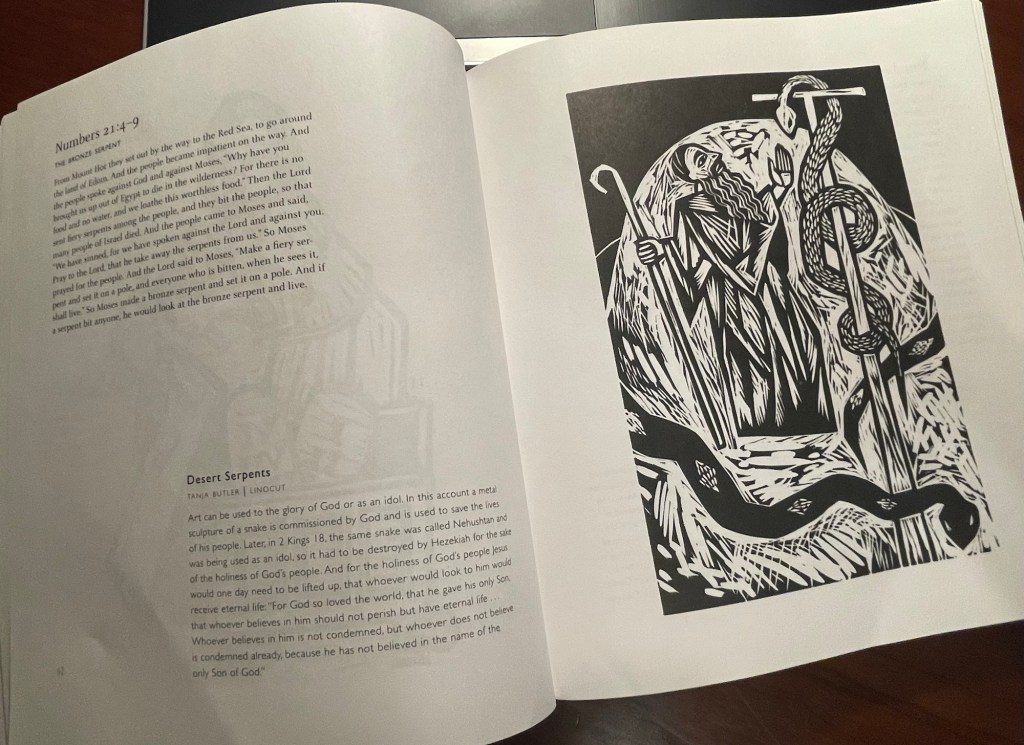
“Desert Serpents” by Tanja Butler as presented in Revealed: A Storybook Bible for Grown-Ups by Ned Bustard.

Then the people of Israel set out from Mount Hor, taking the road to the Red Sea to go around the land of Edom. But the people grew impatient with the long journey, and they began to speak against God and Moses. “Why have you brought us out of Egypt to die here in the wilderness?” they complained. “There is nothing to eat here and nothing to drink. And we hate this horrible manna!”

So the Lord sent poisonous snakes among the people, and many were bitten and died. Then the people came to Moses and cried out, “We have sinned by speaking against the Lord and against you. Pray that the Lord will take away the snakes.” So Moses prayed for the people.

Then the Lord told him, “Make a replica of a poisonous snake and attach it to a pole. All who are bitten will live if they simply look at it!” So Moses made a snake out of bronze and attached it to a pole. Then anyone who was bitten by a snake could look at the bronze snake and be healed!

Numbers 21:4-9

Dear God, before I get into praying about this passage, I want to just spend some time with this image. Is there anything here I can learn from Tanja Butler’s “Desert Serpents”?

  1. I see Moses holding his staff which is shaped like a shepherd’s crook. Is that right? Were all staffs that way? It’s not important, I suppose, but it reminds me of all of the images of Joseph in the stable with Mary and the baby Jesus that portray Joseph as holding a shepherd’s crook. Why?
  2. The serpents on the ground are mainly black while the serpent on the staff has much more white in it.
  3. Moses has his hand up towards the serpent and he is looking at the serpent.
  4. I’m trying to tell what that is behind Moses. Is it supposed to be a hut? A pile of hay? I’m not sure.
  5. The staff upon which the serpent is mounted looks a bit like a cross as we perceive the Roman crosses to look later in history.

Really, that’s about all that I’m noticing. Bustard points out in his commentary that later in 2 Kings 18:4, the Israelite king breaks destroys this very serpent because the Israelites had turned it into an idol. And of course, Jesus references this serpent in John 3:14-15 when he’s talking to Nicodemus and he compares himself with this life-saving serpent.

I think about human nature and our wont to complain. Our wont to take over our lives ourselves and abandon you. Our wont to only submit to you after we’ve come to the end of ourselves.

I was listening to an interview yesterday with John Dickson, an Australian who was comparing Christianity in the United States with Christianity in Australia 12 years ago. I’ve heard him before. He is where I got the line that Jesus gave us four tools and four tools only to impact our world because they are the only tools he used: prayer, service, persuasion, and suffering. One comment he made is that now that Christians are a minority in Australia they no longer have the option of political power and enforcing their will on the minority, so they are having to lean into these four tools. His perspective is that even with Christians still in the majority in the U.S., if we don’t limit ourselves to Jesus’s example and continue to push to politically force our will on the rest of the country, we will only hasten our decent into what Australia has become.

Father, the thing I need to be better at is persuasion. I need to first understand why I believe what I believe. I need to not just spout off opinions without thought, but to think through why I believe what I believe and then form those thoughts into coherent, legitimate arguments to persuade my neighbor. And if I lose, then I need to lose well and prepare harder for the next time, both in exploring why I believe what I believe and then articulating it in a good way. So help me to do that. Help me to be the man you need me to be in the lives of others. Help me to love well.

I pray this in Jesus and with your Holy Spirit,

Amen
 

Tags: , , , , , ,

1 Timothy 2

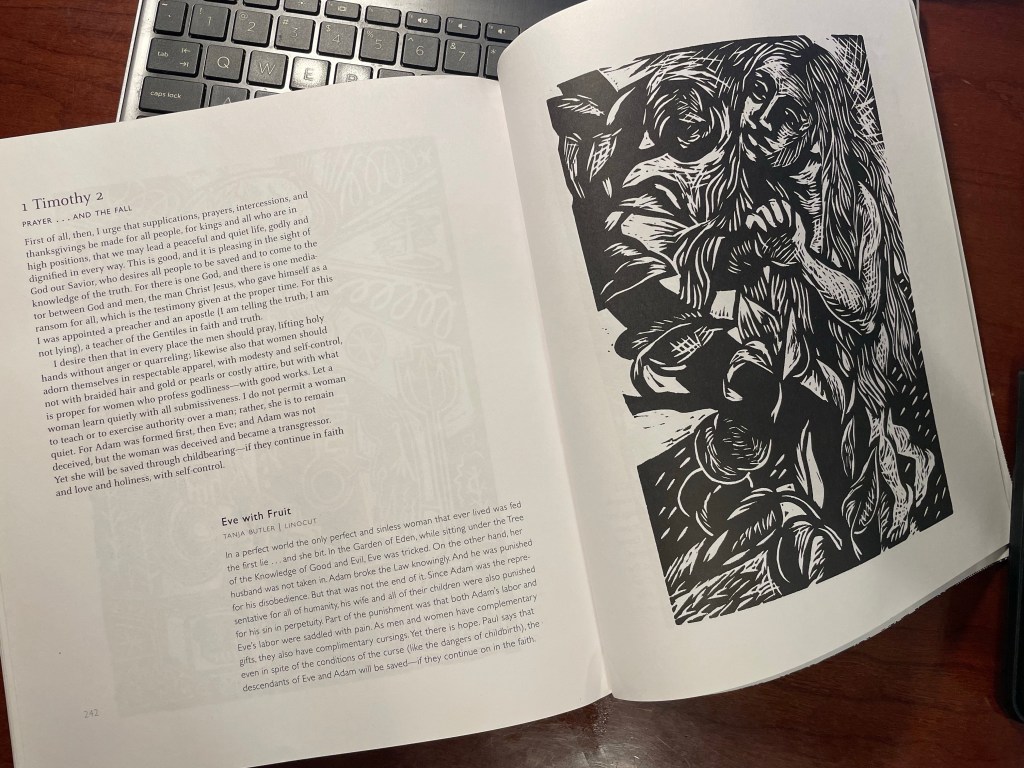
This image is from Revealed: A Storybook Bible for Grown-Ups compiled by Ned Bustard. The image is called “Eve with Fruit” and was created by Tanja Butler.

I urge you, first of all, to pray for all people. Ask God to help them; intercede on their behalf, and give thanks for them. Pray this way for kings and all who are in authority so that we can live peaceful and quiet lives marked by godliness and dignity. This is good and pleases God our Savior, who wants everyone to be saved and to understand the truth. For,

There is one God and one Mediator who can reconcile God and humanity—the man Christ Jesus. He gave his life to purchase freedom for everyone.

This is the message God gave to the world at just the right time. And I have been chosen as a preacher and apostle to teach the Gentiles this message about faith and truth. I’m not exaggerating—just telling the truth.

In every place of worship, I want men to pray with holy hands lifted up to God, free from anger and controversy.

And I want women to be modest in their appearance. They should wear decent and appropriate clothing and not draw attention to themselves by the way they fix their hair or by wearing gold or pearls or expensive clothes. 10 For women who claim to be devoted to God should make themselves attractive by the good things they do.

11 Women should learn quietly and submissively. 12 I do not let women teach men or have authority over them. Let them listen quietly. 13 For God made Adam first, and afterward he made Eve. 14 And it was not Adam who was deceived by Satan. The woman was deceived, and sin was the result. 15 But women will be saved through childbearing, assuming they continue to live in faith, love, holiness, and modesty.

1 Timothy 2

Dear God, I have to say, this is a tough one for me, starting with verse 11. Paul was so good with women and liberating to them. Jesus was the same. That’s what makes 1 Timothy 2:11-15 really hard for me. That and the fact that I know so many women who have something to teach me. Locally, my favorite preacher I’ve heard in town is a woman. She is the associate pastor of a church, but if I ever happen to visit on a day when she is preaching it is a good thing. I like her.

And I have to say, Paul blaming Eve for the fall back in the garden seems a little harsh too. Was Adam not there? Not a part of it? I just stopped this prayer to go and grab a biblical commentary written by Gary Demarest. He leaned into the idea of supporting women in leadership and confining Paul’s words to Timothy’s specific situation where he was serving and not women overall. He used Paul’s words in support of women serving and playing a major part in Christianity in other books such as Romans and Philippians to back that up. Overall, I don’t think Paul thought we would be still reading this specific letter he was writing to Timothy 2,000 years later.

With all of that said, what is this image of Eve created by Tanja Butler and what did she see in this story that she put down through this image? Frankly, it is hard for me to make a lot out in this image.

  • I see Eve with long hair cascading over her body. She appears to have not clothes, so this is “pre-fall.”
  • She is looking up as if looking at the fruit in the branches of the tree.
  • I see leaves and round items that I assume are the fruit she eats.
  • It looks like her hands are clasped together, but I don’t think she has a piece of the fruit yet. I think she’s just eyeing it longingly.
  • I’m surprised that I don’t see the serpent or Adam. I think Butler has her alone in this moment. I assume Satan has done his work and left her to sit with her temptation. Adam isn’t there to talk through it with her. It’s just her and the fruit. I’ve had that loneliness with temptation before. Just me, alone, longing to do something I shouldn’t do.

Bustard has an interesting take on the Adam and Eve story in his commentary on this passage and piece of art:

In a perfect world the only perfect and sinless woman that ever lived was fed the first lie…[ellipses his] and she bit. In the Garden of Eden, while sitting under the Tree of the Knowledge of Good and Evil, Eve was tricked. On the other hand, her husband was not taken in. Adams broke the Law knowingly. And he was punished for his disobedience. But that was not the end of it. Since Adam was the representative for all of humanity, his wife and all of their children were also punished for his sin in perpetuity. Part of the punishment was that both Adam’s labor and Eve’s labor were saddled with pain. As men and women have complementary gifts, they also have complimentary cursings. yet there is hope. Paul says that even in spite of the conditions of the curse (like the dangers of childbirth), the descendants of Even and Adam will be saved–if they continue on in the faith.

Revealed: A Storybook Bible for Grown-Ups, page 242.

Father, I think for me and this image, what is sticking with me is the solo image of Eve struggling with temptation. As I said, I’ve been alone with temptation before, whether in my office at work thinking through options to a problem, to being at home and wanting to do things that might satisfy my own desires and/or addictions. I guess this gives me a fresh look at the words, “And lead me not unto temptation, but deliver me from evil.” I offer that to you as my prayer this morning.

I pray this through the grace you offer me in the life, death, and resurrection of Jesus,

Amen


Tags: , , ,

Matthew 2:7-15

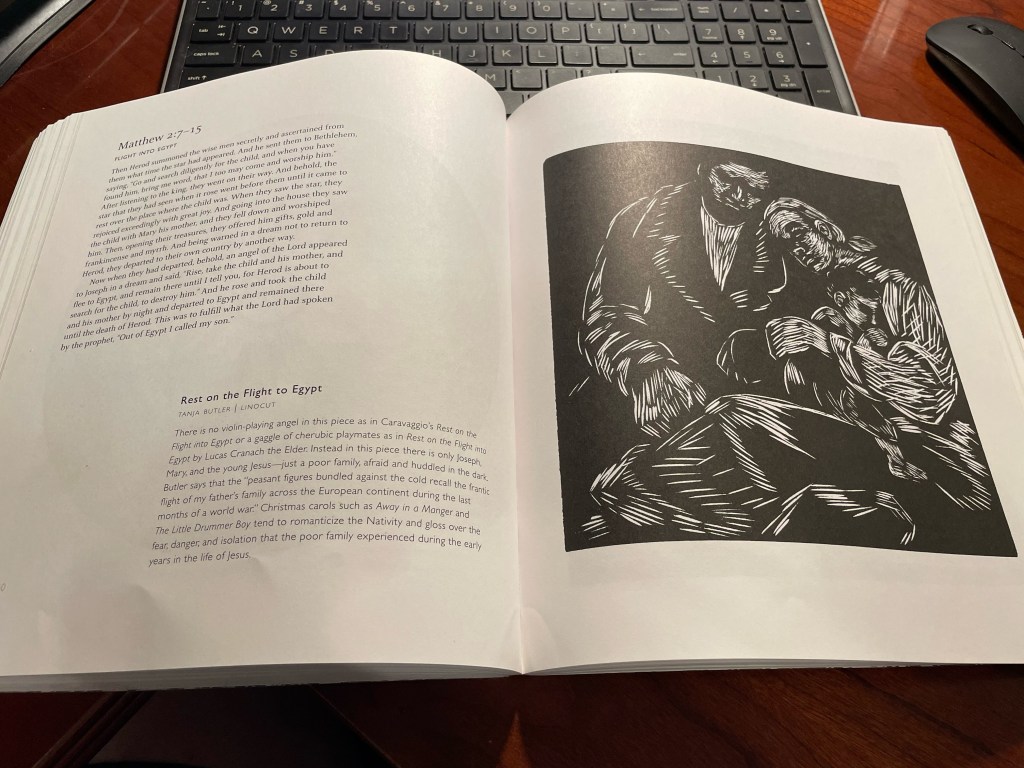
“Rest on the Flight to Egypt” by Tanja Butler from Revealed: A Storybook Bible for Grown-Ups y Ned Bustard

Then Herod called for a private meeting with the wise men, and he learned from them the time when the star first appeared. Then he told them, “Go to Bethlehem and search carefully for the child. And when you find him, come back and tell me so that I can go and worship him, too!”

After this interview the wise men went their way. And the star they had seen in the east guided them to Bethlehem. It went ahead of them and stopped over the place where the child was. 10 When they saw the star, they were filled with joy! 11 They entered the house and saw the child with his mother, Mary, and they bowed down and worshiped him. Then they opened their treasure chests and gave him gifts of gold, frankincense, and myrrh.

12 When it was time to leave, they returned to their own country by another route, for God had warned them in a dream not to return to Herod.

13 After the wise men were gone, an angel of the Lord appeared to Joseph in a dream. “Get up! Flee to Egypt with the child and his mother,” the angel said. “Stay there until I tell you to return, because Herod is going to search for the child to kill him.”

14 That night Joseph left for Egypt with the child and Mary, his mother, 15 and they stayed there until Herod’s death. This fulfilled what the Lord had spoken through the prophet: “I called my Son out of Egypt.”

Matthew 2:87-15

Dear God, I figured that, on Father’s Day, I would spend some time with you and my favorite father of the Bible. If you were to ask most Christians who their favorite father of the Bible is, it would probably be Joseph, Jesus’s earthly father. I mean, really, there isn’t much competition here. Frankly, it’s hard to think of another good one. You have to do some deep cuts and maybe consider Samson’s dad, Manoah. He was simple, but seemingly good. And it’s hard to find anything wrong with John the Baptist’s dad, Zechariah, but we don’t get to see him in action as much. But Joseph…well, Joseph is worth of his own book, in my opinion.

This story is just one of several we get of Joseph being obedient to you. But perhaps my favorite story about him is the first time we see him in Matthew 1:18-19.

18 This is how Jesus the Messiah was born. His mother, Mary, was engaged to be married to Joseph. But before the marriage took place, while she was still a virgin, she became pregnant through the power of the Holy Spirit. 19 Joseph, to whom she was engaged, was a righteous man and did not want to disgrace her publicly, so he decided to break the engagement quietly.

Since this isn’t a story about him being a father, I didn’t start here, but it’s remarkable. In the midst of pain, hurt, and betrayal–in the midst of having his reputation destroyed–he “did not want to disgrace her publicly, so he decided to break the engagement quietly.” Wow. That’s a special man.

But back to him as a father. This is a remarkable story because he believed the dream and didn’t wait until morning to act on it. I wonder if Mary protested. I wonder if Jesus fussed. I don’t know what kind of life he had built in Bethlehem at that point, but he threw it all away to keep this boy–God’s son–safe.

As I look at this picture by Tanja Butler, I notice that it is made completely of lines and shadows. Frankly, the lines make me think of straw (almost like the Scarecrow in the Wizard of Oz). That makes me think of the manger in which Jesus was laid. The shadows give the impression that it’s dark and the white are the scant reflections of just enough light to give us the picture. Jesus is in Mary’s arms, sucking his thumb. Mary has her head against Joseph’s shoulder. Perhaps she’s resting. Perhaps he’s comforting her. Maybe both. I cannot tell if her eyes are open or not. The one line on her left eye makes me think they are closed. And Joseph is there. The design of his coat is almost a more modern look with lapels. Perhaps Butler is trying to make me think of his as a professional who has given up his business for this journey. Perhaps she is trying to communicate that the weather demands a coat. But Jesus appears to be barefoot, so maybe I’m wrong about all of that. The depiction of Joseph’s face actually makes him look a little like Abraham Lincoln to me. I wonder if that was intentional as well.

Looking at Bustard’s commentary on this piece, he says:

There is no violin-playing angel in this piece as in Caravaggio’s “Rest on the Flight into Egypt” or a gaggle of cherubic playmates as in “Rest on the Flight into Egypt by Lucas Cranach the Elder. Instead in this piece there is only Joseph, Mary, and the young Jesus–just a poor family, afraid and huddled in the dark. Butler says that the peasant figures buddled against the cold [maybe I was right about the coat] recall the frantic flight of my father’s family across the European continent during the last months of the world war.” Christmas carols such as “Away in a Manger” and “The Little Drummer Boy” tend to romanticize the Nativity and gloss over the fear, danger, and isolation that the poor family experienced during the early years in the life of Jesus.

Father, I don’t know what is coming for my children. I don’t know what plans Satan has. I don’t know what plans he has for me. But I know that I love you, I worship you, and I want to be everything you need me to be for them regardless of what it costs me. Oh, help me to be the man my children need me to be.

In Jesus’s name I pray,

Amen


Tags: , , ,