“Each one of us here today will at one time in our lives look upon a loved one who is in need and ask the same question: We are willing to help, Lord, but what, if anything, is needed? For it is true we can seldom help those closest to us. Either we don’t know what part of ourselves to give or, more often than not, the part we have to give is not wanted. And so it is those we live with and should know who elude us. But we can still love them – we can love completely without complete understanding.”
Dear God, a friend gave me this quote to read yesterday and it brought tears to my eyes. I saw this moving about 30 years ago, but I’ve never read the book. I think I need to read the book.
I feel eluded and it both frustrates and hurts. But how much do I reject the love and help you long to give me sometimes? How often do I misinterpret what you did out of love as something you did against me? You are a good God. You are a good Father. You long to give me good gifts.
I’m watching a mother I know right now who has a special-needs child. She is aching for her child. She is doing whatever she can for him. Spending any amount of money and resources for him. That child will never understand a tenth of what she has done for him or is doing for him. There’s no way he can. What will happen one day if that child rejects the help the mother is offering? How much will that hurt her.
I am reminded of the story I mentioned a few weeks ago that Andy Stanley told about his young child who scratched the hood of his car “practicing her letters.” There was no way for her to know what that mistake cost Andy and his wife, and she had no way of repaying that mistake. She needed complete grace.
I’ve had wrongs done to me and I’ve done wrongs to others. Some debts accrued from some of the mistakes I’ve made cannot be repaid. I have no capacity to repay them. It’s impossible. And the wrongs done to me cannot be repaid. There is no way to deal with the wrongs in a just way. They simply need forgiveness.
So now I’m left with a need for grace extended to me. I’m left with love to offer, but, in some cases, it is not wanted. So, Holy Spirit, I’m asking you right now for some of the things I’m experiencing: What, if anything, is needed? I’ll do whatever you ask no matter what it costs me. I really will. And I ask that, if I am too close to the situation to offer assistance–if “the part [I] have to give is not wanted”–please raise up others who can meet that need. Use this pain. Don’t let it be wasted. Use it in a lot of lives. Be glorified, O Lord. Whatever it costs me, I don’t care. Be glorified, O Lord.
Saturday was silent Surely it was through But since when has impossible Ever stopped You
Friday’s disappointment Is Sunday’s empty tomb? Since when has impossible Ever stopped You?
This is the sound of dry bones rattling This is the praise make a dead man walk again Open the grave, I’m coming out I’m gonna live, gonna live again This is the sound of dry bones rattling
Pentecostal fire Stirring something new You’re not gonna run out of miracles Anytime soon
Yeah, resurrection power It runs in my veins, too I believe there’s another miracle Here in this room!
This is the sound of dry bones rattling This is the praise make a dead man walk again Open the grave, I’m coming out I’m gonna live, gonna live again This is the sound of dry bones rattling
My God is able to save and deliver and heal And restore anything that He wants to Just ask the man who was thrown On the bones of Elisha If there’s anything that He can’t do Just ask the stone that was rolled At the tomb in the garden What happens when God says to move
I feel Him moving it now I feel Him doing it now I feel Him doing it now Do it now Do it now
This is the sound of dry bones rattling Yeah, this is the praise make a dead man walk again Open the grave, I’m coming out I’m gonna live, gonna live again Open the grave, I’m coming out I’m gonna live, gonna live again Open the grave, I’m coming out I’m gonna live, gonna live again This is the sound of dry bones rattling
So I prophesied as I was commanded And as I was prophesying, there was a noise A rattling sound and the bones came together Bone to bone I look, and tendons and flesh appeared on them And skin covered them but there was no breath in them Then He said to me, “Prophesy to the breath Prophesy son of man and sing to it” This is what the sovereign Lord says “Come breath from the four winds and breathe Into this land, today live!”
Live! Live! Dry bones Hear the word of the Lord!
Live! (Live!) Live! (Live!) Dry bones Hear the word of the Lord!
Live! (Live!) Live! (Live!) Dry bones Hear the word of the Lord!
Live! (Live!) Live! (Live!) Live! (Live!)
Oh, this is the sound of dry bones rattling Yeah, this is the praise make a dead man walk again Open the grave, I’m coming out I’m gonna live, gonna live again Open the grave, I’m coming out I’m gonna live, gonna live again Open the grave, I’m coming out I’m gonna live, gonna live again This is the sound of dry bones rattling
Dear God, I feel hopeless. I feel like I’m experiencing “Friday’s disappointment.” Can you really turn this into Sunday’s empty tomb? This song is so hopeful. I feel like I need to just drive with it playing in my car and sing it as loud as I can. I know this is the second time I’ve ever done a prayer journal to it, but I didn’t feel this much despair last time. Right now, I feel desperate. I feel hopeless. Is there really hope?
Then there’s my role in all of this. What do I do next? How can I go from here? I know what my human heart wants to do. What do you want me to do?
Holy Spirit, I need your counsel. I need your light. I need your help. I need you to speak to me. I need you to speak through me. I am truly empty. Fill me, please.
I pray all of this in the name of the one true God,
Aidan you’re young But Aidan you’re growing fast Me and your mom And all the love we have We can only take you so far As far as we can But you’ll need something more to guide your heart As you grow into a man
Let mercy lead Let love be the strength in your legs And in every footprint that you leave There’ll be a drop of grace If we can reach Beyond the wisdom of this age Into the foolishness of God That foolishness will save Those who believe Although their foolish hearts may break They will find peace And I’ll meet you in that place Where mercy leads
Aidan the day Aidan the day will come You’ll run the race That takes us way beyond All our trials and all our failures And all the good we dream of But you can’t see yet where it is you’re heading But one day you’ll see the face of love
Let mercy lead Let love be the strength in your legs And in every footprint that you leave There’ll be a drop of grace If we can reach Beyond the wisdom of this age Into the foolishness of God That foolishness will save Those who believe Although their foolish hearts may break They will find peace And I’ll meet you in that place Let mercy lead Let mercy lead
Dear God, at what point do we just let go of the wrongs done to us?
I came across this song this morning, and it felt providential. If I were writing words to the newborn child of a friend, could I come up with words any better than these? Mercy. Mercy. Mercy.
We will come across people throughout our lives–family and friends–who need mercy. I need mercy extended to me because despite my best efforts I have made many mistakes. I need mercy. I need to extend mercy. I need your mercy.
Father, while I sing this song for those I love, help me to live it for myself too. Help me to let mercy lead, let love be the strength of my legs, and leave drops of grace everywhere I go. Help me to reach beyond human wisdom and into your foolishness. Thank you for foolishly saving me. And even though my heart is broken, help me to find your peace.
22 During the night Jacob got up and took his two wives, his two servant wives, and his eleven sons and crossed the Jabbok River with them. 23 After taking them to the other side, he sent over all his possessions.
24 This left Jacob all alone in the camp, and a man came and wrestled with him until the dawn began to break. 25 When the man saw that he would not win the match, he touched Jacob’s hip and wrenched it out of its socket. 26 Then the man said, “Let me go, for the dawn is breaking!”
But Jacob said, “I will not let you go unless you bless me.”
27 “What is your name?” the man asked.
He replied, “Jacob.”
28 “Your name will no longer be Jacob,” the man told him. “From now on you will be called Israel, because you have fought with God and with men and have won.”
29 “Please tell me your name,” Jacob said.
“Why do you want to know my name?” the man replied. Then he blessed Jacob there.
30 Jacob named the place Peniel (which means “face of God”), for he said, “I have seen God face to face, yet my life has been spared.” 31 The sun was rising as Jacob left Peniel, and he was limping because of the injury to his hip. 32 (Even today the people of Israel don’t eat the tendon near the hip socket because of what happened that night when the man strained the tendon of Jacob’s hip.)
Genesis 32:22-32
Dear God, this is the weirdest story. I confess that I don’t understand your relationship with Jacob. There isn’t a whole lot that is redeeming about him. Yesterday, I prayed through the “stairway to heaven” story and how Jacob decided to essentially make a bargain with you in exchange for his worship. Now, he wrestles with someone who I’m still not convinced is you and demands a blessing from them. It’s all so weird.
So how am I weird? That’s always the question I have to ask myself–especially when I’m critical or judgmental of the biblical character. In fact, the more critical I am the more I need to figure out what it is that in me that is reacting to negatively to them. What is in me that I see in them?
I had dinner with an old friend last night. It was truly a great evening for me. I hope it was good for him too. We talked about an entire array of things. It’s always interesting to sit and try to catch someone up on my life and to get caught up on theirs. It kind of makes me see myself through different eyes, and when I say some things out loud I realize they don’t sound as reasonable (or as horrible) as they sounded in my head.
Father, Jesus, Holy Spirit, I want to come to you with no conditions on my end. No strings attached. Jacob was all about selfish conditions. I want to get to the point where I simply come. I come to you. “Here I am to worship. Here I am to bow down. Here I am to say that you’re my God. You’re altogether lovely. Altogether worthy. Altogether wonderful to me.
10 Meanwhile, Jacob left Beersheba and traveled toward Haran. 11 At sundown he arrived at a good place to set up camp and stopped there for the night. Jacob found a stone to rest his head against and lay down to sleep. 12 As he slept, he dreamed of a stairway that reached from the earth up to heaven. And he saw the angels of God going up and down the stairway.
13 At the top of the stairway stood the Lord, and he said, “I am the Lord, the God of your grandfather Abraham, and the God of your father, Isaac. The ground you are lying on belongs to you. I am giving it to you and your descendants. 14 Your descendants will be as numerous as the dust of the earth! They will spread out in all directions—to the west and the east, to the north and the south. And all the families of the earth will be blessed through you and your descendants. 15 What’s more, I am with you, and I will protect you wherever you go. One day I will bring you back to this land. I will not leave you until I have finished giving you everything I have promised you.”
16 Then Jacob awoke from his sleep and said, “Surely the Lord is in this place, and I wasn’t even aware of it!” 17 But he was also afraid and said, “What an awesome place this is! It is none other than the house of God, the very gateway to heaven!”
18 The next morning Jacob got up very early. He took the stone he had rested his head against, and he set it upright as a memorial pillar. Then he poured olive oil over it. 19 He named that place Bethel (which means “house of God”), although it was previously called Luz.
20 Then Jacob made this vow: “If God will indeed be with me and protect me on this journey, and if he will provide me with food and clothing, 21 and if I return safely to my father’s home, then the Lord will certainly be my God. 22 And this memorial pillar I have set up will become a place for worshiping God, and I will present to God a tenth of everything he gives me.”
Genesis 28:10-22
Dear God, it stuns me that Jacob would see what he saw and then still have the audacity to make a deal with you. “If God will indeed be with me…then the Lord will certainly be my God.” It seems like the pledging of a tenth of everything should have been part of the deal from this point forward, not something to be negotiated.
With that being said, how many times do I negotiate with you? Do I withhold my worship when I am hurting? Do I turn my back on you when I think you are working too slowly and it’s time to get things done? It’s always been so easy for me to be critical of Jacob, but I guess there are two things about him that can encourage me. First, I’m probably more like him than I want to admit, and, second, if your mercy can extend to him then it can extend to me too.
Father, Jesus, Holy Spirit, I am not making anything an obstacle to me worshipping you today. That’s what Jacob was doing. Even after his vision, he needed an excuse to not worship you. He wasn’t ready. I want to be ready. I want to be your worshipper, your ambassador, and your child. Thank you for giving me that opportunity through Jesus.
I pray all of this in the name of the Father, the Son, and the Holy Spirit, my Triune God,
6 So when the apostles were with Jesus, they kept asking him, “Lord, has the time come for you to free Israel and restore our kingdom?”
7 He replied, “The Father alone has the authority to set those dates and times, and they are not for you to know. 8 But you will receive power when the Holy Spirit comes upon you. And you will be my witnesses, telling people about me everywhere—in Jerusalem, throughout Judea, in Samaria, and to the ends of the earth.”
9 After saying this, he was taken up into a cloud while they were watching, and they could no longer see him. 10 As they strained to see him rising into heaven, two white-robed men suddenly stood among them. 11 “Men of Galilee,” they said, “why are you standing here staring into heaven? Jesus has been taken from you into heaven, but someday he will return from heaven in the same way you saw him go!”
12 Then the apostles returned to Jerusalem from the Mount of Olives, a distance of half a mile. 13 When they arrived, they went to the upstairs room of the house where they were staying.
Here are the names of those who were present: Peter, John, James, Andrew, Philip, Thomas, Bartholomew, Matthew, James (son of Alphaeus), Simon (the zealot), and Judas (son of James). 14 They all met together and were constantly united in prayer, along with Mary the mother of Jesus, several other women, and the brothers of Jesus.
Acts 1:6-14
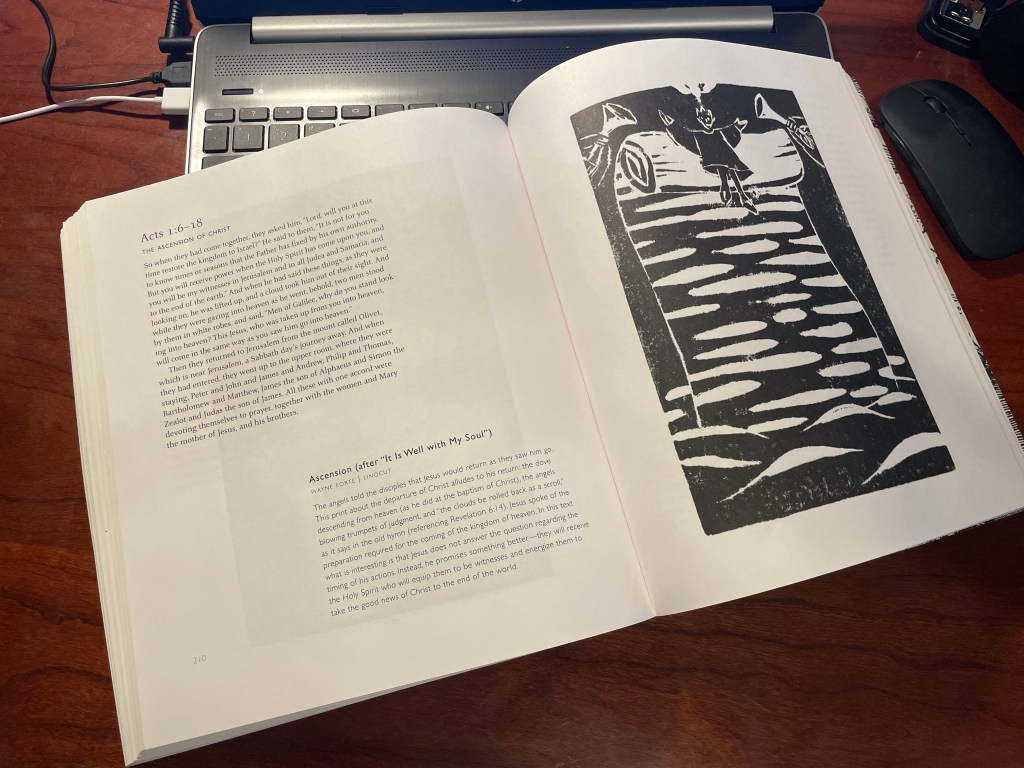
Dear God, as with most of the other pictures I look at from this book, I’ve read the passage (there’s a typo in the book, by the way. The title on the page says it goes through verse 18, but it is really 14), and I have some thoughts. But first I want to take my recent reading of the passage and look to see what the artist, Wayne Forte, put in his image for me to see:
Jesus with his arms open wide
The dove/Holy Spirit above him (I think that’s what it is)
The two angels who speak to the disciples in the story are pictured with trumpets as Jesus ascends.
The unraveling scroll is a bridge. Or is Jesus floating and the scroll is representing Jesus being “The Word?”
Is the scroll transparent and the white marks are clouds?
The white marks below the scroll look like hills (like the hill Jesus ascended from)
Okay, I just read Bustard’s description of the image, and it mentions something I thought about but didn’t say: “This print about the departure of Christ alludes to his return: the dove descending from heaven (as he did at the baptism of Christ), the angels blowing trumpets of judgment, and the ‘clouds be rolled back as a scroll,’ as it says in the old hymn (referencing Revelation 6:14).”
So now back to what I noticed when I read the story for myself.
They were still linking all of this to Israel’s liberation and return to power/glory. That’s really something. That was a concept that was really baked into their psyches. They seemingly couldn’t break free from it. They really, really wanted to overcome being trod upon. Because this was such a big deal to even these close followers of you who knew you intimately, I guess it makes sense that it should be so baked into our collective consciences as well. In our country, we have those who have the power who will do absolutely everything they can to keep it. We also have those who want that power and will do what they can to take it. And it’s nearly all of us. It’s the Christian church, the atheists, the socialists, the right-wing conservatives–everyone. Everyone is going for that power. We want to make sure our country has the most power in the world (economically, militarily, and politically), and we want to make sure our “group” is the one wielding that power, both within the country and outside of it.
Jesus doesn’t admonish them for thinking about the restoration of Israel, but simply says that they’ll never know when.
Jesus goes a different direction and tells them about the Holy Spirit coming. I have to say, there are times when I wonder, given the Trinity, if the three of you aren’t so intertwined that “praying in Jesus’s name” isn’t also “praying in the name of the Holy Spirit and the Father” as well. Hence some denominations start and end their prayers with, “In the name of the Father, the Son, and the Holy Spirit.” When Jesus comes into my heart (as a Baptist would say), is that more accurately represented as the Holy Spirit coming into my heart? Is there a difference?
Jesus sends them to Jerusalem, all of Judea, Samaria (did I hear that right–the Samaritans?), and the ends of the earth (hold it, what?!?).
The angels (I’m assuming they are angels) told them Jesus would return the same way he left (hence Forte’s depiction of a scene that could represent either Jesus’s ascension or return).
The place where they were was only about half a mile (a Sabbath’s day journey) from where they were staying.
The remaining 11 were with other disciples plus Mary, Jesus’s mother, and Jesus’s brothers. The other disciples included women.
They spent a lot of their time in prayer. I wonder what kinds of things they prayed for. Were they following the “Lord’s Prayer” template Jesus taught them? Were they praying for clarity of mission, protection from persecution, and daily provision?
Father, as I think about this, I think the lessons I’m leaving with are that I need to not worry about power/influence (they are idols), not worry about trying to understand you or your plan (ignorance is my ally), and simply worship you, spending time in prayer. Help me to do all of these things. And going back to what I prayed about earlier this week, help me to embrace the tools you have given me to impact the world: prayer, service, persuasion, and suffering.
I pray all of this in the name of the Father, the Son, and the Holy Spirit,
The above image is fromRevealed: A Storybook Bible for Grown-Ups written and compiled by Ned Bustard. The image is called “Esther and the King (after marc Chagall)” and is a combination of two Marc Chagall images done by Bustard.
Before each young woman was taken to the king’s bed, she was given the prescribed twelve months of beauty treatments—six months with oil of myrrh, followed by six months with special perfumes and ointments. When it was time for her to go to the king’s palace, she was given her choice of whatever clothing or jewelry she wanted to take from the harem. That evening she was taken to the king’s private rooms, and the next morning she was brought to the second harem, where the king’s wives lived. There she would be under the care of Shaashgaz, the king’s eunuch in charge of the concubines. She would never go to the king again unless he had especially enjoyed her and requested her by name. Esther was the daughter of Abihail, who was Mordecai’s uncle. (Mordecai had adopted his younger cousin Esther.) When it was Esther’s turn to go to the king, she accepted the advice of Hegai, the eunuch in charge of the harem. She asked for nothing except what he suggested, and she was admired by everyone who saw her. Esther was taken to King Xerxes at the royal palace in early winter of the seventh year of his reign. And the king loved Esther more than any of the other young women. He was so delighted with her that he set the royal crown on her head and declared her queen instead of Vashti. To celebrate the occasion, he gave a great banquet in Esther’s honor for all his nobles and officials, declaring a public holiday for the provinces and giving generous gifts to everyone. Esther 2:12-18
Dear God, I don’t know that I have much to say about the story of Esther in this, but I was thumbing through this book this morning, and I noticed something in Bustard’s image of King Ahasuerus. He looks pensive and unassuming. He looks nervous and gentle. He looks unsure of himself. I haven’t yet read Bustard’s description of his work, but what it makes me think of is a man who, no matter what he looks like on the outside is something totally different on the inside. I guess it’s not common for people, men or women, to be completely transparent and let people see what they are experiencing on the inside. The veneer is too important.
It also makes me think of dogmatic Christians. It finally occurred to me a few months ago that the more confident someone appears that they are right about something–especially theologically, but it applies across topics–the more they are likely unsure about that very thing. For example, if I am the type of person that says every word in the Bible has to be factually accurate then it is likely that my brain needs that to be true because I am afraid everything I believe about you will unravel if it’s not true. So the fact that there are two creation stories in Genesis 1 and Genesis 2 just needs to be ignored. Who was the woman Cain married and where did she come from? I shouldn’t stop and consider that either. When and how did Davis meet Saul? Was it the Goliath story (1 Samuel 17:55) or had he met him before as his harpist (1 Samuel 16:21)?
So now that I’ve pointed the finger at others, how am I like the king in this picture? How am I like the dogmatic Christian whose faith might be more fragile than even they realize? I think the biggest mistake I sometimes make is thinking that I need to understand you to worship you. I need to understand myself completely before I can live effectively for you. Frankly, that’s not what Jesus tells me I need to do. Who are usually the most carefree people? Unless they’ve experienced some sort of trauma, it is children. They don’t understand their parents. They don’t even understand themselves or their motivations. And sure, they aren’t good at loving their neighbors as themselves, but whenever they learn to do it they are happy. And they are happy when they love their parents.
Father, Jesus, Holy Spirit, I don’t even understand how the Trinity of your consubstantial oneness works. But I don’t have to to worship you. The king in this image with Esther is depicted as unsure of himself even though he probably did not physically portray that in his body language. Help me to reduce the facades I have built as much as possible. Not that it’s not appropriate to have some things about me I don’t show others, but for the most part my life is the most useful to you when I am the most transparent. So help me to be that. Forgive me for my pride. For my arrogance. For not loving you and loving others the way I should. Lead me today. Do it all for your glory.
I pray all of them through the mercy afforded to my by Jesus’s blood,
This is a link to Andy Stanley’s interview with John Dickson about Christianity’s impact on history. I recommend the entire interview, but the parts I am referencing start at the 38:50 mark.
Dear God, I just finished listening to this interview Andy Stanley with North Point Community Church did with John Dickson. Apparently, about 15 years ago in Australia, there was a debate between people who think religion has harmed the world (particularly Christianity) and those who thought it had helped the world. In pre- and post-debate surveys, the overwhelming consensus among the attendees was that it had harmed the world. The debate did nothing to move the needle. How sad.
The tools Jesus gave us
I could go on an on about the interview and what he said, but if there is anyone who actually reads these prayers I do to you, I highly recommend listening to the entire interview. With that said, at the 38:50 mark, they start talking about one of his main theses in the book. It is that Jesus gave us a very limited set of tool to use to transform the world around us.
Prayer
Service
Persuasion
Suffering
It feels like the American church today has added influence and power to that list. Why? Because we are afraid, I think. I think we are afraid of not being able to persuade. I think we don’t really believe in our message to the point we can articulate it and offer it to others. No, the easiest thing to do is force them into our way of thinking. To gain power over them. To protect ourselves from them by any earthly means necessary. We have forgotten that we’ve already won the war. Satan might win today’s battle. Someone might harm me in some way because of my beliefs, and I might feel like I lost today. But I have won. I have won in you. I have won my loving you with all of my heart and loving others.
It’s the singer, not the song
The other thing that struck me (to the point of giving me chills) comes at the 43:15 mark. Dickson talks compares Jesus’s Christianity with a genius piece of music, “Bach’s Cello Suite in G Major, Prelude.” Jesus’s Christianity, even more so than Bach’s piece, of course, is perfect. What Jesus aspired us to through faith in him was perfect. It was attractive to humans because it was so good. The problem has been people’s interpretation of it ever since. If Jesus’ Christianity is the song, then Christians are the singer.
Dickson took two cello lessons and then recorded himself trying to play the Bach piece. It was lacking, to say the least. It didn’t communicate the intricate nuances or the beautiful structure Bach wrote. In short, he butchered it. But then he played a professional cellist (maybe Yo Yo Ma, I don’t know) playing it the way it is supposed to be played and the brilliance of the piece is obvious, even to the most novice of listeners.
To quote Mr. Dickson from the interview: “If you have been hurt by the church or by an individual Christian, it’s because Christians haven’t played the melody. It’s not because the melody isn’t beautiful. And I reckon, if you have been hurt by the church, every genuine Christian in this building and watching on would want to say to you straight and look you in the eye and say, “We are sorry. We are sorry that we haven’t loved like Christ loved us. And we beg you, despite our poor performance, to see if you can hear the melody again: ‘Love your enemies.’ ‘Do good to those who hate you.’ ‘Bless those who mistreat you.’ A melody Jesus took all the way to his cross for us.”
Father, Jesus, Holy Spirit, there are times when I want to use more power and influence to expedite me getting my way. Prayer, service, persuasion, and suffering are too slow. But at the end of the day, they are all you gave me. They are the only tool you gave me. And as soon as I start trying to use other tools I start playing notes to a different melody than the Christianity Jesus taught us. I am sorry. Hel me to be patient in your victory and to lean all of the way into prayer, service, persuasion, and suffering as the only melody I try to play for your glory–for your kingdom to come and your will to be done on earth as it is in heaven.
I pray this through Jesus’ name because he taught us how to love you and he gave everything so I could be here this morning,
21 So I find it to be a law that when I want to do right, evil lies close at hand. 22 For I delight in the law of God, in my inner being, 23 but I see in my members another law waging war against the law of my mind and making me captive to the law of sin that dwells in my members. 24 Wretched man that I am! Who will deliver me from this body of death? 25 Thanks be to God through Jesus Christ our Lord! So then, I myself serve the law of God with my mind, but with my flesh I serve the law of sin.
8 There is therefore now no condemnation for those who are in Christ Jesus. 2 For the law of the Spirit of life has set you free in Christ Jesus from the law of sin and death.
35 Who shall separate us from the love of Christ? Shall tribulation, or distress, or persecution, or famine, or nakedness, or danger, or sword? 36 As it is written,
“For your sake we are being killed all the day long; we are regarded as sheep to be slaughtered.”
37 No, in all these things we are more than conquerors through him who loved us. 38 For I am sure that neither death nor life, nor angels nor rulers, nor things present nor things to come, nor powers, 39 nor height nor depth, nor anything else in all creation, will be able to separate us from the love of God in Christ Jesus our Lord.
Romans 7:21-8:2, 35-39
Dear God, this is a complete coincidence and not why I chose this today, but I heard the end of this passage read at a funeral yesterday. So as I think about this passage and Ned Bustard’s artistic interpretation of it through his work Simul Justus et Peccator (At Once Justified and a Sinner), I wonder what there might be for here this morning.
First, here is what I’m noticing about Bustard’s image:
The face in the mirror seems to be a fairly accurate reflection of the face we see outside of the mirror. He didn’t make it look worse that it is.
Bustard’s publishing company is called “Square Halo Books.” Bustard says on his web page, “In Christian art, the square halo identified a living person presumed to be a saint.” So the man in the mirror is presumed to be a saint.
The square halo is not represented in the mirrored image. It is only seen by us, not the man himself.
I seen apple with a bite out of it on the desk. I presume this is original sin.
I see what appears to be a bag of money on the ground, but it is marked with “xxx.” I assume this indicates that they money is more of a problem than a solution.
The man’s head is resting in his hands. It gives the appearance of despair.
The man is frowning and his eyes are sad.
In the mirrored image, the mans clothes have horizontal stripes, making it seem like he feels imprisoned.
I don’t see a significance to it, but the candle on the table seems to be what is illuminating the room.
The man is barefoot and appears to be in his pajamas. This is either at the end of the day or the beginning of the day. He is either regretting his day or dreading his day. There is no optimism in his eyes.
So those are my observations before reading Bustard’s description of the image. Here is what he said: “The print conveys the idea of being both sinful and righteous through symbols from Christian art. The black bird, the Adam’s apple, and the thirty pieces of silver [oh, that’s what the money was supposed to be] represent sin. The candle and mirror are God’s Word. The man is clothed in Christ’s righteousness–in the form of the robe and sash ubiquitous in Sunday school pictures of Jesus [I don’t see the robe and sash]. The square halo indicates that he is a living saint.”
Okay, I have to say that I feel pretty good about the things I noticed. I didn’t the candle and mirror as your Word. I missed the money reference to the 30 pieces of silver Judas received for betraying Jesus. And I still don’t see the robe and sash he mentions. But overall, I think I got it.
So what do I do with it? Well, how do I see myself when I look in the mirror? The truth is, I am as much of a dichotomy as anyone in the world. I am sinful. I am redeemed. I do good. I do bad. I am a living saint. I deserve death, but you have offered me life.
Father, help me to see this for myself today and to see others this way too. Help me to offer them the same benefits of your redemption that you offer me. And may those who see me as a failed man be able to maybe extend some of that mercy as well. Not for my sake as much as for theirs.
I pray all of this through the mercy and grace of Jesus that makes me, of all people, a saint,
8 One day Elisha went on to Shunem, where a wealthy woman lived, who urged him to eat some food. So whenever he passed that way, he would turn in there to eat food. 9 And she said to her husband, “Behold now, I know that this is a holy man of God who is continually passing our way. 10 Let us make a small room on the roof with walls and put there for him a bed, a table, a chair, and a lamp, so that whenever he comes to us, he can go in there.”
11 One day he came there, and he turned into the chamber and rested there. 12 And he said to Gehazi his servant, “Call this Shunammite.” When he had called her, she stood before him. 13 And he said to him, “Say now to her, ‘See, you have taken all this trouble for us; what is to be done for you? Would you have a word spoken on your behalf to the king or to the commander of the army?’” She answered, “I dwell among my own people.” 14 And he said, “What then is to be done for her?” Gehazi answered, “Well, she has no son, and her husband is old.” 15 He said, “Call her.” And when he had called her, she stood in the doorway. 16 And he said, “At this season, about this time next year, you shall embrace a son.” And she said, “No, my lord, O man of God; do not lie to your servant.” 17 But the woman conceived, and she bore a son about that time the following spring, as Elisha had said to her.
18 When the child had grown, he went out one day to his father among the reapers. 19 And he said to his father, “Oh, my head, my head!” The father said to his servant, “Carry him to his mother.” 20 And when he had lifted him and brought him to his mother, the child sat on her lap till noon, and then he died. 21 And she went up and laid him on the bed of the man of God and shut the door behind him and went out. 22 Then she called to her husband and said, “Send me one of the servants and one of the donkeys, that I may quickly go to the man of God and come back again.” 23 And he said, “Why will you go to him today? It is neither new moon nor Sabbath.” She said, “All is well.” 24 Then she saddled the donkey, and she said to her servant, “Urge the animal on; do not slacken the pace for me unless I tell you.” 25 So she set out and came to the man of God at Mount Carmel.
When the man of God saw her coming, he said to Gehazi his servant, “Look, there is the Shunammite. 26 Run at once to meet her and say to her, ‘Is all well with you? Is all well with your husband? Is all well with the child?’” And she answered, “All is well.” 27 And when she came to the mountain to the man of God, she caught hold of his feet. And Gehazi came to push her away. But the man of God said, “Leave her alone, for she is in bitter distress, and the Lord has hidden it from me and has not told me.” 28 Then she said, “Did I ask my lord for a son? Did I not say, ‘Do not deceive me?’” 29 He said to Gehazi, “Tie up your garment and take my staff in your hand and go. If you meet anyone, do not greet him, and if anyone greets you, do not reply. And lay my staff on the face of the child.” 30 Then the mother of the child said, “As the Lord lives and as you yourself live, I will not leave you.” So he arose and followed her. 31 Gehazi went on ahead and laid the staff on the face of the child, but there was no sound or sign of life. Therefore he returned to meet him and told him, “The child has not awakened.”
32 When Elisha came into the house, he saw the child lying dead on his bed. 33 So he went in and shut the door behind the two of them and prayed to the Lord. 34 Then he went up and lay on the child, putting his mouth on his mouth, his eyes on his eyes, and his hands on his hands. And as he stretched himself upon him, the flesh of the child became warm. 35 Then he got up again and walked once back and forth in the house, and went up and stretched himself upon him. The child sneezed seven times, and the child opened his eyes. 36 Then he summoned Gehazi and said, “Call this Shunammite.” So he called her. And when she came to him, he said, “Pick up your son.” 37 She came and fell at his feet, bowing to the ground. Then she picked up her son and went out.
2 Kings 4:8-37
Dear God, this is an interesting story. It’s interesting because it happened. It’s interesting because it happened the way it happened (a child was given as a “gift”–I suppose–to a couple that didn’t ask for him dies and then is resurrected). It is also interesting because it was recorded for us to know these thousands of years later. Why?
As I’ve thought about this since this morning when I first read it, I think the idea I’ve finally come to is that you used this child in the lives of this couple the same way you use children for parent or person who raises them. You change them through this child. In this case, I think even Elisha didn’t know what you were up to. Gehazi didn’t either. They thought they were giving her and her husband a child. This wonderful gift of joy and love. What they were really doing was giving this couple the gift of refinement. You used this child to refine them and make them even more your children. You also used it to impact Elisha’s life as well. This child changed everyone he touched. I guess every child does to some extent or another.
I had lunch just two days ago with a dear man who lost his 11-year-old girl to leukemia just 10 months ago. It’s tragic. He commented that it was easier to go through the strain of fighting the leukemia than it is to endure this loss. This man and his wife are people are great faith. They love you. What could possibly come from this?
Then there’s the mourning process. I go back to the Garth Brooks song “The Dance” that I’ve talked about a few times with you before. I still can’t hear that song without tears coming to my eyes.
The chorus is actually in the thumbnail of the YouTube video I just linked to. It says it all. If they’d have known the pain in store for them with this child, they might have been tempted to avoid it. To not experience it. But if they’d have missed that opportunity, they’d have missed “the dance” they had with their little girl.
I’ve sung this song for myself over pain I’ve experienced. Nothing like theirs. Nothing even close. But I’ve had pain that I would love to have removed. This pain still stays with me every day. But I’m glad I never had the chance to even consider making the decision about whether or not to avoid the path that brought me here because that path shaped me in its good times, and it is shaping me now. The question is, how will I move forward and enable that pain to shape me even now?
Father, I wish I could take my friend and his wife’s pain away. All I know to pray now is that, if this pain must be experienced, then please make it count. It hurts too much for it to be wasted. This much pain should somehow, ultimately, maybe even in ways they will never see, produce some kind of way for your kingdom to come and your will to be done on this earth as it is in heaven. Holy Spirit, please sit close this couple, even in this very moment. Help them to feel the Spirit of the Lord. Help them to feel you in your role as counselor, comforter, and even healer. Flow through them into their children. Flow through them into this world that seems intent on running from you. And do the same for my wife and me. Don’t let our pain be wasted. Don’t let the pain the ones we love are experiencing be wasted either. Oh, Lord. My heart is heavy for me, but it is heavier right now for this couple. Holy Spirit, like I prayed for the couple in our town who lost their son to suicide a few months ago, please moan for us in words that are too deep for understanding. Pray for us to the Father. Jesus, touch this couple. Fill them with your peace.
I pray all of this through the grace of Jesus and with the power of the Holy Spirit,



 Emails to God