RSS

Category Archives: Matthew

Passion Week – Cleansing the Temple: Matthew 21:12-17


The image above is from Revealed: A Storybook Bible for Grown-Ups by Ned Bustard. The image was created by Albrecht Durer and is called “Christ Driving the Moneylenders from the Temple.”

Matthew 21:12-17

And Jesus entered the temple and drove out all who sold and bought in the temple, and he overturned the tables of the money-changers and the seats of those who sold pigeons. He said to them, “It is written, ‘My house shall be called a house of prayer,’ but you make it a den of robbers.” And the blind and the lame came to him in the temple, and he healed them. But when the chief priests and the scribes saw the wonderful things that he did, and the children crying out in the temple, “Hosanna to the Son of David!” they were indignant, and they said to him, “Do you hear what these are saying?” And Jesus said to them, “Yes; have you never read, “‘Out of the mouth of infants and nursing babies you have prepared praise’?” And leaving them, he went out of the city to Bethany and lodged there.

Dear God, I’ve read this story and heard about this story so many times that it can be hard to come at it fresh. But this image from Mr. Durer helps a little. There are some striking things about it:

  • Jesus is holding a whip. It’s different than the one that will be used on him later in the week, but it’s interesting to see a violent Jesus. Is there a time and a place for violence?
  • The man on the ground seems to be knocked out or incapacitated in some way. I know this is just the artist’s rendition, but it’s an interesting thought as to what extent of physical damage Jesus did.
  • There is a man holding a lamb. People were there to get what they needed for the Passover. Jesus would become their lamb. In fact, in reality, there would become no need for these things again. It makes me wonder what the disciples did for the Passover in the y ears to come. Did they still follow all of the Jewish rituals? I’ll be they did.
  • I think I see a Pharisee’s hat way in the background on the right.
  • Jesus is very heavily clothed. I don’t normally picture him with that much clothing.
  • The artist decided that Jesus was right-handed. I wonder if he really was.

Here i what the author of the book had to say about this image:

in contrast to Late Gothic depictions of a delicate or fragile Christ, in this piece, Durer created an intense, militant, and manly Christ. A modern Jesus would politely ask the money changers to leave. But that is not the Jesus of Scripture. He forcefully drives the money changers out, overturning tables and throwing seats. Jesus acts in this audacious manner because he knows he owns the temple. He is defending his place in the same way a home owner would defend his own house. Jesus is violent, defiant, and takes into his own hands the removal of those who desecrate the temple. This work was part of a larger series of prints called The Small Passion, and was quite relevant to the time. A Christ who as fighting for holiness rang true with young Reformers.

I guess the thing that I would also add is that this is the beginning of a violent week. Jesus is very intense in his emotion and his passion (little “p”). He only has a little bit of time left and there isn’t any to waste.

Father, help me to not grieve you the way these moneychangers grieved you. As I raise money for a nonprofit, help me to aspire to the best parts of philanthropy and not manipulate people for my own purposes. During this Passion Week, help me to be very mindful of who you are, what you did, and what that means to me today. Help me to worship you well and follow your leading.

In Jesus’s name I pray,

Amen


Tags: , , , ,

Passion Week – The Triumphal Entry: Matthew 21:1-11; Mark 11:1-11; Luke 19:28-44; John 12:12-16

The image above is from Revealed: A Storybook Bible for Grown-Ups by Ned Bustard. The image is called “The Triumphal Entry” and was created by Diego Jourdan Pereira.

Matthew 21:1-11

As Jesus and the disciples approached Jerusalem, they came to the town of Bethphage on the Mount of Olives. Jesus sent two of them on ahead. “Go into the village over there,” he said. “As soon as you enter it, you will see a donkey tied there, with its colt beside it. Untie them and bring them to me. If anyone asks what you are doing, just say, ‘The Lord needs them,’ and he will immediately let you take them.” This took place to fulfill the prophecy that said, “Tell the people of Jerusalem, ‘Look, your King is coming to you. He is humble, riding on a donkey— riding on a donkey’s colt.’” The two disciples did as Jesus commanded. They brought the donkey and the colt to him and threw their garments over the colt, and he sat on it. Most of the crowd spread their garments on the road ahead of him, and others cut branches from the trees and spread them on the road. Jesus was in the center of the procession, and the people all around him were shouting, “Praise God for the Son of David! Blessings on the one who comes in the name of the Lord! Praise God in highest heaven!” The entire city of Jerusalem was in an uproar as he entered. “Who is this?” they asked. And the crowds replied, “It’s Jesus, the prophet from Nazareth in Galilee.”

Mark 11:1-11

As Jesus and his disciples approached Jerusalem, they came to the towns of Bethphage and Bethany on the Mount of Olives. Jesus sent two of them on ahead. “Go into that village over there,” he told them. “As soon as you enter it, you will see a young donkey tied there that no one has ever ridden. Untie it and bring it here. If anyone asks, ‘What are you doing?’ just say, ‘The Lord needs it and will return it soon.’” The two disciples left and found the colt standing in the street, tied outside the front door. As they were untying it, some bystanders demanded, “What are you doing, untying that colt?” They said what Jesus had told them to say, and they were permitted to take it. Then they brought the colt to Jesus and threw their garments over it, and he sat on it. Many in the crowd spread their garments on the road ahead of him, and others spread leafy branches they had cut in the fields. Jesus was in the center of the procession, and the people all around him were shouting, “Praise God! Blessings on the one who comes in the name of the Lord! Blessings on the coming Kingdom of our ancestor David! Praise God in highest heaven!” So Jesus came to Jerusalem and went into the Temple. After looking around carefully at everything, he left because it was late in the afternoon. Then he returned to Bethany with the twelve disciples.

Luke 19:28-44

After telling this story, Jesus went on toward Jerusalem, walking ahead of his disciples. As he came to the towns of Bethphage and Bethany on the Mount of Olives, he sent two disciples ahead. “Go into that village over there,” he told them. “As you enter it, you will see a young donkey tied there that no one has ever ridden. Untie it and bring it here. If anyone asks, ‘Why are you untying that colt?’ just say, ‘The Lord needs it.’” So they went and found the colt, just as Jesus had said. And sure enough, as they were untying it, the owners asked them, “Why are you untying that colt?” And the disciples simply replied, “The Lord needs it.” So they brought the colt to Jesus and threw their garments over it for him to ride on. As he rode along, the crowds spread out their garments on the road ahead of him. When he reached the place where the road started down the Mount of Olives, all of his followers began to shout and sing as they walked along, praising God for all the wonderful miracles they had seen. “Blessings on the King who comes in the name of the Lord! Peace in heaven, and glory in highest heaven!” But some of the Pharisees among the crowd said, “Teacher, rebuke your followers for saying things like that!” He replied, “If they kept quiet, the stones along the road would burst into cheers!” But as he came closer to Jerusalem and saw the city ahead, he began to weep. “How I wish today that you of all people would understand the way to peace. But now it is too late, and peace is hidden from your eyes. Before long your enemies will build ramparts against your walls and encircle you and close in on you from every side. They will crush you into the ground, and your children with you. Your enemies will not leave a single stone in place, because you did not recognize it when God visited you.”

John 12:12-16

The next day, the news that Jesus was on the way to Jerusalem swept through the city. A large crowd of Passover visitors took palm branches and went down the road to meet him. They shouted, “Praise God! Blessings on the one who comes in the name of the Lord! Hail to the King of Israel!” Jesus found a young donkey and rode on it, fulfilling the prophecy that said: Do not be afraid, O Daughter of Zion; see your king is coming, seated on a donkey’s cold.” His disciples didn’t understand at the time that this was a fulfillment of prophecy. But after Jesus entered into his glory, they remembered what had happened and realized that these things had been written about him.

Dear God, I want to spend some time with the Triumphal Entry today. It is Palm Sunday after all. My wife and I went to a special church service this morning where a man who is with “Jews for Jesus” came to walk the congregation through the different parts of the Passover meal. So now, as we enter Passion Week, I want to take some time to really sit with this week in a different way than I ever have before. Of course, that starts with Revealed: A Storybook Bible for Grown-Ups and what I’ve been getting out of the different artists’ interpretations of the stories.

So here I am with the Triumphal Entry. The first thing I did was look to confirm that the story shows up in all four Gospels. It does, although John seems to have a different focus than the other three. The first three give a lot more backstory, but John focuses on the crowds, the excitement, how the prophecy angle impacted the disciples after it was all said and done, and the Lazarus connection (remembering that one John gives us the Lazarus resurrection story).

So what did Diego Jourdan Pereira notice in this story? First, this image is a little difficult for a left-brained person like me to decipher. It’s hard to tell what I’m seeing here. I see the donkey with its head down. I see Jesus, who appears to have his head down. Are those lines in the background palm branches? I ended up having to go to the commentary on this piece a little sooner than I like. Here’s what Ned Bustard said about the piece, including a quote from the artist:

According to Jewish tradition the glory of God appeared through the Beautiful Gate and will appear again when the Messiah comes (Ezekiel 44:1-3). And it is said that Jesus entered through this gate on Palm Sunday. But the gate, disciples, crowds, cloaks, palm branches, and hosannas are all missing from this depiction of the Triumphal Entry. All that remains is a downcast donkey and a sorrowful Jesus. The artist explains, “The more I thought about it, the more it seemed to me that while everyone else was celebrating around him, Christ’s mind was elsewhere. He was thinking about the destruction of Jerusalem and his own impending fate on the Cross. His tears are internal as well as external.” But Jesus would not turn aside from the path. Luke 9:51 says, “When the days drew near for him to be taken up, he set his face to go to Jerusalem.”

I’m having so many thoughts, it’s hard to sort through them. I guess my day started with a revelation that might have been more obvious to other Christians–you intentionally made Jesus’s crucifixion and resurrection part of Passover. Jesus could have been killed any time and in any way, but your plan was to have his death and resurrection exactly coincide with the Passover celebration in Jerusalem that year. Why had I never thought of that? I guess I can be a little dense.

Then I have the thought from Luke 9 that Bustard brings out in the end of his description–that Jesus “set his face to go to Jerusalem.” We’ll see the emotions of Jesus play out over the next few days. In fact, he probably shows more emotion during this week than he does in the rest of the stories about him. He clears the temple out of anger. He curses a fig tree. He sweats blood. But when it comes down to it, he didn’t have to do this. He could have bailed, except for the fact that he was following your will, and your will was for him to walk this path. He was to be our Passover lamb.

Father, hep me to sink into this week. Help me to spend this week worshipping you–every aspect of you. You are GREAT and yet you are humble. You are all powerful, yet you are sacrificially loving. You can look through the screaming crowds of the Triumphal Entry and see the wickedness in each of us, and yet you proceed. You knew better than to believe the love you were getting from the crowd. You knew that some would turn on you and some would simply disappear. The more I sit with these ideas the more humbled and thankful I am.

In Jesus’ name I pray,

Amen


Tags: , ,

Matthew 20:17-19

Matthew 20:17-19 [NLT]
17 As Jesus was going up to Jerusalem, he took the twelve disciples aside privately and told them what was going to happen to him. 18 “Listen,” he said, “we’re going up to Jerusalem, where the Son of Man[a] will be betrayed to the leading priests and the teachers of religious law. They will sentence him to die. 19 Then they will hand him over to the Romans to be mocked, flogged with a whip, and crucified. But on the third day he will be raised from the dead.”

Dear God, the biggest thing I think of when it comes to passages like this is that, on the rare occasions when you give us insights into the future (and they are very rare), they are more about comforting and reassuring us than they are about letting us in on the secret. In this case, the disciples didn’t have to know this information in order for it to all happen. In fact, their response to this knowledge might have gotten in the way. But the reason you NEEDED them to know was that you knew that they would need to be able to remember back to these moments and realize that this was part of the plan all along. Twenty or 30 years down the road, as Matthew thought back on this and put pen to paper, he could be assured that this was all okay.

I can’t say that I’ve gotten a lot of words of prophecy from you. One of my many one-liners is that you keep me on a need-to-know basis and I very rarely need to know. But I can almost always look back on events in my life and see your providence, even when, at the time, I felt like all was lost. I have had some trials (no worse than anyone else’s to be sure), but I can almost always look back on them after a good amount of time and see what you were doing for me, for those I love, or within me to grow me into a place where you need me to be.

Father, thank you for your patience with me. There’s a Keith and Melody Green song called “Make My Life A Prayer To You.” In it, there’s a line that says, “I want to thank you now for being patient with me. It’s so hard to see when my eyes are on me. So I guess I’ll have to trust and just believe what you say. Lord, you’re coming again. Coming to take me away.” So to finish this prayer with the chorus of that song, “Make my life a prayer to you. I want to do what you want me to . No empty words and no white lies. No token prayers. No compromise. I want to shine the light you gave through your son you sent to save us from our self and our despair. It comforts me to know you’re really there.”

In Jesus’ name I pray,

Amen

 
Leave a comment

Posted by on April 2, 2019 in Hymns and Songs, Matthew


Tags: , , , ,

Matthew 6:9-13

Matthew 6:9-13 [NLT]
9 Pray like this:

Our Father in heaven,
may your name be kept holy.
10 May your Kingdom come soon.
May your will be done on earth,
as it is in heaven.
11 Give us today the food we need,
12 and forgive us our sins,
as we have forgiven those who sin against us.
13 And don’t let us yield to temptation,
but rescue us from the evil one.

Dear God, it’s interesting to compare the different Bible translations for the Lord’s Prayer. Subtle word changes can make a difference. I normally use either the New Living Translation or the New American Standard. In this case, I’ve put the NLT above.

I want to start this by putting some other versions below. Let’s start with the one a lot of us know by heart–the King James Version:

King James Version

9 After this manner therefore pray ye:
Our Father which art in heaven, Hallowed be thy name.
10 Thy kingdom come, Thy will be done in earth, as it is in heaven.
11 Give us this day our daily bread.
12 And forgive us our debts, as we forgive our debtors.
13 And lead us not into temptation, but deliver us from evil: For thine is the kingdom, and the power, and the glory, for ever. Amen.

Then I want to look at the most popular version when I was a kid, the NIV:

New International Version

9 “This, then, is how you should pray:

“‘Our Father in heaven,
hallowed be your name,
10 your kingdom come,
your will be done,
on earth as it is in heaven.
11 Give us today our daily bread.
12 And forgive us our debts,
as we also have forgiven our debtors.
13 And lead us not into temptation,
but deliver us from the evil one.

And finally, for some variety, The Message:

The Message

With a God like this loving you, you can pray very simply. Like this:

Our Father in heaven,
Reveal who you are.
Set the world right;
Do what’s best—
as above, so below.
Keep us alive with three square meals.
Keep us forgiven with you and forgiving others.
Keep us safe from ourselves and the Devil.
You’re in charge!
You can do anything you want!
You’re ablaze in beauty!
Yes. Yes. Yes.

A couple of interesting things. First, for whatever reason, the KJV adds “for thine is the kingdom and the power and the glory, forever.” Where did that come from? Not that I disagree, but the others don’t have that at all.

I also think The Message is a radical departure from the others, and I don’t like it. I think Mr. Peterson changed too much to make it contemporary. Having tried to take some old English texts and translate them into modern English, I can appreciate how hard this is. That being said, I think he went too far afield from what is meant.

The part about “trespasses,” “debts,” and “sins” is interesting. Of course, most of us learned trespasses, but I never understood that as a child. I had a pastor in middle school and high school that used “sins.” I like that better.

With all of that said, when I am in church and saying the prayer, here is what I say. And I pray this to you now:

My Father, who is in Heaven
Hallowed (I’ve never found a better word than that) be your name
Your kingdom come, your will be done
On Earth as it is in Heaven
Give me this day my daily bread
And forgive me of my sins,
As I forgive those who sin against me
And lead me not into temptation,
But deliver me from evil
For the kingdom, the power, and the glory are yours
Now and forever.

I pray all of this by the power of the blood of the man, your son, who taught me to pray it,

Amen

 
1 Comment

Posted by on March 12, 2019 in Matthew


Tags: , , , ,

The Temptation of Christ — Matthew 4:1-4

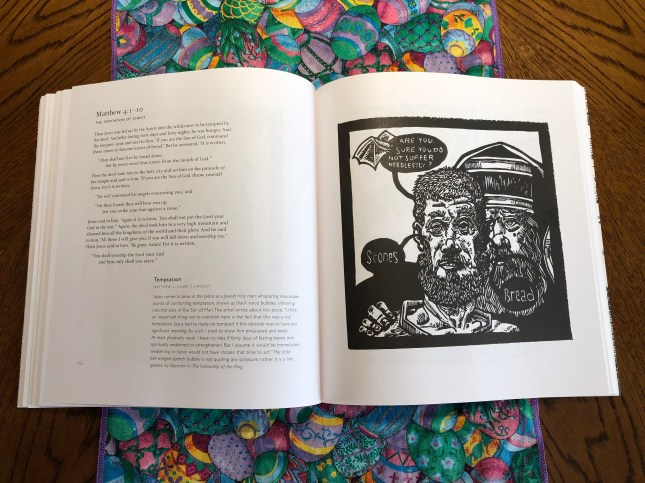
IMG_1704
This image is from Revealed: A Storybook Bible for Grown-Ups by Ned Bustard. The image was created by Matthew L. Clark.

Matthew 4:1-4
1 Then Jesus was led by the Spirit into the wilderness to be tempted there by the devil. 2 For forty days and forty nights he fasted and became very hungry.
3 During that time the devil came and said to him, “If you are the Son of God, tell these stones to become loaves of bread.”
4 But Jesus told him, “No! The Scriptures say,
‘People do not live by bread alone,
but by every word that comes from the mouth of God.’”


Dear God, I might or might not have noticed this before, but this morning what strikes me about this passage is the fact that the Spirit appears to Jesus in the form of a dove at his baptism, and then it is the Spirit that leads him into the wilderness to be tempted. You didn’t shield him from temptation. You actually led him into it so that he could learn and be stronger.

That’s one of the hardest things to understand as a parent. Where is the line between protecting our child and getting in the way of the lessons they need to learn for later in life? And it changes with every age. There are the early stages when they reach for an electrical outlet and we physically prevent it because they cannot understand. Then there is the phase where we warn them with words, but sometimes they disobey us and get hurt anyway. And then there are the times when they are adults that we offer them our love, but we also offer them tough love and truth (not that tough love isn’t appropriate during the earlier parts as well).

In the spirit of looking at the art that Ned Bustard put with these Bible stories in Revealed: A Storybook Bible for Grown-ups, I want to spend some time with the artist who did a piece about this picture and see what he/she noticed that I might have missed or interpreted differently. In this case, Matthew L. Clark did this piece called “Temptation.”

So what do I notice in this piece?

  • Jesus looks pretty haggard. I’m not sure that I’ve ever thought about what he would look like after being in the wilderness for 40 days with no food, but I suppose he wouldn’t have looked like the pretty pictures of him I saw in Sunday school. This is a good point by the artist.
  • This image focuses only on the first temptation. The first words at the top are not explicitly said by Satan, but they carry that feeling of self pity that we all get from time to time. Self pity is the root of a lot of sin. “I have the right.” “I deserve better.” “How dare you?!?” In this case, Clark is suggesting that part of Jesus’ temptation is the idea that he might be questioning what all of this is for. “Why did the Spirit lead me out here for 40 days to do this?” “Is this suffering necessary?”
  • The words “Stones” and “Bread” set the stage for the temptation Clark is addressing. It’s hunger, but he is also suggesting in the first one that it’s also about doubting you and doubting the Spirit.
  • I couldn’t tell what the image is at the top of the top speech bubble. In the description, it is apparently batwings. It is to indicate that this is not scripture. Clark says he took the line from Boromir in The Fellowship of the Ring.
  • I wondered what Satan is wearing in the picture. Is he a king? Again, thankfully, Clark gives us an explanation. He has Satan appearing to tempt Jesus as a Jewish holy man. Someone whom he should trust. How many times have I been led astray by those I trusted? How many times have I led others astray who trusted me

Finally, here is what Clark has to say about his piece:

I think an important thing not to overlook here is the fact that this was a real temptation. Jesus had to really be tempted if this episode was to have any significant meaning. As such, I tried to show him emaciated and weak. At least physically weak. I have no idea if forty days of fasting leaves one spiritually weakened or strengthened. But I assume it would be immediately weakening or Satan would not have chosen that time to act.”

Father, I will face temptations today. Help me to recognize them when they come. Help me to renounce self pity and embrace the work you have given me to do today. Guide my heart into the channel of your will for me regardless of its benefits or costs to me. And help me to know how to parent my grown children. Help me to not do anything that will get in the way of what you are trying to do in their lives. Love them richly. Love my wife as well and help me to know how you need me to love her. Again, do all of this for your glory, your plan, and so that your will and kingdom will come to earth.

In Jesus’ name I pray,

Amen


Tags: , , , , ,

Matthew 6:1-6

Matthew 6:1-6 [NLT]
1 “Watch out! Don’t do your good deeds publicly, to be admired by others, for you will lose the reward from your Father in heaven. 2 When you give to someone in need, don’t do as the hypocrites do—blowing trumpets in the synagogues and streets to call attention to their acts of charity! I tell you the truth, they have received all the reward they will ever get. 3 But when you give to someone in need, don’t let your left hand know what your right hand is doing. 4 Give your gifts in private, and your Father, who sees everything, will reward you.
5 “When you pray, don’t be like the hypocrites who love to pray publicly on street corners and in the synagogues where everyone can see them. I tell you the truth, that is all the reward they will ever get. 6 But when you pray, go away by yourself, shut the door behind you, and pray to your Father in private. Then your Father, who sees everything, will reward you.

Dear God, every time I have ever journaled on this passage, it has always been weird for me because I am doing it through a public prayer journal. I’ll admit that there are times when I stop and check my spirit to see if I am doing this for the approval of others or for their encouragement. I THINK it’s the latter. I certainly hope and pray that that is the case.

Another thing as a nonprofit that solicits donations from people is how I treat those donations, and what kinds of motivations I give to people for giving to our agency. The same is true for my wife and me and how we do our giving. Personally, I think it is a positive for the nonprofit when they put someone’s name on a donor list because it is like an endorsement from that donor that says that the donor believes enough in the organization to give money to it. When my wife and I give to a nonprofit, I certainly want that nonprofit to use my gift to its maximum effectiveness, and I think part of that is listing somewhere that I am a donor to them.

Now I am uncomfortable with getting into “donor levels.” One thing I’ve done in the past is asked a nonprofit that separates donations by size in their listings to list my wife and I in the lowest category regardless of how much we gave. I don’t want it to necessarily be known how much I gave, but I do want people to know that we support that nonprofit.

Father, I guess it all comes down to motives and why I do this. I’ll confess that I look at the statistics for this blog and look to see how many visits it gets. I can imagine that it would become a real ego problem for me if I felt like the people reading it knew who I was, but I am usually as anonymous to them as they are to me. But I do pray that the posting of these prayer journals is a witness to others. I pray that they will see the importance of spending time in scripture and prayer. I pray that they will be encouraged by the honest prayers of someone who is just trying to figure out my path by holding your hand through the bad times and the good. I pray that they will also be drawn into spending their own time meditating on scripture and seeking you with all of their strength, heart, mind, and soul.

In Jesus’ name I pray,

Amen


Leave a comment

Posted by on March 6, 2019 in Matthew


The Baptism of Christ — Matthew 3:1-2, 11-17

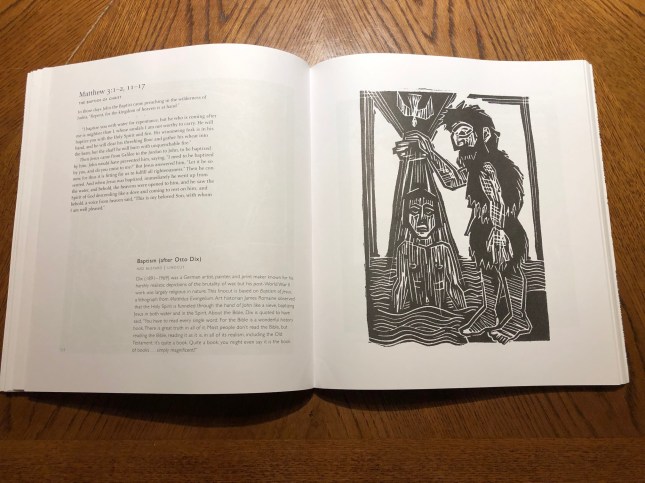
IMG_1695
The image above is from Revealed: A Storybook Bible for Grown-ups by Ned Bustard. While not all of the images in the book were created by Bustard, this one happens to be. It is called “Baptism (after Otto Dix).”

Matthew 3:1-2, 11-17
1 In those days John the Baptist came to the Judean wilderness and began preaching. His message was, 2 “Repent of your sins and turn to God, for the Kingdom of Heaven is near.”

11 “I baptize with[a] water those who repent of their sins and turn to God. But someone is coming soon who is greater than I am—so much greater that I’m not worthy even to be his slave and carry his sandals. He will baptize you with the Holy Spirit and with fire. 12 He is ready to separate the chaff from the wheat with his winnowing fork. Then he will clean up the threshing area, gathering the wheat into his barn but burning the chaff with never-ending fire.”
13 Then Jesus went from Galilee to the Jordan River to be baptized by John. 14 But John tried to talk him out of it. “I am the one who needs to be baptized by you,” he said, “so why are you coming to me?”
15 But Jesus said, “It should be done, for we must carry out all that God requires.” So John agreed to baptize him.
16 After his baptism, as Jesus came up out of the water, the heavens were opened[d] and he saw the Spirit of God descending like a dove and settling on him. 17 And a voice from heaven said, “This is my dearly loved Son, who brings me great joy.”

Dear God, when I think about this story it always makes me wonder where baptism came from and why it all of a sudden appeared with John. And why did Jesus need to be baptized? It’s really interesting.

But today isn’t about wrestling with that question. The point of this series is to take an artist’s interpretation of this story and see if there is something she or he saw that I missed. In this case, Ned Bustard (and Matthäus Evangelium) did some interesting things that I’m noticing here:

  • The first thing I noticed was that the Holy Spirit, as represented by a dove, seems to be funneling through the water in John’s hand. The image makes me think about your Holy Spirit entering the world through us through our baptism.
  • John is wearing his trademark animal skins for clothes. No shoes, of course, but that leads me to the next point.
  • He is not in the water with Jesus. It would have been easy for the artist to put John in the water with Jesus, but John is intentionally drawn as standing on dry land. I’m not sure how to interpret this except to say that this baptism is all about Jesus.
  • Visually, the artist depicted John as being completely dry. The lines that make up his body run in every direction. Up, down, crisscross, diagonally, etc. On the other hand, Jesus is drawn under the water  as represented by the water flowing over him. Except for his specific facial features, nipples, abdomen, and belly button, everything else is drawn vertically and seems to represent the water flowing over him.
  • John is just using his hand and seems to be getting a lot of water to pour from that method. This again leads me back to the idea that there is more than just water flowing over Jesus, but it is your Holy Spirit flowing through the water that is pouring from John’s hand.
  • Jesus’ face looks sad, and John looks very serious. I don’t know why the artist chose these facial expressions. Perhaps the artist was thinking about what was about to come in Jesus’ live over the next 40 days?
  • Jesus is clean-shaven with a nice haircut, and John has long hair and a beard. This certainly shows a difference in the style of the two men.

I intentionally didn’t read Bustard’s description of this piece until after I had gone through this exercise. Here is what he had to say about it:

Baptism (after Otto Dix)

Dix (1891-1969) was a German artist, painter, and print maker know for his harshly realistic depictions of the brutality of war; but his post-World War II work was largely religious in nature. This linocut is based on Baptism of Jesus, a lithograph from Matthäus Evangelium. Art historian James Romaine observed that the Holy Spirit is funneled through the hand of John like a sieve, baptizing Jesus in both water and in the Spirit. About the Bible, Dix is quoted to have said, “You have to read every single word. For the Bible is a wonderful history book. There is great truth in all of it. Most people don’t read the Bible, but reading the Bile, reading it as it is, in all of its realism, including the Old Testament: It’s quite a book. Quite a book, you even say it is the book of books…simply magnificent!”

5950-2

Reading Bustards description reminded me of something I noticed, but forgot to mention. I am a believer in both the baptism by water and the baptism in the Holy Spirit. I think there is good evidence for it in not only the book of Acts, but in my life as well. This image shows that both water and the Holy Spirit were involved in Jesus’ baptism, with Bustard’s interpretation making that point a little more obvious than the original.

Father, help me to remember today that I am covered in your water, in your Holy Spirit, and in Jesus’ redeeming blood. Help me to remember that I am not only covered by these things, but filled with them as well. I am no longer my own. I am a new creation. The old has gone and the new has come. Help me to remember that.

In Jesus’ name I pray,

Amen


Tags: , , , ,

Joseph of Nazareth

Matthew 1:18-25 [NLT]
18 This is how Jesus the Messiah was born. His mother, Mary, was engaged to be married to Joseph. But before the marriage took place, while she was still a virgin, she became pregnant through the power of the Holy Spirit. 19 Joseph, to whom she was engaged, was a righteous man and did not want to disgrace her publicly, so he decided to break the engagement quietly.
20 As he considered this, an angel of the Lord appeared to him in a dream. “Joseph, son of David,” the angel said, “do not be afraid to take Mary as your wife. For the child within her was conceived by the Holy Spirit. 21 And she will have a son, and you are to name him Jesus, for he will save his people from their sins.”
22 All of this occurred to fulfill the Lord’s message through his prophet:
23
“Look! The virgin will conceive a child!
She will give birth to a son,
and they will call him Immanuel,
which means ‘God is with us.’”
24 When Joseph woke up, he did as the angel of the Lord commanded and took Mary as his wife. 25 But he did not have sexual relations with her until her son was born. And Joseph named him Jesus.

Matthew 2:13-15 [NLT]
13 After the wise men were gone, an angel of the Lord appeared to Joseph in a dream. “Get up! Flee to Egypt with the child and his mother,” the angel said. “Stay there until I tell you to return, because Herod is going to search for the child to kill him.”
14 That night Joseph left for Egypt with the child and Mary, his mother, 15 and they stayed there until Herod’s death. This fulfilled what the Lord had spoken through the prophet: “I called my Son out of Egypt.”

Luke 1:26-28 [NLT]
26 In the sixth month of Elizabeth’s pregnancy, God sent the angel Gabriel to Nazareth, a village in Galilee, 27 to a virgin named Mary. She was engaged to be married to a man named Joseph, a descendant of King David. 28 Gabriel appeared to her and said, “Greetings, favored woman! The Lord is with you!”

Luke 2 [NLT]
2 At that time the Roman emperor, Augustus, decreed that a census should be taken throughout the Roman Empire. 2 (This was the first census taken when Quirinius was governor of Syria.) 3 All returned to their own ancestral towns to register for this census. 4 And because Joseph was a descendant of King David, he had to go to Bethlehem in Judea, David’s ancient home. He traveled there from the village of Nazareth in Galilee. 5 He took with him Mary, to whom he was engaged, who was now expecting a child.
6 And while they were there, the time came for her baby to be born. 7 She gave birth to her firstborn son. She wrapped him snugly in strips of cloth and laid him in a manger, because there was no lodging available for them.
The Shepherds and Angels
8 That night there were shepherds staying in the fields nearby, guarding their flocks of sheep. 9 Suddenly, an angel of the Lord appeared among them, and the radiance of the Lord’s glory surrounded them. They were terrified, 10 but the angel reassured them. “Don’t be afraid!” he said. “I bring you good news that will bring great joy to all people. 11 The Savior—yes, the Messiah, the Lord—has been born today in Bethlehem, the city of David! 12 And you will recognize him by this sign: You will find a baby wrapped snugly in strips of cloth, lying in a manger.”
13 Suddenly, the angel was joined by a vast host of others—the armies of heaven—praising God and saying,
14
“Glory to God in highest heaven,
and peace on earth to those with whom God is pleased.”
15 When the angels had returned to heaven, the shepherds said to each other, “Let’s go to Bethlehem! Let’s see this thing that has happened, which the Lord has told us about.”
16 They hurried to the village and found Mary and Joseph. And there was the baby, lying in the manger. 17 After seeing him, the shepherds told everyone what had happened and what the angel had said to them about this child. 18 All who heard the shepherds’ story were astonished, 19 but Mary kept all these things in her heart and thought about them often. 20 The shepherds went back to their flocks, glorifying and praising God for all they had heard and seen. It was just as the angel had told them.
Jesus Is Presented in the Temple
21 Eight days later, when the baby was circumcised, he was named Jesus, the name given him by the angel even before he was conceived.
22 Then it was time for their purification offering, as required by the law of Moses after the birth of a child; so his parents took him to Jerusalem to present him to the Lord. 23 The law of the Lord says, “If a woman’s first child is a boy, he must be dedicated to the Lord.” 24 So they offered the sacrifice required in the law of the Lord—“either a pair of turtledoves or two young pigeons.”
The Prophecy of Simeon
25 At that time there was a man in Jerusalem named Simeon. He was righteous and devout and was eagerly waiting for the Messiah to come and rescue Israel. The Holy Spirit was upon him 26 and had revealed to him that he would not die until he had seen the Lord’s Messiah. 27 That day the Spirit led him to the Temple. So when Mary and Joseph came to present the baby Jesus to the Lord as the law required, 28 Simeon was there. He took the child in his arms and praised God, saying,
29
“Sovereign Lord, now let your servant die in peace,
as you have promised.
30
I have seen your salvation,
31
which you have prepared for all people.
32
He is a light to reveal God to the nations,
and he is the glory of your people Israel!”
33 Jesus’ parents were amazed at what was being said about him. 34 Then Simeon blessed them, and he said to Mary, the baby’s mother, “This child is destined to cause many in Israel to fall, and many others to rise. He has been sent as a sign from God, but many will oppose him. 35 As a result, the deepest thoughts of many hearts will be revealed. And a sword will pierce your very soul.”
The Prophecy of Anna
36 Anna, a prophet, was also there in the Temple. She was the daughter of Phanuel from the tribe of Asher, and she was very old. Her husband died when they had been married only seven years. 37 Then she lived as a widow to the age of eighty-four. She never left the Temple but stayed there day and night, worshiping God with fasting and prayer. 38 She came along just as Simeon was talking with Mary and Joseph, and she began praising God. She talked about the child to everyone who had been waiting expectantly for God to rescue Jerusalem.
39 When Jesus’ parents had fulfilled all the requirements of the law of the Lord, they returned home to Nazareth in Galilee. 40 There the child grew up healthy and strong. He was filled with wisdom, and God’s favor was on him.
Jesus Speaks with the Teachers
41 Every year Jesus’ parents went to Jerusalem for the Passover festival. 42 When Jesus was twelve years old, they attended the festival as usual. 43 After the celebration was over, they started home to Nazareth, but Jesus stayed behind in Jerusalem. His parents didn’t miss him at first, 44 because they assumed he was among the other travelers. But when he didn’t show up that evening, they started looking for him among their relatives and friends.
45 When they couldn’t find him, they went back to Jerusalem to search for him there. 46 Three days later they finally discovered him in the Temple, sitting among the religious teachers, listening to them and asking questions. 47 All who heard him were amazed at his understanding and his answers.
48 His parents didn’t know what to think. “Son,” his mother said to him, “why have you done this to us? Your father and I have been frantic, searching for you everywhere.”
49 “But why did you need to search?” he asked. “Didn’t you know that I must be in my Father’s house?” 50 But they didn’t understand what he meant.
51 Then he returned to Nazareth with them and was obedient to them. And his mother stored all these things in her heart.
52 Jesus grew in wisdom and in stature and in favor with God and all the people.

Dear God, I just love this man. Greatest man of the Bible? I’d put him in the running. Like the Heisman Trophy voting, he might not win the award (that might go to Paul or David), but he would certainly be invited to New York. Why? Because he did all of the little things that don’t show up in the box score (another sports metaphor). He sacrificed his dreams, reputation, and comfort for the call to live a simple, poor yet unbelievably important and critical life. How much of Jesus formation as a human involved watching his earthly father?

Of course, I could go through each part of the story right now, but I’m not going to. I mean, yes, he decided to do the most honorable thing he could think to do BEFORE he got an angel visit in deciding to break with Mary quietly because “he did not want to disgrace her publicly.” He takes the pregnant wife to Bethlehem (it would have been a whole lot easier to go through the census without her being pregnant). He escapes to Egypt with her on the command of an angel. He goes through losing God’s son in Jerusalem later. And no earthly reward for him is ever recorded. Just one life, submitted to you. He lived and he died and history moved on, but the dominoes he was part of knocking over changed the whole world.

So what do I expect of my life? Do I look for greatness? Do I look for importance? Do I look for wealth and comfort? Or do I simply look to you for my sustenance and daily bread? The answer is yes to all. I confess to you that I want people to think I’m great. My ego is huge and I’m sorry for that. I want to be important and get love from people. My insecurity drives me in that way. I want to not have to worry about money and purchase the things my heart desires. My greed and covetousness can be insatiable. And then there are times like this when I repent of this and just look to you for your direction and your daily bread. I remember that you are my provider and my deliverer. You give me what I need and what I need to have to be the most effective part of your plan that I can be.

Father, I would not get invited to New York for the Heisman ceremony like Joseph would, and that’s okay. In fact, it is probably better for me to live the smallest life I can because my ego has a hard time handling any widespread acknowledgment or acclaim. So do with me what you need to do. Use my life to knock over at least one domino in your plan so that your kingdom will come and your will will be done on earth as it is in heaven.

In Jesus’ name I pray,

Amen

[As a P.S. to anyone who might be reading this, here is a link to one of my favorite Christmas songs. It is about Joseph and what it must have been like for him. It’s called “Strange Way to Save the World” and it’s sung by 4Him,]

 
1 Comment

Posted by on December 8, 2018 in Luke, Matthew, Uncategorized


Tags: , , ,

Matthew 5:43-48

Matthew 5:43-48 NIV
[43] “You have heard that it was said, ‘Love your neighbor and hate your enemy.’ [44] But I tell you, love your enemies and pray for those who persecute you, [45] that you may be children of your Father in heaven. He causes his sun to rise on the evil and the good, and sends rain on the righteous and the unrighteous. [46] If you love those who love you, what reward will you get? Are not even the tax collectors doing that? [47] And if you greet only your own people, what are you doing more than others? Do not even pagans do that? [48] Be perfect, therefore, as your heavenly Father is perfect.

Dear God, I chose this passage because of the part in the middle about the sun rising and the rain falling on the righteous and the unrighteous. I forgot that that verse is right in the middle of all of this stuff about loving my enemies.

In this case, I think Jesus is referring to rain and sun as both good things that God gives to everyone, no matter how good or evil. What I’m taking from this is that we are all in this together, and beyond the fact that we share the earth together is the idea that my enemy is still your child and at the most basic level, I need to, at a minimum, be praying that they have a relationship that is as close to you as possible. If I think they are evil, then that is one type of prayer. But if they are a seemingly good person with whom I have simply become at odds then that is another type of prayer. And I might have a direct role to play in that person’s life, but if I allow the darkness of bitterness and hate to consume me then I am no good to them, to myself, or to you.

Father, make me an instrument of your peace. It is in pardoning that I am pardoned. Help me to care more about my enemy’s well-being and submit my own ego and demands for my rights to your will.

In Jesus’ name I pray,

Amen

 
Leave a comment

Posted by on October 25, 2018 in Matthew


Tags: , ,

Peter & John — Matthew 27:56

Among them were Mary Magdalene, Mary (the mother of James and Joseph), and the mother of James and John, the sons of Zebedee.

Matthew 27:56

Dear God, it’s interesting that Matthew skips so much detail. We will find out in other Gospels that John was there with his mother. We will get Peter’s redemption scene along the water. There’s just a lot that Matthew leaves out.

I can’t remember how much the other Gospels mention her, but I’m curious to see how much them mention James and John’s mother. I know she gets mentioned as a foolish person asking for greatness for her sons, but I don’t remember anything beyond that. In this case, Matthew is careful to point out that she is here at the cross, but she’s not there at the tomb on Sunday morning. Was she too busy being worried about her boys? Was she part of hiding them? Of course, anything would be a guess, but it is notable that somewhere between Friday night and a Sunday morning her priorities shift.

Father, I’m grateful the other Gospels give us more about Peter’s redemption. I’m also glad we get more details above John. Continue to teach me as I go through this process and get into Mark tomorrow.

In Jesus’ name I pray,

Amen

 
Leave a comment

Posted by on September 17, 2018 in Matthew, Peter and John


Tags: , , , ,