RSS

Category Archives: John

John 12:1-8

John 12:1-8
Six days before the Passover celebration began, Jesus arrived in Bethany, the home of Lazarus—the man he had raised from the dead. A dinner was prepared in Jesus’ honor. Martha served, and Lazarus was among those who ate with him. Then Mary took a twelve-ounce jar of expensive perfume made from essence of nard, and she anointed Jesus’ feet with it, wiping his feet with her hair. The house was filled with the fragrance. But Judas Iscariot, the disciple who would soon betray him, said, “That perfume was worth a year’s wages. It should have been sold and the money given to the poor.” Not that he cared for the poor—he was a thief, and since he was in charge of the disciples’ money, he often stole some for himself. Jesus replied, “Leave her alone. She did this in preparation for my burial. You will always have the poor among you, but you will not always have me.”

Dear God, I have to admit that I never noticed this before, but I think it is interesting. Frankly, it makes me think that I should spend some more time with Mary and Martha and who they were as people. Who said what and when?

Mary and Martha appear to have definite personality types, and I am starting to get the picture that there was something about Mary that irritated left-brained, Type-A personalities, but Jesus liked. He saw a value in Mary’s seeming immaturity and irresponsibility. Martha got mad at her sister for not helping out and Jesus told her in Luke 10:41-42, “My dear Martha, you are worried and upset over all these details! There is only one thing worth being concerned about. Mary has discovered it, and it will not be taken away from her.”

In this story, when Judas gets mad at Mary for wasting the perfume, Jesus says, “Leave her alone. She did this in preparation for my burial. You will always have the poor among you, but you will not always have me.”

So as someone who is more like Martha and even Judas than I am like Mary, what does Jesus have to say to me? I think you probably need me to know that I worry about a lot of stuff and a lot of details, but I allow myself to take my eyes off what what I should be concerned about—you.

I was talking to my wife this morning about fundraising for the nonprofit where I work. Last night, I was at a very expensive private school, and a parent at the school was telling me how they do their fundraising gala every other year. I won’t go into the details, but it is basically evident that the strategy is to get as much money as they can from people by appealing to their egos. Whether it is putting a name on a building or even auctioning off good parking places for 5-figure amounts, people are encouraged to give as a way of increasing themselves. The value given in exchange for the donation focuses on building up the donor.

When I am planning an event for our nonprofit, it is tempting to sometimes fall into that trap. But that’s not what you have called us to do. If I am going to “treat fundraising as ministry” then the value exchange isn’t about appealing to and increasing the donor’s humanness. It is about helping them to decrease as you increase. It is about putting them in touch with a world that is beyond the one that they know. It is about loving them and caring about them. It is about glorifying you. It is about the peace and joy that you give to us when we give of ourselves sacrificially.

Father, all of that sounds very noble, but it is harder to put into practice. Even now, our nonprofit has an event coming up soon and I have a couple of things designed to give donors some recognition (putting their name on a table or listing them in a program). Some of that is necessary and I get that. But help me to focus on what’s important in this and the other areas of my life. When it comes to my children, help me to ignore the things that the world measures as success and to care about, pray for, and nurture the aspects of their lives that will impact their souls. Help me to learn the lesson you want to teach me through Mary’s life.

In Jesus’s name I pray,

Amen

 
Leave a comment

Posted by on April 6, 2019 in John


Tags: , , ,

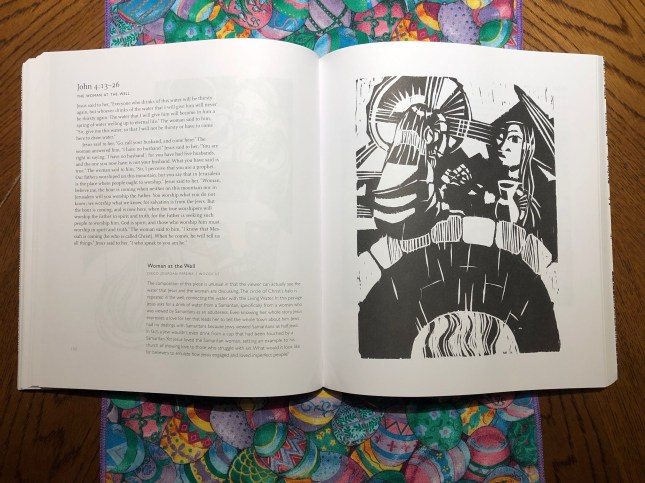
The Woman at the Well – John 4:13-26

Woman at the Well
The image above is from Revealed: A Storybook Bible for Grown-Ups by Ned Bustard. The image itself was created by Diego Jourdan Pereira and is called “Woman at the Well.”

John 4:13-26 [NLT]
13 Jesus replied, “Anyone who drinks this water will soon become thirsty again. 14 But those who drink the water I give will never be thirsty again. It becomes a fresh, bubbling spring within them, giving them eternal life.”
15 “Please, sir,” the woman said, “give me this water! Then I’ll never be thirsty again, and I won’t have to come here to get water.”
16 “Go and get your husband,” Jesus told her.
17 “I don’t have a husband,” the woman replied.
Jesus said, “You’re right! You don’t have a husband— 18 for you have had five husbands, and you aren’t even married to the man you’re living with now. You certainly spoke the truth!”
19 “Sir,” the woman said, “you must be a prophet. 20 So tell me, why is it that you Jews insist that Jerusalem is the only place of worship, while we Samaritans claim it is here at Mount Gerizim, where our ancestors worshiped?”
21 Jesus replied, “Believe me, dear woman, the time is coming when it will no longer matter whether you worship the Father on this mountain or in Jerusalem. 22 You Samaritans know very little about the one you worship, while we Jews know all about him, for salvation comes through the Jews. 23 But the time is coming—indeed it’s here now—when true worshipers will worship the Father in spirit and in truth. The Father is looking for those who will worship him that way. 24 For God is Spirit, so those who worship him must worship in spirit and in truth.”
25 The woman said, “I know the Messiah is coming—the one who is called Christ. When he comes, he will explain everything to us.”
26 Then Jesus told her, “I am the Messiah!”


Dear God, I’ve heard this story so many times that I want to see if I can enter it through the image created by Diego Jourdan Pereira instead of starting with the passage.

Knowing what I know of the story, what is it that I see here?

  • First I suppose I have to admit that it’s a little hard for a left-brained person like me to make out everything in this image.
  • I see the woman first. She is the center of the story, and she is holding a pitcher in which she can carry the water she’s come to get.
  • There’s the well. It has water at the bottom and rocks surrounding it at the top.
  • Jesus has his back to us and is sitting on the well. Okay, maybe I am noticing something interesting that Mr. Jourdan Pereira did here–he kept the woman the center of the story. Jesus is looking at her just like we are.
  • I never imagined Jesus sitting on the actual well itself talking to the woman. That’s interesting.
  • Jesus seems to have the holiness halo around his head that a lot of Catholic artwork does for the Holy Family and saints. (Bustard’s commentary mentions that “the circle of Christ’s halo is repeated in the well, connecting the water with the Living Water.)
  • I can’t tell what it is, but there seems to be a subtle cross that is upside down and crooked just above Jesus hands–between him and the woman.
  • I suppose those are mountains in the distance behind her.

I really like the idea that this image and this story are all about the woman. It’s not about Jesus needing water. It’s about Jesus entering this woman’s life and world. She is holding her pitcher, in need of some water. She came to the well for the water, but what she found there was Jesus sitting on the well. He’s in the same place as the water for which she came, but he has a different water to offer her.

Of course, there is the story itself. What is the living water of which Jesus speaks? The first thing he has to do is get her sin out on the table. She is going to be ashamed of it, and she’ll get mad, change the subject, and try to fight back by drawing a line between them: We Samaritans think this while you Jews think that. But Jesus changes the premise of her argument and tells her that all of it is wrong: Jesus replied, “Believe me, dear woman, the time is coming when it will no longer matter whether you worship the Father on this mountain or in Jerusalem.” (verse 21)

Then he has to teach her about worshiping “in spirit and in truth.” (verses 23 and 24) We’ve put so many constructs on what worshiping you looks like, when the truth is that you are so much bigger than our constructs.

My wife and I were talking this morning about death and afterlife. We discussed the difference between those who believe that we are dormant until Jesus comes again and those who believe we enter the afterlife immediately (whether it be heaven, hell or even purgatory). We finally concluded that all of this is problematic because we are putting our earthly construct of “time” onto the construct of your timelessness. My personal belief is that I don’t know how it will all happen, but I’m confident that I’m not capable of understanding it on this side of death because it is through death that I will cross through the veil.

Okay, now I’m rambling. I guess the point I am getting from this story this morning is that you are there to meet us where we are, get us to discuss our sin and deal with it through your grace and your call to holiness, and then worship you in spirit and in truth, which is possible because you are the Messiah. How’s that for a summary?

Father, help me to really worship you today. I started this day with a secular song in my head and I played it while I made my breakfast. It was a nice love song. Then I decided that I needed to prepare my heart for this time with you so I put on some Christian songs that would lead me into worship and bring me into a place of wanting to spend this time with you. Thankfully, it worked. So, like I said at the beginning of this paragraph, help me to worship you today, but to do it in spirit and in truth. Help me to deal with my sin in a humble way before you. Help me to do what you would have me to do for your glory.

In Jesus’ name I pray,

Amen


Tags: , , , , , ,

Peter & John — John 21:18-24

John 21:18-24 NIV
[18] Very truly I tell you, when you were younger you dressed yourself and went where you wanted; but when you are old you will stretch out your hands, and someone else will dress you and lead you where you do not want to go.” [19] Jesus said this to indicate the kind of death by which Peter would glorify God. Then he said to him, “Follow me!” [20] Peter turned and saw that the disciple whom Jesus loved was following them. (This was the one who had leaned back against Jesus at the supper and had said, “Lord, who is going to betray you?”) [21] When Peter saw him, he asked, “Lord, what about him?” [22] Jesus answered, “If I want him to remain alive until I return, what is that to you? You must follow me.” [23] Because of this, the rumor spread among the believers that this disciple would not die. But Jesus did not say that he would not die; he only said, “If I want him to remain alive until I return, what is that to you?” [24] This is the disciple who testifies to these things and who wrote them down. We know that his testimony is true.

Dear God, I read something interesting yesterday by Eugene Peterson in his book Run With The Horses: The Quest For Life At Its Best:

Scripture, however, doesn’t play that game. Something very different takes place in the life of faith: each person discovers all the elements of a unique and original adventure. We are prevented from following in another’s footsteps and are called to an incomparable association with Christ. The Bible makes it clear that every time that there is a story of faith, it is completely original.

This passage calls this to mind. We want to compare ourselves with others to see how we measure up. If we perceive they are living worse than us then we feel better about ourselves. If we think their lives are better than ours then we feel worse. The common denominator is that it’s about us and our expectations for how good our lives should be.

What I think Jesus is trying to teach Peter, John, and even us today through this conversation is that we need to stop trying to use the lives of others to benchmark our own. Sure, we can use others as inspiration and encouragement, but our eyes need to be on the path you have for us and the race you have for us to walk. Oh, how I hope I’m getting mine right in your eyes and accomplishing what you need to accomplish through me.

Father, thank you for the comfort that you do give me. Thank you for your love. Help me to be at peace with my life and to make my decisions based on your still small voice and counsel through the Holy Spirit. I have some decisions to make even today—some big ones. Help me to be wise.

In Jesus’ name I pray,

Amen

 
Leave a comment

Posted by on November 30, 2018 in John, Peter and John


Tags: , ,

Peter & John — John 21:12-17

John 21:12-17 NASB
[12] Jesus said to them, “Come and have breakfast.” None of the disciples ventured to question Him, “Who are You?” knowing that it was the Lord. [13] Jesus came and took the bread and gave it to them, and the fish likewise. [14] This is now the third time that Jesus was manifested to the disciples, after He was raised from the dead. [15] So when they had finished breakfast, Jesus said to Simon Peter, “Simon, son of John, do you love Me more than these?” He said to Him, “Yes, Lord; You know that I love You.” He said to him, “Tend My lambs.” [16] He said to him again a second time, “Simon, son of John, do you love Me?” He said to Him, “Yes, Lord; You know that I love You.” He said to him, “Shepherd My sheep.” [17] He said to him the third time, “Simon, son of John, do you love Me?” Peter was grieved because He said to him the third time, “Do you love Me?” And he said to Him, “Lord, You know all things; You know that I love You.” Jesus said to him, “Tend My sheep.

Dear God, the thing that we lose when reading something versus hearing it is tone of voice. The thing we lose by not seeing it is body language. I feel like these passages have suffered from that loss. I’d love to hear Jesus’ and Peter’s voices during this exchange. I’d love to see Jesus’ facial expressions and body language. I wonder what John saw and heard in that moment.

I heard a long time ago something I’ve never verified for myself. Someone once told me that Jesus keeps asking Peter if he “agape” loves Him and Peter answer that he “phileo” loves Jesus. I suppose I should look that up one day. It’s never really made sense to me that in that moment Peter wouldn’t come back to Jesus with the same type of love he was requesting.

Either way, by the end of this conversation it seems that Peter is not only restored from the denying three times story, but he is completely set up to lead the new church. Basically, he has his head back on straight again. Grace has freed him.

I heard about a friend yesterday who made a mistake and I have a feeling they are walking around with a lot of guilt. Now I can see that friend acting out and in a funk, and I have a feeling that what is truly needed right now is freedom from that mistake and others that this friend has made.

Father, my wife and I are doing something today to support. Friend that puts us out of our comfort zone. Please help us to do it well. Help us to be ministers of your grace and peace. Give us wisdom and discernment at any given moment, and even be with us while we drive alone. Strengthen us through each other. Let your Holy Spirit be in the car with us and counsel us so that we might really do the right things by the people around us.

In Jesus’ name I pray,

Amen

 
Leave a comment

Posted by on November 29, 2018 in John, Peter and John


Tags: , ,

John 21:1-11

John 21:1-11 NASB
[1] After these things Jesus manifested Himself again to the disciples at the Sea of Tiberias, and He manifested Himself in this way. [2] Simon Peter, and Thomas called Didymus, and Nathanael of Cana in Galilee, and the sons of Zebedee, and two others of His disciples were together. [3] Simon Peter said to them, “I am going fishing.” They said to him, “We will also come with you.” They went out and got into the boat; and that night they caught nothing. [4] But when the day was now breaking, Jesus stood on the beach; yet the disciples did not know that it was Jesus. [5] So Jesus said to them, “Children, you do not have any fish, do you?” They answered Him, “No.” [6] And He said to them, “Cast the net on the right-hand side of the boat and you will find a catch.” So they cast, and then they were not able to haul it in because of the great number of fish. [7] Therefore that disciple whom Jesus loved said to Peter, “It is the Lord.” So when Simon Peter heard that it was the Lord, he put his outer garment on (for he was stripped for work), and threw himself into the sea. [8] But the other disciples came in the little boat, for they were not far from the land, but about one hundred yards away, dragging the net full of fish. [9] So when they got out on the land, they saw a charcoal fire already laid and fish placed on it, and bread. [10] Jesus said to them, “Bring some of the fish which you have now caught.” [11] Simon Peter went up and drew the net to land, full of large fish, a hundred and fifty-three; and although there were so many, the net was not torn.

Dear God, it’s hard sometimes to read these stories with new, fresh eyes when they are stories I’ve read so many times before and about which I’ve already had some strong opinions. In this case, this is a great Peter story that gives us a pretty good looking into his emotional state and his impulsiveness.

I love the simple line, “I’m going fishing.” Back to the roots. I wonder how long it had been since he had been fishing. I wonder whose boat they used. They were back at the Sea of Galilee. Perhaps they used John’s and James’ dad’s boats. Maybe they fished on and off again over the years. There’s so much we don’t know. But we do know that These five guys were together and Peter finally decided to go and fish and maybe even make a little money. The other four followed him.

Then, to add insult to injury, they didn’t catch anything. Peter’s sense of being lost and depressed after having denied Jesus is now being piled upon with fruitless work. And then Jesus shows up.

I guess I am seeing something new here. It’s from Jesus. If I were mapping this out, I would think that Jesus came back from the dead and then had a strategy session with the disciples before he ascended. His seemingly infrequent appearances are interesting and now what I would expect. I guess he was teaching them some lessons about independent thinking and getting along without himself. I’m sure their conversations while he wasn’t around were full of “What do we do next?” questions.

Father, I guess that’s how you still work with us today. In a lot of ways, we are left to struggle through and depend upon our own intelligence, intuition and experience to solve problems or make choices, all the while seeking your wisdom and discernment. I know that’s how I feel right now. We are doing strategic planning at work and we are working hard to discern your will while trying to layer our collective contributions we bring to the table. My wife and I are doing the same thing with some challenges we are facing. I have to say, It’d be nice if you’d just hire a sky writer and tell us what to do, but this is also a good process. So thank you for the struggle. Thank you for your love. Please speak to all of us as we wrestle through these challenges.

In Jesus’ name I pray,

Amen

 
Leave a comment

Posted by on November 28, 2018 in John, Peter and John


Tags: , , ,

Peter & John — John 20:1-10

John 20:1-10 NASB
[1] Now on the first day of the week Mary Magdalene came early to the tomb, while it was still dark, and saw the stone already taken away from the tomb. [2] So she ran and came to Simon Peter and to the other disciple whom Jesus loved, and said to them, “They have taken away the Lord out of the tomb, and we do not know where they have laid Him.” [3] So Peter and the other disciple went forth, and they were going to the tomb. [4] The two were running together; and the other disciple ran ahead faster than Peter and came to the tomb first; [5] and stooping and looking in, he saw the linen wrappings lying there; but he did not go in. [6] And so Simon Peter also came, following him, and entered the tomb; and he saw the linen wrappings lying there, [7] and the face-cloth which had been on His head, not lying with the linen wrappings, but rolled up in a place by itself. [8] So the other disciple who had first come to the tomb then also entered, and he saw and believed. [9] For as yet they did not understand the Scripture, that He must rise again from the dead. [10] So the disciples went away again to their own homes.

Dear God, several years ago I noticed something interesting about this story. In fact, this is one of the reasons I wanted to compare and contrast John and Peter. John outruns Peter there (what does it say about his state of mind that he would either intentionally or unintentionally outrun Peter), but then he cautiously stops and doesn’t go in, but only looks at a distance.

On the other hand, Peter isn’t as fast as John, but he’s certainly more bold. He gets there last, but goes straight in. John then follows Peter.

As I sit here and think about it this morning, this is the first activity of the new Christian church’s leadership post-resurrection, and in it I think Peter shows why his personality allows him to be the leader. He is, indeed, courageous. He is also a little less cautious, which can be a problem. In the case of how things will play out, I think John will need that part of Peter’s personality to move him out of his comfort zone, but Peter will need people like John to help him see the big picture before acting.

Father, help me to be the person you want me to be to accomplish what you have for our group to accomplish. It’s board meeting week. I bring a certain set of weaknesses and strengths to the table as does everyone else. As we talk and discuss everything before us, my prayer is that we will be able to accept the work and input of the others that you need us to have so that we can be as effective in our work as possible. And of course, do it all for your glory and not ours.

In Jesus’ name I pray,

Amen

 
Leave a comment

Posted by on November 26, 2018 in John, Peter and John


Tags: , , , ,

Peter & John — John 19:25-27

John 19:25-27
25 Standing near the cross were Jesus’ mother, and his mother’s sister, Mary (the wife of Clopas), and Mary Magdalene. 26 When Jesus saw his mother standing there beside the disciple he loved, he said to her, “Dear woman, here is your son.” 27 And he said to this disciple, “Here is your mother.” And from then on this disciple took her into his home.


Dear God, for the purposes of what I’m doing here, I am going to assume that John is referring to himself in verse 26 when he mentions “the disciple he loved.” I wonder what it was about John that made Jesus decide to do this. Was it his dependability? Was it that he knew John would be the last of the disciples to die so he’d be around longer? Or was it simply that he was the one who was there? Of course, we don’t know that none of the other disciples weren’t there. We’ve assumed, but we don’t know that.

I’m guessing it was a combination of trusting John and his availability at the time. But I wonder why Jesus didn’t assume that his siblings would take care of her. I know that it is vague about whether or not Jesus’ siblings were from a previous marriage for Joseph and Mary had no other children besides Jesus. I’ve never subscribed to that belief, but this story would seem to support that theory. On the other hand, perhaps Mary had been following Jesus and his siblings just didn’t understand or know how to relate to everything they were seeing. They didn’t know what to make of Mary, Jesus, or the disciples. James (Jesus’ brother, not John’s) finally figured it out, but I don’t think we know about any others. John was probably his best option and as he hung there dying, he needed John’s help for his mother.

I suppose there is something to be said for just showing up. John was there. We don’t know how close he was able to stay all day, but he seems to have some good information about things that were said and done throughout the day so I think he was certainly lurking in the shadows, if nothing else. But there he is, the temperamental disciple, now pensively and fearfully following Jesus to the cross. There is no asking if he should call down fire on the church leaders. He’s not rebuking people. He’s just there, being traumatized and watching his world change before him in ways that he cannot begin to understand. Again, though, to his credit, he’s right there and in a position to hear Jesus for what John thinks will be for the last time.

Father, I don’t know what I have to offer, but I at least offer you my presence. I give you my submission to your will—as best as I know how. I give you my ego—as much as I am capable. I give you my dreams that focus on my own comfort, reward, and enjoyment. And I give you my willingness to embrace the task that you have given me to do. The task of testifying to the Gospel of your grace.

In Jesus’ name I pray,

Amen

 
Leave a comment

Posted by on November 25, 2018 in John, Peter and John


Tags: , ,

Peter & John — John 18:17-18,25-27

John 18:17-18,25-27 NASB
[17] Then the slave-girl who kept the door said to Peter, “You are not also one of this man’s disciples, are you?” He said, “I am not.” [18] Now the slaves and the officers were standing there, having made a charcoal fire, for it was cold and they were warming themselves; and Peter was also with them, standing and warming himself. [25] Now Simon Peter was standing and warming himself. So they said to him, “You are not also one of His disciples, are you?” He denied it, and said, “I am not.” [26] One of the slaves of the high priest, being a relative of the one whose ear Peter cut off, said, “Did I not see you in the garden with Him?” [27] Peter then denied it again, and immediately a rooster crowed.

Dear God, John chooses to tell this story much more mercifully and matter-of-factly than the others. He leaves out Peter’s shame, although later, along the water after the resurrection, he will capture the restoration.

The thing I notice about John throughout this book is that he seems to empathize with people. He has mercy for them. I concluded several year ago that he has mercy and sympathy for Pilate. In this case, he was as scared as Peter was and would probably have denied Jesus too if anyone had bothered to ask him. He feels for Peter.

How is my mercy level for other people? I hope it’s at least getting better. The hardest part is when they have offended me. How do I look beyond my own feelings and ego and try to see where that person might be coming from and then extend grace to them while also seeing if I can help them?

As I sit here, I can think of countless times I have not done this well—especially with family. It’s frustrating. And the times I have done it right, my eyes have seen no benefit from it. It seems like the other person often takes advantage of my mercy and tries to use it as an opportunity to abuse me more.

Father, thank you for John’s example of mercy and discretion. Thank you that he was able to look at the failings of others and at least appreciate where they were coming from. Give me that ability today. I have certain situations in my heart. Please give me peace and wisdom to deal with them beyond my natural capabilities.

In Jesus’ name I pray,

Amen

 
Leave a comment

Posted by on November 24, 2018 in John, Peter and John


Tags: , , ,

Peter & John — John 18:7-11

John 18:7-11
7 Once more he asked them, “Who are you looking for?”
And again they replied, “Jesus the Nazarene.”
8 “I told you that I AM he,” Jesus said. “And since I am the one you want, let these others go.” 9 He did this to fulfill his own statement: “I did not lose a single one of those you have given me.”
10 Then Simon Peter drew a sword and slashed off the right ear of Malchus, the high priest’s slave. 11 But Jesus said to Peter, “Put your sword back into its sheath. Shall I not drink from the cup of suffering the Father has given me?”

Dear God, it’s interesting to see what John decides to tell us and what he leaves out. He tells us about Peter cutting off the ear, but he doesn’t tell us that Jesus healed the ear or why Peter had a sword in the first place (Luke 22:36-37). He also leaves out something else important. He doesn’t tell the part about Jesus praying on the Mount of Olives and the disciples praying with Him falling asleep. Hmmm. I wonder if he carried that shame the rest of his life.

But back to Peter. I already mentioned this in a previous journal, but I think it is significant to note that Peter was, indeed, ready to defend Jesus, follow Jesus, battle for Jesus, and die for Jesus. That’s just not how Jesus needed this to work out. This is evidenced by what John tells us in verse 8 with Jesus saying, “”And since I am the one you want, let these others go.” I don’t remember Matthew, Mark, or Luke giving us that detail. At some point, I am going to do a side-by-side comparison of every story the four Gospels give us so that I can get a better look at exactly what John wanted us to know that was unique to the other three.

I was watching a documentary on Bill Murray the other day, and a guy talked about a Taoist Proverb that has a principle I’ve clung to the last few years as things have and haven’t gone the way I wanted them to. To paraphrase quickly, it seems there was a man who had a prized horse:

  • One day the horse ran away and his neighbor came over and told him it was such a shame that this bad thing had happened. The man replied, “Who is to know what is good or what is bad?”
  • The next day the horse came back, but he brought with him 10 prized wild horses. The neighbor came and rejoiced with him remarking that it was such a great thing. The man replied, “Who is to know what is good or what is bad?”
  • The next day the man’s son was trying to train one of the horses and broke his leg. The neighbor expressed sympathy for such a terrible thing happening, but the man replied, “Who is to know what is good or what is bad?”
  • The next day the army came to conscript able-bodied men to go to war. The son was left behind because of his broken leg, and the neighbor rejoiced with the man, but the man replied, “Who is to know what is good or what is bad?”

And so the story goes on and on. Peter felt like a failure that night. John felt like a failure too. And they did, indeed, fail. Judas Iscariot failed that week as well. But in all of it, your plan prevailed. You didn’t need them to fail, but you allowed for their failure. They didn’t understand that Jesus’ death was good and fighting to save Jesus by cutting off an ear was bad. But looking back and telling the story years later, John was able to see a little more clearly and understand what you were up to.

Father, I am truly sorry for my failings. I really am. But on this Thanksgiving Day, I want to thank you for working around all of my faults and flaws to not only love me, but to do you will on earth through me. Maybe things could be done better if I was better, but I am able to sleep peacefully at night knowing that you are my God, you love me, and you forgive me. Thank you.

In Jesus’ name I pray,

Amen

 
Leave a comment

Posted by on November 22, 2018 in John, Peter and John


Tags: , , , ,

Peter & John — John 14:5,8,22

John 14:5 NASB
[5] Thomas said to Him, “Lord, we do not know where You are going, how do we know the way?”
John 14:8 NASB
[8] Philip said to Him, “Lord, show us the Father, and it is enough for us.”
John 14:22 NASB
[22] Judas (not Iscariot) said to Him, “Lord, what then has happened that You are going to disclose Yourself to us and not to the world?”

Dear God, I want to look at John as writer and storyteller this morning. He gives us a unique window into the Last Supper. Thomas, Philip, and the good Judas get call outs here. I don’t know that it’s as important what they asked (they were basically all just trying to make sense of what was happening around them) as it is that John was going through the evening in his memory and these are some of the specifics he remembered. “Thomas asked Him where He was going.” “Philip wanted to see a revelation of God (that one was pretty silly of him to say—Jesus didn’t seem to like that one).” “Judas (gotta be clear which one) wanted to understand why things were so shrouded and confusing.” These might have all been things John himself wanted to ask and that’s why he remembered them. Or maybe he was remembering Jesus’ answers and then thought back to which questions had provoked each one. Either way, John is painting a unique picture of that evening. The disciples were confused, scared, insecure, and a bit intimidated.

Father, thank you for these 11 men. Thank you that you gave the early church a group of people who were imperfect but cake together to continue the work here on earth. Thank you that one day we will all follow you and go where you will go. Finally, thank you for John taking the time to write all of this down and give it to us.

In Jesus’ name I pray,

Amen

 
Leave a comment

Posted by on November 21, 2018 in John, Peter and John


Tags: , , , ,