RSS

Tag Archives: Laban

Fathers of the Bible – Laban

As soon as Laban heard the news about Jacob, his sister’s son, he hurried to meet him. He embraced him and kissed him and brought him to his home, and there Jacob told him all these things. Then Laban said to him, “You are my own flesh and blood.” After Jacob had stayed with him for a whole month, Laban said to him, “Just because you are a relative of mine, should you work for me for nothing? Tell me what your wages should be.” Now Laban had two daughters; the name of the older was Leah, and the name of the younger was Rachel. Leah had weak eyes, but Rachel had a lovely figure and was beautiful. Jacob was in love with Rachel and said, “I’ll work for you seven years in return for your younger daughter Rachel.” Laban said, “It’s better that I give her to you than to some other man. Stay here with me.” So Jacob served seven years to get Rachel, but they seemed like only a few days to him because of his love for her. Then Jacob said to Laban, “Give me my wife. My time is completed, and I want to make love to her. ” So Laban brought together all the people of the place and gave a feast. But when evening came, he took his daughter Leah and brought her to Jacob, and Jacob made love to her. And Laban gave his servant Zilpah to his daughter as her attendant. When morning came, there was Leah! So Jacob said to Laban, “What is this you have done to me? I served you for Rachel, didn’t I? Why have you deceived me? ” Laban replied, “It is not our custom here to give the younger daughter in marriage before the older one. Finish this daughter’s bridal week; then we will give you the younger one also, in return for another seven years of work. ” And Jacob did so. He finished the week with Leah, and then Laban gave him his daughter Rachel to be his wife. Laban gave his servant Bilhah to his daughter Rachel as her attendant. Jacob made love to Rachel also, and his love for Rachel was greater than his love for Leah. And he worked for Laban another seven years. After Rachel gave birth to Joseph, Jacob said to Laban, “Send me on my way so I can go back to my own homeland. Give me my wives and children, for whom I have served you, and I will be on my way. You know how much work I’ve done for you.” But Laban said to him, “If I have found favor in your eyes, please stay. I have learned by divination that the Lord has blessed me because of you.” He added, “Name your wages, and I will pay them.” Jacob heard that Laban’s sons were saying, “Jacob has taken everything our father owned and has gained all this wealth from what belonged to our father.” And Jacob noticed that Laban’s attitude toward him was not what it had been. Then the Lord said to Jacob, “Go back to the land of your fathers and to your relatives, and I will be with you.” So Jacob sent word to Rachel and Leah to come out to the fields where his flocks were. He said to them, “I see that your father’s attitude toward me is not what it was before, but the God of my father has been with me. You know that I’ve worked for your father with all my strength, yet your father has cheated me by changing my wages ten times. However, God has not allowed him to harm me. If he said, ‘The speckled ones will be your wages,’ then all the flocks gave birth to speckled young; and if he said, ‘The streaked ones will be your wages,’ then all the flocks bore streaked young. So God has taken away your father’s livestock and has given them to me. Then Rachel and Leah replied, “Do we still have any share in the inheritance of our father’s estate? Does he not regard us as foreigners? Not only has he sold us, but he has used up what was paid for us. Surely all the wealth that God took away from our father belongs to us and our children. So do whatever God has told you.” Then Jacob put his children and his wives on camels, and he drove all his livestock ahead of him, along with all the goods he had accumulated in Paddan Aram, to go to his father Isaac in the land of Canaan. When Laban had gone to shear his sheep, Rachel stole her father’s household gods. Moreover, Jacob deceived Laban the Aramean by not telling him he was running away. So he fled with all he had, crossed the Euphrates River, and headed for the hill country of Gilead. On the third day Laban was told that Jacob had fled. Taking his relatives with him, he pursued Jacob for seven days and caught up with him in the hill country of Gilead. Then God came to Laban the Aramean in a dream at night and said to him, “Be careful not to say anything to Jacob, either good or bad.” Jacob had pitched his tent in the hill country of Gilead when Laban overtook him, and Laban and his relatives camped there too. Then Laban said to Jacob, “What have you done? You’ve deceived me, and you’ve carried off my daughters like captives in war. Why did you run off secretly and deceive me? Why didn’t you tell me, so I could send you away with joy and singing to the music of timbrels and harps? You didn’t even let me kiss my grandchildren and my daughters goodbye. You have done a foolish thing. I have the power to harm you; but last night the God of your father said to me, ‘Be careful not to say anything to Jacob, either good or bad.’ Now you have gone off because you longed to return to your father’s household. But why did you steal my gods? ” Jacob answered Laban, “I was afraid, because I thought you would take your daughters away from me by force. But if you find anyone who has your gods, that person shall not live. In the presence of our relatives, see for yourself whether there is anything of yours here with me; and if so, take it.” Now Jacob did not know that Rachel had stolen the gods. So Laban went into Jacob’s tent and into Leah’s tent and into the tent of the two female servants, but he found nothing. After he came out of Leah’s tent, he entered Rachel’s tent. Now Rachel had taken the household gods and put them inside her camel’s saddle and was sitting on them. Laban searched through everything in the tent but found nothing. Rachel said to her father, “Don’t be angry, my lord, that I cannot stand up in your presence; I’m having my period. ” So he searched but could not find the household gods. Jacob was angry and took Laban to task. “What is my crime?” he asked Laban. “How have I wronged you that you hunt me down? Now that you have searched through all my goods, what have you found that belongs to your household? Put it here in front of your relatives and mine, and let them judge between the two of us. “I have been with you for twenty years now. Your sheep and goats have not miscarried, nor have I eaten rams from your flocks. I did not bring you animals torn by wild beasts; I bore the loss myself. And you demanded payment from me for whatever was stolen by day or night. This was my situation: The heat consumed me in the daytime and the cold at night, and sleep fled from my eyes. It was like this for the twenty years I was in your household. I worked for you fourteen years for your two daughters and six years for your flocks, and you changed my wages ten times. If the God of my father, the God of Abraham and the Fear of Isaac, had not been with me, you would surely have sent me away empty-handed. But God has seen my hardship and the toil of my hands, and last night he rebuked you. ” Laban answered Jacob, “The women are my daughters, the children are my children, and the flocks are my flocks. All you see is mine. Yet what can I do today about these daughters of mine, or about the children they have borne? Come now, let’s make a covenant, you and I, and let it serve as a witness between us.” So Jacob took a stone and set it up as a pillar. He said to his relatives, “Gather some stones.” So they took stones and piled them in a heap, and they ate there by the heap. Laban called it Jegar Sahadutha, and Jacob called it Galeed. Laban said, “This heap is a witness between you and me today.” That is why it was called Galeed. It was also called Mizpah, because he said, “May the Lord keep watch between you and me when we are away from each other. If you mistreat my daughters or if you take any wives besides my daughters, even though no one is with us, remember that God is a witness between you and me.” Laban also said to Jacob, “Here is this heap, and here is this pillar I have set up between you and me. This heap is a witness, and this pillar is a witness, that I will not go past this heap to your side to harm you and that you will not go past this heap and pillar to my side to harm me. May the God of Abraham and the God of Nahor, the God of their father, judge between us.” So Jacob took an oath in the name of the Fear of his father Isaac. He offered a sacrifice there in the hill country and invited his relatives to a meal. After they had eaten, they spent the night there. Early the next morning Laban kissed his grandchildren and his daughters and blessed them. Then he left and returned home.
Genesis 29:13-30,30:25-28,31:1-9,14-55

Dear God, I sat down to do this yesterday and I got stuck because I was going to do Jacob. The stores of him as a father are so many that I wasn’t sure how to proceed. I gave up, but then last night I realized I had skipped a pretty influential father from Genesis–Laban.

Laban and his sister, Rebekah, Jacob’s mother, were pretty deceitful people. Rebekah was willing to tell Isaac anything to get her way and Laban proved to be a similar person with Jacob. He knew he would never marry off Leah so he pulled the old switcharoo. What’s interesting is how this family trait seems to filter down by generations with Rachel stealing his gods and lying about it.

So what should Laban have done with Leah? Should he have made the honest bargain up front? And how did all of this impact both Leah and Rachel? Well, the jealousy is easy enough to see. But Leah must have always carried around an insecurity because she knew she was Jacob’s second choice to her beautiful sister. And then there was the business of having their servants sleep with Jacob to have more children. Just weird. I have to tell you, this is a really weird way to build a nation of your chosen people. I don’t see anyone here who is really worth choosing.

So Laban and Rebekah had a family culture of deceit. Rachel perpetuated it to some extent. And every woman in the story felt insecure and jealous. What would their lives have been like with some simplicity and honesty? And if they had done it right, would your plan have played out?

Father, like I said, all of these people are interesting and I can’t say that I would choose any of them as my people if I were you. But I’m not you. I think the theme of all of these parent stories from the Bible is that all of them were pretty bad parents. But somehow your plan allows for that. So I can perhaps take a little of the pressure off of myself and simply throw myself at your feet in worship. I will just have to trust that you have made your plan “John proof.”

In Jesus’s name I pray,

Amen
 
Leave a comment

Posted by on January 8, 2020 in Fathers of the Bible, Genesis


Tags: , , ,

Fathers of the Bible — Abraham and Isaac (Part 2)

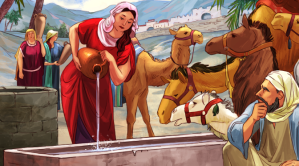
Abraham was now a very old man, and the Lord had blessed him in every way. One day Abraham said to his oldest servant, the man in charge of his household, “Take an oath by putting your hand under my thigh. Swear by the Lord, the God of heaven and earth, that you will not allow my son to marry one of these local Canaanite women. Go instead to my homeland, to my relatives, and find a wife there for my son Isaac.” The servant asked, “But what if I can’t find a young woman who is willing to travel so far from home? Should I then take Isaac there to live among your relatives in the land you came from?” “No!” Abraham responded. “Be careful never to take my son there. For the Lord, the God of heaven, who took me from my father’s house and my native land, solemnly promised to give this land to my descendants. He will send his angel ahead of you, and he will see to it that you find a wife there for my son. If she is unwilling to come back with you, then you are free from this oath of mine. But under no circumstances are you to take my son there.” So the servant took an oath by putting his hand under the thigh of his master, Abraham. He swore to follow Abraham’s instructions. Then he loaded ten of Abraham’s camels with all kinds of expensive gifts from his master, and he traveled to distant Aram-naharaim. There he went to the town where Abraham’s brother Nahor had settled. He made the camels kneel beside a well just outside the town. It was evening, and the women were coming out to draw water. “O Lord, God of my master, Abraham,” he prayed. “Please give me success today, and show unfailing love to my master, Abraham. See, I am standing here beside this spring, and the young women of the town are coming out to draw water. This is my request. I will ask one of them, ‘Please give me a drink from your jug.’ If she says, ‘Yes, have a drink, and I will water your camels, too!’—let her be the one you have selected as Isaac’s wife. This is how I will know that you have shown unfailing love to my master.” Before he had finished praying, he saw a young woman named Rebekah coming out with her water jug on her shoulder. She was the daughter of Bethuel, who was the son of Abraham’s brother Nahor and his wife, Milcah. Rebekah was very beautiful and old enough to be married, but she was still a virgin. She went down to the spring, filled her jug, and came up again. Running over to her, the servant said, “Please give me a little drink of water from your jug.” “Yes, my lord,” she answered, “have a drink.” And she quickly lowered her jug from her shoulder and gave him a drink. When she had given him a drink, she said, “I’ll draw water for your camels, too, until they have had enough to drink.” So she quickly emptied her jug into the watering trough and ran back to the well to draw water for all his camels. The servant watched her in silence, wondering whether or not the Lord had given him success in his mission. Then at last, when the camels had finished drinking, he took out a gold ring for her nose and two large gold bracelets for her wrists. “Whose daughter are you?” he asked. “And please tell me, would your father have any room to put us up for the night?” “I am the daughter of Bethuel,” she replied. “My grandparents are Nahor and Milcah. Yes, we have plenty of straw and feed for the camels, and we have room for guests.” The man bowed low and worshiped the Lord. “Praise the Lord, the God of my master, Abraham,” he said. “The Lord has shown unfailing love and faithfulness to my master, for he has led me straight to my master’s relatives.” The young woman ran home to tell her family everything that had happened. Now Rebekah had a brother named Laban, who ran out to meet the man at the spring. He had seen the nose-ring and the bracelets on his sister’s wrists, and had heard Rebekah tell what the man had said. So he rushed out to the spring, where the man was still standing beside his camels. Laban said to him, “Come and stay with us, you who are blessed by the Lord! Why are you standing here outside the town when I have a room all ready for you and a place prepared for the camels?” So the man went home with Laban, and Laban unloaded the camels, gave him straw for their bedding, fed them, and provided water for the man and the camel drivers to wash their feet. Then food was served. But Abraham’s servant said, “I don’t want to eat until I have told you why I have come.” “All right,” Laban said, “tell us.” “I am Abraham’s servant,” he explained. “And the Lord has greatly blessed my master; he has become a wealthy man. The Lord has given him flocks of sheep and goats, herds of cattle, a fortune in silver and gold, and many male and female servants and camels and donkeys. “When Sarah, my master’s wife, was very old, she gave birth to my master’s son, and my master has given him everything he owns. And my master made me take an oath. He said, ‘Do not allow my son to marry one of these local Canaanite women. Go instead to my father’s house, to my relatives, and find a wife there for my son.’ “But I said to my master, ‘What if I can’t find a young woman who is willing to go back with me?’ He responded, ‘The Lord, in whose presence I have lived, will send his angel with you and will make your mission successful. Yes, you must find a wife for my son from among my relatives, from my father’s family. Then you will have fulfilled your obligation. But if you go to my relatives and they refuse to let her go with you, you will be free from my oath.’ “So today when I came to the spring, I prayed this prayer: ‘O Lord, God of my master, Abraham, please give me success on this mission. See, I am standing here beside this spring. This is my request. When a young woman comes to draw water, I will say to her, “Please give me a little drink of water from your jug.” If she says, “Yes, have a drink, and I will draw water for your camels, too,” let her be the one you have selected to be the wife of my master’s son.’ “Before I had finished praying in my heart, I saw Rebekah coming out with her water jug on her shoulder. She went down to the spring and drew water. So I said to her, ‘Please give me a drink.’ She quickly lowered her jug from her shoulder and said, ‘Yes, have a drink, and I will water your camels, too!’ So I drank, and then she watered the camels. “Then I asked, ‘Whose daughter are you?’ She replied, ‘I am the daughter of Bethuel, and my grandparents are Nahor and Milcah.’ So I put the ring on her nose, and the bracelets on her wrists. “Then I bowed low and worshiped the Lord. I praised the Lord , the God of my master, Abraham, because he had led me straight to my master’s niece to be his son’s wife. So tell me—will you or won’t you show unfailing love and faithfulness to my master? Please tell me yes or no, and then I’ll know what to do next.” Then Laban and Bethuel replied, “The Lord has obviously brought you here, so there is nothing we can say. Here is Rebekah; take her and go. Yes, let her be the wife of your master’s son, as the Lord has directed.” When Abraham’s servant heard their answer, he bowed down to the ground and worshiped the Lord. Then he brought out silver and gold jewelry and clothing and presented them to Rebekah. He also gave expensive presents to her brother and mother. Then they ate their meal, and the servant and the men with him stayed there overnight. But early the next morning, Abraham’s servant said, “Send me back to my master.” “But we want Rebekah to stay with us at least ten days,” her brother and mother said. “Then she can go.” But he said, “Don’t delay me. The Lord has made my mission successful; now send me back so I can return to my master.” “Well,” they said, “we’ll call Rebekah and ask her what she thinks.” So they called Rebekah. “Are you willing to go with this man?” they asked her. And she replied, “Yes, I will go.” So they said good-bye to Rebekah and sent her away with Abraham’s servant and his men. The woman who had been Rebekah’s childhood nurse went along with her. They gave her this blessing as she parted: “Our sister, may you become the mother of many millions! May your descendants be strong and conquer the cities of their enemies.” Then Rebekah and her servant girls mounted the camels and followed the man. So Abraham’s servant took Rebekah and went on his way. Meanwhile, Isaac, whose home was in the Negev, had returned from Beer-lahai-roi. One evening as he was walking and meditating in the fields, he looked up and saw the camels coming. When Rebekah looked up and saw Isaac, she quickly dismounted from her camel. “Who is that man walking through the fields to meet us?” she asked the servant. And he replied, “It is my master.” So Rebekah covered her face with her veil. Then the servant told Isaac everything he had done. And Isaac brought Rebekah into his mother Sarah’s tent, and she became his wife. He loved her deeply, and she was a special comfort to him after the death of his mother.
Genesis 24

Dear God, when comparing this story to the others stories in Genesis, it should probably not be overlooked how much space was given to this one scene. While doing these other stories, I have been struck by how economical the storytelling has been, but this one uses an entire chapter. We meet Rebekah and we meet Laban (whom we will meet later when it’s time for Jacob to marry). But there are two things I noticed about Abraham’s parenting of Isaac in this story:

  1. He wanted Isaac to NOT marry a Canaanite woman, but a woman from the family. He saw that it was important to find someone who would not pull Isaac away from you or the customs of worshipping you. The whole thing about keeping it in the family feels weird to me, but we will assume this wasn’t weird at the time because no one seems to blink an eye at it.
  2. He didn’t want Isaac to leave the area. He didn’t want him to go leave Canaan, but to stay there. I wonder how old Isaac was at this time. I know Sarah was 127 when she died, but I’m not totally sure how they measured years at that point, and I don’t know how old she was when he was born. I know that Abraham was 100 when Isaac was born and died at 175, but, again, I don’t know how long a year was in their time. My point is, at that point he didn’t trust Isaac to make the decisions that Abraham thought best.

So this is really a story, from a parenting perspective, about putting blinders on your child to help guide them. It would be helpful to know Isaac’s age for context, but there are certainly times in raising a child when you put blinders on them, and then there are times when you take them away and let them discover their own boundaries the hard way.

I was talking with someone last night about their granddaughter and the frustrating decisions she is making. The granddaughter is 20 and was only adopted by this woman’s daughter three or four years ago. She has seen a lot. She has lived a more difficult life than I probably ever will. And this grandmother wants to save her from some of the bad decisions she is making right now. As I talked to her, however, it became clear to me that, at this point, the best we can offer as parents or grandparents is a safe place/home base for the adult children as they figure out the boundaries of their lives for themselves. My grandmother once said that you can’t put an old head on young shoulders. So true.

Father, help me to know how to parent my adult children. Help me to know what to do and what not to do. Love them through me. Parent them as you need them to be parented at this stage of their lives through me. Grant me the serenity to accept the things I cannot change, the courage to change the things I can, and the wisdom to know the difference.

In Jesus’s name I pray,

Amen

 
Leave a comment

Posted by on January 2, 2020 in Fathers of the Bible, Genesis


Tags: , , ,