RSS

Tag Archives: Fathers of the Bible

Parents of the Bible: From Adam & Eve to Mary & Joseph is now live on Substack

Hello friends. This is not a prayer to God. I’m letting anyone who reads this blog know that I have taken the prayer journals I did a few years ago on Mothers of the Bible and Fathers of the Bible, and put them all in one place. You can find it here on Substack.

There are 82 prayer journals that will drop once a week for the next 82 weeks, starting with Eve. If you read any of these prayers at the time, you know it was my way of trying to consider what their lives must have been like as parents. I was trying to see what God could teach me about myself as a parent through the struggles I’ve had. I learned a lot. I hope it can be a source of encouragement for others.

The Substack is free, but if you should want to download a pdf of all 82 journals at once you can subscribe for a month for $5, download the pdf, and then cancel your subscription. Of course, you can also go to any of them as they were written at the time from clicking the links I provided in the first paragraph.

Thank you for the kind support many of you give me through this blog. I hope my journey with the Father, the Son, and the Holy Spirit through these prayers is an encouragement in your own discipleship. Journaling my way through scripture in this way has changed my life.

John

 
Leave a comment

Posted by on November 4, 2024 in Miscellaneous


Tags: , , , , ,

Ecclesiastes 3

For everything there is a season,
    a time for every activity under heaven.
A time to be born and a time to die.
    A time to plant and a time to harvest.
A time to kill and a time to heal.
    A time to tear down and a time to build up.
A time to cry and a time to laugh.
    A time to grieve and a time to dance.
A time to scatter stones and a time to gather stones.
    A time to embrace and a time to turn away.
A time to search and a time to quit searching.
    A time to keep and a time to throw away.
A time to tear and a time to mend.
    A time to be quiet and a time to speak.
A time to love and a time to hate.
    A time for war and a time for peace.

What do people really get for all their hard work? 10 I have seen the burden God has placed on us all. 11 Yet God has made everything beautiful for its own time. He has planted eternity in the human heart, but even so, people cannot see the whole scope of God’s work from beginning to end. 12 So I concluded there is nothing better than to be happy and enjoy ourselves as long as we can. 13 And people should eat and drink and enjoy the fruits of their labor, for these are gifts from God.

14 And I know that whatever God does is final. Nothing can be added to it or taken from it. God’s purpose is that people should fear him. 15 What is happening now has happened before, and what will happen in the future has happened before, because God makes the same things happen over and over again.

16 I also noticed that under the sun there is evil in the courtroom. Yes, even the courts of law are corrupt! 17 I said to myself, “In due season God will judge everyone, both good and bad, for all their deeds.”

18 I also thought about the human condition—how God proves to people that they are like animals. 19 For people and animals share the same fate—both breathe and both must die. So people have no real advantage over the animals. How meaningless! 20 Both go to the same place—they came from dust and they return to dust. 21 For who can prove that the human spirit goes up and the spirit of animals goes down into the earth? 22 So I saw that there is nothing better for people than to be happy in their work. That is our lot in life. And no one can bring us back to see what happens after we die.

Ecclesiastes 3

Dear God, let’s face it, most everyone over 40 knows the beginning of this song from The Byrds classic, “Turn, Turn, Turn.”

I could spend a lot of time talking about the different seasons in life, but I am actually drawn to two other parts of this chapter. First, verse 11: 11 Yet God has made everything beautiful for its own time. He has planted eternity in the human heart, but even so, people cannot see the whole scope of God’s work from beginning to end. I think my Mothers of the Bible and Fathers of the Bible series taught me that I will never be able to see what you are doing in the grand scope of things. My life is too short and my mind is too small. Naomi could never have seen that her path in life would lead to the lineage of Jesus (through Ruth and Boaz, to Obed, to Jesse, to David, to, ultimately, Jesus.) Hagar couldn’t have seen her suffering would lead to her freedom from slavery until much later in life. I can’t even figure out how taking a trip this week impacts the rest of my life. Almost nothing is known to me. And that’s okay. It’s just hard to learn to accept.

Then there is the part in verses 18-20: 18 I also thought about the human condition—how God proves to people that they are like animals. 19 For people and animals share the same fate—both breathe and both must die. So people have no real advantage over the animals. How meaningless! 20 Both go to the same place—they came from dust and they return to dust. I mentioned this the other day after I read the whole book at once and then prayed about my takeaways. Solomon (or the person writing from his perspective) has such a Solomon-centric, humancentric view of the world at this point, that he sees the only path as being self indulgence. Verses 12 and 13: 12 So I concluded there is nothing better than to be happy and enjoy ourselves as long as we can. 13 And people should eat and drink and enjoy the fruits of their labor, for these are gifts from God. Verse 22a: 22 So I saw that there is nothing better for people than to be happy in their work. That is our lot in life.

Whenever I think of the quiet sufferer who didn’t “live their best life now” (see Joel Osteen’s heresy) I think of the poor widow who put a couple of coins into the offering at the Temple. Jesus saw it and gathered his disciples around him to point it out and use it as a teachable moment. But there is no evidence that she ever knew he saw her. There is no evidence she ever had any more money when she died than she did that day. And there is no evidence that she ever knew that her act of worship and duty to you would be preserved as an example to billions of people over the millennia. So Solomon, I know you didn’t have her as an example yet when you wrote this, but she is my example. My life is not about me.

Father, we are on an interesting journey through Ecclesiastes. It’s a little like Job where you have a lot of people talking and saying the wrong things, including Job. Taken out of context, this could be a dangerous book. But for me the message of peace is found in 3:11: 11 Yet God has made everything beautiful for its own time. He has planted eternity in the human heart, but even so, people cannot see the whole scope of God’s work from beginning to end. So I trust you with eternity. I trust you with my life. I trust you with my wife’s and children’s lives. My wife and I prayed for a cousin who is getting married today. I trust you with their lives as well. Be God. Don’t let one thing slip from your notice. And use every struggle to refine all of us into your children.

I pray all of this in Jesus and with your Holy Spirit,

Amen

 
Leave a comment

Posted by on October 12, 2024 in Ecclesiastes


Tags: , , , , , , , ,

Fathers of the Bible — Abraham (Ishmael)

Now Sarai, Abram’s wife, had not been able to bear children for him. But she had an Egyptian servant named Hagar. So Sarai said to Abram, “The Lord has prevented me from having children. Go and sleep with my servant. Perhaps I can have children through her.” And Abram agreed with Sarai’s proposal. So Sarai, Abram’s wife, took Hagar the Egyptian servant and gave her to Abram as a wife. (This happened ten years after Abram had settled in the land of Canaan.) So Abram had sexual relations with Hagar, and she became pregnant. But when Hagar knew she was pregnant, she began to treat her mistress, Sarai, with contempt. Then Sarai said to Abram, “This is all your fault! I put my servant into your arms, but now that she’s pregnant she treats me with contempt. The Lord will show who’s wrong—you or me!” Abram replied, “Look, she is your servant, so deal with her as you see fit.” Then Sarai treated Hagar so harshly that she finally ran away. The angel of the Lord found Hagar beside a spring of water in the wilderness, along the road to Shur. The angel said to her, “Hagar, Sarai’s servant, where have you come from, and where are you going?” “I’m running away from my mistress, Sarai,” she replied. The angel of the Lord said to her, “Return to your mistress, and submit to her authority.” Then he added, “I will give you more descendants than you can count.” And the angel also said, “You are now pregnant and will give birth to a son. You are to name him Ishmael (which means ‘God hears’), for the Lord has heard your cry of distress. This son of yours will be a wild man, as untamed as a wild donkey! He will raise his fist against everyone, and everyone will be against him. Yes, he will live in open hostility against all his relatives.” Thereafter, Hagar used another name to refer to the Lord, who had spoken to her. She said, “You are the God who sees me.” She also said, “Have I truly seen the One who sees me?” So that well was named Beer-lahai-roi (which means “well of the Living One who sees me”). It can still be found between Kadesh and Bered. So Hagar gave Abram a son, and Abram named him Ishmael. Abram was eighty-six years old when Ishmael was born…When Isaac grew up and was about to be weaned, Abraham prepared a huge feast to celebrate the occasion. But Sarah saw Ishmael—the son of Abraham and her Egyptian servant Hagar—making fun of her son, Isaac. So she turned to Abraham and demanded, “Get rid of that slave woman and her son. He is not going to share the inheritance with my son, Isaac. I won’t have it!” This upset Abraham very much because Ishmael was his son. But God told Abraham, “Do not be upset over the boy and your servant. Do whatever Sarah tells you, for Isaac is the son through whom your descendants will be counted. But I will also make a nation of the descendants of Hagar’s son because he is your son, too.” So Abraham got up early the next morning, prepared food and a container of water, and strapped them on Hagar’s shoulders. Then he sent her away with their son, and she wandered aimlessly in the wilderness of Beersheba.
Genesis 16:1-16,21:8-14

Dear God, there is so much to discuss with Abraham as a father that I thought I would split it into two parts. I’ll look at Ishmael first, and then Isaac.

What a tragedy that this even took place. I have to say that Abraham really didn’t seem to have much regard for women. He gave Sarai/Sarah away to other men twice out of fear for his life (Pharaoh and Abimelech). He took the slave girl as his wife and conscripted her into being the fulfillment of your promise to him. And now he gives into Sarah’s command to send Hagar and Ishmael off into the wilderness with just some water and food. No servants to go help her get established. No camels or livestock. Not real settlement for his wife except marching orders.

So how did all of this make Ishmael feel as a son? Here are some questions:

  • What did it teach him about how he should treat women? I suppose he saw his mother’s love for him. He had to have appreciated who she was. In fact, I would imagine that it was men and Abraham that he had trouble trusting. But much like I think Solomon learned a lack of respect for women from his father, I suspect that what Abraham modeled here wasn’t very helpful to the women who would encounter Ishmael.
  • How did Ishmael respond to his dad? I think it is important to note that Islam tells all of this a little differently. For example, they apparently tell the story of Abraham being tested and willing to sacrifice Isaac with Ishmael in the Isaac role. I don’t know where the truth in that story is, but either way, all of this would have to leave a child with trust issues.
  • Did Ishmael ever get any fatherly love/nurturing from Abraham? None is really recorded. The prophecy over Ishmael is that he will have conflict with others all of his life, but that’s pretty much how he was raised. His mother and Sarah were in conflict. Abraham seemed unable to control the enmity between them. He was probably treated differently by others. When he and him mom were sent away and he almost died, I’m sure it made him bitter. And then the years of struggling in the wilderness while Isaac grew up in what at the time would have been considered luxury. Yeah, I can see where this would have left him bitter and very tough.

I think the big take aways from this thread of Abraham’s story are that we should wait on your timing, and, if we get out ahead of you and make a mistake, we should humbly do our best to pay the price and natural consequences of our actions and not try to mitigate their impact on our personal lives by making them someone else’s problem. Ishmael and Hagar got caught in a pretty bad web. I am sorry for them. I’m also sorry for any times when I’ve given my own children any reason to not trust me. I’m sorry for anything I might have done that shifted the burden of my mistakes/sin from me to anyone else, including them. Please help me to always wait on your timing and to take responsibility for the sins I commit.

In Jesus’s name I pray,

Amen

 
Leave a comment

Posted by on December 31, 2019 in Fathers of the Bible, Genesis


Tags: , , , , ,

Fathers of the Bible – Noah

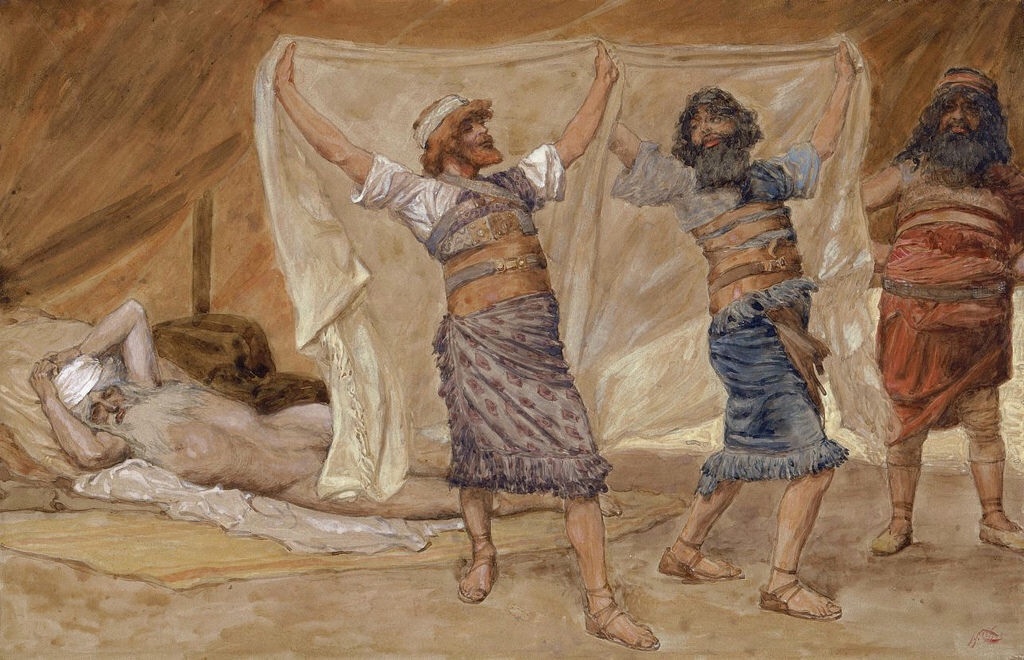
The sons of Noah who came out of the boat with their father were Shem, Ham, and Japheth. (Ham is the father of Canaan.) From these three sons of Noah came all the people who now populate the earth. After the flood, Noah began to cultivate the ground, and he planted a vineyard. One day he drank some wine he had made, and he became drunk and lay naked inside his tent. Ham, the father of Canaan, saw that his father was naked and went outside and told his brothers. Then Shem and Japheth took a robe, held it over their shoulders, and backed into the tent to cover their father. As they did this, they looked the other way so they would not see him naked. When Noah woke up from his stupor, he learned what Ham, his youngest son, had done. Then he cursed Canaan, the son of Ham: “May Canaan be cursed! May he be the lowest of servants to his relatives.” Then Noah said, “May the Lord, the God of Shem, be blessed, and may Canaan be his servant! May God expand the territory of Japheth! May Japheth share the prosperity of Shem, and may Canaan be his servant.”
Genesis 9:18-27

Dear God, this has always been a hard story for me. Even when I was a child and I first read it, I’ve never liked it. But for the purposes of this series on motherhood and fatherhood, I think it’s an important story to sit with.

We have a few things happening here. First, there is a passage of time–enough to grow grapes and then ferment them into wine. This obviously wasn’t an immediate process. There was time for them to have struggled together. The struggled through building the ark. They struggled through the experience of the ark. Now, they’ve struggled through the reestablishment of life. Did hard feelings develop over that time?

The thing I see now is Ham relishing in the idea of mocking his father. Knocking him down a peg or two. “Hey, guys. Wanna see dad drunk off his a** and naked on the ground?”

I think most fathers of children after a certain age have felt, at least once, the disdain and bitterness from a child. As much as children might experience rejection at the hands of their father or mother, mothers and fathers have felt rejection from their parents. Sometimes, the division seems insurmountable. I’ve certainly been there. I can see my children, especially when they were teens, enjoying the experience of mocking me and taking me down a peg. And I can see me lashing out in anger as Noah does.

I’ve never liked Noah’s response to Ham. It feels too harsh–especially to Canaan. But as I sit and think about this, what is a good way to hurt the son who’s hurt you? You hurt his son. From a list of Ham’s children later, I’m assuming Canaan wasn’t the oldest because he’s listed last (Genesis 10:6), but maybe he was the youngest and Ham’s favorite at the time. I don’t think this was about poor Canaan. It was about causing Ham as much pain as possible in the moment.

We never really get any resolution to this story. Noah lived another 350 years after the flood. What were those like between Ham and Noah? Canaan and Noah? Canaan and his dad, Ham? Did they ever reconcile? And why did the author give us this story? Was it to explain a superiority of their lineage over the Canaanites?

When it comes to my own life, how do I respond to my children’s disrespect and/or anger? The ugly truth is that the answer is all over the map. Sometimes I’ve actually responded in love. Sometimes I’ve given them the freedom to work through their feelings of me and waited for them to mature and see things (and me) a little differently. Sometimes! Most of the time, unfortunately, I’ve responded as Noah did–impetuous anger. It can be hard to see myself reflected in this story that I’ve never liked.

Father, help me to respect and honor my parents and my wife’s parents (living and dead). Help me to love them with your love. Help me to see them with your eyes. And with my children, help me to patiently love them as they grow. Help me to see myself through their eyes and respond to them in mercy. Help me to reveal your character to them through my responses to them. Draw them closer to yourself. Please don’t let me do anything to get in the way of your plan for them through my own foolishness, selfishness, or insecurity.

In Jesus’s name I pray,

Amen
 
Leave a comment

Posted by on December 28, 2019 in Fathers of the Bible, Genesis


Tags: ,