RSS

Tag Archives: David

Fathers of the Bible — David (Part 3)

Now it was after this that Absalom the son of David had a beautiful sister whose name was Tamar, and Amnon the son of David loved her. Amnon was so frustrated because of his sister Tamar that he made himself ill, for she was a virgin, and it seemed hard to Amnon to do anything to her. But Amnon had a friend whose name was Jonadab, the son of Shimeah, David’s brother; and Jonadab was a very shrewd man. He said to him, “O son of the king, why are you so depressed morning after morning? Will you not tell me?” Then Amnon said to him, “I am in love with Tamar, the sister of my brother Absalom.” Jonadab then said to him, “Lie down on your bed and pretend to be ill; when your father comes to see you, say to him, ‘Please let my sister Tamar come and give me some food to eat, and let her prepare the food in my sight, that I may see it and eat from her hand.’” So Amnon lay down and pretended to be ill; when the king came to see him, Amnon said to the king, “Please let my sister Tamar come and make me a couple of cakes in my sight, that I may eat from her hand.” Then David sent to the house for Tamar, saying, “Go now to your brother Amnon’s house, and prepare food for him.” So Tamar went to her brother Amnon’s house, and he was lying down. And she took dough, kneaded it, made cakes in his sight, and baked the cakes. She took the pan and dished them out before him, but he refused to eat. And Amnon said, “ Have everyone go out from me.” So everyone went out from him. Then Amnon said to Tamar, “Bring the food into the bedroom, that I may eat from your hand.” So Tamar took the cakes which she had made and brought them into the bedroom to her brother Amnon. When she brought them to him to eat, he took hold of her and said to her, “Come, lie with me, my sister.” But she answered him, “No, my brother, do not violate me, for such a thing is not done in Israel; do not do this disgraceful thing! As for me, where could I get rid of my reproach? And as for you, you will be like one of the fools in Israel. Now therefore, please speak to the king, for he will not withhold me from you.” However, he would not listen to her; since he was stronger than she, he violated her and lay with her. Then Amnon hated her with a very great hatred; for the hatred with which he hated her was greater than the love with which he had loved her. And Amnon said to her, “Get up, go away!” But she said to him, “No, because this wrong in sending me away is greater than the other that you have done to me!” Yet he would not listen to her. Then he called his young man who attended him and said, “Now throw this woman out of my presence, and lock the door behind her.” Now she had on a long-sleeved garment; for in this manner the virgin daughters of the king dressed themselves in robes. Then his attendant took her out and locked the door behind her. Tamar put ashes on her head and tore her long-sleeved garment which was on her; and she put her hand on her head and went away, crying aloud as she went. Then Absalom her brother said to her, “Has Amnon your brother been with you? But now keep silent, my sister, he is your brother; do not take this matter to heart.” So Tamar remained and was desolate in her brother Absalom’s house. Now when King David heard of all these matters, he was very angry. But Absalom did not speak to Amnon either good or bad; for Absalom hated Amnon because he had violated his sister Tamar. Now it came about after two full years that Absalom had sheepshearers in Baal-hazor, which is near Ephraim, and Absalom invited all the king’s sons. Absalom came to the king and said, “Behold now, your servant has sheepshearers; please let the king and his servants go with your servant.” But the king said to Absalom, “No, my son, we should not all go, for we will be burdensome to you.” Although he urged him, he would not go, but blessed him. Then Absalom said, “If not, please let my brother Amnon go with us.” And the king said to him, “Why should he go with you?” But when Absalom urged him, he let Amnon and all the king’s sons go with him. Absalom commanded his servants, saying, “See now, when Amnon’s heart is merry with wine, and when I say to you, ‘Strike Amnon,’ then put him to death. Do not fear; have not I myself commanded you? Be courageous and be valiant.” The servants of Absalom did to Amnon just as Absalom had commanded. Then all the king’s sons arose and each mounted his mule and fled. Now it was while they were on the way that the report came to David, saying, “Absalom has struck down all the king’s sons, and not one of them is left.” Then the king arose, tore his clothes and lay on the ground; and all his servants were standing by with clothes torn. Jonadab, the son of Shimeah, David’s brother, responded, “Do not let my lord suppose they have put to death all the young men, the king’s sons, for Amnon alone is dead; because by the intent of Absalom this has been determined since the day that he violated his sister Tamar. Now therefore, do not let my lord the king take the report to heart, namely, ‘all the king’s sons are dead,’ for only Amnon is dead.” Now Absalom had fled. And the young man who was the watchman raised his eyes and looked, and behold, many people were coming from the road behind him by the side of the mountain. Jonadab said to the king, “Behold, the king’s sons have come; according to your servant’s word, so it happened.” As soon as he had finished speaking, behold, the king’s sons came and lifted their voices and wept; and also the king and all his servants wept very bitterly. Now Absalom fled and went to Talmai the son of Ammihud, the king of Geshur. And David mourned for his son every day. So Absalom had fled and gone to Geshur, and was there three years. The heart of King David longed to go out to Absalom; for he was comforted concerning Amnon, since he was dead. Now Joab the son of Zeruiah perceived that the king’s heart was inclined toward Absalom. So Joab sent to Tekoa and brought a wise woman from there and said to her, “Please pretend to be a mourner, and put on mourning garments now, and do not anoint yourself with oil, but be like a woman who has been mourning for the dead many days; then go to the king and speak to him in this manner.” So Joab put the words in her mouth. Now when the woman of Tekoa spoke to the king, she fell on her face to the ground and prostrated herself and said, “ Help, O king.” The king said to her, “What is your trouble?” And she answered, “Truly I am a widow, for my husband is dead. Your maidservant had two sons, but the two of them struggled together in the field, and there was no one to separate them, so one struck the other and killed him. Now behold, the whole family has risen against your maidservant, and they say, ‘Hand over the one who struck his brother, that we may put him to death for the life of his brother whom he killed, and destroy the heir also.’ Thus they will extinguish my coal which is left, so as to leave my husband neither name nor remnant on the face of the earth.” Then the king said to the woman, “Go to your house, and I will give orders concerning you.” The woman of Tekoa said to the king, “O my lord, the king, the iniquity is on me and my father’s house, but the king and his throne are guiltless.” So the king said, “Whoever speaks to you, bring him to me, and he will not touch you anymore.” Then she said, “Please let the king remember the Lord your God, so that the avenger of blood will not continue to destroy, otherwise they will destroy my son.” And he said, “ As the Lord lives, not one hair of your son shall fall to the ground.” Then the woman said, “Please let your maidservant speak a word to my lord the king.” And he said, “Speak.” The woman said, “ Why then have you planned such a thing against the people of God? For in speaking this word the king is as one who is guilty, in that the king does not bring back his banished one. For we will surely die and are like water spilled on the ground which cannot be gathered up again. Yet God does not take away life, but plans ways so that the banished one will not be cast out from him. Now the reason I have come to speak this word to my lord the king is that the people have made me afraid; so your maidservant said, ‘Let me now speak to the king, perhaps the king will perform the request of his maidservant. For the king will hear and deliver his maidservant from the hand of the man who would destroy both me and my son from the inheritance of God.’ Then your maidservant said, ‘Please let the word of my lord the king be comforting, for as the angel of God, so is my lord the king to discern good and evil. And may the Lord your God be with you.’” Then the king answered and said to the woman, “Please do not hide anything from me that I am about to ask you.” And the woman said, “Let my lord the king please speak.” So the king said, “Is the hand of Joab with you in all this?” And the woman replied, “As your soul lives, my lord the king, no one can turn to the right or to the left from anything that my lord the king has spoken. Indeed, it was your servant Joab who commanded me, and it was he who put all these words in the mouth of your maidservant; in order to change the appearance of things your servant Joab has done this thing. But my lord is wise, like the wisdom of the angel of God, to know all that is in the earth.” Then the king said to Joab, “Behold now, I will surely do this thing; go therefore, bring back the young man Absalom.” Joab fell on his face to the ground, prostrated himself and blessed the king; then Joab said, “Today your servant knows that I have found favor in your sight, O my lord, the king, in that the king has performed the request of his servant.” So Joab arose and went to Geshur and brought Absalom to Jerusalem. However the king said, “Let him turn to his own house, and let him not see my face.” So Absalom turned to his own house and did not see the king’s face.
2 Samuel 13-14

Dear God, something I don’t think I’ve ever noticed this before, but Amnon made David an unwitting accomplice in his plan. It’s also interesting the language the translators use to describe what Amnon did to Tamar. This NASB choosed “violate.” The New Living Translation (a more modern so it actually uses the word “rape,” as does The Message and the NIV. King James just says “forced.” Rape is an ugly word, but that’s what it was. It was rape.

So as a dad, David had an interesting response to this rape and then Absalom’s reaction. He did nothing. It says he got angry, but, functionally, he did nothing. I am only left with assumptions, but I can’t help but wonder how his getting caught with Bathsheba (I am convinced everyone knew) caused him to give up the moral high ground with Amnon. His oldest son probably knew he had, essentially, raped Bathsheba and killed her husband after she got pregnant. Did the shame from this keep David from confronting Amnon and defending his daughter?

It’s always interesting to try and hold my children to a higher standard than I’m willing to live up to. Examples (not necessarily from my own life):

  • You have to go to church, but I don’t
  • You shouldn’t drink or do drugs in high school, but I did
  • You shouldn’t experiment sexually before marriage, but I did
  • You shouldn’t cheat in school, but I did
  • You should date and marry only Christians, but I didn’t

I have a friend who did A LOT of stuff in high school. He is a very conservative Christian now, but when he told me he did a lot of very edgy stuff as a teenager, including messing around with some sodomy. Now that he is a father of a teenager, he finds himself trying to reconcile himself between his own history and where he ended up and what he wants for his son and what he expects of his son.

The real victim here is Tamar. David simply wasn’t there for her. He didn’t even take her into the palace. He left it undone. He was an unwitting accomplice to Amnon’s sin (he had led her to the lion’s den) and he did nothing afterward. Thankfully, Absalom was at least able to show his sister some love and support. I’m not saying he did the right thing by killing Amnon and then, eventually, trying to take over his father’s throne, but I can certainly see how he ended up where he did.

Father, I am sorry for my sin. I’m sorry for the times I failed my own parents growing up and when I’ve failed you. I’m sorry for the times I didn’t provide the leadership my children needed. I’m sorry for when I’ve failed my wife. Please heal over those shortcomings so I can be the father you need me to be for my children and the husband I need to be for my wife.

In Jesus’s name I pray,

Amen


Tags: , , ,

Fathers of the Bible — David (Part 2)

When Uriah’s wife heard that her husband was dead, she mourned for him. When the period of mourning was over, David sent for her and brought her to the palace, and she became one of his wives. Then she gave birth to a son. But the Lord was displeased with what David had done. So the Lord sent Nathan the prophet to tell David this story: “There were two men in a certain town. One was rich, and one was poor. The rich man owned a great many sheep and cattle. The poor man owned nothing but one little lamb he had bought. He raised that little lamb, and it grew up with his children. It ate from the man’s own plate and drank from his cup. He cuddled it in his arms like a baby daughter. One day a guest arrived at the home of the rich man. But instead of killing an animal from his own flock or herd, he took the poor man’s lamb and killed it and prepared it for his guest.” David was furious. “As surely as the Lord lives,” he vowed, “any man who would do such a thing deserves to die! He must repay four lambs to the poor man for the one he stole and for having no pity.” Then Nathan said to David, “You are that man! The Lord, the God of Israel, says: I anointed you king of Israel and saved you from the power of Saul. I gave you your master’s house and his wives and the kingdoms of Israel and Judah. And if that had not been enough, I would have given you much, much more. Why, then, have you despised the word of the Lord and done this horrible deed? For you have murdered Uriah the Hittite with the sword of the Ammonites and stolen his wife. From this time on, your family will live by the sword because you have despised me by taking Uriah’s wife to be your own. “This is what the Lord says: Because of what you have done, I will cause your own household to rebel against you. I will give your wives to another man before your very eyes, and he will go to bed with them in public view. You did it secretly, but I will make this happen to you openly in the sight of all Israel.” Then David confessed to Nathan, “I have sinned against the Lord.” Nathan replied, “Yes, but the Lord has forgiven you, and you won’t die for this sin. Nevertheless, because you have shown utter contempt for the word of the Lord by doing this, your child will die.” After Nathan returned to his home, the Lord sent a deadly illness to the child of David and Uriah’s wife. David begged God to spare the child. He went without food and lay all night on the bare ground. The elders of his household pleaded with him to get up and eat with them, but he refused. Then on the seventh day the child died. David’s advisers were afraid to tell him. “He wouldn’t listen to reason while the child was ill,” they said. “What drastic thing will he do when we tell him the child is dead?” When David saw them whispering, he realized what had happened. “Is the child dead?” he asked. “Yes,” they replied, “he is dead.” Then David got up from the ground, washed himself, put on lotions, and changed his clothes. He went to the Tabernacle and worshiped the Lord. After that, he returned to the palace and was served food and ate. His advisers were amazed. “We don’t understand you,” they told him. “While the child was still living, you wept and refused to eat. But now that the child is dead, you have stopped your mourning and are eating again.” David replied, “I fasted and wept while the child was alive, for I said, ‘Perhaps the Lord will be gracious to me and let the child live.’ But why should I fast when he is dead? Can I bring him back again? I will go to him one day, but he cannot return to me.” Then David comforted Bathsheba, his wife, and slept with her. She became pregnant and gave birth to a son, and David named him Solomon. The Lord loved the child and sent word through Nathan the prophet that they should name him Jedidiah (which means “beloved of the Lord”), as the Lord had commanded.
2 Samuel 11:26-12:25

Dear God, what must it have been like to be Bathsheba? She was forced into adultery. Her husband was killed. Her baby (presumably her first child) died. Then, ultimately, her next son ends up being the king of Israel. She would never had guessed the life you had for her, but I can’t help but feel sorry for her and wish for her the normal life she foresaw for herself.

But in terms of David as a father, he seems very detached in this story. I think I mentioned this in my last prayer journal about this. He didn’t seem to care that he wouldn’t get to know this child. His approach to comforting Bathsheba was to sleep with her. What? As if the opportunity to have sex with him made it all better? I don’t know. Maybe it did.

I’ve also mentioned this before, but I wonder how much of David’s attitude towards women got passed down to his children. Amnon raped his sister. Solomon slept with, at minimum, hundreds of women. One of the other sons, I can’t remember which one, slept with one of David’s concubines. And I’m sure that it was a poorly kept secret what David had done with Bathsheba and Uriah. I’m sure Solomon and all of the other children grew up hearing the stories. How did that impact David’s relationships with them? Did he lose the high ground forever? When one reads 2 Samuel, this is certainly the beginning of the decline of David’s success. The apex of his joy and victory is certainly behind him at this point.

Yes, the losing of the moral high ground is probably really significant when it comes to his relationships with his children. They probably did not respect him after that. Absolom didn’t.

Father, I don’t want or need my children to see me as perfect, but I certainly want to set an example for them. A perfect example doesn’t help because it gives them an unrealistic, condemning view of what a man should be. At the same time, a life of debauchery is no good either. Help me to just be a man that follows you, is humble about his mistakes, and gives his children the love and direction that. you need them to have through me. Do it all, ultimately, for your glory so that you might live through them and enter the world through them.

In Jesus’s name I pray,

Amen

 
Leave a comment

Posted by on February 29, 2020 in 2 Samuel, Fathers of the Bible


Tags: , ,

Fathers of the Bible — David

These are the sons who were born to David in Hebron: The oldest was Amnon, whose mother was Ahinoam from Jezreel. The second was Daniel, whose mother was Abigail, the widow of Nabal from Carmel. The third was Absalom, whose mother was Maacah, the daughter of Talmai, king of Geshur. The fourth was Adonijah, whose mother was Haggith. The fifth was Shephatiah, whose mother was Abital. The sixth was Ithream, whose mother was Eglah, David’s wife. These sons were all born to David in Hebron. After moving from Hebron to Jerusalem, David married more concubines and wives, and they had more sons and daughters. These are the names of David’s sons who were born in Jerusalem: Shammua, Shobab, Nathan, Solomon, Ibhar, Elishua, Nepheg, Japhia, Elishama, Eliada, and Eliphelet.
2 Samuel 3:2-5,5:13-16

Dear God, for a long time now, David has been one of my “great man, bad father” examples.

One of the interesting things to note is that, of the first six boys born to him, they all had different mothers. Another interesting thing. Right before Solomon, it lists Nathan. Is this Bathsheba’s first child that died? Did they name him after the prophet that confronted David with his sin? Interesting.

You know that I started wondering last year about whether or not David would have made an even better judge for Israel than king. Was it the power of being king that corrupted his heart and distracted him? Not that Samuel was that great of a father. It’s just an interesting question.

We will see some interesting stories coming up about David’s parenting. Amnon will do something reprehensible–what will David do? Absolom will respond to Amnon’s action–what will David do? Even when Bathsheba’s baby dies, David’s response is peculiar. He didn’t seem to care about this child as his own. He didn’t mourn not getting to spend the rest of his life with this child. He treated it more as a random life for which he had responsibility, and he cared whether or not you would save it. When you didn’t, he moved on. I wonder if this story by itself gives us the insight we need into how David felt as a father. Is this how all fathers felt back then? Was this the cultural norm?

Father, you know how I feel about my children. It fascinates me how much of my thoughts they consume, even now that they are in their 20s. I hope for them. I pray for them every day. I reach out to them. I try to show them love. But now that they are older, I also try to back off enough so that they can have the space they need to develop their own relationships with you. Help me to find that line. Help me to be exactly what you need me to be for them. I’m sorry for how I’ve failed them and failed you in the past. I know I’ve let my own ego get wrapped up in my responses to them. I’m doing my best to not let that happen anymore.

In Jesus’s name I pray,

Amen

 
Leave a comment

Posted by on February 27, 2020 in 2 Samuel, Fathers of the Bible


Tags:

Fathers of the Bible — Saul (Part 2)

Saul now urged his servants and his son Jonathan to assassinate David. But Jonathan, because of his strong affection for David, told him what his father was planning. “Tomorrow morning,” he warned him, “you must find a hiding place out in the fields. I’ll ask my father to go out there with me, and I’ll talk to him about you. Then I’ll tell you everything I can find out.” The next morning Jonathan spoke with his father about David, saying many good things about him. “The king must not sin against his servant David,” Jonathan said. “He’s never done anything to harm you. He has always helped you in any way he could. Have you forgotten about the time he risked his life to kill the Philistine giant and how the Lord brought a great victory to all Israel as a result? You were certainly happy about it then. Why should you murder an innocent man like David? There is no reason for it at all!” So Saul listened to Jonathan and vowed, “As surely as the Lord lives, David will not be killed.” Afterward Jonathan called David and told him what had happened. Then he brought David to Saul, and David served in the court as before. Then Saul sent troops to watch David’s house. They were told to kill David when he came out the next morning. But Michal, David’s wife, warned him, “If you don’t escape tonight, you will be dead by morning.” So she helped him climb out through a window, and he fled and escaped. Then she took an idol and put it in his bed, covered it with blankets, and put a cushion of goat’s hair at its head. When the troops came to arrest David, she told them he was sick and couldn’t get out of bed. But Saul sent the troops back to get David. He ordered, “Bring him to me in his bed so I can kill him!” But when they came to carry David out, they discovered that it was only an idol in the bed with a cushion of goat’s hair at its head. “Why have you betrayed me like this and let my enemy escape?” Saul demanded of Michal. “I had to,” Michal replied. “He threatened to kill me if I didn’t help him.” David now fled from Naioth in Ramah and found Jonathan. “What have I done?” he exclaimed. “What is my crime? How have I offended your father that he is so determined to kill me?” “That’s not true!” Jonathan protested. “You’re not going to die. He always tells me everything he’s going to do, even the little things. I know my father wouldn’t hide something like this from me. It just isn’t so!” Then David took an oath before Jonathan and said, “Your father knows perfectly well about our friendship, so he has said to himself, ‘I won’t tell Jonathan—why should I hurt him?’ But I swear to you that I am only a step away from death! I swear it by the Lord and by your own soul!” “Tell me what I can do to help you,” Jonathan exclaimed. David replied, “Tomorrow we celebrate the new moon festival. I’ve always eaten with the king on this occasion, but tomorrow I’ll hide in the field and stay there until the evening of the third day. If your father asks where I am, tell him I asked permission to go home to Bethlehem for an annual family sacrifice. If he says, ‘Fine!’ you will know all is well. But if he is angry and loses his temper, you will know he is determined to kill me. Show me this loyalty as my sworn friend—for we made a solemn pact before the Lord —or kill me yourself if I have sinned against your father. But please don’t betray me to him!” “Never!” Jonathan exclaimed. “You know that if I had the slightest notion my father was planning to kill you, I would tell you at once.” Then David asked, “How will I know whether or not your father is angry?” “Come out to the field with me,” Jonathan replied. And they went out there together. Then Jonathan told David, “I promise by the Lord, the God of Israel, that by this time tomorrow, or the next day at the latest, I will talk to my father and let you know at once how he feels about you. If he speaks favorably about you, I will let you know. But if he is angry and wants you killed, may the Lord strike me and even kill me if I don’t warn you so you can escape and live. May the Lord be with you as he used to be with my father. And may you treat me with the faithful love of the Lord as long as I live. But if I die, treat my family with this faithful love, even when the Lord destroys all your enemies from the face of the earth.” So Jonathan made a solemn pact with David, saying, “May the Lord destroy all your enemies!” And Jonathan made David reaffirm his vow of friendship again, for Jonathan loved David as he loved himself. Then Jonathan said, “Tomorrow we celebrate the new moon festival. You will be missed when your place at the table is empty. The day after tomorrow, toward evening, go to the place where you hid before, and wait there by the stone pile. I will come out and shoot three arrows to the side of the stone pile as though I were shooting at a target. Then I will send a boy to bring the arrows back. If you hear me tell him, ‘They’re on this side,’ then you will know, as surely as the Lord lives, that all is well, and there is no trouble. But if I tell him, ‘Go farther—the arrows are still ahead of you,’ then it will mean that you must leave immediately, for the Lord is sending you away. And may the Lord make us keep our promises to each other, for he has witnessed them.” So David hid himself in the field, and when the new moon festival began, the king sat down to eat. He sat at his usual place against the wall, with Jonathan sitting opposite him and Abner beside him. But David’s place was empty. Saul didn’t say anything about it that day, for he said to himself, “Something must have made David ceremonially unclean.” But when David’s place was empty again the next day, Saul asked Jonathan, “Why hasn’t the son of Jesse been here for the meal either yesterday or today?” Jonathan replied, “David earnestly asked me if he could go to Bethlehem. He said, ‘Please let me go, for we are having a family sacrifice. My brother demanded that I be there. So please let me get away to see my brothers.’ That’s why he isn’t here at the king’s table.” Saul boiled with rage at Jonathan. “You stupid son of a whore!” he swore at him. “Do you think I don’t know that you want him to be king in your place, shaming yourself and your mother? As long as that son of Jesse is alive, you’ll never be king. Now go and get him so I can kill him!” “But why should he be put to death?” Jonathan asked his father. “What has he done?” Then Saul hurled his spear at Jonathan, intending to kill him. So at last Jonathan realized that his father was really determined to kill David. Jonathan left the table in fierce anger and refused to eat on that second day of the festival, for he was crushed by his father’s shameful behavior toward David. The next morning, as agreed, Jonathan went out into the field and took a young boy with him to gather his arrows. “Start running,” he told the boy, “so you can find the arrows as I shoot them.” So the boy ran, and Jonathan shot an arrow beyond him. When the boy had almost reached the arrow, Jonathan shouted, “The arrow is still ahead of you. Hurry, hurry, don’t wait.” So the boy quickly gathered up the arrows and ran back to his master. He, of course, suspected nothing; only Jonathan and David understood the signal. Then Jonathan gave his bow and arrows to the boy and told him to take them back to town. As soon as the boy was gone, David came out from where he had been hiding near the stone pile. Then David bowed three times to Jonathan with his face to the ground. Both of them were in tears as they embraced each other and said good-bye, especially David. At last Jonathan said to David, “Go in peace, for we have sworn loyalty to each other in the Lord’s name. The Lord is the witness of a bond between us and our children forever.” Then David left, and Jonathan returned to the town.
1 Samuel 19:1-7,11-17,20:1-42

Dear God, I don’t know if these stories are as much about Saul’s parenting as they are about a deranged king, but Jonathan and Michal has to deal with him as a dad so I guess they are fair game for this little series.

I guess the thing I’ve always admired about Jonathan is that he wasn’t threatened by David. He was okay with not being king. Saul, on the other hand, was consumed with the thought of David replacing his family as king.

I’m sure that at some point after Samuel’s anointing and David’s arrival Saul had dreams of his lineage being the king of Israel forever. He probably looked at his boys and their boys and already had their succession order figured out. It’s part of our vanity. Part of our sinful nature seems to be to want to be known from a fake and power standpoint. If we live a quiet faithful life, we consider it a waste. We must leave our mark!!

I suppose Saul could have responded differently to Samuel’s speech about you taking the kingdom from him (1 Samuel 15:28). He could have submitted to it. He could have asked Samuel, okay, what do I do now? But there’s no way he could voluntarily let go of that power and it poisoned him from then on. Outside of Lyndon Johnson, no president of the United States has ever not run for a second term, and I’m sure some of them considered it.

Then there is how his children were forced to respond to him. They had to lie. They had to hide and scheme. How would their lives have been different, or even better, if they had been able to yield to David’s throne. If David had not been on the run from Saul and living in exile, would Jonathan have lived longer? Would Saul?

Father, as I parent my children, help me to do it in the moment. As I express love and support for them, help me to detach my ego from it. I don’t want anything to get in the way of what you need me to do for them. And I know I’ve failed at this in the past. I’ve felt sorry for myself more times than I can count. I’ve even had bouts of it this weekend. But that does them no good. It does me no good. And it brings you no glory. I am very sorry for the ways in which I am like Saul and look to my children to feed my ego.

In Jesus’s name I pray,

Amen

 
Leave a comment

Posted by on February 24, 2020 in 1 Samuel, Fathers of the Bible


Tags: , , ,

1 King’s 12:26

Jeroboam thought to himself, “Unless I am careful, the kingdom will return to the dynasty of David.
1 Kings 12:26

Dear God, I should have gone just half of a chapter further when I did my study of Solomon a few months ago. I read Fred Smith’s weekly blog this morning and it was about Jeroboam’s reign as king and how it not only went south, but influenced Israelite Kong’s for generations. It lead me to go back and look at his life to see what I can learn. When I went back to 1 Kings, I found this verse. There’s a concept that seems like the original sin that set up all of the others. He decided that hanging onto the tribe for himself was the most important priority.

Contrast that with David. David, a flawed and sinful man whom power corrupted with the indulgences of lust and self gratification still had one thing right when it came to his life. He knew that everything was from you and for your will to be done it would have to remain your right to give and take the throne any time you wanted. He wouldn’t take it from Saul (1 Samuel 24:6-7) and he wouldn’t keep it from Absolom (2 Samuel 15:25-26). He allowed himself to indulge his vices (which caused him countless problems), but he had his overall philosophy and theology correct. He didn’t try to force his will upon you.

Father, I know I have a will that wants to dictate what I allow you to do. I have a will about being safe within my job and my income. I have a will when it comes to what I want my marriage to look like. I have a will about what I how I want my children’s lives to go. But that’s not the prayer Jesus taught us. Let your kingdom come and your will be done on Earth as it is in Heaven. That is my prayer today. Make me sensitive to your will, and help me to be willing to put it all on the table for your will and your glory.

In Jesus’s name I pray,

Amen

 
Leave a comment

Posted by on December 7, 2019 in 1 Kings


Tags: , , , , , ,

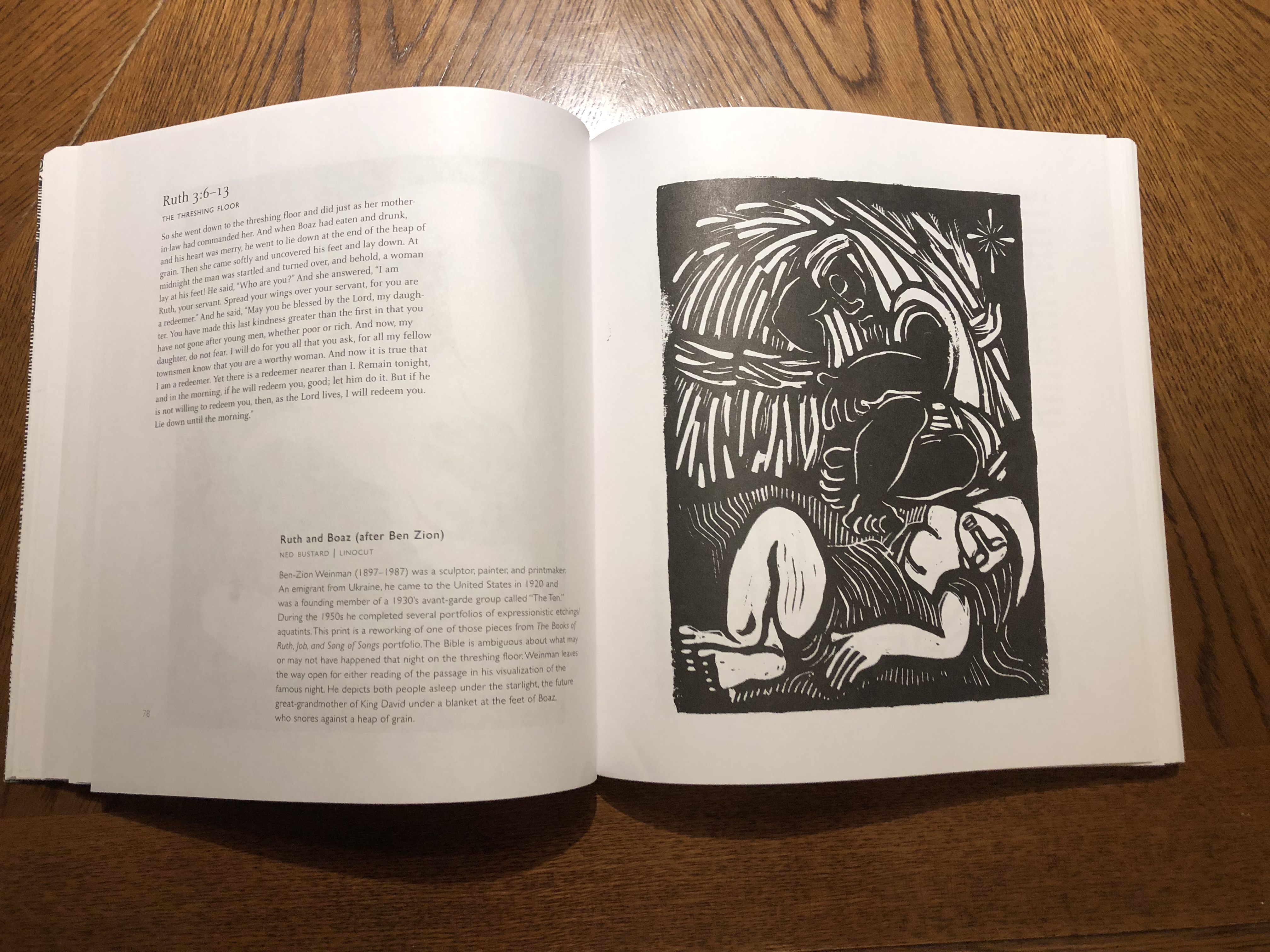
Revealed: A Storybook Bible for Grown-Ups — The Threshing Floor (Ruth 3:6-13)


The above image is from Revealed: A Storybook Bible for Grown-Ups by Ned Bustard. The image itself is called “Ruth and Boaz (after Ben Zion)” and was created by Ned Bustard. 

So she went down to the threshing floor that night and followed the instructions of her mother-in-law. After Boaz had finished eating and drinking and was in good spirits, he lay down at the far end of the pile of grain and went to sleep. Then Ruth came quietly, uncovered his feet, and lay down. Around midnight Boaz suddenly woke up and turned over. He was surprised to find a woman lying at his feet! “Who are you?” he asked. “I am your servant Ruth,” she replied. “Spread the corner of your covering over me, for you are my family redeemer.” “The Lord bless you, my daughter!” Boaz exclaimed. “You are showing even more family loyalty now than you did before, for you have not gone after a younger man, whether rich or poor. Now don’t worry about a thing, my daughter. I will do what is necessary, for everyone in town knows you are a virtuous woman. But while it’s true that I am one of your family redeemers, there is another man who is more closely related to you than I am. Stay here tonight, and in the morning I will talk to him. If he is willing to redeem you, very well. Let him marry you. But if he is not willing, then as surely as the Lord lives, I will redeem you myself! Now lie down here until morning.”
Ruth 3:6-13

Dear God, I’ve spent some time looking at Ruth and Boaz, but I don’t know remember spending too much time thinking about Boaz himself. You know, trying to get into his skin. To do that, we have to go back to his introduction in chapter 2. Here are some verses in chapter 2 that are striking me about him and his character:

Boaz went over and said to Ruth, “Listen, my daughter. Stay right here with us when you gather grain; don’t go to any other fields Stay right behind the young women working in my field. See which part of the field they are harvesting, and then follow them. I have warned the young men not to treat you roughly. And when you are thirsty, help yourself to water they have drawn from the well.” (Ruth 2:8-9)

Not only did Boaz provide food for her, but he also cast a net of physical protection over her. I have been reminded over and over again how vulnerable women are to physical harm. I was talking with a friend yesterday morning about our daughters and wishing we could protect them better. My wife and I have talked about her uneasiness walking in crowds and fear of being groped by an anonymous man walking by. These just aren’t fears that I have, but they are real and legitimate fears for women. In fact, until this morning, I don’t think I’ve ever given much thought to the physical danger Ruth was in by going out to glean in the fields. But Boaz thought about it.  Why did he care so much? What was it about Ruth that got his attention?

“Yes, I know,” Boaz replied. “But I also know about everything you have done for your mother-in-law since the death of your husband. I have heard how you left your father and mother and your own land to live here among complete strangers. May the LORD, the God of Israel, under whose wings you have come to take refuge, reward you fully for what you have done.” (Ruth 2:11-12)

I think that speaks for itself. So I guess my question is, were Ruth and Naomi manipulating Boaz in chapter 3? At the end of the day, I suppose this was part of the culture at the time. In fact, I don’t know that I’ll ever fully understand this story because I don’t understand the culture of that time and place enough. But I do know that this ended up being part of your plan because these two people became David’s great-grandparents. Boaz did a lot of wonderful things, but he never knew he had done this. He was faithful in what you had given to him to steward, and the results would have been beyond anything he ever would have dreamed.

I suppose I would be remiss if I didn’t go back to this image by Bustard and at least say what he had to say about it in his book:

Ben-Zion Weinman (1897-1987) was a sculptor, painter, and printmaker. An emigrant from Ukraine, he came to the United States in 1920 and was a founding member of a 1930’s avant-garde group called “The Ten.” Curing the 1950s he completed several portfolios of expressionistic etchings/aquatints. This print is a reworking of one of those pieces from The Books of Ruth, Job, and Song of Songs portfolio. The Bible is ambiguous about what may or may not have happened that night on the threshing floor: Weinman leaves the way open for either reading of the passage in his visualization of the famous night. He depicts both people asleep under the starlight, the future great-grandmother of King David under a blanket at the feed of Boaz, who snores against a heap of grain.

I looked for the original, and I couldn’t be sure which image was the one that Bustard used as the inspiration, but it’s interesting to consider that the author of Ruth left the events of that night vague. I’d never considered that before. I just took it for what was written on the page. Perhaps I’m naïve.

Father, help me to be faithful this day. Help me to not look to my legacy or my future because I have zero idea how you might be using me. The author Gary Thomas said in one of his books (it might have been Sacred Parenting) that our role in history is to be born, possibly procreate, and then get out of the way. What you do with our lives after that is up to you. Help me to embrace that simplicity and to offer you this one life that I get on earth to further your kingdom and your glory.

In Jesus’s name I pray,

Amen


Tags: , , , , ,

Solomon — 1 Chronicles 22:2-19

So David gave orders to call together the foreigners living in Israel, and he assigned them the task of preparing finished stone for building the Temple of God. David provided large amounts of iron for the nails that would be needed for the doors in the gates and for the clamps, and he gave more bronze than could be weighed. He also provided innumerable cedar logs, for the men of Tyre and Sidon had brought vast amounts of cedar to David. David said, “My son Solomon is still young and inexperienced. And since the Temple to be built for the Lord must be a magnificent structure, famous and glorious throughout the world, I will begin making preparations for it now.” So David collected vast amounts of building materials before his death. Then David sent for his son Solomon and instructed him to build a Temple for the Lord, the God of Israel. “My son, I wanted to build a Temple to honor the name of the Lord my God,” David told him. “But the Lord said to me, ‘You have killed many men in the battles you have fought. And since you have shed so much blood in my sight, you will not be the one to build a Temple to honor my name. But you will have a son who will be a man of peace. I will give him peace with his enemies in all the surrounding lands. His name will be Solomon, and I will give peace and quiet to Israel during his reign. He is the one who will build a Temple to honor my name. He will be my son, and I will be his father. And I will secure the throne of his kingdom over Israel forever.’ “Now, my son, may the Lord be with you and give you success as you follow his directions in building the Temple of the Lord your God. And may the Lord give you wisdom and understanding, that you may obey the Law of the Lord your God as you rule over Israel. For you will be successful if you carefully obey the decrees and regulations that the Lord gave to Israel through Moses. Be strong and courageous; do not be afraid or lose heart! “I have worked hard to provide materials for building the Temple of the Lord —nearly 4,000 tons of gold, 40,000 tons of silver, and so much iron and bronze that it cannot be weighed. I have also gathered timber and stone for the walls, though you may need to add more. You have a large number of skilled stonemasons and carpenters and craftsmen of every kind. You have expert goldsmiths and silversmiths and workers of bronze and iron. Now begin the work, and may the Lord be with you!” Then David ordered all the leaders of Israel to assist Solomon in this project. “The Lord your God is with you,” he declared. “He has given you peace with the surrounding nations. He has handed them over to me, and they are now subject to the Lord and his people. Now seek the Lord your God with all your heart and soul. Build the sanctuary of the Lord God so that you can bring the Ark of the Lord’s Covenant and the holy vessels of God into the Temple built to honor the Lord ’s name.”
1 Chronicles 22:2-19

Dear God, I know I talked about this before when I covered the beginning of Solomon’s reign in 1 Kings, but it bears repeating that a lot of people worked very hard to hand a fully developed kingdom over to Solomon. He got a pretty turn-key situation.

I pretty much inherited the same kind of thing at my job, although on a much, much smaller scale. Heck, you could probably say the same thing for my life in general. I was born in this country which was built by the sacrifice (sometimes the ultimate sacrifice) of a lot of people. I was born into a family that gave me a chance at education and advancement in life. Yes, I walked into life, adulthood, and even this job with a lot of advantages. So what am I doing with them? Am I willing to do the hard work to live up to this responsibility. Am I ready to continue to worship you when my heart is “prone to wander” (as the line from “Come Thou Fount” says)?

Father, all I have is today…this moment. I can’t get too far out into the future or I will lose my focus on you. I can’t be tied down in the past or I won’t experience your victory. So help me to take advantage of this moment. Help me to start with worshipping you and spending time with you. Then help me to take the love you give me and give it to others around me. And finally, help me to respond to your calls to action and use the life you’ve given me so that you might enter the world as much as possible.

In Jesus’s name I pray,

Amen

 
Leave a comment

Posted by on August 23, 2019 in 1 Chronicles, Solomon


Tags: , ,

Solomon — 1 Kings 11:41-12:4

The rest of the events in Solomon’s reign, including all his deeds and his wisdom, are recorded in The Book of the Acts of Solomon. Solomon ruled in Jerusalem over all Israel for forty years. When he died, he was buried in the City of David, named for his father. Then his son Rehoboam became the next king. Rehoboam went to Shechem, where all Israel had gathered to make him king. When Jeroboam son of Nebat heard of this, he returned from Egypt, for he had fled to Egypt to escape from King Solomon. The leaders of Israel summoned him, and Jeroboam and the whole assembly of Israel went to speak with Rehoboam. “Your father was a hard master,” they said. “Lighten the harsh labor demands and heavy taxes that your father imposed on us. Then we will be your loyal subjects.”
1 Kings 11:41-12:4

Dear God, I’m going to wrap up the 1 Kings telling of Solomon’s story by looking again at this initial exchange between Israel’s leaders and Rehoboam. Apparently, by the end of Solomon’s reign we know there were two pretty distinctly negative things about him:

  1. He worshiped other gods because of his many, many wives.
    He was a harsh king that gave people harsh labor and high taxes.

It takes me back to 1 Samuel 8 when Samuel warned the people who were then the leaders of Israel:

“This is how a king will reign over you,” Samuel said. “The king will draft your sons and assign them to his chariots and his charioteers, making them run before his chariots. Some will be generals and captains in his army, some will be forced to plow in his fields and harvest his crops, and some will make his weapons and chariot equipment. The king will take your daughters from you and force them to cook and bake and make perfumes for him. He will take away the best of your fields and vineyards and olive groves and give them to his own officials. He will take a tenth of your grain and your grape harvest and distribute it among his officers and attendants. He will take your male and female slaves and demand the finest of your cattle and donkeys for his own use. He will demand a tenth of your flocks, and you will be his slaves. When that day comes, you will beg for relief from this king you are demanding, but then the Lord will not help you.”
1 Samuel 8:11-18

I’ve mused in these journals what Israel (and David) would have looked like if David had been a judge and not a king. I think David’s life would have played out completely differently. Even if he had been more of a warrior judge like Joshua instead of a spiritual leader judge, he still would have lived a much different life. But I suppose that any of us that make ourselves king, whether it be in reality or figuratively in our own minds or families, will end up needing people to rule over. That can include a spouse or children. But if we can keep thinking of ourselves as your servants and the servants of those whom you called us to love, them we have a chance at being more useful to you and getting more done in the long run.

Father, help me to be exactly who you need me to be for those around me. Use my life to draw others’ hearts to you. Increase through me and help me to decrease. Do it all for your glory and so that you are worshipped.

In Jesus’s name I pray,

Amen

 
Leave a comment

Posted by on August 22, 2019 in 1 Kings, 1 Samuel, Solomon


Tags: , , , , ,

Solomon — 1 Kings 1:38-40

So Zadok the priest, Nathan the prophet, Benaiah son of Jehoiada, and the king’s bodyguard took Solomon down to Gihon Spring, with Solomon riding on King David’s own mule. There Zadok the priest took the flask of olive oil from the sacred tent and anointed Solomon with the oil. Then they sounded the ram’s horn and all the people shouted, “Long live King Solomon!” And all the people followed Solomon into Jerusalem, playing flutes and shouting for joy. The celebration was so joyous and noisy that the earth shook with the sound.
1 Kings 1:38-40

Dear God, I wish we had more about Solomon’s relationships with Bathsheba, David, and all of the people involved with his ascent to the throne. One thing I’ve noticed in the telling of this story is that Adonijah was a self promoter while the author here had yet to tell us anything that Solomon has said on his own behalf. We won’t get a quote from him until he has to deal with Adonijah at the end of this chapter.

The other interesting thing is the the writer goes out of his way to tell us that Adonijah was spoiled and undisciplined. What kind of a mother was Bathsheba? I’m betting she disciplined her children. At least Solomon was thought enough of by Nathan, et. al., to be promoted and desired as the next king.

But back to the subtext of the fact that the author is careful to contrast Adonijah and Solomon by who they did and didn’t promote themselves. My dad told me one time when I was young that if I ever got a promotion at work, on my first day in the new job I would likely not see much difference in my future because I had already been doing those things. The message that I received in that was, “Work hard and let the reward come from the hard work.” In words my wife, the writer would use, “Show, don’t tell.”

Father, we are still a few chapters and executions away from Solomon asking you for wisdom, but I want to continue to seek that from you. Help me to simply serve you and then let your plan unfold around me. My biggest danger is allowing inaction and lethargy to keep me from what you’ve called me to do. So please make your call clear to me. I repent for the things I’ve done and the things I’ve failed to do.

In Jesus’s name I pray,

Amen

 
Leave a comment

Posted by on July 7, 2019 in 1 Kings, Solomon


Tags: , , , , ,

Solomon – 1 Kings 1:1-14

King David was now very old, and no matter how many blankets covered him, he could not keep warm. So his advisers told him, “Let us find a young virgin to wait on you and look after you, my lord. She will lie in your arms and keep you warm.” So they searched throughout the land of Israel for a beautiful girl, and they found Abishag from Shunem and brought her to the king. The girl was very beautiful, and she looked after the king and took care of him. But the king had no sexual relations with her. About that time David’s son Adonijah, whose mother was Haggith, began boasting, “I will make myself king.” So he provided himself with chariots and charioteers and recruited fifty men to run in front of him. Now his father, King David, had never disciplined him at any time, even by asking, “Why are you doing that?” Adonijah had been born next after Absalom, and he was very handsome. Adonijah took Joab son of Zeruiah and Abiathar the priest into his confidence, and they agreed to help him become king. But Zadok the priest, Benaiah son of Jehoiada, Nathan the prophet, Shimei, Rei, and David’s personal bodyguard refused to support Adonijah. Adonijah went to the Stone of Zoheleth near the spring of En-rogel, where he sacrificed sheep, cattle, and fattened calves. He invited all his brothers—the other sons of King David—and all the royal officials of Judah. But he did not invite Nathan the prophet or Benaiah or the king’s bodyguard or his brother Solomon. Then Nathan went to Bathsheba, Solomon’s mother, and asked her, “Haven’t you heard that Haggith’s son, Adonijah, has made himself king, and our lord David doesn’t even know about it? If you want to save your own life and the life of your son Solomon, follow my advice. Go at once to King David and say to him, ‘My lord the king, didn’t you make a vow and say to me, “Your son Solomon will surely be the next king and will sit on my throne”? Why then has Adonijah become king?’ And while you are still talking with him, I will come and confirm everything you have said.”
1 Kings 1:1-14

Dear God, I think it is important to note that the story of Solomon cannot be told without including Nathan. Nathan is woven throughout Solomon’s (and Bathsheba’s) story. He is the prophet whom David consults about building the temple (2 Samuel 7). He is the prophet who rebukes David about what he did with Bathsheba and Uriah, and through you gave Solomon a new name–Jedidiah (2 Samuel 12). And now he is the prophet who orchestrates Solomon’s rise to the throne (1 Kings 1). Interestingly, these are the only three stories we get about Nathan.

I normally do these journals to you first thing in the morning, but as I opened the scriptures today I found myself with a lot of questions and researching a lot of things. First, I went to 1 Chronicles to see how it recorded the transition from David’s rule to Solomon’s. I was surprised to see a completely different portrait painted. The accounting of it in Chronicles was much tidier and more honorable. It really focused on David’s passing the torch to Solomon to build the temple. But I’ll talk about the temple another time. Today, I want to talk about Nathan.

I had a new thought today that I don’t think I’ve had before. Nathan apparently had a soft spot in his heart for Bathsheba and Solomon. I won’t say that he knew about David’s sin with Bathsheba before anyone else did. I’ll bet is was actually a pretty poorly kept secret. But he was the one willing to confront David. He was the one who spoke out on your behalf and on behalf of the woman. He watched her go through the loss of her child. He watched her give birth to Solomon. He got the word from you that Solomon was special and to be renamed Jedidiah (I wonder why that name didn’t stick–I searched the entire Bible, and 2 Samuel 12:25 is the only time it is ever mentioned).

Fast forward many years. David is at the end of his life and his fourth-born son, Adonijah (the first three are seemingly dead) starts to position himself for the throne. 1 Kings 1:6 seems to go out of its way to tell us that he wasn’t a good guy, but was spoiled and undisciplined. This apparently got Nathan’s attention and he decided it was time to act on behalf of the boy whom you had told him to rename and his mother.

Nathan probably doesn’t get enough love from history. Yes, the writer of Samuel and Kings gives us what we need to know about his role in things, but it’s almost too brief. I almost missed it. He was apparently a man who cared about your righteousness enough to speak truth to power and then risk his life to do what he perceived to be your will.

Father, make me a man of this kind of courage. Help me to know when to speak and when not to speak. Help me to know when to act and when not to act. God, grant me the serenity to accept the things I cannot change, the courage to change the things I can, and the wisdom to know the difference. But do it in reverse order of that prayer. Give me the wisdom to know when you are calling me to act, when you are calling me to not act but pray, and when you are calling me to accept a situation. Give me the courage to follow your call. And when it is time to accept your judgment and a situation about which I am to do nothing, fill me with your peace.

In Jesus’s name I pray,

Amen

 
Leave a comment

Posted by on July 5, 2019 in 1 Kings, 2 Samuel, Solomon


Tags: , , , , ,