RSS

Tag Archives: Daniel

Daniel 6

Darius the Mede decided to divide the kingdom into 120 provinces, and he appointed a high officer to rule over each province. The king also chose Daniel and two others as administrators to supervise the high officers and protect the king’s interests. Daniel soon proved himself more capable than all the other administrators and high officers. Because of Daniel’s great ability, the king made plans to place him over the entire empire.

Then the other administrators and high officers began searching for some fault in the way Daniel was handling government affairs, but they couldn’t find anything to criticize or condemn. He was faithful, always responsible, and completely trustworthy. So they concluded, “Our only chance of finding grounds for accusing Daniel will be in connection with the rules of his religion.”

So the administrators and high officers went to the king and said, “Long live King Darius! We are all in agreement—we administrators, officials, high officers, advisers, and governors—that the king should make a law that will be strictly enforced. Give orders that for the next thirty days any person who prays to anyone, divine or human—except to you, Your Majesty—will be thrown into the den of lions. And now, Your Majesty, issue and sign this law so it cannot be changed, an official law of the Medes and Persians that cannot be revoked.” So King Darius signed the law.

10 But when Daniel learned that the law had been signed, he went home and knelt down as usual in his upstairs room, with its windows open toward Jerusalem. He prayed three times a day, just as he had always done, giving thanks to his God. 11 Then the officials went together to Daniel’s house and found him praying and asking for God’s help. 12 So they went straight to the king and reminded him about his law. “Did you not sign a law that for the next thirty days any person who prays to anyone, divine or human—except to you, Your Majesty—will be thrown into the den of lions?”

“Yes,” the king replied, “that decision stands; it is an official law of the Medes and Persians that cannot be revoked.”

13 Then they told the king, “That man Daniel, one of the captives from Judah, is ignoring you and your law. He still prays to his God three times a day.”

14 Hearing this, the king was deeply troubled, and he tried to think of a way to save Daniel. He spent the rest of the day looking for a way to get Daniel out of this predicament.

15 In the evening the men went together to the king and said, “Your Majesty, you know that according to the law of the Medes and the Persians, no law that the king signs can be changed.”

16 So at last the king gave orders for Daniel to be arrested and thrown into the den of lions. The king said to him, “May your God, whom you serve so faithfully, rescue you.”

17 A stone was brought and placed over the mouth of the den. The king sealed the stone with his own royal seal and the seals of his nobles, so that no one could rescue Daniel. 18 Then the king returned to his palace and spent the night fasting. He refused his usual entertainment and couldn’t sleep at all that night.

19 Very early the next morning, the king got up and hurried out to the lions’ den. 20 When he got there, he called out in anguish, “Daniel, servant of the living God! Was your God, whom you serve so faithfully, able to rescue you from the lions?”

21 Daniel answered, “Long live the king! 22 My God sent his angel to shut the lions’ mouths so that they would not hurt me, for I have been found innocent in his sight. And I have not wronged you, Your Majesty.”

23 The king was overjoyed and ordered that Daniel be lifted from the den. Not a scratch was found on him, for he had trusted in his God.

24 Then the king gave orders to arrest the men who had maliciously accused Daniel. He had them thrown into the lions’ den, along with their wives and children. The lions leaped on them and tore them apart before they even hit the floor of the den.

25 Then King Darius sent this message to the people of every race and nation and language throughout the world:

“Peace and prosperity to you!

26 “I decree that everyone throughout my kingdom should tremble with fear before the God of Daniel.

For he is the living God,
    and he will endure forever.
His kingdom will never be destroyed,
    and his rule will never end.
27 He rescues and saves his people;
    he performs miraculous signs and wonders
    in the heavens and on earth.
He has rescued Daniel
    from the power of the lions.”

28 So Daniel prospered during the reign of Darius and the reign of Cyrus the Persian.

Daniel 6

Dear God, I had an interesting thought as I read this story this morning: Should Daniel have tried to stop King Darius from killing the plotters and their families? Should he have said, “No, King. Have mercy”? And if the men needed to die, did their wives and children need to die too? I can see why Darius made this decision. He was a worldly king who made worldly decisions. But should Daniel have used it as a teachable moment for all of them? I honestly don’t know the answer to any of these questions, but they are the questions that came to mind when I read this story.

As I type this prayer to you, it is Thanksgiving morning. It’s a quiet morning for my wife and me. She is out walking the dog. I am taking advantage of this moment of solitude to pray to you. Holy Spirit, sit with me and talk with me as I make this moment intentional.

When I first started this morning and before I found the Daniel passage as the Old Testament reading for the day, I was thinking about Abraham Lincoln’s first Thanksgiving proclamation. It was published in October 1863 and decreed that the last Thursday of November should be a national day of Thanksgiving. I think we’ve tweaked it since then to make it the Thursday before the last weekend of November, but the tradition still stands. What’s remarkable to me about the proclamation is that it was set right in the middle of the Civil War. He found things to be grateful for in the midst of unimaginable suffering and anxiety, and he thought it was the best thing for the nation to be able to recognize the good in their lives. It is still that way. In the midst of a stressful year–and it has been a stressful year–the healthiest thing we can do is worship you and give thanks.

Father, as I sit here this morning, my life is not exactly the way I want it to be. I have sorrows and sadness. But there is so much that I’m taking for granted and ungrateful for in the midst of that sorrow, and my lack of gratitude is killing the fruit you are trying to grow in me. If I am ungrateful for the good and only focus on what I perceive to be bad (even though you might be using it and working the “bad” to be good, and I just cannot see it) then I will miss the opportunity to worship you, be grateful for what I have–starting with you–and then let your Spirit flow through me. I’m going to church here in a few minutes. I pledge to make it a time of great thanksgiving from my heart and worship of you.

I pray this in Jesus and with your Holy Spirit,

Amen
 
Leave a comment

Posted by on November 27, 2025 in Daniel


Tags: , , , , , , , , ,

Daniel 5 (with some Daniel 3)

Many years later King Belshazzar gave a great feast for 1,000 of his nobles, and he drank wine with them. While Belshazzar was drinking the wine, he gave orders to bring in the gold and silver cups that his predecessor, Nebuchadnezzar, had taken from the Temple in Jerusalem. He wanted to drink from them with his nobles, his wives, and his concubines. So they brought these gold cups taken from the Temple, the house of God in Jerusalem, and the king and his nobles, his wives, and his concubines drank from them. While they drank from them they praised their idols made of gold, silver, bronze, iron, wood, and stone.

Suddenly, they saw the fingers of a human hand writing on the plaster wall of the king’s palace, near the lampstand. The king himself saw the hand as it wrote, and his face turned pale with fright. His knees knocked together in fear and his legs gave way beneath him.

The king shouted for the enchanters, astrologers, and fortune-tellers to be brought before him. He said to these wise men of Babylon, “Whoever can read this writing and tell me what it means will be dressed in purple robes of royal honor and will have a gold chain placed around his neck. He will become the third highest ruler in the kingdom!”

But when all the king’s wise men had come in, none of them could read the writing or tell him what it meant. So the king grew even more alarmed, and his face turned pale. His nobles, too, were shaken.

10 But when the queen mother heard what was happening, she hurried to the banquet hall. She said to Belshazzar, “Long live the king! Don’t be so pale and frightened. 11 There is a man in your kingdom who has within him the spirit of the holy gods. During Nebuchadnezzar’s reign, this man was found to have insight, understanding, and wisdom like that of the gods. Your predecessor, the king—your predecessor King Nebuchadnezzar—made him chief over all the magicians, enchanters, astrologers, and fortune-tellers of Babylon. 12 This man Daniel, whom the king named Belteshazzar, has exceptional ability and is filled with divine knowledge and understanding. He can interpret dreams, explain riddles, and solve difficult problems. Call for Daniel, and he will tell you what the writing means.”

Daniel Explains the Writing

13 So Daniel was brought in before the king. The king asked him, “Are you Daniel, one of the exiles brought from Judah by my predecessor, King Nebuchadnezzar? 14 I have heard that you have the spirit of the gods within you and that you are filled with insight, understanding, and wisdom. 15 My wise men and enchanters have tried to read the words on the wall and tell me their meaning, but they cannot do it. 16 I am told that you can give interpretations and solve difficult problems. If you can read these words and tell me their meaning, you will be clothed in purple robes of royal honor, and you will have a gold chain placed around your neck. You will become the third highest ruler in the kingdom.”

17 Daniel answered the king, “Keep your gifts or give them to someone else, but I will tell you what the writing means. 18 Your Majesty, the Most High God gave sovereignty, majesty, glory, and honor to your predecessor, Nebuchadnezzar. 19 He made him so great that people of all races and nations and languages trembled before him in fear. He killed those he wanted to kill and spared those he wanted to spare. He honored those he wanted to honor and disgraced those he wanted to disgrace. 20 But when his heart and mind were puffed up with arrogance, he was brought down from his royal throne and stripped of his glory. 21 He was driven from human society. He was given the mind of a wild animal, and he lived among the wild donkeys. He ate grass like a cow, and he was drenched with the dew of heaven, until he learned that the Most High God rules over the kingdoms of the world and appoints anyone he desires to rule over them.

22 “You are his successor, O Belshazzar, and you knew all this, yet you have not humbled yourself. 23 For you have proudly defied the Lord of heaven and have had these cups from his Temple brought before you. You and your nobles and your wives and concubines have been drinking wine from them while praising gods of silver, gold, bronze, iron, wood, and stone—gods that neither see nor hear nor know anything at all. But you have not honored the God who gives you the breath of life and controls your destiny! 24 So God has sent this hand to write this message.

25 “This is the message that was written: Mene, mene, tekel, and Parsin. 26 This is what these words mean:

Mene means ‘numbered’—God has numbered the days of your reign and has brought it to an end.
27 Tekel means ‘weighed’—you have been weighed on the balances and have not measured up.
28 Parsin means ‘divided’—your kingdom has been divided and given to the Medes and Persians.”

29 Then at Belshazzar’s command, Daniel was dressed in purple robes, a gold chain was hung around his neck, and he was proclaimed the third highest ruler in the kingdom.

30 That very night Belshazzar, the Babylonian king, was killed.

31 And Darius the Mede took over the kingdom at the age of sixty-two.

Danie 5

Dear God, the Old Testament reading for the Catholic Church today was portions of Daniel 5, but I figured I’d just do the whole chapter since it forms the story. I think they were just trying to keep the public reading time down a little by focusing on the essence of the story.

Of course, when I was reading this story I first wanted to compare myself with Daniel. How might I be faithful and wise like Daniel was? How might I be humble and eschew all glory offered to me and just humbly perform my assignment which includes glorifying you? What words of wisdom and warning are you giving to me that I need to share with others? Those are the questions I started to ask myself.

Then I saw this king sitting over there in the story. He’s actually the protagonist of this chapter in Daniel’s book. Belshazzar. Accomplished, but also handed a kingdom by his father Nebuchadnezzar. So more Solomon than David. Arrogant. Presumptuous. Self-congratulatory and disrespectful. In the end, powerless. How much of me is like him, and if I’m not like him now, how much potential do I have to become like him? What do I need to do to guard myself from slipping into the trap that grabbed him?

I think one of the first things I need to do is offer you all of my worship. The Catholic Psalm of the Day is Daniel 3:62-67 (I’ll confess, before today I never noticed the Catholic Church used psalms for the Psalm of the Day that weren’t from the Book of Psalms.

R. (59b) Give glory and eternal praise to him.
“Sun and moon, bless the Lord;
praise and exalt him above all forever.”
R. Give glory and eternal praise to him.
“Stars of heaven, bless the Lord;
praise and exalt him above all forever.”
R. Give glory and eternal praise to him.
“Every shower and dew, bless the Lord;
praise and exalt him above all forever.”
R. Give glory and eternal praise to him.
“All you winds, bless the Lord;
praise and exalt him above all forever.”
R. Give glory and eternal praise to him.
“Fire and heat, bless the Lord;
praise and exalt him above all forever.”
R. Give glory and eternal praise to him.
“Cold and chill, bless the Lord;
praise and exalt him above all forever.”
R. Give glory and eternal praise to him.

Interestingly, these verses are not in the Protestant Bible. They are in the Catholic Bible and, I presume, the Jewish version of Daniel. These words were sung by Shadrach, Meshach, and Abednego in the fiery furnace (hence the references to heat and chill. These were the words sung by those who were facing persecution for their love for you. We really do miss something in our Protestant Bibles (and I say “our” because I am not Catholic, but continue to worship with Catholics because my wife is Catholic and I both think it’s important to worship with her and have come to appreciate parts of Catholic theology and tradition). I love having this piece of the story. Daniel 3 in the Protestant Bible has 30 verses. In the Catholic Bible, Daniel 3 has 100 verses. 70 verses of great stuff. Too bad I’ve never really noticed or read it before.

But I digress. How do I keep from becoming like Belshazzar? First, submit to you and worship you. Check. Next, examine my heart before you and repent. Where do I take credit for the things that I have when it could all be gone in a heartbeat? What do I take for granted that is really so fragile, up to and including my health and life? We are not as strong as we think we are. I am not as strong as I think I am. So second is self reflection/examination and repentance. Oh, Father, I am sorry for my ingratitude and arrogance in that area.

Next, how do I do with the second commandment (according to Jesus) of loving my neighbor as myself? Am I there sacrificing for others? Loving my enemies or those I simply don’t like? Am I willing to go the extra mile for not only my friends (even sinners do that), but also for those with whom I disagree or don’t appreciate? Father, give me eyes to see my hypocrisy here and help me to recognize when you are calling me to act in your name, regardless what it will cost me.

Father, I have a lot more Belshazzar in me than I do Daniel. On a spectrum of Belshazzar to Daniel, I would love for my needle to point towards the Daniel side of the scale than Belshazzar’s, but I recognize that it’s a constant struggle to submit to you in worship, submit to you in repentance, and submit to you and my neighbors in love and sacrifice. Walk with me, Holy Spirit. Speak to me. Guide me. And in the words of the song “Spirit of the Living God,” “Break me. Melt me. Mold Me. Fill me.”

I pray this in Jesus and with your Holy Spirit,

Amen

 
Leave a comment

Posted by on November 26, 2025 in Daniel


Tags: , , , , , , , , , , , , , , , ,

Colossians 2:8-10

Don’t let anyone capture you with empty philosophies and high-sounding nonsense that come from human thinking and from the spiritual powers of this world, rather than from Christ. For in Christ lives all the fullness of God in a human body. 10 So you also are complete through your union with Christ, who is the head over every ruler and authority.

Colossians 2:8-10

Dear God, I was listening to the Geoff Moore and the Distance song “Tell Me Again” this morning while I was getting ready for work, and it was talking about some of the Bible stories from the Old Testament that I love so much, and I got to thinking about Daniel and then Shadrach, Meshach, and Abednego. Are these the most flawlessly-portrayed Bible characters? Okay, now that I think about it, there are a lot of Bible characters for whom we don’t really get to see their weaknesses. Isaiah. Even Paul after he’s converted on the road to Damascus seems pretty perfect. But all those guys from Genesis all the way through 2 Kings are pretty flawed. But when you get into the exile and you look at Daniel and the other three and how they worshipped and loved you through difficult times, even up to the threat of death, is really impressive.

But I know that I know that I know that if I were to tell any one of those four men that I perceived them to be as good and holy of people as there are in the Bible they would roll their eyes, laugh, and tell me just how flawed they were. They weren’t even close to being who they were designed to be. I just didn’t get those stories. In some way, I just get the Facebook version of their lives. The highlights. The greatest hits. And if someone were to see my greatest hits only then it would look pretty cool too. But there is a lot of crud that fills in between those highlights. And that’s okay in the sense that I don’t have to be perfect or even better than David to be good enough for you. In fact, the more time I spent with David the last few months working with the men from Christian Men’s Life Skills the more I learned that there really wasn’t that much about him I found honorable. He lied a lot. He killed a lot. But I think what made him different is that he leaned into you in his failings. He prayed. He sang and wrote psalms/poetry. And he didn’t take shortcuts to the throne. He waited on you. Ironically, I think he had my problem in that he seemed to have a problem with confrontation. He didn’t confront Amnon when he raped Tamar. He didn’t confront Absalom when he killed Amnon. He didn’t confront Joab when he killed Abner. He just kind of let things fester and left some of the confronting (and killing) to Solomon to do later. In fact, now that I think about it, Solomon is different because he wanted peace on all sides on a macro level, but he didn’t mind confronting individuals in front of him.

All of that is to say that this passage by Paul makes it clear that Jesus was different. He wasn’t a good man. He wasn’t a good teacher. He was you incarnate. He was you in the flesh. And somehow, through this reconciliation with you through Jesus, there is this piece of my nature, the core of me, that is whole. While I’m still here in the current earth, I will make mistakes. I will hurt people. I fill frustrate you and grieve you sometimes. But I also walk with this newness about me that, the more I allow it to, exudes your fruit. On a scale of 1-10, I might be a 3, but at least tomorrow I have a chance to be a 3.0001. Just a little more every day.

Father, thank you that you love me through all of this. Thank you that I can be sure that Daniel et. al. were just as flawed as I am. They had amazing faith in their best moments, but I am sure they also had their moments like Elijah where they were calling down fire and being powerful in your name in one moment and then hiding in caves from the king in the next. As a flawed man, I am in good company. Thank you for Jesus. Now, help me to take the mercy you have for me and give it generously to those around me.

I pray this in Jesus and with your Holy Spirit,

Amen

 
Leave a comment

Posted by on July 16, 2025 in Colossians


Tags: , , , , , , , , ,

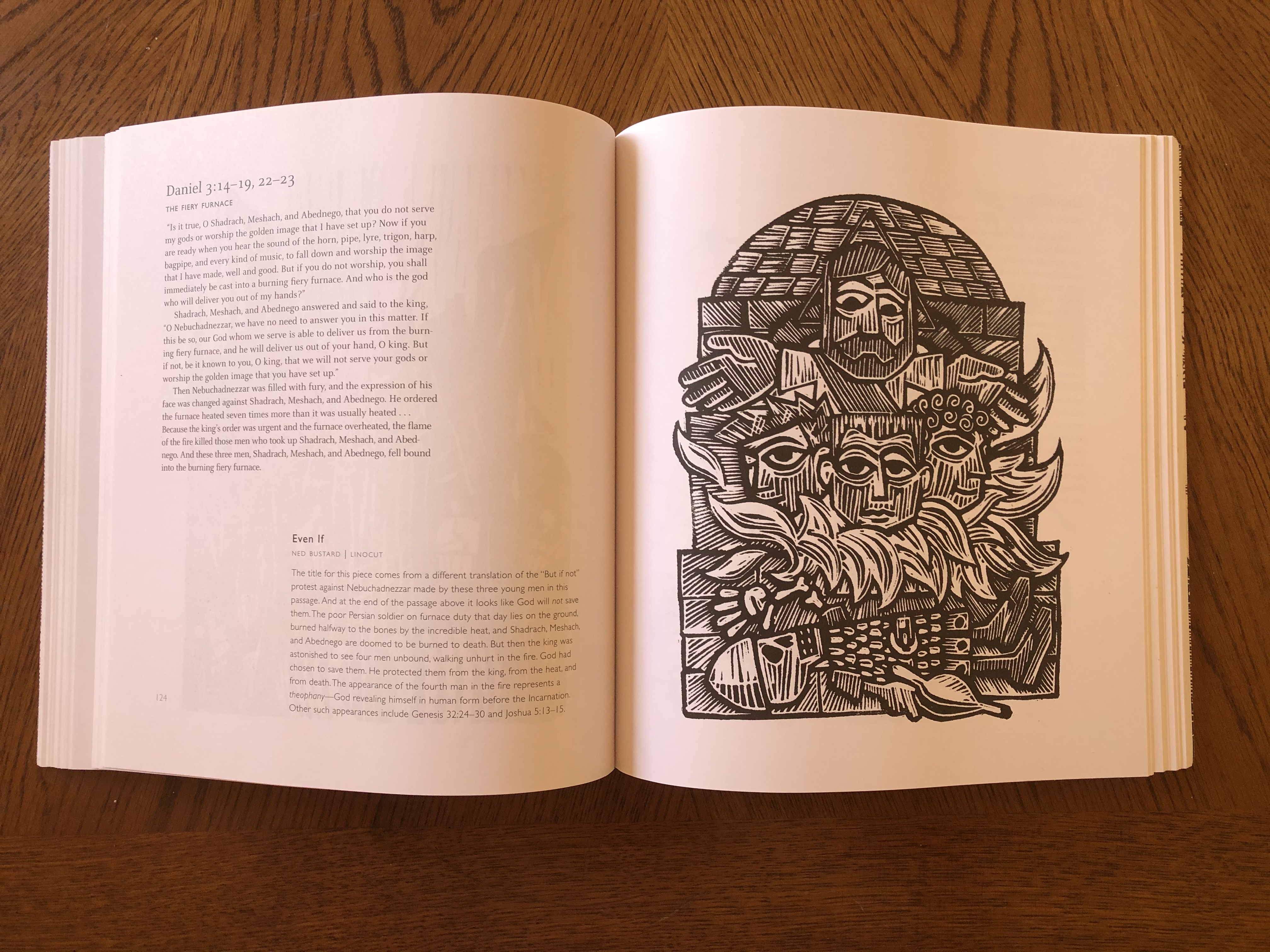
The Fiery Furnace – Daniel 3:14-23

The above image is from Revealed: A Storybook Bible for Grown-Ups by Ned Bustard. The image is called “Even If” and was created by Ned Bustard.

Daniel 3:13-23
Furious with rage, Nebuchadnezzar summoned Shadrach, Meshach and Abednego. So these men were brought before the king, and Nebuchadnezzar said to them, “Is it true, Shadrach, Meshach and Abednego, that you do not serve my gods or worship the image of gold I have set up? Now when you hear the sound of the horn, flute, zither, lyre, harp, pipe and all kinds of music, if you are ready to fall down and worship the image I made, very good. But if you do not worship it, you will be thrown immediately into a blazing furnace. Then what god will be able to rescue you from my hand?” Shadrach, Meshach and Abednego replied to him, “King Nebuchadnezzar, we do not need to defend ourselves before you in this matter. If we are thrown into the blazing furnace, the God we serve is able to deliver us from it, and he will deliver us from Your Majesty’s hand. But even if he does not, we want you to know, Your Majesty, that we will not serve your gods or worship the image of gold you have set up. ” Then Nebuchadnezzar was furious with Shadrach, Meshach and Abednego, and his attitude toward them changed. He ordered the furnace heated seven times hotter than usual and commanded some of the strongest soldiers in his army to tie up Shadrach, Meshach and Abednego and throw them into the blazing furnace. So these men, wearing their robes, trousers, turbans and other clothes, were bound and thrown into the blazing furnace. The king’s command was so urgent and the furnace so hot that the flames of the fire killed the soldiers who took up Shadrach, Meshach and Abednego, and these three men, firmly tied, fell into the blazing furnace.

Dear God, before I get into the artwork that accompanies this story, I want to spend a little time with a revelation that I had. Christians/Jews in the Bible who were living in exile or under the rule of a non-Jewish/Christian king didn’t seem to complain about persecution. Whether it was Shadrach, Meshach, and Abednego in this story or Paul, Peter, or any of the other martyrs in the New Testament, they seem to take it in stride. Now, I’m sure they were scared and frustrated, but they seemingly dealt with that internally and with you. Externally, however, they just worshipped you through it.

Contrast that with how a lot of Christians respond to what they call “persecution of Christians” in our country today. First, I hardly think it can be called persecution in light of what real persecution looks like. But I hear a lot of whining about Christians being persecuted. Outside of the enforcement of the separation between church and state rules that have been set up, I’m not even totally sure what they’ve been referring to. And maybe I have only a limited picture because I live in the South where there are still large parts of the community that honor faith, but even so, whining is not how to be a witness for you. In this case, Shadrach, Meshach, and Abednego influenced the king by their faith in action, not by complaining to him that he was being unfair. Paul and Peter were the same way. Letting our faith shine in the midst of trials is what changes hearts. Complaining only makes others tune us out.

Okay, with that being said, let me take a look at this image created by Bustard and see what I see before I read his description.

  • You are overlooking Shadrach, Meshach, and Abednego with your arms out wide and your hands open. Everything about you is outstretched and present.
  • Your eyes are focused on Shadrach, Meshach, and Abednego.
  • The flames are very present. They have not been removed. The three of them had to go into the fire.
  • The three men are certainly given distinct looks and hair styles.
  • The one on the right with the curly hair seems to have a rye smile.
  • All three of the men are looking at us while you are focused on them.
  • The guard is dead and the fire had already skeletonized him.
  • The guard is holding a bellows, indicating that he was part of making the fire as hot as possible and he paid a priced for it.
    • He sacrificed his life out of obedience to a king/god that couldn’t save him from the fire that you saved Shadrach, Meshach, and Abednego from.
  • I just noticed a triangle behind your head. Is that a reference to the Trinity? If so, that’s a nice touch.

With that said, here is what Bustard said about his piece “Even If.”

The title for this piece comes from a different translation of the “But if not” protest against Nebuchadnezzar made by these three young men in this passage. And at the end of the passage above it looks like God will not save them. The poor Persian soldier on furnace duty that day lies on the ground, burned hallway to the bones by the incredible heat, and Shadrach, Meshach, and Abednego are doomed to be burned to death. But then the king was astonished to see four men unbound, walking  unhurt in the fire. God had chosen to save them. He protected them from the king, from the heat, and from death. The appearance of the fourth man in the fire represents a theophany–God revealing himself in human form before the incarnation. Other such appearances include Genesis 32:24-30 and Joshua 5:13-15.

Father, I will follow you “even if” you choose not to save me from earthly situations. I will follow you “even if” I am disappointed with how things that I for which I’m praying turn out. I will follow you “even if” I am angry with you. I will follow you “even if” the road is hard. Let “even if” be my mantra today. I have nothing to prove to anyone else. I am following you “even if” they can’t understand why. But with that said, let my life be an example to others of why, and draw others to yourself through what they see of you in me.

In Jesus’s name I pray,

Amen


Tags: , , , , , ,