RSS

Category Archives: Genesis

Mothers of the Bible — Hagar

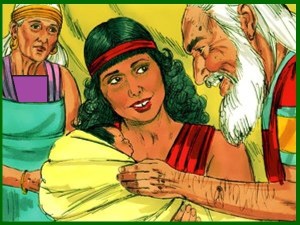
Now Sarai, Abram’s wife, had not been able to bear children for him. But she had an Egyptian servant named Hagar. So Sarai said to Abram, “The Lord has prevented me from having children. Go and sleep with my servant. Perhaps I can have children through her.” And Abram agreed with Sarai’s proposal. So Sarai, Abram’s wife, took Hagar the Egyptian servant and gave her to Abram as a wife. (This happened ten years after Abram had settled in the land of Canaan.) So Abram had sexual relations with Hagar, and she became pregnant. But when Hagar knew she was pregnant, she began to treat her mistress, Sarai, with contempt. Then Sarai said to Abram, “This is all your fault! I put my servant into your arms, but now that she’s pregnant she treats me with contempt. The Lord will show who’s wrong—you or me!” Abram replied, “Look, she is your servant, so deal with her as you see fit.” Then Sarai treated Hagar so harshly that she finally ran away. The angel of the Lord found Hagar beside a spring of water in the wilderness, along the road to Shur. The angel said to her, “Hagar, Sarai’s servant, where have you come from, and where are you going?” “I’m running away from my mistress, Sarai,” she replied. The angel of the Lord said to her, “Return to your mistress, and submit to her authority.” Then he added, “I will give you more descendants than you can count.” And the angel also said, “You are now pregnant and will give birth to a son. You are to name him Ishmael (which means ‘God hears’), for the Lord has heard your cry of distress. This son of yours will be a wild man, as untamed as a wild donkey! He will raise his fist against everyone, and everyone will be against him. Yes, he will live in open hostility against all his relatives.” Thereafter, Hagar used another name to refer to the Lord, who had spoken to her. She said, “You are the God who sees me.” She also said, “Have I truly seen the One who sees me?” So that well was named Beer-lahai-roi (which means “well of the Living One who sees me”). It can still be found between Kadesh and Bered. So Hagar gave Abram a son, and Abram named him Ishmael. Abram was eighty-six years old when Ishmael was born. So Abraham said to God, “May Ishmael live under your special blessing!” But God replied, “No—Sarah, your wife, will give birth to a son for you. You will name him Isaac, and I will confirm my covenant with him and his descendants as an everlasting covenant. As for Ishmael, I will bless him also, just as you have asked. I will make him extremely fruitful and multiply his descendants. He will become the father of twelve princes, and I will make him a great nation. But my covenant will be confirmed with Isaac, who will be born to you and Sarah about this time next year.” When God had finished speaking, he left Abraham. On that very day Abraham took his son, Ishmael, and every male in his household, including those born there and those he had bought. Then he circumcised them, cutting off their foreskins, just as God had told him. Abraham was ninety-nine years old when he was circumcised, and Ishmael, his son, was thirteen. Both Abraham and his son, Ishmael, were circumcised on that same day, along with all the other men and boys of the household, whether they were born there or bought as servants. All were circumcised with him. When Isaac grew up and was about to be weaned, Abraham prepared a huge feast to celebrate the occasion. But Sarah saw Ishmael—the son of Abraham and her Egyptian servant Hagar—making fun of her son, Isaac. So she turned to Abraham and demanded, “Get rid of that slave woman and her son. He is not going to share the inheritance with my son, Isaac. I won’t have it!” This upset Abraham very much because Ishmael was his son. But God told Abraham, “Do not be upset over the boy and your servant. Do whatever Sarah tells you, for Isaac is the son through whom your descendants will be counted. But I will also make a nation of the descendants of Hagar’s son because he is your son, too.” So Abraham got up early the next morning, prepared food and a container of water, and strapped them on Hagar’s shoulders. Then he sent her away with their son, and she wandered aimlessly in the wilderness of Beersheba. When the water was gone, she put the boy in the shade of a bush. Then she went and sat down by herself about a hundred yards away. “I don’t want to watch the boy die,” she said, as she burst into tears. But God heard the boy crying, and the angel of God called to Hagar from heaven, “Hagar, what’s wrong? Do not be afraid! God has heard the boy crying as he lies there. Go to him and comfort him, for I will make a great nation from his descendants.” Then God opened Hagar’s eyes, and she saw a well full of water. She quickly filled her water container and gave the boy a drink. And God was with the boy as he grew up in the wilderness. He became a skillful archer, and he settled in the wilderness of Paran. His mother arranged for him to marry a woman from the land of Egypt.
Genesis 16:1-16,17:18-27,21:8-21

Dear God, this was such a difficult situation, and I can’t help but think that Hagar was set up for failure in some ways. Was she mean to Sarai? Maybe. But was she basically trafficked when she was given to Abram as his “wife.” Yeah, maybe. And since I’m looking at parents of the Bible, and, specifically, Hagar, right now, I’ll skip the whole discussion of what a mess Abram created by not waiting on you to fulfill your promise. Right now I want to see what I notice about Hagar in all of this.

  • She was a slave, which, in my mind, is abhorrent. I don’t know that she was given any kind of a choice when it came to having a child with Abram. Of course, in that culture, I don’t know what kind of choice any woman had, including Sarai. But I don’t know that she would have volunteered for this duty.
  • I think she saw her opportunity for advancement when she got pregnant. This was her chance to be treated as more than a slave. This translation says that after Hagar became pregnant she began to treat Sarai with contempt. Well, yeah. And she probably didn’t feel like she should be at the servant level either. I’ve seen employees treat supervisors with contempt when they felt they were mistreated in the workplace. And I’ve see those supervisors get really mad about it. There were a lot of emotions happening here, and I think it’s probably been pretty easy for a lot of people to trash Hagar without maybe seeing this from her perspective.
  • The conflict with Sarai gets to the point where Hagar runs away and it takes an angel visit to get her to go back. If she hadn’t gone back, she and Ishmael (who wasn’t yet born) would likely have died, and you obviously didn’t want Ishmael to die. It also appears that you wanted Hagar as well.
  • She goes back and submits to Sarai (I’m sure that was awkward). Then she has the baby. He grows and then Isaac is born. As there is between any children, there is conflict between Ishmael and Isaac, with Ishmael teasing Isaac. This resulted in Hagar having water and food strapped to her shoulders and being sent away. Man, this seems brutal. As they were dying in the wilderness, Hagar was in despair. But you encouraged her with another angel visit, gave her access to water, and she pressed on in caring for her son.
  • Ultimately, she raised him and arranged for him to marry a woman from the land of Egypt.

This slave girl/woman lived a difficult life and she really had the cards stacked against her, but she was actually very faithful, especially to her son. I think people have probably been unmerciful towards her over the last thousands of years because she was mean to Sarai at the beginning and because she and Ishmael got sent away. But as I read this story, I see a slave forced into pregnancy who loved her child and spent her life trying to provide for him.

Father, thank you for mothers. Thank you that you instituted something within most women that is innate in caring for and loving their children. Yes, sometimes it goes too far. Sometimes it is unhealthy. And sometimes they can’t let go when the time comes. But mothers are such a critical part of the provision you give to us, especially when we are young. Thank you for the instincts you give them to love us so well.

In Jesus’s name I pray,

Amen

 
Leave a comment

Posted by on December 30, 2019 in Genesis, Mothers of the Bible


Tags: , , , , ,

Fathers of the Bible – Noah

The sons of Noah who came out of the boat with their father were Shem, Ham, and Japheth. (Ham is the father of Canaan.) From these three sons of Noah came all the people who now populate the earth. After the flood, Noah began to cultivate the ground, and he planted a vineyard. One day he drank some wine he had made, and he became drunk and lay naked inside his tent. Ham, the father of Canaan, saw that his father was naked and went outside and told his brothers. Then Shem and Japheth took a robe, held it over their shoulders, and backed into the tent to cover their father. As they did this, they looked the other way so they would not see him naked. When Noah woke up from his stupor, he learned what Ham, his youngest son, had done. Then he cursed Canaan, the son of Ham: “May Canaan be cursed! May he be the lowest of servants to his relatives.” Then Noah said, “May the Lord, the God of Shem, be blessed, and may Canaan be his servant! May God expand the territory of Japheth! May Japheth share the prosperity of Shem, and may Canaan be his servant.”
Genesis 9:18-27

Dear God, this has always been a hard story for me. Even when I was a child and I first read it, I’ve never liked it. But for the purposes of this series on motherhood and fatherhood, I think it’s an important story to sit with.

We have a few things happening here. First, there is a passage of time–enough to grow grapes and then ferment them into wine. This obviously wasn’t an immediate process. There was time for them to have struggled together. The struggled through building the ark. They struggled through the experience of the ark. Now, they’ve struggled through the reestablishment of life. Did hard feelings develop over that time?

The thing I see now is Ham relishing in the idea of mocking his father. Knocking him down a peg or two. “Hey, guys. Wanna see dad drunk off his a** and naked on the ground?”

I think most fathers of children after a certain age have felt, at least once, the disdain and bitterness from a child. As much as children might experience rejection at the hands of their father or mother, mothers and fathers have felt rejection from their parents. Sometimes, the division seems insurmountable. I’ve certainly been there. I can see my children, especially when they were teens, enjoying the experience of mocking me and taking me down a peg. And I can see me lashing out in anger as Noah does.

I’ve never liked Noah’s response to Ham. It feels too harsh–especially to Canaan. But as I sit and think about this, what is a good way to hurt the son who’s hurt you? You hurt his son. From a list of Ham’s children later, I’m assuming Canaan wasn’t the oldest because he’s listed last (Genesis 10:6), but maybe he was the youngest and Ham’s favorite at the time. I don’t think this was about poor Canaan. It was about causing Ham as much pain as possible in the moment.

We never really get any resolution to this story. Noah lived another 350 years after the flood. What were those like between Ham and Noah? Canaan and Noah? Canaan and his dad, Ham? Did they ever reconcile? And why did the author give us this story? Was it to explain a superiority of their lineage over the Canaanites?

When it comes to my own life, how do I respond to my children’s disrespect and/or anger? The ugly truth is that the answer is all over the map. Sometimes I’ve actually responded in love. Sometimes I’ve given them the freedom to work through their feelings of me and waited for them to mature and see things (and me) a little differently. Sometimes! Most of the time, unfortunately, I’ve responded as Noah did–impetuous anger. It can be hard to see myself reflected in this story that I’ve never liked.

Father, help me to respect and honor my parents and my wife’s parents (living and dead). Help me to love them with your love. Help me to see them with your eyes. And with my children, help me to patiently love them as they grow. Help me to see myself through their eyes and respond to them in mercy. Help me to reveal your character to them through my responses to them. Draw them closer to yourself. Please don’t let me do anything to get in the way of your plan for them through my own foolishness, selfishness, or insecurity.

In Jesus’s name I pray,

Amen

 
Leave a comment

Posted by on December 28, 2019 in Fathers of the Bible, Genesis


Tags: ,

Fathers of the Bible – Adam

Adam made love to his wife Eve, and she became pregnant and gave birth to Cain. She said, “With the help of the Lord I have brought forth a man.” Later she gave birth to his brother Abel. Now Abel kept flocks, and Cain worked the soil. In the course of time Cain brought some of the fruits of the soil as an offering to the Lord. And Abel also brought an offering—fat portions from some of the firstborn of his flock. The Lord looked with favor on Abel and his offering, but on Cain and his offering he did not look with favor. So Cain was very angry, and his face was downcast. Then the Lord said to Cain, “Why are you angry? Why is your face downcast? If you do what is right, will you not be accepted? But if you do not do what is right, sin is crouching at your door; it desires to have you, but you must rule over it. ” Now Cain said to his brother Abel, “Let’s go out to the field.” While they were in the field, Cain attacked his brother Abel and killed him. Then the Lord said to Cain, “Where is your brother Abel?” “I don’t know, ” he replied. “Am I my brother’s keeper?” The Lord said, “What have you done? Listen! Your brother’s blood cries out to me from the ground. Now you are under a curse and driven from the ground, which opened its mouth to receive your brother’s blood from your hand. When you work the ground, it will no longer yield its crops for you. You will be a restless wanderer on the earth. ” Cain said to the Lord, “My punishment is more than I can bear. Today you are driving me from the land, and I will be hidden from your presence; I will be a restless wanderer on the earth, and whoever finds me will kill me.” But the Lord said to him, “Not so; anyone who kills Cain will suffer vengeance seven times over. ” Then the Lord put a mark on Cain so that no one who found him would kill him. So Cain went out from the Lord’s presence and lived in the land of Nod, east of Eden. Adam made love to his wife again, and she gave birth to a son and named him Seth, saying, “God has granted me another child in place of Abel, since Cain killed him.” Seth also had a son, and he named him Enosh. At that time people began to call on the name of the Lord.
Genesis 4:1-16,25-26

Dear God, same verses as yesterday, but different parent. Adam. We don’t really get that much about either Adam or Eve from these stories. They weren’t the author’s point, I suppose. But they were there. They were talking with each other about their boys. They were talking with you. It’s interesting that the author doesn’t bother to tell us what Adam’s sacrificing habits were like. Did he bring you his best? What kind of an example was he? Assuming he was a good example, was there just only so much he could do to impart his values to his sons?

As a dad, I have so many of my own failings. I would love it if I could only pass on what I consider to be the positive parts of who I am to my children and skip the selfish, carnal parts. And then there is my inability to protect them from the things or the traumas I can’t control. The pain that life can bring.

I try to imagine what it was like for Adam to experience Abel’s loss, respond to Cain and comfort Eve. And then parent Seth in a world where Cain has been exiled. How do you make sense of all of it?

Father, parenting is so much harder than I ever imagined it has pushed, stretched, and even broken me in ways I never thought possible. But in my better moments I remember to bring the broken pieces of my heart to you for you to heal and redeem. Adam needed to feel your redemption for Cain and his actions. He needed to heal. He needed Seth. And he needed Eve. I too need you and my wife and others you out around me. And I need your Spirit. Teach me to be the father you need me to be for my adult children.

In Jesus’s name I pray,

Amen

 
Leave a comment

Posted by on December 27, 2019 in Fathers of the Bible, Genesis


Tags:

Mothers of the Bible — Eve

Now Adam had sexual relations with his wife, Eve, and she became pregnant. When she gave birth to Cain, she said, “With the Lord’s help, I have produced a man!” Later she gave birth to his brother and named him Abel. When they grew up, Abel became a shepherd, while Cain cultivated the ground. When it was time for the harvest, Cain presented some of his crops as a gift to the Lord. Abel also brought a gift—the best portions of the firstborn lambs from his flock. The Lord accepted Abel and his gift, but he did not accept Cain and his gift. This made Cain very angry, and he looked dejected. “Why are you so angry?” the Lord asked Cain. “Why do you look so dejected? You will be accepted if you do what is right. But if you refuse to do what is right, then watch out! Sin is crouching at the door, eager to control you. But you must subdue it and be its master.” One day Cain suggested to his brother, “Let’s go out into the fields.” And while they were in the field, Cain attacked his brother, Abel, and killed him. Afterward the Lord asked Cain, “Where is your brother? Where is Abel?” “I don’t know,” Cain responded. “Am I my brother’s guardian?” But the Lord said, “What have you done? Listen! Your brother’s blood cries out to me from the ground! Now you are cursed and banished from the ground, which has swallowed your brother’s blood. No longer will the ground yield good crops for you, no matter how hard you work! From now on you will be a homeless wanderer on the earth.” Cain replied to the Lord, “My punishment is too great for me to bear! You have banished me from the land and from your presence; you have made me a homeless wanderer. Anyone who finds me will kill me!” The Lord replied, “No, for I will give a sevenfold punishment to anyone who kills you.” Then the Lord put a mark on Cain to warn anyone who might try to kill him. So Cain left the Lord’s presence and settled in the land of Nod, east of Eden.

Adam had sexual relations with his wife again, and she gave birth to another son. She named him Seth, for she said, “God has granted me another son in place of Abel, whom Cain killed.” When Seth grew up, he had a son and named him Enosh. At that time people first began to worship the Lord by name.
Genesis 4:1-16,25-26

Dear God, as I watched the musical Dear Evan Hansen a few days ago, I found myself focusing on the parents. They felt such despair and confusion. The very first song is called, “Anybody Have a Map?”

It made me think about parenting and how few people in the Bible are good role models for us. The I wondered if you don’t have something to teach me by looking at the mothers and fathers of the Bible. Obviously, I can’t look at every single one, but there are certainly some highlights. And it starts with Eve.

I wish we got more about Eve here–or Adam, for that matter. Talk about not having a map! There were no Growing Kids God’s Way or Sacred Parenting books for her to get off of Amazon.com. There weren’t any support groups or Sunday school classes to help teach her. To quote the song, “Anybody Have a Map” that I mentioned above: “I’m flying blind, and I’m making this up as I go.”

I wonder what it was like for he to see her two sons grow up into such different people. And I wonder how old Cain and Abel were when this story happened. Were they teenagers? Did it grieve her to see that Cain held back the best of his crops from God while Abel brought his best? Did she and Adam pray about the boys and talk to you about them? Did she learn some lessons from raising Cain that she applied to Abel? I’ve heard it said that no two children are born to the same parents, and I’m sure that is true for Cain and Abel.

And then one day Cain did it. His jealousy pushed him to kill his own brother. They had possibly never experienced death before. Did Cain understand what would happen? Did he understand that Abel would be gone forever. Did he know that was possible?

As for Eve, how devastated was she? How much a failure did she feel like? Was she inconsolable for a while? The only insight we are given into this is her joy in Seth’s birth and then, presumably, her grandchild’s birth. Cain had children, but we don’t know if Eve ever knew them. Did she ever speak to Cain again? One thing that is interesting to point out is that, according to verse 26, this is when people began to worship you by name. Was this a lesson that Eve learned from her experience? Did she do something different with Seth that taught him to worship you by name?

Father, I suspect that the ultimate theme in this series of mothers (and fathers) of the Bible is that all of them will have made a lot of mistakes, and most will experience tragedy. How foolish are we, then, to think that our mistakes will be small and our tragedies minimal? How foolish am I? So I give all of this to you and ask that you take my best attempts and my worst mistakes and redeem them beyond what they deserve.

In Jesus’s name I pray,

Amen

 
Leave a comment

Posted by on December 26, 2019 in Genesis, Mothers of the Bible


Tags: , , , , ,

Interpretation of Dream — Genesis 41:1-13


The image above is from Revealed: A Storybook Bible for Grown-Ups by Ned Bustard. The image is called “Joseph and the Dreams” and was created by Wayne Forte.

After two whole years, Pharaoh dreamed that he was standing by the Nile, and behold, there came up out of the Nile seven cows, attractive and plump, and they fed in the reed grass. And behold, seven other cows, ugly and thin, came up out of the Nile after them, and stood by the other cows on the bank of the Nile. And the ugly, thin cows ate up the seven attractive, plump cows. And Pharaoh awoke. And he fell asleep and dreamed a second time. And behold, seven ears of grain, plump and good, were growing on one stalk. And behold, after them sprouted seven ears, thin and blighted by the east wind. And the thin ears swallowed up the seven plump, full ears. And Pharaoh awoke, and behold, it was a dream. So in the morning his spirit was troubled, and he sent and called for all the magicians of Egypt and all its wise men. Pharaoh told them his dreams, but there was none who could interpret them to Pharaoh. Then the chief cupbearer said to Pharaoh, “I remember my offenses today. When Pharaoh was angry with his servants and put me and the chief baker in custody in the house of the captain of the guard, we dreamed on the same night, he and I, each having a dream with its own interpretation. A young Hebrew was there with us, a servant of the captain of the guard. When we told him, he interpreted our dreams to us, giving an interpretation to each man according to his dream. And as he interpreted to us, so it came about. I was restored to my office, and the baker was hanged.”
Genesis 41:1-13

Dear God, it feels like it’s been a while since I really dug in and spent some time with one of the images from the Bustard book Revealed: A Storybook Bible for Grown-Ups. There is so much in this image, I might need to break my observations into categories.

Chief Cup Bearer:

  • The original dream had three branches on the vines and I see three clusters of grapes.
  • The cup bearer is small combed hair and clean shaven.
  • The cup bearer is dressed.
  • The cub bearer is obviously bearing a cup for Pharaoh.

Chief Baker:

  • The baker is hanging (some translations say he was impaled, but the artist went with the hanging translation).
  • The baker is naked.
  • The birds are literally eating his flesh while he is still hanging.
  • There is a basked by his feet to represent the basket that had been on his head in the dream.
  • In death, his face is turned towards Pharaoh.

General:

  • Pharaoh is seen as being much larger than the cup bearer.
  • His headpiece has a cobra snake on it.
  • He has the traditional eye make-up to make it obvious to us that this is Pharaoh.
  • There is a fence as a backdrop in the image. I’m not sure what that is about. Could that represent the wall that Joseph is behind, still in prison. It’s interesting that Joseph is not represented in this image.

I’ve made these observations before reading what Bustard had to say about this piece and this story.

John Piper writes: “Life is not a straight line leading from one blessing to the next and then finally to heaven. Life is a winding and troubled road. Switchback after switchback. And the point of biblical stories like Joseph…is to help us feel in our bones (not just know in our heads) that God is for us in all these strange turns. God is not just showing up after the trouble and cleaning it up. He is plotting the course and managing the troubles with far-reaching purposes for our good and for the glory of Jesus Christ.” It is often difficult to see the point of the evil circumstances in our lives, but examples like the life of Joseph serve as reminders that God is actively working for our benefit. The sometimes circuitous paths he sets us on are to keep us loving him and depending on him. They are for our good and his glory.

I like the line “…examples like the life of Joseph serve as reminders…” because the structure of the Bible is such an interesting way for you to have communicated with us and laid out the bread crumbs for us to find our way to you. I was thinking about this recently. How else would I have done it? If I were God, would I have just laid out a manual with a bunch of rules or would I just give example after example of how I have interacted with my people over thousands of years? Obviously, you picked the latter, and while that certainly gives impacts the way we develop as individuals and corporately as the church it also gives us greater insight into you. In storytelling parlance, you show more than you tell.

Father, help me to remember that you are sovereign and that there is a plan. Let that faith in something I cannot always see sustain me in my pursuit of you and the peace I experience in you. Be glorified in me so that others might be drawn to you as well.

In Jesus’s name I pray,

Amen


Tags: , , , , , ,

Genesis 19:36-38

As a result, both of Lot’s daughters became pregnant by their own father. When the older daughter gave birth to a son, she named him Moab. He became the ancestor of the nation now known as the Moabites. When the younger daughter gave birth to a son, she named him Ben-ammi. He became the ancestor of the nation now known as the Ammonites.
Genesis 19:36-38

Dear God, this is one of those, “What?!?” stories. So you went to the trouble of saving Lot only to have his wife killed and then leaving him alone with these daughters, giving birth (literally) to the Ammonite and Moabite nations—future enemies of Abraham’s offspring?

You don’t give us a ton about Lot, but it’s interesting to me that this is how his story abruptly ends. Our last picture of him is of him falling victim to his daughters and fathering two nations. The end. So why did you even give us Lot’s story? I suppose there are a couple of good reasons.

1. We got to see how he made a seemingly smart decision that turned out foolish when he and Abraham split up the land.

2. We got to see the Sodom and Gomorrah story and learn about your disgust with debauchery.

3.) We got to see the result of his wife’s disobedience

4.) We learned the origins of the Moabites and Ammonites (although this information was probably more relevant to readers at the time this was written than it is to us).

Father, I don’t know where I’m going with all of this, but i suppose, at the end of the day, the story of Lot is a reminder about the importance of purity. It’s a reminder about the effects of one decision. I suppose this last story about Lot and his daughters is a reminder that isolation is not good. Yes, Lot had picked the wrong community before, but to take his girls and isolate them like that was a mistake as well. Being in community, so that I can both give to and receive from it is important. So help me to remember all of these lessons today as I try to follow you.

In Jesus’s name I pray,

Amen

 
Leave a comment

Posted by on July 2, 2019 in Genesis


Tags: ,

The Drunkeness of Noah – Genesis 9:8-15, 20-23


The image above is from Revealed: A Storybook Bible for Grown-Ups by Ned Bustard. The image is called “Failed Savior” and was created by Ned Bustard.

Then God said to Noah and to his sons with him: “I now establish my covenant with you and with your descendants after you 10 and with every living creature that was with you—the birds, the livestock and all the wild animals, all those that came out of the ark with you—every living creature on earth. 11 I establish my covenant with you: Never again will all life be destroyed by the waters of a flood; never again will there be a flood to destroy the earth.”

12 And God said, “This is the sign of the covenant I am making between me and you and every living creature with you, a covenant for all generations to come: 13 I have set my rainbow in the clouds, and it will be the sign of the covenant between me and the earth. 14 Whenever I bring clouds over the earth and the rainbow appears in the clouds, 15 I will remember my covenant between me and you and all living creatures of every kind. Never again will the waters become a flood to destroy all life…

20 Noah, a man of the soil, proceeded to plant a vineyard. 21 When he drank some of its wine, he became drunk and lay uncovered inside his tent. 22 Ham, the father of Canaan, saw his father naked and told his two brothers outside. 23 But Shem and Japheth took a garment and laid it across their shoulders; then they walked in backward and covered their father’s naked body. Their faces were turned the other way so that they would not see their father naked.
Genesis 9:8-15, 20-23

Dear God, when I opened Revealed: A Storybook Bible for Grown-Ups this morning, this is the first image I turned to. I’ve never liked this story, and I almost turned away. But then I got to thinking that perhaps I should explore this story more. Why does it hit me that way?

I’ve never liked the image of the human Noah. Why tell us this story? Why not just leave it at verse 19 and the part about you putting your bow in the sky as a reminder of your covenant with us? I really don’t need to know about Noah getting blackout drunk and being discovered by his son. Or do I?

My first inclination was to focus on Noah’s shame in this image and the reaction of his sons (and then his subsequent response to them). When I looked at Bustard’s image, I saw:

  • A fat old man passed out.
  • An umbrella. I thought it was a clever nod to the rain and a way to use it to give Noah a little modesty. Obviously, Bustard wasn’t going for a period piece.
  • The wine bottle and glass are also obviously not period, but communicate that the subject of the image is drunk and passed out.
  • The life preserver was a nice nod to the ark.

That’s what I saw. But here’s Bustard’s description of the piece:

Hebrews 11:7 states that “By faith Noah, being warned by God concerning events as yet unseen, in reverent fear constructed an ark for the saving of his household. By this he condemned the world and became an heir of the righteousness that comes by faith.” But although he was instrumental in saving all of the living, Noah was not the promised Savior. Noah is shown here drunk, lying in a cruciform, and with a life preserver forming a halo of sorts around his head. He is an inebriated old man, and the symbol of his saving work is broken and covers him as poorly as the fig leaves covered the shame of Adam and Eve.

Hmm. I had never thought about comparing Jesus and Noah. I hadn’t thought about Noah being your “savior” for the remnant of humanity and comparing that with Jesus being our Savior. The halo. The cruciform. The fact that the umbrella is broken. I had missed all of that. Interesting.

Father, there is none righteous, no not one (Romans 3:10). Except for Jesus, of course. Thank you for a complete savior. Thank you for an inclusive savior. Noah was an exclusive savior, sent by you to preserve the remnant of mankind. Jesus was sent to rip away the veil between you and us and present all of us to you as an unblemished bride. Help me to live into that and to carry that to others who need you today.

In Jesus’s name I pray,

Amen


Tags:

The Flood – Genesis 7:17-24


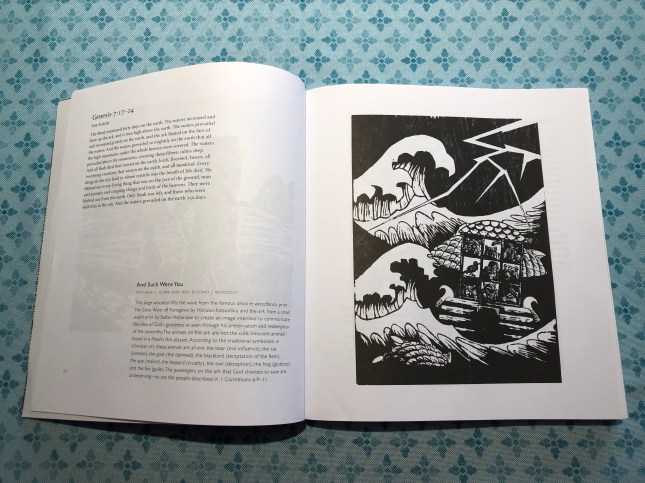
The image above is from Revealed: A Storybook Bible for Grown-Ups by Ned Bustard. The image itself is called “And Such Were You” and was created by Matthew L. Clark and Ned Bustard.

Dear God, I looked at this passage this morning and looked at the picture for a while and, frankly, I was having trouble getting anything from it. Then I read Bustard’s commentary in the bottom paragraph on the left. It says:

This large woodcut lifts the wave from the famous Ulithi-e woodblock print The Great Wave off Kanagawa by Hokusai Katsushika and the ark from a small Washington print by Saadi Watanabe to create an image intended to communicate the idea of God’s goodness as seen through the preservation and redemption of the unworthy. The animals on this ark are not the cute, innocent animals found in a Noah’s Ark play set. According to the traditional symbolism in Christian art, these animals are all evil: the bear (evil influence), the cat (laziness), the goat (the damned), the blackbird (temptation of the flesh), the ape (malice), the leopard (cruelty), the owl (devotion), the hog (gluttony) and the fox (guile). The passengers on the ark that God chooses to save are undeserving–as are the people described in 1 Corinthians 6:9-11.

So, of course, after I read that, I went to 1 Corinthians 6:9-11:

Do you not know that the wicked will not inherit the kingdom of God? Do not be deceived. Neither the sexually immoral nor idolators nor adulterers nor male prostitutes nor homosexual offenders nor thieves nor greedy nor dunkards nor slanderers nor swindlers will inherit the kingdom of God. And that is what some of you were. But you were washed, you were sanctified, you were justified in the name of the Lord Jesus Christ and by the Spirit of our God. (NIV)

Yes, I like this. I like Bustard’s idea that you saved the unworthy with the ark and you saved me, the unworthy, with Jesus. The trick is, how do I stop grieving you with wickedness in my heart. And it’s not just the obvious that sticks out on the Corinthians passage like the idolatry and sexual immorality, but it’s the seemingly little things like slander, drunkenness and stealing. No one is innocent. We love to judge others, but none of us are pure.

Father, help me to embrace your forgiveness and pursue you. Help me to forgive others as you have forgiven me, extend grace when it isn’t deserved and being your light of love, joy, peace, gentleness, faithfulness, kindness and self control into the world.

In Jesus’s name I pray,

Amen


Tags: , , , ,

The Binding – Genesis 22:9-18

IMG_1724
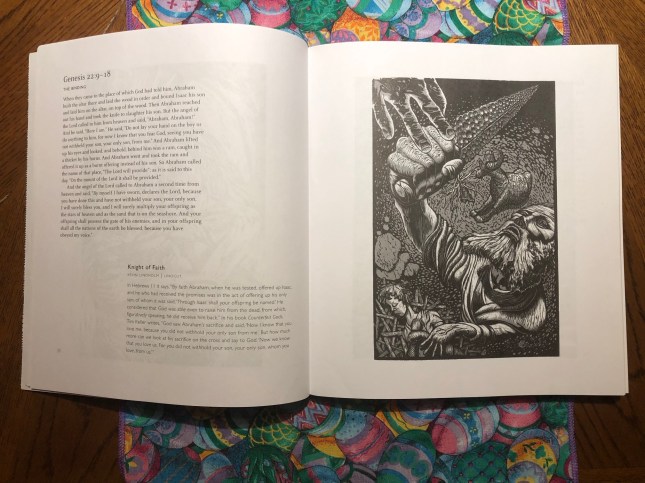
The image above is from Redeemed: A Storybook Bible for Grown-ups by Ned Bustard. This particular piece of art was done by Kevin Lindholm and is called “Knight of Faith.”

Genesis 22:9-18 [NLT]
9 When they arrived at the place where God had told him to go, Abraham built an altar and arranged the wood on it. Then he tied his son, Isaac, and laid him on the altar on top of the wood. 10 And Abraham picked up the knife to kill his son as a sacrifice. 11 At that moment the angel of the Lord called to him from heaven, “Abraham! Abraham!”
“Yes,” Abraham replied. “Here I am!”
12 “Don’t lay a hand on the boy!” the angel said. “Do not hurt him in any way, for now I know that you truly fear God. You have not withheld from me even your son, your only son.”
13 Then Abraham looked up and saw a ram caught by its horns in a thicket. So he took the ram and sacrificed it as a burnt offering in place of his son. 14 Abraham named the place Yahweh-Yireh (which means “the Lord will provide”). To this day, people still use that name as a proverb: “On the mountain of the Lord it will be provided.”
15 Then the angel of the Lord called again to Abraham from heaven. 16 “This is what the Lord says: Because you have obeyed me and have not withheld even your son, your only son, I swear by my own name that 17 I will certainly bless you. I will multiply your descendants[a] beyond number, like the stars in the sky and the sand on the seashore. Your descendants will conquer the cities of their enemies. 18 And through your descendants all the nations of the earth will be blessed—all because you have obeyed me.”

Dear God, I’ve spent some time with this story in the past. So much time, in fact, that I’m curious to see what I might have missed.

It’s interesting to me that Bustard chose, in this book’s telling of the story of Abraham being asked to sacrifice Isaac, to start with their arrival at the place for the sacrifice. I’ve usually spent more time in verses 1-8 than I have 9-18. So what is here that I might have missed in the past? Or what have I seen before of which you need to remind me?

Verse 9 alone must have really done something to alter the relationship between Isaac and Abraham. Frankly, I’m a little surprised that Isaac even worshipped you after that. If I had been him, I would have thought my dad was crazy and that would have included his worship of you. If I try to imagine this scene, it’s horrific. I almost need to just set that aside before I get deeper into the story because if I start to look at this story through Isaac’s eyes it freaks me out a little.

The thing I’ve noticed in this story in the past is Abraham’s possible idolization of his son and the promise that you gave him about his descendants. In verses 1-8, as he is lying to Sarah, to the servant, and to Isaac; as he is walking for a few days to reach the site; as he is eating and talking with Isaac; as he is silently thinking and praying; I am sure that he was doing a lot of repenting and wondering how much he had failed you by taking his eyes off of you and giving in to his own vanity.

With all of that said, let me see what I notice in this image:

  • The most prominent thing in the image is the knife. It seems like it’s the first thing Lindholm wants me to see. The knife, gripped by Abraham’s fist. Something horrific is about to happen and I don’t think the artist wants me to miss that fact.
  • The next thing I notice is Abraham’s face. He is staring up. Is the look in his eyes desperation? Despair? Anguish? Surprise?
  • There is a hand with two fingers touching Abraham’s hand. The fingers are no bigger than Abraham’s. They are a different color.
  • There is the boy. His eyes are closed. Given the comments I made earlier about the horror of verse 9, it would have been an interesting choice to leave Isaac’s eyes open. Did Lindholm consider that? Was that perhaps just too hard to see so he closed them instead? Was Isaac just waiting for the end? Another choice would have been to make Isaac look afraid. Terrified. But Lindholm chose to make him asleep. Interesting. Perhaps he envisioned that Abraham knocked him out.
  • There is the ram, already there, with his horns stuck in the thicket. If I had been the artist I might have shown a larger, more dense thicket, but perhaps Lindholm is suggesting that you didn’t need to do much to provide this ram for the sacrifice.

In the description of this picture, Bustard quotes Tim Keller: “God saw Abraham’s sacrifice and said, ‘Now I know that you love me, because you did not withhold your only son from me.’ But how much more can we look at his sacrifice on the cross and say to God, ‘Now we know that you love us. For you did not withhold your son, your only son, whom you love, from us.”

Father, search me today and help me to see what I have not sacrificed to you. Which parts of my vanity are still too important to me? Deal with me gently, Father. I know I am proud. I know I am vain. I know I can be selfish. Help me, Father to not get to a point where you have to go to these lengths to get my attention and repentance.

In Jesus’ name I pray,

Amen


Tags: , , , , , ,

Genesis 18:17

Genesis 18:17 [NLT]
“Should I hide my plan from Abraham?” the Lord asked.

Dear God, yes, please hide from me what you are doing. That’s my first response when I read this verse and I think back on my life so far. Very rarely would it have benefited me to know what you were doing in advance. I heard your call in a given moment and sometimes I obeyed it regardless of what the future held. And sometimes it was a hard future. But I am glad that I didn’t know how hard it would be going into it.

Even now, as I think of some of the challenges ahead of me and two that involve work that are predominantly on my heart, it really is better that I don’t know everything that will happen between now and when you resolve these situations. After the journey my wife and I took over 15 years ago, I came up with a saying that you keep me on a need-to-know basis and I very rarely need to know. I still think that is true.

Father, I have a couple of difficult situations with which I’m currently dealing, and I have friends who are also dealing with hard things. Please help us all. Help us to, first, cry out to you. I’ve been praying to you about one of my things all morning. Please hear my cry. Help me to do everything according to your plan and your will. Holy Spirit, fill me, pour through me, and bring glory to your name through me, even if it costs me something. Not my will, but your will be done.

In Jesus’ name I pray,

Amen

 
Leave a comment

Posted by on March 20, 2019 in Genesis


Tags: