RSS

Category Archives: 1 Kings

Solomon — 1 Kings 1:38-40

So Zadok the priest, Nathan the prophet, Benaiah son of Jehoiada, and the king’s bodyguard took Solomon down to Gihon Spring, with Solomon riding on King David’s own mule. There Zadok the priest took the flask of olive oil from the sacred tent and anointed Solomon with the oil. Then they sounded the ram’s horn and all the people shouted, “Long live King Solomon!” And all the people followed Solomon into Jerusalem, playing flutes and shouting for joy. The celebration was so joyous and noisy that the earth shook with the sound.
1 Kings 1:38-40

Dear God, I wish we had more about Solomon’s relationships with Bathsheba, David, and all of the people involved with his ascent to the throne. One thing I’ve noticed in the telling of this story is that Adonijah was a self promoter while the author here had yet to tell us anything that Solomon has said on his own behalf. We won’t get a quote from him until he has to deal with Adonijah at the end of this chapter.

The other interesting thing is the the writer goes out of his way to tell us that Adonijah was spoiled and undisciplined. What kind of a mother was Bathsheba? I’m betting she disciplined her children. At least Solomon was thought enough of by Nathan, et. al., to be promoted and desired as the next king.

But back to the subtext of the fact that the author is careful to contrast Adonijah and Solomon by who they did and didn’t promote themselves. My dad told me one time when I was young that if I ever got a promotion at work, on my first day in the new job I would likely not see much difference in my future because I had already been doing those things. The message that I received in that was, “Work hard and let the reward come from the hard work.” In words my wife, the writer would use, “Show, don’t tell.”

Father, we are still a few chapters and executions away from Solomon asking you for wisdom, but I want to continue to seek that from you. Help me to simply serve you and then let your plan unfold around me. My biggest danger is allowing inaction and lethargy to keep me from what you’ve called me to do. So please make your call clear to me. I repent for the things I’ve done and the things I’ve failed to do.

In Jesus’s name I pray,

Amen

 
Leave a comment

Posted by on July 7, 2019 in 1 Kings, Solomon


Tags: , , , , ,

Solomon – 1 Kings 1:1-14

King David was now very old, and no matter how many blankets covered him, he could not keep warm. So his advisers told him, “Let us find a young virgin to wait on you and look after you, my lord. She will lie in your arms and keep you warm.” So they searched throughout the land of Israel for a beautiful girl, and they found Abishag from Shunem and brought her to the king. The girl was very beautiful, and she looked after the king and took care of him. But the king had no sexual relations with her. About that time David’s son Adonijah, whose mother was Haggith, began boasting, “I will make myself king.” So he provided himself with chariots and charioteers and recruited fifty men to run in front of him. Now his father, King David, had never disciplined him at any time, even by asking, “Why are you doing that?” Adonijah had been born next after Absalom, and he was very handsome. Adonijah took Joab son of Zeruiah and Abiathar the priest into his confidence, and they agreed to help him become king. But Zadok the priest, Benaiah son of Jehoiada, Nathan the prophet, Shimei, Rei, and David’s personal bodyguard refused to support Adonijah. Adonijah went to the Stone of Zoheleth near the spring of En-rogel, where he sacrificed sheep, cattle, and fattened calves. He invited all his brothers—the other sons of King David—and all the royal officials of Judah. But he did not invite Nathan the prophet or Benaiah or the king’s bodyguard or his brother Solomon. Then Nathan went to Bathsheba, Solomon’s mother, and asked her, “Haven’t you heard that Haggith’s son, Adonijah, has made himself king, and our lord David doesn’t even know about it? If you want to save your own life and the life of your son Solomon, follow my advice. Go at once to King David and say to him, ‘My lord the king, didn’t you make a vow and say to me, “Your son Solomon will surely be the next king and will sit on my throne”? Why then has Adonijah become king?’ And while you are still talking with him, I will come and confirm everything you have said.”
1 Kings 1:1-14

Dear God, I think it is important to note that the story of Solomon cannot be told without including Nathan. Nathan is woven throughout Solomon’s (and Bathsheba’s) story. He is the prophet whom David consults about building the temple (2 Samuel 7). He is the prophet who rebukes David about what he did with Bathsheba and Uriah, and through you gave Solomon a new name–Jedidiah (2 Samuel 12). And now he is the prophet who orchestrates Solomon’s rise to the throne (1 Kings 1). Interestingly, these are the only three stories we get about Nathan.

I normally do these journals to you first thing in the morning, but as I opened the scriptures today I found myself with a lot of questions and researching a lot of things. First, I went to 1 Chronicles to see how it recorded the transition from David’s rule to Solomon’s. I was surprised to see a completely different portrait painted. The accounting of it in Chronicles was much tidier and more honorable. It really focused on David’s passing the torch to Solomon to build the temple. But I’ll talk about the temple another time. Today, I want to talk about Nathan.

I had a new thought today that I don’t think I’ve had before. Nathan apparently had a soft spot in his heart for Bathsheba and Solomon. I won’t say that he knew about David’s sin with Bathsheba before anyone else did. I’ll bet is was actually a pretty poorly kept secret. But he was the one willing to confront David. He was the one who spoke out on your behalf and on behalf of the woman. He watched her go through the loss of her child. He watched her give birth to Solomon. He got the word from you that Solomon was special and to be renamed Jedidiah (I wonder why that name didn’t stick–I searched the entire Bible, and 2 Samuel 12:25 is the only time it is ever mentioned).

Fast forward many years. David is at the end of his life and his fourth-born son, Adonijah (the first three are seemingly dead) starts to position himself for the throne. 1 Kings 1:6 seems to go out of its way to tell us that he wasn’t a good guy, but was spoiled and undisciplined. This apparently got Nathan’s attention and he decided it was time to act on behalf of the boy whom you had told him to rename and his mother.

Nathan probably doesn’t get enough love from history. Yes, the writer of Samuel and Kings gives us what we need to know about his role in things, but it’s almost too brief. I almost missed it. He was apparently a man who cared about your righteousness enough to speak truth to power and then risk his life to do what he perceived to be your will.

Father, make me a man of this kind of courage. Help me to know when to speak and when not to speak. Help me to know when to act and when not to act. God, grant me the serenity to accept the things I cannot change, the courage to change the things I can, and the wisdom to know the difference. But do it in reverse order of that prayer. Give me the wisdom to know when you are calling me to act, when you are calling me to not act but pray, and when you are calling me to accept a situation. Give me the courage to follow your call. And when it is time to accept your judgment and a situation about which I am to do nothing, fill me with your peace.

In Jesus’s name I pray,

Amen
 
Leave a comment

Posted by on July 5, 2019 in 1 Kings, 2 Samuel, Solomon


Tags: , , , , ,

Solomon – 2 Samuel 12:13-25

Then David confessed to Nathan, “I have sinned against the Lord.” Nathan replied, “Yes, but the Lord has forgiven you, and you won’t die for this sin. Nevertheless, because you have shown utter contempt for the word of the Lord by doing this, your child will die.” After Nathan returned to his home, the Lord sent a deadly illness to the child of David and Uriah’s wife. David begged God to spare the child. He went without food and lay all night on the bare ground. The elders of his household pleaded with him to get up and eat with them, but he refused. Then on the seventh day the child died. David’s advisers were afraid to tell him. “He wouldn’t listen to reason while the child was ill,” they said. “What drastic thing will he do when we tell him the child is dead?” When David saw them whispering, he realized what had happened. “Is the child dead?” he asked. “Yes,” they replied, “he is dead.” Then David got up from the ground, washed himself, put on lotions, and changed his clothes. He went to the Tabernacle and worshiped the Lord. After that, he returned to the palace and was served food and ate. His advisers were amazed. “We don’t understand you,” they told him. “While the child was still living, you wept and refused to eat. But now that the child is dead, you have stopped your mourning and are eating again.” David replied, “I fasted and wept while the child was alive, for I said, ‘Perhaps the Lord will be gracious to me and let the child live.’ But why should I fast when he is dead? Can I bring him back again? I will go to him one day, but he cannot return to me.” Then David comforted Bathsheba, his wife, and slept with her. She became pregnant and gave birth to a son, and David named him Solomon. The Lord loved the child and sent word through Nathan the prophet that they should name him Jedidiah (which means “beloved of the Lord ”), as the Lord had commanded.
2 Samuel 12:13-25

Dear God, after yesterday’s prayer journal to you, I want to spend some time with Solomon. When I said his name to my wife this morning, she quoted the musical Hamilton and said, “Have it all lose it all.” But he never really lost everything. He just let evil take him over and became awful. I want to see if I can trace it and what I can learn from his life.

And so I am starting with his conception and birth. Born from the sin of David taking Bathsheba and killing her husband Uriah, if David had done things the right way then Solomon should never have been here. After I read this story this morning the thought occurred to me that I can see where people start to build a case for predestination. None of this should have happened, but it did and history took a turn.

I like the little detail in this story that David was comforting Bathsheba. We don’t often think about what this woman went through. She was, at best, taken by the king, or, at worst, raped by him. Then she got pregnant. Then her husband was killed. And then she lost the child. What a horrifying and overwhelming 12 months this must have been for her. Did she even want this new life? We just never spend any time thinking about her in this. We just think about David’s sin and his repentance (see Psalm 51).

So Solomon was born from a union that should never have been and an act of comfort for a distraught woman who had lost so much. Do you predestine things, or do you redeem them? I choose to think you redeem them. Knowing Solomon’s origin story also gives me the peace to know that you have made your plans beyond what my own sin affects, both the things I do and the things I fail to do.

I guess one thing I should add is that I am here today by your will. On paper, my parents should not have married. My mother was divorced. Should she have stayed with her first husband (I don’t think so). My dad chose her against his parents’ wishes. And yet here I am. I’m no Solomon, but I certainly owe my life to you. And my own son is here only because of a miscarriage before him. If that pregnancy hadn’t ended early he wouldn’t be here.

Father, help me to honor you today. You knew me before I was born. I am grateful for my knowledge of you and the opportunity to worship you, even as a Gentile. Please forgive me for the things I do and the things I fail to do. Redeem every action I take and bring glory to yourself through me.

In Jesus’s name I pray,

Amen

 
Leave a comment

Posted by on July 4, 2019 in 1 Kings, Solomon


Tags: , , , ,

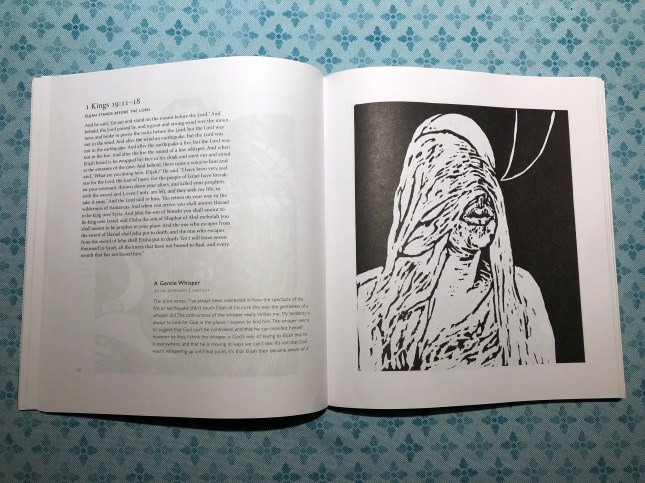
Elijah Stands Before the Lord – 1 Kings 19:11-18


The above image is from Revealed: A Storybook Bible for Grown-Ups by Ned Bustard. The image is called “A Gentle Whisper” and was created by Justin Sorensen.

1 Kings 19:11-18

“Go out and stand before me on the mountain,” the Lord told him. And as Elijah stood there, the Lord passed by, and a mighty windstorm hit the mountain. It was such a terrible blast that the rocks were torn loose, but the Lord was not in the wind. After the wind there was an earthquake, but the Lord was not in the earthquake. And after the earthquake there was a fire, but the Lord was not in the fire. And after the fire there was the sound of a gentle whisper. When Elijah heard it, he wrapped his face in his cloak and went out and stood at the entrance of the cave. And a voice said, “What are you doing here, Elijah?” He replied again, “I have zealously served the Lord God Almighty. But the people of Israel have broken their covenant with you, torn down your altars, and killed every one of your prophets. I am the only one left, and now they are trying to kill me, too.” Then the Lord told him, “Go back the same way you came, and travel to the wilderness of Damascus. When you arrive there, anoint Hazael to be king of Aram. Then anoint Jehu grandson of Nimshi to be king of Israel, and anoint Elisha son of Shaphat from the town of Abel-meholah to replace you as my prophet. Anyone who escapes from Hazael will be killed by Jehu, and those who escape Jehu will be killed by Elisha! Yet I will preserve 7,000 others in Israel who have never bowed down to Baal or kissed him!”

Dear God, Bustard didn’t include verse 10 in this lesson, but I think it’s important because it starts with you asking Elijah a question and then Elijah answers. It is after this exchange that you decide to “pass by.”

There he came to a cave, where he spent the night. But the Lord said to him, “What are you doing here, Elijah?” Elijah replied, “I have zealously served the Lord God Almighty. But the people of Israel have broken their covenant with you, torn down your altars, and killed every one of your prophets. I am the only one left, and now they are trying to kill me, too.”

Elijah passively accuses you of the same thing I have accused you of. He feels like you have let him down. You have disappointed him. I have felt disappointed by you too. For Elijah, I think he felt like he “zealously served” you and you still didn’t come through with the people falling into line. After he did such a great job, why should his life be on the line?

Then you told him to get ready because you were going to come by. And you did some things that would physically scare him. A huge wind that crumbled rocks. An earthquake. Fire. Were you showing him that you could take his life in a minute? Were you making that point to him?

What I’ve always liked about this story is that when you showed up you were gentle. A gentle whisper is what you used to once again ask your question of Elijah: “What are you doing here, Elijah?” His answer didn’t change, but I wonder if his tone of voice did. Was there anger in his first answer? Were there tears in the second?

My wife and I were talking this morning about the fine line we often cross between feeling close to you and living in the Spirit and being completely fallen. Thank you that you give us people like Elijah who experienced the same thing.

Now, regarding this image, here we have Elijah with the cloak he put over his own eyes, and I assume that is your presence approaching his face. Is that a knife? A claw? A feather? I don’t know. Here is what the artist, Justin Sorensen, says about this story:

I’ve always been interested in how the specs tackle of the fire or earthquake didn’t touch Elijah at his core the way the gentleness of a whisper did. The ordinariness of the whisper really strikes me. My tendency is always to look for God in the places I expect to find him. The whisper seems always to suggest that God can’t be controlled, and that he can manifest himself however he likes. I think the whisper is God’s way of saying to Elijah that he is everywhere, and that he is moving in ways we can’t see. It’s not that God wasn’t whispering up until that point, it’s that Elijah then became aware of it.

Father, help me to consider my life worth nothing to me. Help me to simply finish the race and complete the task you have given me–the task of testifying to your grace.

In Jesus’ name I pray,

Amen


Tags: , , , , , ,

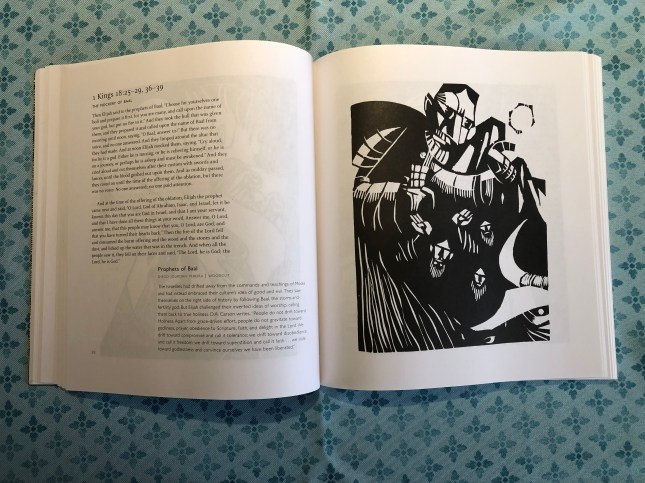
The Mockery of Baal — 1 Kings 18:25-29, 36-39


The image above is from Revealed: A Storybook Bible for Grown-Ups by Ned Bustard. The image is called “Prophets of Baal” as was created by Diego Jourdan Pereira.

1 Kings 18:25-29,36-39
Then Elijah said to the prophets of Baal, “You go first, for there are many of you. Choose one of the bulls, and prepare it and call on the name of your god. But do not set fire to the wood.” So they prepared one of the bulls and placed it on the altar. Then they called on the name of Baal from morning until noontime, shouting, “O Baal, answer us!” But there was no reply of any kind. Then they danced, hobbling around the altar they had made. About noontime Elijah began mocking them. “You’ll have to shout louder,” he scoffed, “for surely he is a god! Perhaps he is daydreaming, or is relieving himself. Or maybe he is away on a trip, or is asleep and needs to be wakened!” So they shouted louder, and following their normal custom, they cut themselves with knives and swords until the blood gushed out. They raved all afternoon until the time of the evening sacrifice, but still there was no sound, no reply, no response. At the usual time for offering the evening sacrifice, Elijah the prophet walked up to the altar and prayed, “O Lord, God of Abraham, Isaac, and Jacob, prove today that you are God in Israel and that I am your servant. Prove that I have done all this at your command. O Lord, answer me! Answer me so these people will know that you, O Lord , are God and that you have brought them back to yourself.” Immediately the fire of the Lord flashed down from heaven and burned up the young bull, the wood, the stones, and the dust. It even licked up all the water in the trench! And when all the people saw it, they fell face down on the ground and cried out, “The Lord —he is God! Yes, the Lord is God!”

Dear God, before I get into the image the Pereira created to go with this story, I want to focus for a minute on something that struck me while I was reading it. The prophets of Baal went to the links of cutting “themselves with knives and swords until the blood gushed out.” The thought that I had that I don’t think I have had before is, how many times have I sacrificed myself waiting for an idol to pay off? Yes, looking back it seems like their custom was ridiculous, but is it any different than what I do when I expect my money, my job, my marriage, or my kids to do something for me. When I give and give and give to them not out of love but out of expectation of them, isn’t that just as foolish?

Now, back to this image, I’ll be rank and SA that I cannot make heads or tails of it. Is the large man in the picture Elijah? Are those images of Baal or the prophets of Baal under his arms? I see the bull’s horns on the bottom right. I see the Sun. But I’m not sure what else it is I’m seeing.

Father, at the end of the day, I just need to be reminded that It is easy for me to make idols–even an idol of you. Not the real you, of course, but of the you that my mind wants to create. The you that I expect to give me what I want and do what I want you to do. Making an idol of that image of you is as bad as making an idol out of anything else. I want to worship the real you. The powerful you. Not the you that does what I want you to do. I certainly need a God whom I serve, not one that serves me.

In Jesus’ name I pray,

Amen


Tags: , , , , ,